
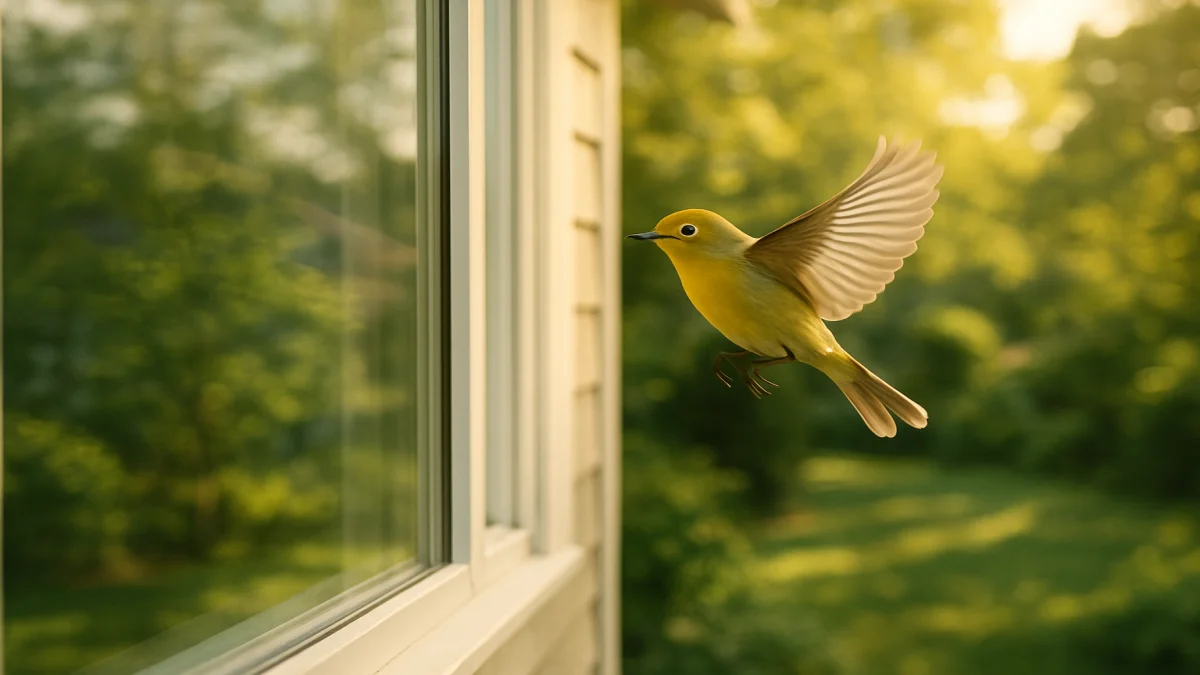
A ruby-throated hummingbird weighs less than a nickel and can fly five hundred miles without stopping, but it can still be killed by the kitchen window over your sink. That is the part most homeowners do not know when they hear the soft, confusing thud outside the house in late April. By the time you walk around to check, the bird is either gone, stunned on the mulch, or already dead in a corner the cat will find first.
The numbers behind that thud are worse than most people guess. The 2014 Cornell study by Scott Loss and colleagues estimated that somewhere between 365 million and close to one billion birds die every year in the United States from flying into glass. Roughly half of those deaths happen at regular homes, not skyscrapers. The American Bird Conservancy calculates that the average American house kills about two birds per year. Multiply that by 140 million households and the math gets painful fast.
The good news is that almost every one of those deaths is preventable with a Saturday afternoon, a ladder, and fifteen to thirty dollars. This guide walks through exactly what to do during the 2026 spring migration window, which in most of the country runs from mid-April through the end of May, and which windows to start with if you only have time to fix one.
FREE: Wildlife Garden Starter Guide
Get our 12-page PDF with the 25 best plants for pollinators, simple habitat tips, and a printable checklist — all 100% free.
No spam. Read our Privacy Policy.Why birds hit the glass in the first place (and why April through May is the deadliest stretch)
Birds do not see glass. They see what glass reflects. A clean pane of window glass at ten in the morning acts like a mirror for the oak tree across the yard, the hydrangea by the foundation, the blue patch of sky above the roofline. A migrating warbler that has been flying since dusk is tired, hungry, and looking for a safe place to drop in. When a window reflects habitat, the bird reads it as habitat and flies at full speed into something it never had a chance to perceive.
The second mechanism is lighting. Researchers estimate that more than eighty percent of North American songbirds migrate at night, using stars, the Earth’s magnetic field, and horizon glow to orient themselves. A lit patio, a bright second-floor hallway left on for the kids, a pole lamp by the driveway, these all pull migrating birds off their flight path and drop them into neighborhoods where daylight then kills them against the glass. One Chicago office building famously cut bird strikes by nearly sixty percent simply by turning off half its lights during migration.
Both mechanisms peak between April 15 and May 31 in most of the Lower 48. The New York State Department of Environmental Conservation and the Bird Alliance of Oregon have both publicly asked residents to reduce outdoor lighting between 11 p.m. and 6 a.m. during that window in 2026. BirdCast, the Cornell-backed migration radar project, usually shows peak passage nights in the hundreds of millions during those six weeks. If your house is going to kill birds this year, it is almost certainly going to happen during that stretch.
A smaller second wave happens in September and October, when first-year birds that have never migrated before are moving south and are even more likely to hit unfamiliar glass. But nothing matches the springtime spike.
The five-minute reflection test that finds the dangerous panes on your house
Before you buy anything, walk the outside of your house and look at your own windows the way a bird would. This is the single most useful thing you will do all weekend, and almost nobody does it.
Pick a clear morning. Start at the corner of the house where the most vegetation sits in front of glass. Stand about ten feet back and look directly at the window. Ask yourself a simple question: can I see the yard in that pane? If you can see the maple, the feeder pole, or the sky clearly reflected in the window, a bird can too, and that window is on your fix list.
The panes that consistently turn up as the worst offenders:
- Large picture windows facing a landscaped yard. These reflect the entire habitat a migrating bird is trying to reach.
- Corner windows that meet at a right angle. Birds see an open flight path straight through two panes of glass. This is the layout that killed birds in the old Chicago Public Library and many modern homes.
- Windows next to bird feeders, birdbaths placed for visibility, or nectar feeders. The American Bird Conservancy recommends placing feeders either within three feet of the glass (so birds cannot get up to speed) or more than thirty feet away (so they register the house as a solid obstacle). The deadly middle ground, five to twenty feet, is where most homeowners put theirs.
- Sliding glass doors, especially to a deck with plants in pots. Add a screen door and the problem usually solves itself. Leave it bare glass and you will find mourning doves on the deck by May.
- Double-hung windows at first-floor height. Low windows are hit more often than upper windows because that is where vegetation lives. Roughly 9 in 10 documented strikes at residential buildings happen below the second floor.
Write your findings on a notepad. Most houses have three to six truly dangerous panes and twenty that are fine. Fixing the first six with care is far more effective than spreading cheap decals across every window you own.
The 2×2 rule that quietly replaced the old 4-inch advice
For years, the standard advice from bird conservation groups was the “2 by 4 rule”: anything you put on your window, whether tape, decals, or paint, needed to be spaced no more than 2 inches apart vertically or 4 inches apart horizontally. Birds, the thinking went, would not try to fly through a gap smaller than that.
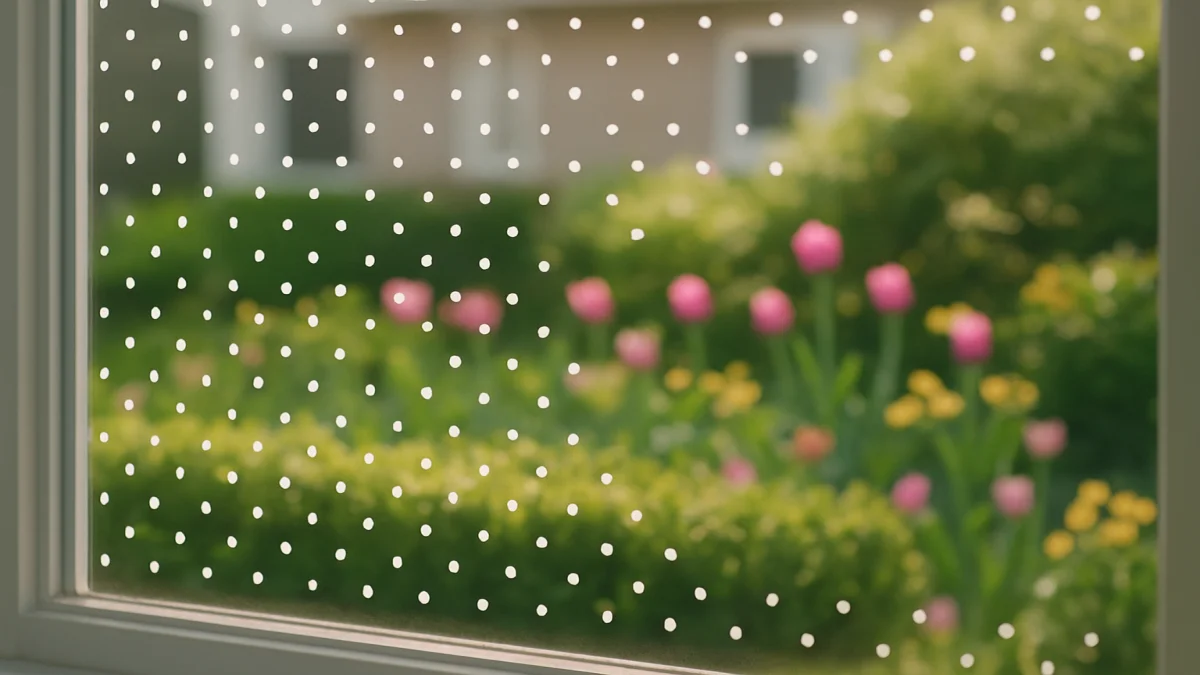
That guidance has quietly been tightened. Research from the American Bird Conservancy and FLAP Canada now points to a 2 by 2 rule: no gap larger than 2 inches in any direction. Canada’s 2019 national standard (CSA A460) already uses the tighter number, and U.S. organizations have been aligning with it. The reason is small birds. Hummingbirds, kinglets, and warblers will routinely attempt to fly through a four-inch gap if they can see green behind it. They cannot squeeze through a two-inch grid, so they veer off.
Practically, this means:
- A window covered in one silhouette decal in the middle does close to nothing. Birds fly around the hawk silhouette into the clear glass beside it.
- A window with stickers at every corner does almost nothing. Again, plenty of clear glass in the middle.
- A window with a 2 by 2 grid of marks across the entire pane is almost completely safe for birds. That is the actual standard.
Once you internalize that rule, a lot of the expensive products you will see on Amazon start to look like decoration rather than solutions. The decorative stained-glass cling with a single dragonfly is pretty. It is not bird-safe. You want full coverage in a tight, repeating pattern.
DIY fixes that work for under $30 (and the ones that only look busy)
If your goal is to stop bird strikes this weekend without waiting for shipping, there are three options that cost less than the tank of gas you used to drive to the hardware store.
Acopian BirdSavers (parachute cord, roughly $18 to $25 per window). Thin vertical strands of black paracord hanging in front of the glass, spaced four inches apart. Birds see moving lines and veer. Acopian sells pre-made versions, or you can build your own from a spool of paracord and a dowel. Homeowners tend to be nervous about aesthetics, but on a white trim window they look like rain. On a picture window facing a garden they look like nothing at all from inside. This is the most visually acceptable DIY option for people with neighbors.
Tempera paint on the outside of the glass (roughly $6 for a multi-pack). Liquid tempera is the cheap craft paint your kids used in grade school. It is non-toxic, water-soluble, and a sponge brush plus a kitchen sponge can turn a six-foot window into a bird-safe pane in twenty minutes. Paint a 2 by 2 grid of dots or a simple line pattern. When you want it off, a hose and a rag wash it away. Rain will not remove it on its own. Tempera is hands-down the cheapest effective fix that exists and is what most wildlife rehabbers recommend for emergencies when a window has killed two birds in a week.
Exterior insect screens ($20 to $35 per standard window at any home improvement store). A full-coverage screen kills reflection, cushions any bird that does hit, and doubles as mosquito control. On windows that already have half-screens on the bottom, adding a full screen is usually just an afternoon and an adjustable frame kit.
On the other side of the line are DIY fixes that look productive but test poorly:
- A single silhouette of a hawk or falcon. Birds do not mistake this for a real predator. It is just a dark shape in otherwise clear glass. See the 2 by 2 rule.
- Sheer curtains left permanently closed. They do help slightly by reducing reflection, but most households open them for light and privacy, so the window is only safe on the days nobody is home.
- Anti-glare window clings placed inside the glass. Almost all window treatments need to go on the outside of the glass to interrupt reflection. Decals on the inside are blocked from the bird’s view by the reflective layer itself. This is the single most common mistake we see.
- Loud noises or fake owls on the roof. Neighbors hate them and birds ignore them within 3 to 5 days.
Window film, exterior decals, and the one popular product that disappoints almost everyone
For homeowners who want a permanent, attractive solution instead of a seasonal paint job, three commercial products come up repeatedly in the conservation literature.
Feather Friendly adhesive dots. Small white dots applied in a dense 2 by 2 grid to the exterior of the glass. From inside the house they are barely noticeable. From outside they look like a subtle fritted pattern. A standard DIY kit covers around 85 square feet and costs roughly $50 to $75 as of this spring. Most homeowners report being able to do a large picture window in an afternoon. This is the product most frequently installed by bird alliances and municipalities.
Solyx bird-safety film. A clear, horizontally striped film that is applied to the outside of the glass. Works by scattering reflection across a field of thin vertical lines. Typically installed by a professional since it needs to be wet-applied without bubbles, so cost usually includes labor.
CollidEscape window film. A perforated one-way film that looks mostly opaque from outside and transparent from inside. Often used on problem windows like sliding glass doors because it blocks reflection aggressively. Slightly darker interior view is the tradeoff.
And then there is the product that keeps disappointing buyers, year after year: UV window decals.
You have seen them. They claim to be invisible to humans but glow to birds because birds see ultraviolet light that we cannot. The pitch is irresistible. The problem is that the evidence that UV decals meaningfully reduce strikes is thin, the decals break down in sunlight within months, and most crucially, they are placed sparsely, nowhere near a true 2 by 2 pattern. Studies from the Bird-window Collision Working Group and others have found only modest effects at best. If you want a clean-looking window, Feather Friendly dots on the outside beat UV decals on the inside almost every time. Spend the money there instead.
What to do when a bird is already lying stunned below the glass
If you open the back door and find a songbird sitting on the deck with its eyes half-closed and its feathers puffed, you have a narrow window to help. The Tufts Wildlife Clinic and Cornell’s All About Birds program both publish almost identical protocols, and they are simpler than most people expect.
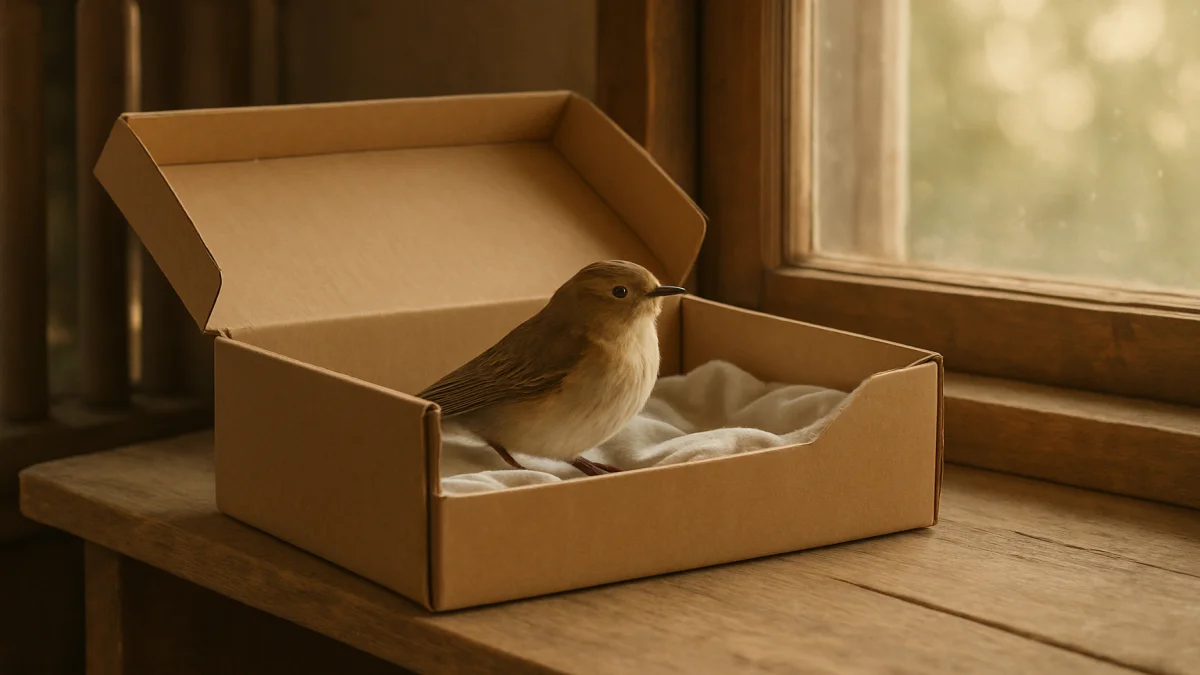
Step one: put it in a box. A shoebox with a paper towel or a soft rag on the bottom is ideal. Cut or poke a few small ventilation holes in the lid. Place the bird inside gently. Do not try to give it water from a dropper or a spoon. Birds can aspirate water easily and die from the attempted help rather than the original strike.
Step two: put the box somewhere dark and completely quiet. A closet, a garage corner with the light off, anywhere away from cats, dogs, children, and household noise. Heat stress is a real concern if it is sunny, so do not leave the box in direct sun.
Step three: wait one hour. Do not peek, do not open the lid to check, do not talk to the bird. The stillness is what lets it recover from the concussion. After one hour, take the closed box outside, set it on the grass a few feet from shelter, and open it. If the bird flies off, you are done. Roughly 60 percent of stunned birds that get a full hour of quiet darkness will recover and fly out on their own, according to rehabber intake records.
Step four: if the bird is still there, watch for a few minutes. If it is standing upright, alert, and simply not moving, give it another thirty minutes. If it is lying on its side, twitching, bleeding from the beak or nostrils, or one wing is drooping lower than the other, it needs a licensed wildlife rehabilitator. The Humane Society maintains a state-by-state rehabber list, and the free Animal Help Now app will show you the nearest one by ZIP code.
Two things you must not do: do not feed the bird, and do not keep it as a patient yourself. Almost every songbird in North America is protected under the Migratory Bird Treaty Act, which means only licensed rehabilitators can legally keep one overnight. Getting it to the right person fast is what saves it.
The porch-light problem nobody warns you about during spring migration
Most of the window-strike conversation focuses on daytime reflections, which is fair because daytime kills the most birds. But the setup for a lot of those daytime strikes actually happens the night before, when artificial light pulls a migrating bird off course and drops it into the wrong neighborhood.
The fixes are quiet, cheap, and produce almost immediate results during the April 15 to May 31 window:
- Turn off floodlights, uplights, and landscape lighting between 11 p.m. and 6 a.m. This is the exact window the New York State DEC asked homeowners to observe in 2026 and the one most Audubon Lights Out chapters nationwide endorse. A smart plug or a $15 outdoor timer does this for you automatically.
- Switch to warm LEDs under 3000 Kelvin. Cool white and blue-tinted bulbs (5000K and up) scatter more light into the sky and pull in more birds. Warm, amber-leaning LEDs draw fewer insects too.
- Shield any light you leave on. A fixture that points down and has a hood sends almost all its light to the ground. An exposed bulb lights the whole backyard sky. Replacing a single unhooded yard light with a downcast fixture can measurably reduce how much your house contributes to local sky glow.
- Close upstairs curtains at night. Second-floor windows lit from within at 2 a.m. are the ones migrating warblers see from a thousand feet up. A set of blackout curtains on a hallway window is one of the most effective things a suburban homeowner can do during migration.
- Move the holiday lights inside, or unplug them. If you kept patio string lights up through April, they are on the list.
You do not need to live in the dark. You need to reduce the light that is leaking upward during a six-week window. After May 31, put the porch light back on normal.
When a cardinal or robin attacks the same window every morning, that is a different problem
If you have a bird that is not striking the glass once and falling off, but is repeatedly flying at the same window, sometimes 20 to 50 times in a single morning, pecking, fluttering, and coming back within minutes, you are looking at territorial aggression, not collision.
Male northern cardinals, American robins, eastern bluebirds, and northern mockingbirds all display this behavior in spring. What is happening is that the male sees his own reflection in the window and mistakes it for a rival male on his territory. He attacks the rival. The rival cannot be defeated because the rival is him. He comes back the next morning.
This behavior is genuinely exhausting for the bird. It can last 4 to 6 weeks, burn calories the bird needs for breeding, and injure him with repeated low-speed impacts. The fix is to kill the reflection on that specific window, but only from the outside, and only as long as the aggressive behavior continues.
- A cardboard cutout taped to the outside of the glass covering the “rival’s” position works within a day or two.
- Tempera paint on the outside, even a sloppy coat, works.
- A sheet of newspaper taped up for a week will usually end the territorial cycle, because the male loses his sense that this patch of “territory” still has a rival.
- Once the bird has paired, nested, and moved on to feeding chicks, the behavior ends on its own. Usually late May into June.
Closing the blinds on the inside will not help, because the reflection is on the outside of the glass. And you do not need to install full bird-safe film for a territorial cardinal, because the bird is not hitting the glass at migration speed. He is flaring at his reflection and bouncing off. Temporary external coverage is enough.
Questions we get before anyone tapes their first pane
Do I really need to fix every window, or just a few? Fix the three to six windows that failed the reflection test first. Most homes have a handful of dangerous panes and a lot of background glass that rarely causes a strike. Start with the picture window over the feeder or the slider to the deck and you will prevent the majority of strikes your house would otherwise cause this year.
Will film or decals ruin my view or my resale value? Exterior Feather Friendly dots are close to invisible from inside the house and do not affect home resale. Tempera paint washes off. Paracord strands slide off a hook. None of these solutions are permanent in the way people fear.
Is this really a spring problem only? Spring is the deadliest window in most of the country, but fall migration (roughly late August through mid-October) is also dangerous, and some resident birds hit glass year-round. If you are doing the work this weekend, leaving the treatment in place through the year is simplest.
Do window screens alone solve the problem? Full exterior screens come very close. They cushion any bird that does hit and break up reflection. Half-screens leave the top portion of the window fully dangerous, so they only help partially.
What about those suction-cup anti-strike hawk eyes that claim to use light reflection? They tend to fall off, do not cover enough of the pane to meet the 2 by 2 rule, and independent testing has been underwhelming. Your money is better spent on a roll of exterior dots or a bottle of tempera.
I live in an apartment, what can I do? Tempera paint on any window that faces a tree or landscaping, Acopian BirdSavers hung inside the window frame (they still interrupt reflection somewhat from inside), and aggressive curtain use at night during migration. You can also call your property manager: several cities now have ordinances that push building owners to address strike-heavy glass in the first three floors.
Can I report a window strike to help scientists track the problem? Yes. Projects like the Bird-window Collision Working Group, dBird, and individual state Audubon chapters collect exactly this kind of data. Your one strike is a single row in a national dataset that helps set policy on bird-safe glass standards.
One weekend, one ladder, one quiet afternoon
The difference between a house that kills two birds a year and a house that kills zero is usually a single Saturday. One walk around the yard with a notepad, one trip to the hardware store for an outdoor timer and a jar of tempera, one afternoon on the ladder with a sponge brush. If you have a picture window on the garden side of the house, a slider to the deck, or a corner window with another window behind it, those are the three to start with.
Do those three windows before April ends and your yard will be measurably safer through the heart of spring migration. Add the porch-light timer the same weekend. Keep the tempera on through May. When fall migration arrives in late August, you already know what to do.
A thrush that should have made it to a Canadian breeding forest in July does not end on your deck. That is what the weekend is worth. If you want more on getting your yard ready for the arriving birds, our hummingbird migration map for 2026 walks through when to expect ruby-throats in each state and how to set up feeders that stay safely away from glass.
External resource: the American Bird Conservancy’s Glass Collisions program maintains an independently tested products list, spacing guidelines, and a free homeowner resource sheet.
Related reading
Want More Wildlife Garden Tips?
Join 5,000+ nature lovers getting our weekly tips on creating wildlife-friendly gardens.
No spam, unsubscribe anytime. Privacy Policy
Emma Harrington
Emma Harrington is a wildlife habitat researcher and content editor with a passion for backyard conservation. She has spent over a decade translating ecological science into practical tips anyone can follow — from selecting native plants to building wildlife-friendly habitats. Her work focuses on helping homeowners transform ordinary yards into thriving ecosystems for bees, butterflies, hummingbirds, and other beneficial wildlife.