
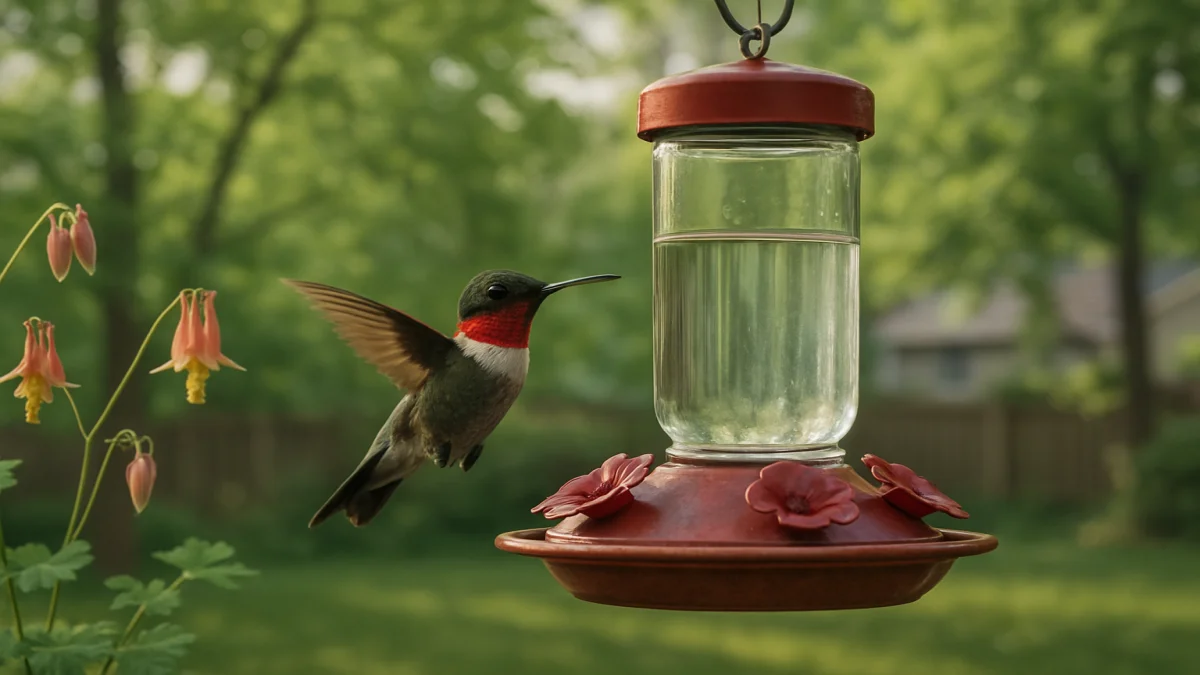
Around the third week of April, something shifts in a yard that has been empty for six months. A flash of movement near the porch railing. A high, insistent chit from a branch you didn’t know was a branch. The hummingbirds are back. Whether ruby-throats reach your part of the country this week, next month, or three weekends from now depends on geography, weather fronts over Louisiana, and a surprisingly reliable pattern that researchers have been mapping for more than a decade.
The 2026 spring migration is running slightly ahead of average. A mild winter pushed early arrivals into the Gulf coast by mid-February, and by this week scouts are already being reported as far north as southern Michigan. If you’re in the central or northern tier of states, the next fourteen days are the window that matters. Hanging a feeder on the wrong day costs you nothing. Hanging it on the right day can turn a quiet backyard into a stopover along one of the most extraordinary animal journeys on the continent.
This guide uses the current 2026 migration map, state-by-state averages compiled by volunteers and researchers, and life-history data from the Cornell Lab of Ornithology and the USDA Forest Service. The goal is practical: give you a clear answer for when to put feeders up, what to plant, and what common mistakes push the birds back out of your yard as quickly as they arrive.
FREE: Wildlife Garden Starter Guide
Get our 12-page PDF with the 25 best plants for pollinators, simple habitat tips, and a printable checklist — all 100% free.
No spam. Read our Privacy Policy.Where the 2026 hummingbird migration is right now
The front edge of the ruby-throated migration crossed the Gulf of Mexico between late February and mid-March this year, which is about one to two weeks earlier than the ten-year average. Early male scouts, who leave their Central American wintering grounds first to claim territory, were confirmed in Houston by February 21, Baton Rouge by March 2, and the Florida panhandle by March 5. The heart of the wave — the larger groups of males followed by females — has been moving north at a steady pace ever since.
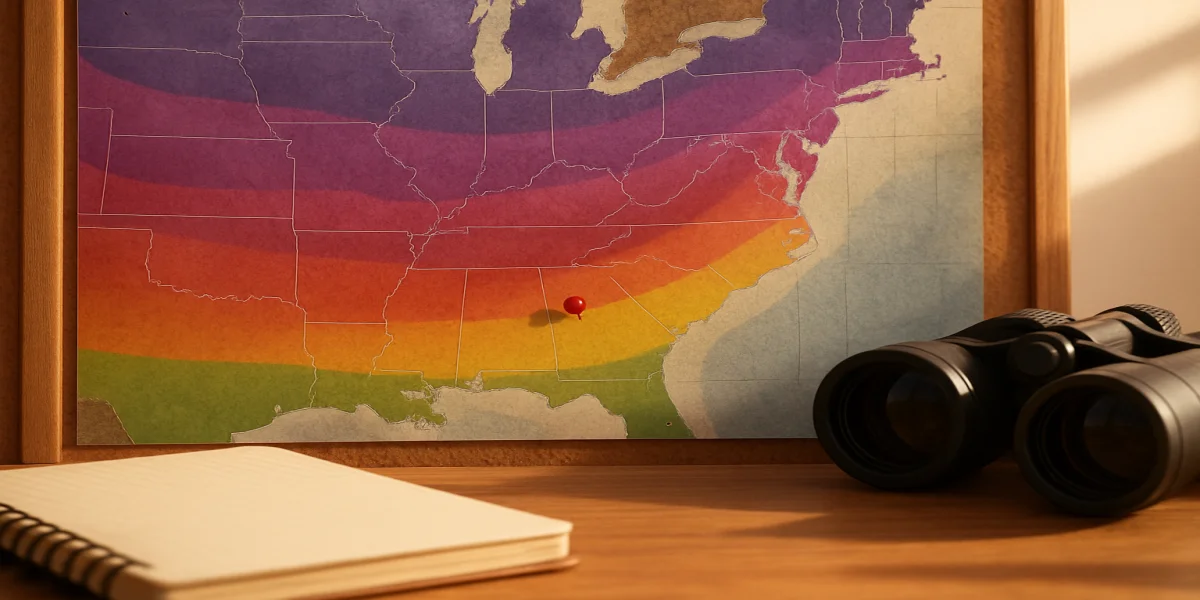
By the third week of April, current reports place the leading edge along a line that runs from roughly southern New England through Pennsylvania, Ohio, Indiana, and across the Great Lakes into southern Wisconsin and Minnesota. Sightings in Vermont, Maine, and eastern Canada typically begin in the final days of April and continue into early May.
Three forces decide the shape of that line each year:
- Temperature thresholds. Hummingbirds rarely push north into an area until daytime highs sit consistently above 55°F. Cold snaps stall the wave for days at a time.
- Nectar availability. Migration syncs with the bloom times of trumpet creeper, wild columbine, red buckeye, and other early-spring nectar sources. In a warm year, those flowers open earlier and pull the birds north faster.
- Wind patterns. A southerly tailwind out of the Gulf accelerates the first leg by days. A persistent northerly front can keep birds clustered along the coast for a week.
One thing worth knowing: the ruby-throated is the only hummingbird species that regularly breeds east of the Great Plains, but it is not the only hummingbird that appears in US yards. Rufous hummingbirds, which breed in the Pacific Northwest and Alaska, drift east during fall and winter and occasionally show up at southeastern feeders into April. Black-chinned, broad-tailed, Anna’s, and Calliope hummingbirds follow their own western and mountain corridors. If you’re west of the Rockies, your arrival windows are different from the ones below.
State-by-state arrival windows you can plan around
These are typical first-sighting dates based on a decade of volunteer-reported data. Your actual arrival may run three to seven days earlier or later depending on elevation, local weather, and whether you live in an urban heat island.
Late February to mid-March (first scouts): South Texas, coastal Louisiana, southern Mississippi, southern Alabama, Florida panhandle, coastal Georgia.
Mid to late March: Central Texas, northern Louisiana, central Mississippi, central Alabama, central Georgia, coastal South Carolina, southern Arkansas.
Early to mid April: Oklahoma, Arkansas, Tennessee, North Carolina, Virginia, southern Kentucky, southern Missouri, eastern Kansas.
Mid to late April: Southern Illinois, southern Indiana, southern Ohio, West Virginia, Maryland, Delaware, New Jersey, southeastern Pennsylvania, southern New York, coastal Connecticut, Rhode Island, and most of southern New England.
Late April to mid May: Central and northern Illinois, northern Indiana, northern Ohio, central and northern Pennsylvania, central and northern New York, Massachusetts, Vermont, New Hampshire, southern Maine, southern Wisconsin, southern Michigan, Iowa, Nebraska, South Dakota, and southern Ontario.
Mid to late May: Northern New England, northern Michigan, northern Wisconsin, northern Minnesota, North Dakota, eastern Manitoba, Quebec, and the Maritimes.
A useful practical rule: put the feeder up two weeks before the earliest expected arrival for your zone. A feeder hanging on a cool, quiet day costs you a cup of sugar water, which is maybe twelve cents. A feeder going up the day after your neighbor’s first sighting means you miss the scouting males who would have otherwise claimed your yard as part of their territory.
The journey: 500 miles nonstop on a body that weighs less than a nickel
The physiology of this migration is one of the best reasons to take the timing seriously. A ruby-throated hummingbird weighs about 3 grams during normal summer life, roughly the mass of a US penny. Before migration, the bird nearly doubles that. Researchers have documented pre-migration weight gains of 25 to 40 percent, with the added mass stored almost entirely as fat for the long flight.
The Gulf of Mexico crossing is the hardest part. For birds that choose the water route instead of tracing the Texas coast, the flight is roughly 500 miles of open water with no food, no rest, and no shelter from weather. Depending on tailwinds it takes 18 to 22 hours of continuous flight. A hummingbird at cruising speed covers 20 to 30 miles per hour. Wings beat 15 to 80 times per second. The heart runs at up to 1,260 beats per minute during active flight.
A bird that lands in your yard in April has just completed one of the most energetically extreme trips in the animal world. In the 72 hours after landfall, it is functionally starving. That is why fresh nectar and plenty of it matters most during those first weeks of arrival, not during the middle of summer when insect prey and natural flowers are abundant.
Quick facts worth saving:
- Typical daily travel during active migration: up to 23 miles in an easy day, 500 miles at a push across the Gulf.
- Lifespan averages 3 to 5 years in the wild, with the oldest banded ruby-throat recorded at 9 years.
- Fall migration reverses in August and September, with the same birds returning to Mexico and Central America.
- Roughly one in four arriving birds is a female; males arrive earlier to establish territory.
When to hang your first feeder, and why late is a real problem
The single most common mistake homeowners make is waiting until they see a hummingbird before putting a feeder out. By then, the scouts have already passed through and either set up in a neighbor’s yard or moved further north.
The timing rule that works: count back two to three weeks from your earliest expected arrival window above, and hang the feeder that weekend. If you are in Virginia with an early-April arrival, the feeder goes up in the last week of March. If you are in southern Michigan with an early-May arrival, the feeder goes up in mid-April. If you are in Maine, the feeder goes up around May 1.
A feeder hanging before the birds arrive serves a specific purpose. Scouts travel 23 miles a day looking for territory. Food sources are one of the three cues they use to decide where to settle and where to invite females. An established feeder is a signal. An empty hook is noise.
A few practical notes about timing through the season:
- Keep the feeder up for at least three weeks after you see your last bird in the fall. Stragglers, often first-year birds or weakened individuals, rely on late-season feeders more than anyone else in the population. There is no evidence that a feeder left out delays migration; photoperiod and hormones drive the decision to leave, not food availability.
- Don’t take feeders down during a late-April cold snap. Temperature drops of 20 degrees or more trigger a physiological state called torpor, where hummingbirds drop their body temperature and metabolism to conserve energy. A reliable food source nearby can be the difference between surviving the cold and not.
- If you have two feeders, hang them on opposite ends of the yard. Males defend food sources aggressively, and two feeders out of sight of each other let a dominant male hold one while giving other birds access to the other.
The four-to-one sugar water recipe, and the ingredients that hurt birds
The recipe is simple enough that there is no reason to buy pre-mixed commercial nectar, which is usually identical to the homemade version but often contains red dye.
The recipe:
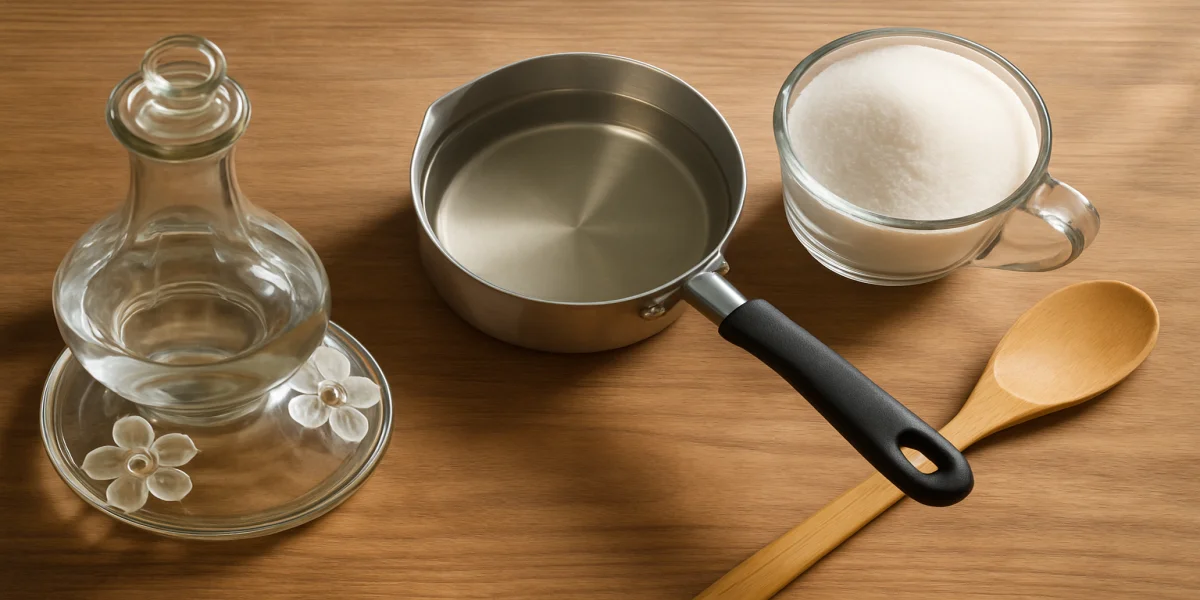
- 1 cup plain white granulated cane sugar
- 4 cups water
- Boil the water, remove from heat, stir in the sugar until fully dissolved, then let cool completely before filling the feeder.
That ratio — 1 part sugar to 4 parts water — approximates the sucrose concentration found in the natural nectar of flowers hummingbirds evolved to feed on. It is endorsed by the Smithsonian Migratory Bird Center, Audubon, and the Cornell Lab.
What to leave out, and why:
- No red dye. Flower nectar is clear. Red dye is not metabolized the same way and has been linked in laboratory studies to kidney and liver issues in small animals. The red parts of the feeder itself attract birds. The liquid does not need to be colored.
- No honey. Honey ferments quickly in a warm feeder and promotes a fatal fungal infection in the bird’s tongue.
- No raw, organic, brown, or unrefined sugar. These contain iron at levels hummingbirds cannot process. Chronic exposure causes iron overload disease, which is fatal.
- No artificial sweeteners. They provide no calories, and calories are the entire point.
- No molasses, agave, or corn syrup. Same reasoning — these are biochemically different from sucrose and either ferment or poison.
Cleaning matters as much as the recipe. In hot weather above 80°F, change the nectar and scrub the feeder every 2 days. In cool weather below 70°F, every 5 to 7 days is fine. If you see black specks, cloudiness, or any slime inside the tube or base, it is past time. A bottle brush, a quick rinse with hot water, and an optional splash of white vinegar will handle most situations. Soap residue can discourage birds, so a thorough rinse matters more than heavy detergent. (For a deeper walkthrough on picking feeders and keeping them mold-free, see our hummingbird feeder guide.)
Feeder placement that attracts more birds and reduces window strike
Where the feeder hangs matters as much as what’s inside it. The ideal spot has three properties:
- Visible perch nearby, within 10 to 15 feet. Hummingbirds feed in quick visits, then retreat to a perch to digest. A shrub, small tree branch, or even a pole makes the feeder territory easier to defend and more attractive to dominant males.
- Partial shade during the hottest part of the day. Direct afternoon sun in July can ferment nectar in 24 hours. A spot that gets morning sun and afternoon shade keeps the sugar water fresh longer and gives the birds a cooler feeding location.
- Within 3 feet of a window or more than 30 feet away. This is counterintuitive but well documented. Window strikes at feeders are a leading cause of hummingbird injury. A feeder placed right against the glass — within about 3 feet — does not give a flushed bird enough runway to build up killing speed. A feeder 30+ feet away removes the reflection from the bird’s flight path entirely. The dangerous zone is roughly 5 to 25 feet out, where reflections read as open sky.
Other placement considerations:
- Keep feeders out of reach of cats, which means at least 5 feet off the ground and at least 8 feet of clearance from any launching surface.
- Avoid hanging feeders directly above patio furniture or walkways. Hummingbirds are messy and sugar water drips.
- If ants find the feeder, use an ant moat filled with plain water rather than any chemical repellent. Oil-based ant barriers can coat a hummingbird’s feathers and prevent flight.
- If bees or wasps become a problem, switch to a saucer-style feeder. Their shorter tubes keep the nectar out of reach of most insects but are still accessible to hummingbird tongues.
Native flowers that matter more than any feeder
A feeder is a convenience for the human who hung it. The birds prefer flowers. A yard with even a modest planting of native nectar sources will hold hummingbirds through the season in a way no feeder alone can. According to the USDA Forest Service, ruby-throated hummingbirds coevolved with a specific group of tubular, red or orange flowers whose shape fits their bill and whose bloom times match the birds’ arrival.
Early-season bloomers hummingbirds seek out in April and early May:
- Red buckeye (Aesculus pavia). Small tree or large shrub, native from Virginia south through Florida and west to Texas. Blooms at almost exactly the moment ruby-throats arrive. A single mature plant can hold multiple birds for weeks.
- Wild columbine (Aquilegia canadensis). Native to most of the eastern half of the country. Nodding red-and-yellow flowers bloom from mid-April through May.
- Coral honeysuckle (Lonicera sempervirens). Native vine, very different from invasive Japanese honeysuckle. Long bloom season starting in April.
- Eastern redbud (Cercis canadensis). Not a classic hummingbird flower, but the early blooms catch newly arrived birds that haven’t found better options yet.
Mid-season bloomers for June and July:
- Bee balm (Monarda didyma or Monarda fistulosa). One of the most reliably visited flowers in any backyard garden.
- Cardinal flower (Lobelia cardinalis). Prefers moist soil. Spectacular red spikes in July and August.
- Trumpet creeper (Campsis radicans). Aggressive vine but nothing rivals it for nectar production.
- Jewelweed (Impatiens capensis). Self-seeding annual that thrives in shady, moist corners.
Late-season fuel for fall migration:
- Salvia (multiple native species). Long bloom windows into October.
- Cardinal flower’s late flush. In a good year, the second bloom carries into September.
- Jewelweed. Late bloom helps southbound birds fuel up.
For a regional breakdown of hummingbird-favorite species by climate zone, see our regional hummingbird plant guide. For gardeners replacing lawn or reworking beds this spring, planting one early-blooming native plus one mid-season and one late-season gives hummingbirds something to find from first arrival through the last fall dispersal. That stacked bloom time is how experienced wildlife gardeners build a yard that keeps birds around for months rather than days.
Quiet mistakes that keep hummingbirds out of a yard that should work
Most yards that struggle to attract hummingbirds share a short list of fixable problems. Working through them is usually faster than buying another feeder.
Letting nectar go bad. Fermented or cloudy sugar water will empty a yard faster than almost anything else. Birds try the feeder once, note the taste, and skip it for weeks. If in doubt, dump it and start over.
Using mosquito sprays. Backyard mosquito sprays kill the small insects hummingbirds depend on for protein and directly poison nesting females who catch exposed prey. Switching to mosquito dunks in standing water sources is effective, hummingbird-safe, and cheaper.
Clearing spider webs obsessively. Hummingbird nests depend on spider silk as their structural binder. A yard that is too tidy in April and May has no nesting material available. Leave a few webs up around porches, eaves, and garden fences through at least mid-June.
A single feeder with two males fighting. If one bird dominates and drives others off, a second feeder out of sight of the first is the fix. Some households run three or four feeders spaced around the yard and see dozens of birds rather than a single aggressive holder.
Hanging feeders in full sun. Nectar ferments, bees swarm, and birds avoid the heat. A small shift to morning sun and afternoon shade solves all three.
Replacing natives with cultivars that look showy but produce no nectar. Many popular garden-center varieties of salvia, bee balm, and honeysuckle have been bred for double blooms or unusual colors and no longer produce enough nectar to support pollinators. Sticking to straight native species or named cultivars labeled “pollinator friendly” avoids the problem.
Using systemic insecticides on ornamental plantings. Neonicotinoid-treated plants carry pesticide in their nectar for weeks after application. Nursery plants labeled “protected for one year” often mean the poison is present in the blooms a hummingbird will drink from. Asking garden centers directly is the only reliable check.
What I get asked the most
Will leaving a feeder up in fall keep hummingbirds from migrating? No. Migration is triggered by day length and hormones, not food availability. Feeders left up into October help stragglers and first-year birds that need the calories. The last local ruby-throat usually leaves by mid-October in the north, late October in the south.
Should I bring the feeder inside overnight? Only in bear country. Hummingbirds go into torpor at night and do not feed, so the feeder being out causes no harm. But bears, raccoons, and flying squirrels will work a feeder once they learn it exists.
Why isn’t the hummingbird coming back after the first visit? The most common reasons are stale nectar, the wrong sugar (anything other than plain white cane sugar), a feeder with residue or mold inside, or a location with no nearby perch. If the recipe is fresh and the feeder is clean, give it two weeks. Migrating birds in April may sample your feeder once and move on, with different birds passing through days later.
Can I use tap water in the recipe? In most municipalities, yes. If your tap water is heavily chlorinated or very hard, using filtered or bottled water is a small upgrade. Do not use distilled water, which lacks the minerals hummingbirds pick up from natural sources.
How high should the feeder hang? Between 5 and 8 feet off the ground is a good range. Higher than eye level keeps it out of cat reach. Lower than 10 feet keeps it easy to refill and clean, which means you’ll actually do it on schedule.
Do other birds at the feeder chase hummingbirds away? Orioles, woodpeckers, and warblers sometimes sample nectar feeders but rarely displace hummingbirds for long. Ants and wasps cause more trouble than other bird species do.
What about those red dye concentrates sold at big-box stores? Skip them. Plain white sugar and water is safer, cheaper, and endorsed by every major bird conservation group. Any nectar concentrate with red coloring adds risk for no benefit.
The window this week
For most of the central and eastern United States, the two weeks around April 20 are the most important time of the year to have a clean, filled feeder hanging. If you have done that and you have even one flowering native plant nearby, you have done more than 80 percent of what it takes to make your yard part of this migration. The rest is watching.
One more data point worth keeping in mind: the continental ruby-throat population has held roughly steady over the past thirty years, even as many other North American bird species have declined. A substantial part of that stability is credited to the network of backyard feeders and native plantings maintained by ordinary homeowners across the eastern half of the country. What looks like a small gesture at a kitchen window is, in aggregate, the reason a bird that weighs less than a nickel still completes 1,500 miles of round-trip flight every year.
For the most current local reports, the live sighting maps at Hummingbird Central update daily through the migration window. Cross-referencing the regional averages above with real-time reports from your county is the fastest way to nail the exact weekend your feeder starts earning its keep.
Related reading
Want More Wildlife Garden Tips?
Join 5,000+ nature lovers getting our weekly tips on creating wildlife-friendly gardens.
No spam, unsubscribe anytime. Privacy Policy
Emma Harrington
Emma Harrington is a wildlife habitat researcher and content editor with a passion for backyard conservation. She has spent over a decade translating ecological science into practical tips anyone can follow — from selecting native plants to building wildlife-friendly habitats. Her work focuses on helping homeowners transform ordinary yards into thriving ecosystems for bees, butterflies, hummingbirds, and other beneficial wildlife.