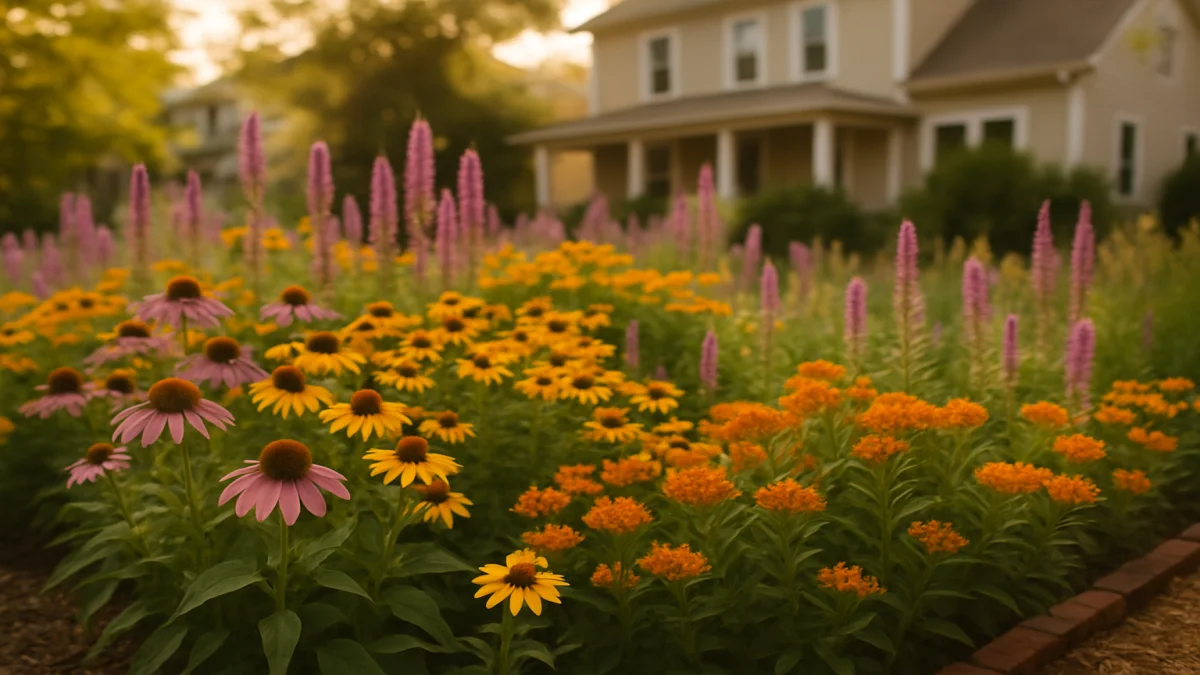
Every spring, I find myself standing in front of a garden-center display, calculating prices in my head, glancing at my cart, and quietly deciding to leave empty-handed. A quart of Echinacea purpurea is going for $11. An annual plant that will wilt by Labor Day costs eight bucks. And remember that flat of plugs I bought for $40 three years ago? It’s now $90. More than one homeowner has shared the feeling of resignation this spring, saying they’re going to fill their beds with fake flowers because of the sky-high prices at places like Lowe’s. It starts as a joke, but then you realize many people give up at this point, leaving their front yard as grass for yet another year while the bees fly by.
This article is for the homeowner who has decided that giving up is not the move. Specifically, it is for the homeowner who has been told over and over that a “real” native garden costs $1,200 to install. And who refuses to spend $1,200 on plants. The good news, after a week of pricing out programs across the country, is that most of the money you would have spent at the big-box store does not need to be spent at all. The garden you actually want. Milkweed, coneflower, asters, a couple of native shrubs. Can be assembled for under $200 if you are willing to stack the right cheap-or-free sources in the right order. This is the budget playbook, ranked from cheapest to most expensive, with the trade-offs spelled out so you can pick what fits your patience level.
When you can’t bring yourself to spend $8 on another annual that won’t outlive August
The starting point of every budget-friendly native garden seems to be irritation. I’ve heard a lot about how annuals are becoming prohibitively expensive, with many places charging around $8 each. This frustration captures a broader shift in the gardening world. Gardeners aren’t just looking to save a few bucks; they’ve crunched the numbers and discovered that buying from retail nurseries just doesn’t make sense anymore. Paying eight dollars for a plant that lasts twelve weeks translates to about $0.67 per week of bloom, while growing a coneflower from seed can cost roughly $0.05 per week over five years. The retail market simply isn’t competitive.
FREE: Wildlife Garden Starter Guide
Get our 12-page PDF with the 25 best plants for pollinators, simple habitat tips, and a printable checklist — all 100% free.
No spam. Read our Privacy Policy.Then there’s the budget dilemma that keeps popping up in conversations about garden conversions. A common target that many set for themselves is an economical route of less than $2,000. Given Blue Water Baltimore’s published rate of $6 per square foot for retail quart-size plants, that budget only stretches to a 333-square-foot garden. That sounds nice, but for most homeowners, it barely covers the front yard, let alone the side strip and back-fence pollinator area they want. Clearly, the math doesn’t add up with retail pricing, but it seems the people insisting it should are often those profiting from the plant sales. Accepting that creating a budget native garden requires sidestepping the retail market entirely can truly open up possibilities.
Why retail prices feel impossible right now (and what you’re actually paying for)
To understand why prices have surged, it helps to look at the factors involved. Over the past five years, three main forces have driven price increases. First, the demand for native plants has approximately doubled nationwide. Many mail-order nurseries, like Prairie Moon, quickly sell out by April, and I keep hearing that demand for native plants appears to double every year. Second, the cost of labor and shipping for growing quart-size perennials in a soilless mix has also roughly doubled during this time. Lastly, big-box retailers have stopped subsidizing these plants, meaning those perennial tables that once lured customers with low prices now need to be profitable on their own.
So when you pay $11 for a quart of coneflower, you are paying about $1.50 for the actual plant and about $9.50 for greenhouse, transportation, retail rent, and the convenience of buying it on the same trip you bought a smoke detector. None of that money is going to a better plant. A coneflower seedling you start yourself in a milk jug becomes the same plant by year two, and a coneflower division from a friend’s three-year-old clump becomes the same plant by August. The retail channel is selling time, not biology. Once you see the bill that way, the workaround starts to look obvious.
The expensive mistake of buying mature plants you don’t actually need
The most common budget killer is the assumption that the garden needs to look “finished” by Memorial Day. It does not, and the people who succeed at the under-$200 build know this. A native plant bed established from plugs and seed in April will look thin and weedy in June, intentional and recognizable in August, and full enough to surprise the neighbors by the second June. Three years from now it will look identical to the bed your neighbor paid $2,400 for, with the difference being that you have $2,200 left over for the rain barrel and the new shrub layer.
The other expensive mistake is buying a single one of each species, the way you would shop for annuals. Pollinator-supporting natives need to be planted in groups of three to seven of the same species. Both because pollinators recognize and forage more efficiently in mass plantings and because individual plants in a sea of mismatched species look exactly like the “rat nest” the HOA neighbor keeps complaining about. Buying nine plugs of three species, in a tight matrix, almost always reads as more intentional than buying twenty-seven different quarts spaced four feet apart. Cheaper, too. And the math compounds when those nine plugs are seed-grown.
Source 1: Winter sowing in milk jugs, the $0 method that works on tough natives
The single highest-leverage move on this list is winter sowing. The technique, formalized in Missouri Extension publication YM105 and refined by Wild Ones chapters across the country, uses a recycled translucent milk jug as a self-regulating cold frame. Cut the jug horizontally with a 2-inch hinge left at the back, drill or punch four to six drainage holes in the bottom, fill with three inches of moistened potting mix, surface-sow seeds at the depth listed on the packet, tape the lid shut with the cap removed, label with the date and species, and set the jug outside in a place that gets rain. That is the entire process. There is no grow light, no daily watering, no hardening-off ritual, and no thinning regime. The seeds cold-stratify naturally over winter, the jug heats up and triggers germination on its own schedule in March or April, and you transplant the seedlings into the bed when they hit two to three inches with true leaves.
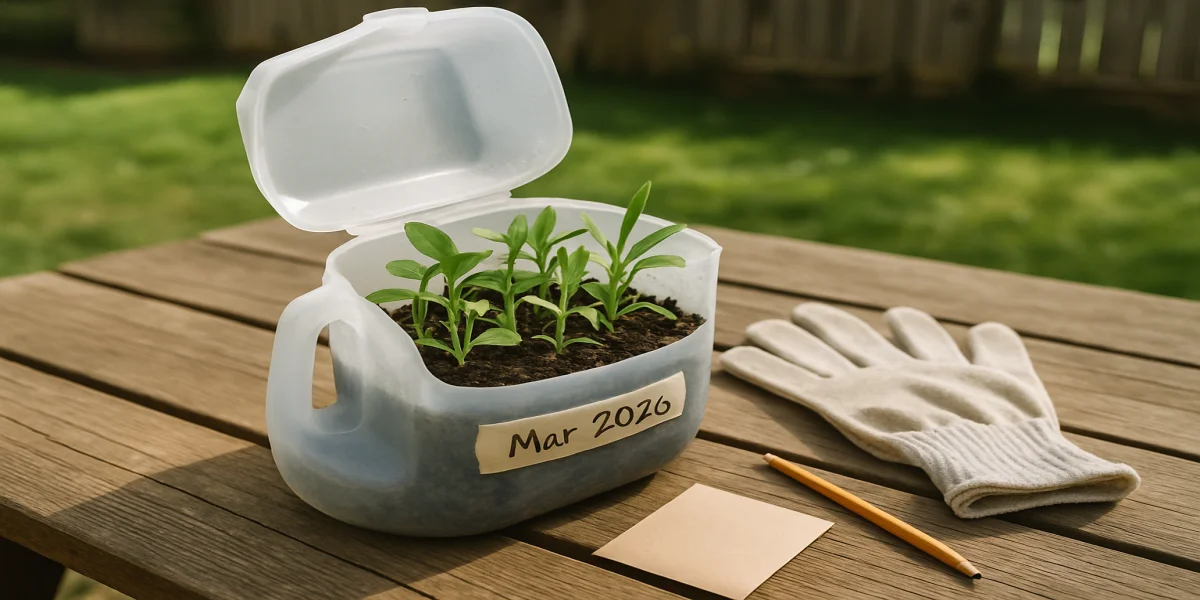
The cost math is what makes this dominate everything else. A $5 bag of potting mix fills six to eight jugs. The jugs are free. A $4 packet of black-eyed Susan seed contains roughly 200 seeds and yields, on average, fifty-plus transplant-ready plants per jug. Run six jugs and you have produced 300 native perennials for under $30. A value of roughly $3,300 at retail quart pricing. Even if your germination rate is half what the seed packet promises, you are still landing on $0.10 to $0.20 per plant.
The natives that respond best to this method are exactly the ones you most want in a pollinator garden: black-eyed Susan, purple coneflower, liatris, common milkweed and butterfly weed, penstemon, lobelia, anise hyssop, wild bergamot, columbine, and most native asters. Tougher prairie species are the ideal winter-sow candidates because they need the cold cycle anyway. The species you cannot easily winter-sow are the ones with very specific stratification windows or double dormancy. Most native trillium, baneberry, and a few woodland ephemerals. But those are the exceptions, not the rule.
The honest catch: you have to start in late fall or early winter for spring planting. If you are reading this in April, the winter-sow window for 2026 has closed for cool-season natives. The fix is to mark a calendar reminder for early December, take fifteen minutes to set up that year’s jugs, and pair the technique with the fall-sow alternative. Direct-sowing seed onto prepared soil in October and letting winter do the stratification in place.
Source 2: Conservation district seedling sales where bare-root shrubs run $5 each
If you missed winter sowing this year and you need actual plants in the ground by May, the next-cheapest channel is your local Soil and Water Conservation District. Almost every county in the United States runs a tree-and-shrub seedling sale in late winter, with bare-root, one-to-two-year-old native trees and shrubs sold in packs at deeply subsidized prices. Northern Virginia’s program sells a four-pack of bare-root shrub seedlings. Pawpaw plus American plum, or Canadian serviceberry plus American elderberry. For $20, which works out to $5 per plant. Cortland County and Ulster County in New York both sell native trees and shrubs in 10-, 25-, 50-, and 100-packs at similar pricing. Clay County in Minnesota sells five-tree bundles. The species mix varies by region but always centers on the foundational habitat plants: oaks, hickories, dogwoods, redbud, river birch, hazelnut, viburnum, ninebark, elderberry, serviceberry.
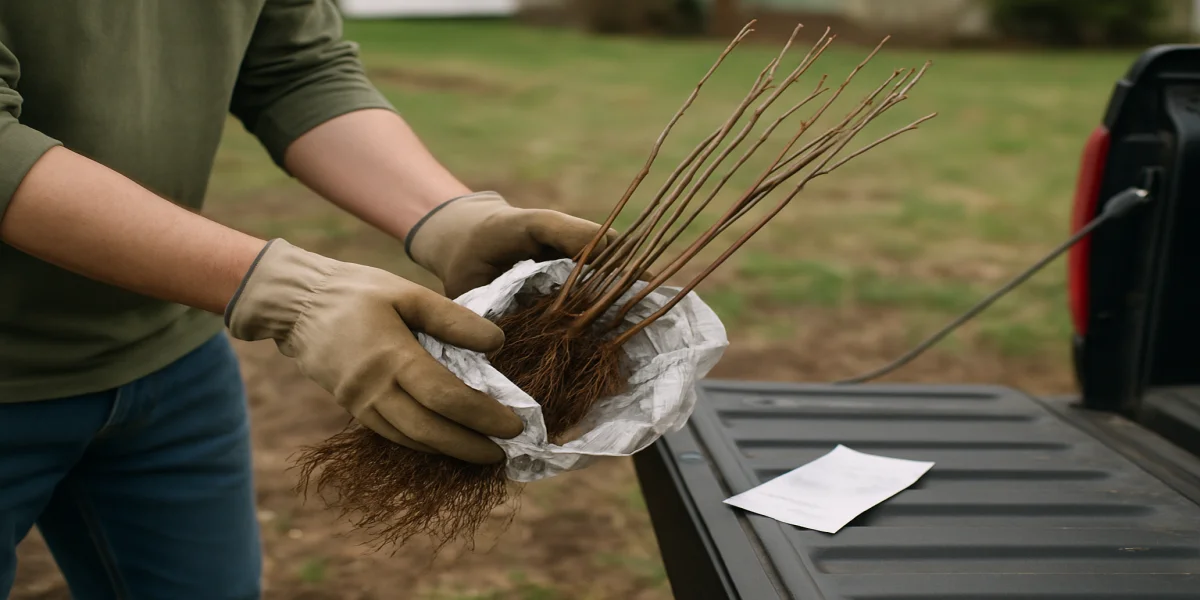
The trade-off is timing. Conservation districts open ordering in mid-January and close as soon as inventory sells out, Northern Virginia’s 2026 sale closed within weeks of opening on February 19. Pickup is typically a single Saturday in mid-April. If you missed this year’s window, set a calendar alert for January 15 of next year, search “[your county] soil and water conservation district seedling sale,” and place an order in the first week orders open. The pickup process is genuinely two minutes. Drive to the county fairgrounds, hand someone a receipt, drive away with a bundle wrapped in damp newspaper and a plastic bag.
The other note: these are bare-root, finger-thick stems that look like nothing on pickup day. Plant them within 48 hours, water deeply twice a week for the first month, mulch the root zone with a shredded leaf layer, and accept that they will spend the first year putting roots down rather than putting leaves out. By year three the serviceberry is six feet tall and the elderberry is fruiting. By year five the dogwood is a focal point. Five dollars per plant is not a typo.
Source 3: State forestry free plant days, plant rescues, and the math of dividing what you already own
The third tier is where the truly free plants come from. Three sources stack here, and most homeowners do not know about any of them.
State forestry distribution programs. Many state forestry agencies, Tennessee, North Carolina, Pennsylvania, Indiana, and others. Distribute bare-root native trees and shrubs at no cost or near-zero cost to landowners enrolled in stewardship, windbreak, or pollinator habitat programs. Pennsylvania’s Howard Nursery, run by the Game Commission, is the often-cited model: any state landowner can purchase seedlings for habitat improvement at prices that effectively cover handling. The application paperwork is light. A property description, a stewardship purpose, and a planting plan sketched on a napkin will do in most states. Search “[your state] forestry seedling program” and read the eligibility page. If you own property and have any reasonable habitat justification, you almost certainly qualify.
Plant rescues. Native plant societies and Wild Ones chapters in many regions organize formal rescues from construction sites, road-widening projects, and solar farm builds, where mature native trees, shrubs, and forbs are about to be bulldozed. Volunteers spend a Saturday digging plants and dividing them among participants. The plants are free, the species are often regionally rare, and the rescues happen because if no one shows up, the plants get scraped into a dumpster. Search “native plant rescue [your state]” and join a society email list. The rescue calendar fills up in February for spring digs.
Plant swaps and division of what you already grow. If you have any established native perennials at all. Even one clump of bee balm, one stand of asters, one mat of obedient plant. You have a multiplier. Most prairie natives respond well to division every two to three years, splitting one parent plant into three to five viable transplants at no cost. Pair division with a local plant swap (the National Seed Swap Day is the last Saturday of January, and most Wild Ones chapters host spring swaps in April and May), and a single existing clump becomes the seed of an entire planting plan. For a step-by-step on dividing perennials and the etiquette of swapping with neighbors without spreading invasives, see our guide on propagating and sharing native plants with neighbors this spring.
What to do when you can’t wait three years for a seedling to look like a plant
The fair objection to everything above is that bare-root seedlings, milk-jug babies, and rescued divisions all look like nothing the year you plant them. If you bought your house last fall and your spouse expects the front yard to look like a magazine by July, you have a real problem that no amount of winter sowing will solve in time. Here is the compromise that consistently works.
Spend $50 to $100. Not more. On three to five “instant-impact” gallon-size plants from a reputable native nursery, and place them at the focal points only: the corner of the bed by the front walk, the spot directly visible from the kitchen window, the anchor by the mailbox. A single mature blazing star or one well-grown serviceberry shrub does almost all the visual work of looking “intentional.” The remaining 90 percent of the bed gets filled with $5 conservation district seedlings, milk-jug-grown plugs, and divisions, and nobody walking past notices that they are small. The eye reads the focal points and assumes the rest of the bed matches. By the second summer the cheaper plants have caught up and the visual gap closes.
This is also the answer to the HOA problem. A native bed that looks intentional. Masses of the same species, distinct edges, a few mature focal plants. Does not get a complaint letter even if 90 percent of it is seedling-stage. The “rat nest” complaint comes from beds that look random. A budget bed planted with intentional structure looks just as composed as a $1,200 retail bed, because composition is free and species count is what costs money.
The other quiet hack: gallon-size plants on clearance at retail nurseries the second week of October. Most retail garden centers slash perennial prices by 50 to 70 percent in mid-October to clear inventory before winter. The plants look rough. Yellowing leaves, beat-up pots. But the root systems are usually fine, and a mid-October planting gives them six full weeks to establish before hard frost. A $14 gallon coneflower marked down to $4 is the same plant the following May. Set a calendar alert for the second Saturday of October and budget a $40 clearance run for the focal-point layer.
What a $150 native garden looks like in year three
To make this concrete, here is a worked budget for converting a 200-square-foot front-yard strip from lawn to a four-season pollinator bed, assembled from the sources above. The total bill comes out under $150 and the bed is fully planted at intentional density.
- Soil prep: $0 for cardboard sheet-mulching from neighbors’ Amazon boxes, plus $30 for a yard of mulch from a local arborist’s free chip drop or a $30 SWCD wood chip delivery. Cardboard plus six inches of chips smother the lawn over fall and winter.
- Foundation shrubs (anchors): Four bare-root shrubs from the conservation district sale at $5 each, total $20. Two American elderberries plus two serviceberries, planted at the bed corners.
- Mass-planted perennials (the bulk): 75 winter-sown plugs across five species (black-eyed Susan, purple coneflower, butterfly weed, anise hyssop, wild bergamot), grown from $20 in seed packets and $10 of potting mix and $0 in milk jugs. Total $30. Planted in five drifts of 15.
- Focal points (instant impact): Three $14 gallon-size native plants on clearance in mid-October, marked down to $5 each. Total $15. Placed at the highest-visibility spots.
- Spring divisions and plant-swap pickups: $0 for fifteen plants split from a friend’s bee balm and a Wild Ones chapter swap.
- Edging and one decorative rock: $40 in scrap brick from Facebook Marketplace and Craigslist freebies.
Total: $135. Year one looks thin. Year two reads as a real planting. Year three is what the neighbor took six months and $2,400 to install. Minus the $2,265.
That is the math the retail channel does not want repeated. The bed you actually want is buildable for under the cost of a single weekend of garden-center shopping, if you are willing to stack the cheap sources, plant for a three-year horizon, and skip the convenience tax. Spring is a good window to start, because the conservation district sales and forestry programs are open right now and the winter-sow window for next year opens in seven months.
Common questions readers send me
Is winter sowing in milk jugs really that simple, or is there a catch?
The catch is patience and timing. You have to set up jugs between December and early March, and you have to leave them outside through actual winter weather. Snow, ice, the works. The mistake people make is bringing the jugs into a garage or a sunroom, which short-circuits the cold cycle the seeds need. Done correctly with cold-stratification-required species, germination rates run 40 to 70 percent, which is more than enough.
What if my Soil and Water Conservation District does not run a seedling sale?
Almost every state has one. The program varies by name. Try searching “[your state] tree and shrub program” or “[your county] conservation district nursery.” If yours genuinely does not, the next stop is your state’s forestry agency or the closest Wild Ones chapter, which usually has reciprocal arrangements with neighboring district sales.
Can I just buy a pollinator seed mix and skip all of this?
Yes, and it is the single cheapest method per square foot. A $30 regional native seed mix covers roughly 500 square feet of meadow when sown densely. The trade-off is control: you cannot dictate exactly which species end up where, and meadow plantings take three full seasons to look like anything other than weeds. For a backyard meadow strip, the seed-mix route is the right call. For a visible front-yard bed where the HOA will be watching, the plug-and-anchor approach reads as more intentional.
How do I know I am buying true natives and not a mislabeled invasive?
Conservation district sales are typically the safest channel because they source from state forestry nurseries that are required to verify provenance. State forestry programs are similarly safe. Big-box stores are not. For confirmation, cross-check species names against the BONAP North American Plant Atlas county-level distribution maps before ordering.
What is the single biggest mistake people make with a budget native garden?
Spreading the budget too thin across too many species. Nine plugs of three species, planted in tight drifts, almost always outperforms 27 individuals of 27 species at the same total cost. Mass plantings read as intentional, support more pollinators per square foot, and are easier to weed because you can recognize what you planted.
For the canonical winter-sowing technique, see Missouri Extension publication YM105, which is the source most state programs reference.
Related reading
Want More Wildlife Garden Tips?
Join 5,000+ nature lovers getting our weekly tips on creating wildlife-friendly gardens.
No spam, unsubscribe anytime. Privacy Policy
Emma Harrington
Emma Harrington is a wildlife habitat researcher and content editor with a passion for backyard conservation. She has spent over a decade translating ecological science into practical tips anyone can follow — from selecting native plants to building wildlife-friendly habitats. Her work focuses on helping homeowners transform ordinary yards into thriving ecosystems for bees, butterflies, hummingbirds, and other beneficial wildlife.