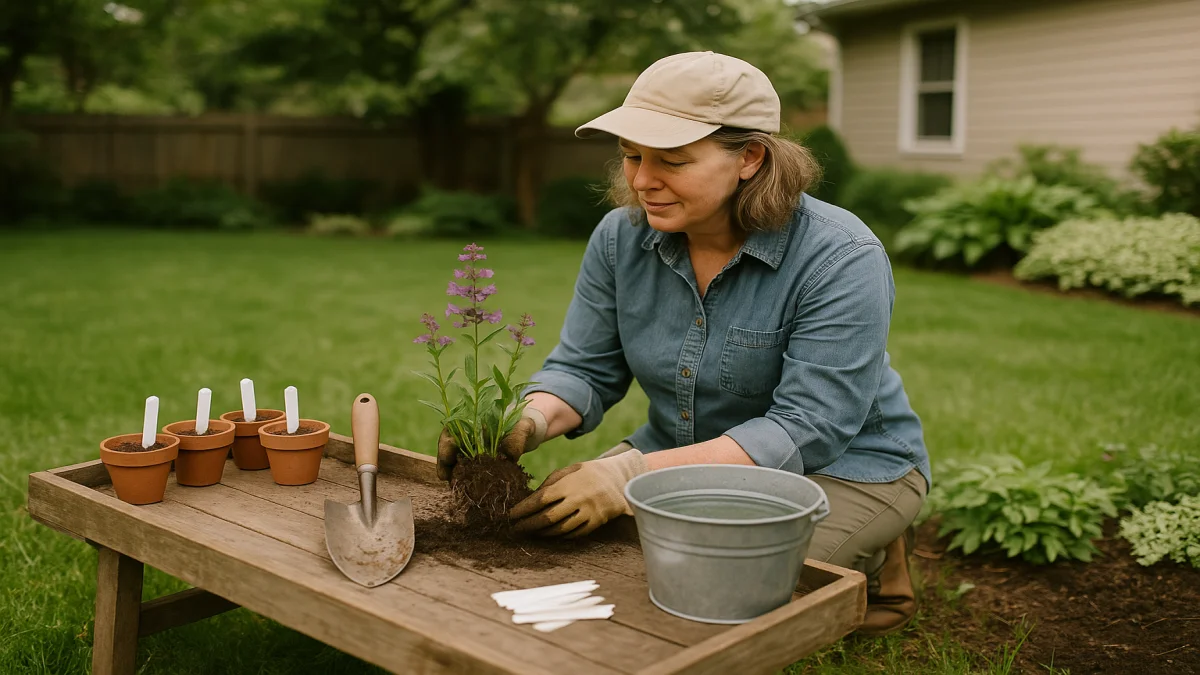
A neighbor I barely knew stopped me in the driveway last April with a trash bag in one hand and a shovel in the other. “I have a hundred extra foamflower,” she said. “Do you want some before the deer find them?” That was how my shady back corner got filled in for free. And how I realized the people around me were quietly running a parallel economy I had no idea existed.
If you’ve been keeping an eye on native plant prices at your local nursery lately, you know the struggle. A single quart-sized penstemon is priced between twelve to fifteen dollars in many areas. Meanwhile, you can find a flat of twenty plugs from a native plant supplier online for around sixty bucks, plus shipping. I’ve noticed that gardeners across the country are arriving at the same conclusion: it often makes more sense to seek out free plants from others in the community rather than paying retail.
But the people I talk to who want to start sharing plants. Or accepting them. Keep hitting the same two walls. The first is mechanical: how do I actually divide this thing without killing the parent plant? The second is social: is there a polite way to do this, and how do I make sure the beautiful vine my neighbor is handing me isn’t going to eat my yard in five years?
FREE: Wildlife Garden Starter Guide
Get our 12-page PDF with the 25 best plants for pollinators, simple habitat tips, and a printable checklist — all 100% free.
No spam. Read our Privacy Policy.This guide is the one I wish I’d had that April afternoon. It covers the exact natives that multiply themselves every spring, the ones that will sulk or die if you touch their roots, a 20-minute division method you can use on most clumping perennials, a water-rooting method for shrubs and vines, and. The part most how-to articles skip. The etiquette of gifting plants without accidentally handing a neighbor the next burning bush epidemic.
Why Backyard Gardeners Are Gifting Plants Instead of Buying Them
Something shifted in 2025 that’s still playing out this spring. Demand for true native plants has roughly doubled year-over-year at specialty nurseries in the Mid-Atlantic and Midwest, and several of the best small growers, Prairie Moon, Izel, regional conservation districts. Started going sold-out by mid-April. Meanwhile big-box stores are still selling the same old cultivars that disappoint pollinators, plus the occasional invasive mislabeled as a “pollinator favorite.”
The gap between demand and supply has done something the native plant movement has wanted for twenty years: it’s turned backyard gardeners into small-scale producers. One suburban gardener in Ohio quietly put 400 little bluestem plugs in her driveway for free last fall. A retired teacher in Raleigh runs an annual foamflower giveaway on Facebook Marketplace. A volunteer at a Minnesota prairie restoration harvests seed on weekends and gives it to anyone who asks.
There’s a second, quieter reason this is happening too. After a long stretch of mandatory online everything, neighborhood-scale generosity feels good in a way that’s hard to explain. Handing someone a rooted piece of your bee balm is a very small act that makes both of you a little more tied to the ground and to each other. The audience phrase for this is “posing with the invasive plants I ripped out of my yard like men on tinder pose with fish”. A joke, but also a real thing: people want to be seen doing this work. Sharing is the natural follow-up to ripping out.
The tradeoff, though, is that propagation done badly undoes a lot of good. You can kill a ten-year-old parent plant with a rushed division. You can introduce a pest to a neighbor’s collection. And. The one that haunts this community. You can pass along a plant that’s invasive in your region without knowing it, because it was already mislabeled when you bought it. That’s the problem we need to engineer around.
Five Native Perennials That Practically Beg to Be Divided in Spring
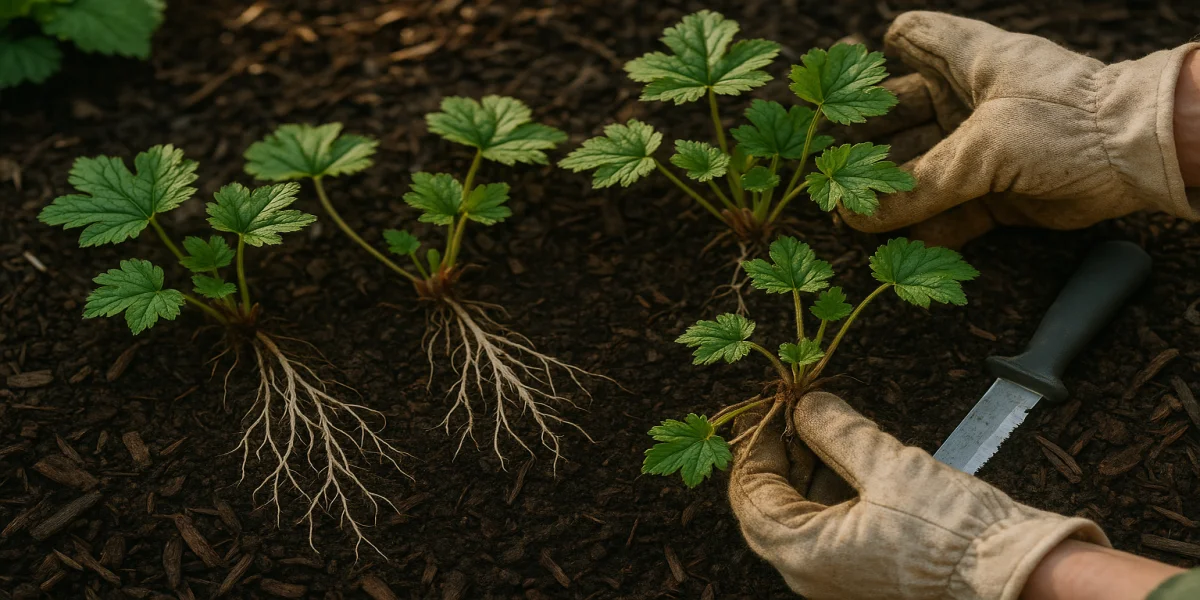
If you’ve never divided a plant before, start with something that wants to be divided. These five are the “open the door and walk through” of native propagation. Every one of them will thank you for breaking it into pieces this April or May.
Foamflower (Tiarella cordifolia). Native across most of the eastern US and a godsend in shady spots where grass gives up. Foamflower spreads by short stolons. Creeping stems that flop over and root themselves. You don’t even need a shovel. Pull back the mulch, find the little plantlets already rooted along the parent’s edges, and gently pry them loose with your fingers. Each plantlet that comes up with a white fleshy root and two or three leaves will become a full clump in one season. A single well-established foamflower can hand you twelve to twenty free babies every spring without noticing.
Beardtongue (Penstemon digitalis). A pollinator magnet, especially for native bumble bees and small carpenter bees. Virginia Cooperative Extension recommends dividing beardtongue every one to three years with a spade or garden fork. The clumps get wider each season, and if you don’t divide, the center dies out and the plant rings hollow. Dig the whole thing up, rock it back and forth to loosen the soil, then split the crown into pieces with a sharp shovel. Four fist-sized divisions from one mature plant is realistic.
Bee balm (Monarda didyma or M. fistulosa). Needs division every one to three years to stay vigorous. The University of Illinois Extension warns that you’ll know it’s time when “reduced flowering with smaller blooms” shows up alongside flopping stems. Water the plant deeply the day before division. Dig wide around the crown to capture the shallow roots. Separate into sections, keeping the tender outer growth and discarding the woody center.
New England aster (Symphyotrichum novae-angliae). The backbone of any fall pollinator garden. Divide every three to five years with a soil knife, saw, or the edge of a sharp spade. The center will be woody and not worth replanting; it’s the outer ring of new growth you want. One mature aster can yield six to eight gallon-sized divisions without breaking a sweat.
Goldenrod (Solidago species, pick the clumping kinds like S. speciosa or S. caesia, not the running ones). Spreads by rhizome. A sharp spade through the edge of a mature clump will give you new plants in five minutes. Skip the aggressively running species (Canada goldenrod, Solidago canadensis) unless you’re planting a meadow. It will march through a tidy bed and your neighbor’s too.
None of these need special equipment. A sharp shovel, a bucket of water, and an hour on a cloudy morning is the entire setup.
Three Natives That Look Shareable But Will Sulk or Die (Taproots and Fussy Roots)
This is the list that saves you from a heartbreaker. Some of the most beautiful and popular natives are built on a single long taproot that goes down a foot or more, and if you try to divide them, you’ll end up with a dead parent plant and two dead divisions.
Butterfly weed (Asclepias tuberosa). Yes, it’s a milkweed, yes monarchs need it, yes you want more of it. But its root is a thick carrot that shoots straight down. Extension horticulturists in every region put this on the “do not divide” list. If you want more butterfly weed to share, collect the seedpods in late summer, refrigerate them for sixty days to cold-stratify, and start seedlings in deep pots. Don’t divide the parent.
Blue wild indigo (Baptisia australis). Same problem. Baptisia has a taproot that can reach three feet in a mature plant. You can cut it in half and plant both pieces, but one or both will sit there and sulk for two years before deciding whether to survive. Stem cuttings in early summer root more reliably than division.
Wild columbine (Aquilegia canadensis). Not a taproot, but the crown is fragile and the plant resents being disturbed. The best way to share columbine is to let it self-seed (it will, prolifically), identify the volunteers in your beds in early spring, and pot up the tiny seedlings with a spoon when they have three or four true leaves. Those transplant beautifully. Digging the parent does not.
A quick rule of thumb: taproot, no; fibrous or rhizomatous root, yes. If you pull a test plant and a single carrot comes up, pot the soil back down and don’t try to divide it again.
The 20-Minute Division Method That Won’t Kill Your Parent Plant
Here’s the exact method that works on every clumping perennial on the “easy” list above. Twenty minutes, one trip to the compost pile, done.
- Water the parent plant deeply the day before. This is the single most-skipped step. Dry roots tear; hydrated roots cut cleanly.
- Pick a cloudy morning. Or do it at dusk. The goal is to keep the divisions out of direct sun while their roots are exposed. In hot weather, throw a damp towel over the pile while you work.
- Dig a wide circle, not a deep hole. Start your shovel about eight inches out from the crown on every side. You want to lift the entire root ball with its soil attached.
- Lift and rinse, or lift and rock. For very small plants, swish the root ball in a bucket of water to loosen the soil so you can see where to cut. For larger plants, just rock the ball back and forth on the ground until the soil falls away from the crown.
- Find the natural breaks. Most clumping perennials are already made of multiple crowns pressed together. You’ll see distinct “fingers” where last year’s growth stopped and this year’s started. Aim your cuts there.
- Cut with a sharp blade. A spade edge, a soil knife, or a pruning saw. Each division should be the size of a quart or gallon nursery pot and must have both roots and visible growth buds or shoots. No buds means no plant.
- Discard the woody center. On plants that are three years or older, the innermost tissue is usually spent and won’t re-sprout well. Compost it.
- Replant the parent and pot up the divisions immediately. Keep everything moist and shaded for the first week. Water every day that it doesn’t rain for two weeks.
Expect to lose one division out of every six to eight. That’s normal. It’s also why you divide generously. You end up with plenty to keep, plant elsewhere in your own yard, and give away.
Rooting Cuttings in Water: A Pain-Free Way to Multiply Spring Blooms
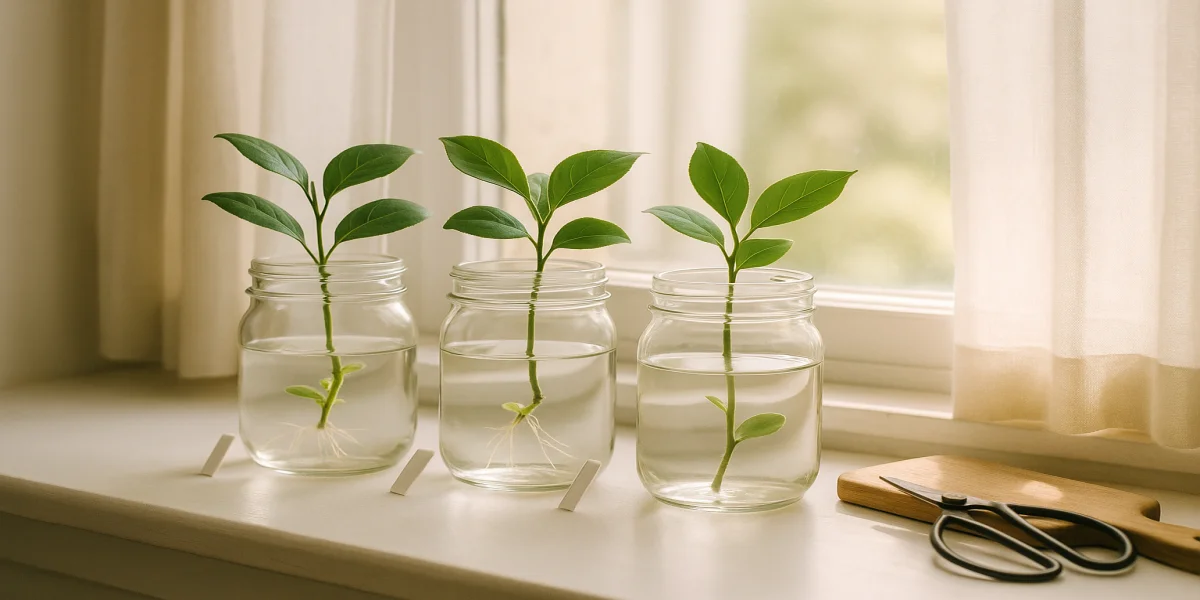
Not everything needs to come out of the ground. Some of the most neighbor-gift-worthy natives propagate from a piece of stem in a glass of water on your kitchen windowsill. This is the method if you have a bad back, a small yard, or a plant you can’t bear to dig up.
Good candidates for water-rooting in spring: elderberry (Sambucus canadensis), serviceberry suckers, American beautyberry (Callicarpa americana), button bush (Cephalanthus occidentalis), buttonbush suckers, ninebark (Physocarpus opulifolius), and most willows (Salix species).
The method:
- Take a six-inch cutting from new growth. This year’s green wood, not last year’s brown wood. Cut just below a leaf node with a sharp pruner.
- Strip off the lower leaves so nothing will be submerged. Leave two or three leaves at the top.
- Stand the cutting in a clean jar of water on a bright windowsill (no direct sun).
- Change the water every three days.
- In ten days to three weeks, you’ll see tiny white roots. When the root mass is about an inch long, pot the cutting in soil and keep it moist for two weeks while it transitions.
A single elderberry bush can give you fifteen to twenty cuttings without setting back its growth. Those cuttings, by August, are sixteen-inch baby shrubs you can gift in a plastic pot with a ribbon.
Willow cuttings are the cheat code. They root so reliably that a willow wand stuck directly in moist ground in April will be a two-foot plant by September. Some permaculture gardeners call this the “hedge for free” trick.
Seed Sharing Without Starting Another Garlic Mustard Epidemic
This is the part of the guide most people skip, and it’s the one that actually matters for the larger native plant movement. Every spring, somewhere, someone with good intentions hands a neighbor a packet of mystery seeds from their yard and starts a new infestation.
Before sharing any seeds, it’s critical to pinpoint the parent plant down to the species level. I can’t stress enough: it’s not enough to say ‘the pink one’ or ‘that tall daisy.’ We need to be precise with genus and species every time. If you’re unsure, taking a photo and using apps to identify them can help. Plus, don’t share the seeds until you’re absolutely certain. I’ve heard stories about gardeners who purchased plants decades ago, only to see them turn into invasive species in their yards. Nobody wants to unintentionally contribute to that.
Cross-check against your regional invasive list before you harvest. Every state has one. Search “[your state] invasive species list” and confirm your target isn’t on it. Many plants sold legally at nurseries for decades. Butterfly bush, Japanese barberry, burning bush, Callery pear, creeping Jenny, Asian wisteria, English ivy. Are on multiple state lists now. If it’s on the list, don’t harvest the seed, don’t share the seed, and consider whether the parent plant should come out.
Clean and dry seed before you bag it. Spread heads on a paper plate in a dry room for a week. Rub the seed off the chaff with your fingers. Store in labeled paper envelopes (not plastic) until you’re ready to share.
Label with four things: genus, species, collection date, and your zip code. The zip code matters because local ecotypes of the same species can behave differently. A penstemon seed collected in Virginia will grow a slightly different plant than the same species from Minnesota, and a good seed-sharer tells the receiver where it came from.
Skip the “mixed wildflower” mystery packet. If you can’t identify every species in a mix, don’t hand it off. Many cheap “native wildflower mixes” on the market contain up to four species that are regionally invasive. Single-species packets only.
The Etiquette of Giving Plants to Neighbors and HOA-Adjacent Yards
Here’s the part my neighbor got right and most people get wrong. There’s a quiet social script for sharing plants, and when you follow it, nobody feels awkward and the plants actually get planted.
Ask first, don’t surprise. A plant left on a porch is a guilt trip. “I have extra beardtongue divisions this weekend. Would you want three?” is a gift. The difference is consent.
Give a potted plant, not a bare-root clump in a grocery bag. A four-inch pot, a six-inch pot, even a cut-down yogurt container with drainage holes. Any pot signals “this is a real plant, not a chore.” Bare-root plants in Safeway bags say “please get rid of this for me.”
Write the name and two words of care on a plastic label. Use a Sharpie on a piece cut from an old plastic milk jug. “Penstemon digitalis / full sun.” That’s enough. The gardening extension offices recommend genus, species, and common name at minimum; a milk-jug label is free and outlasts a popsicle stick.
If the recipient has an HOA, offer to help plant it. A new plant in an HOA-adjacent yard is high-anxiety. An offer to walk over with a trowel defuses ninety percent of it and turns the gift into an hour of real conversation.
When sharing plants, it’s essential to inform others if they have the potential to spread. Giving a heads-up, like saying that a certain plant spreads by runners and should be placed where it can create a patch, rather than crammed into a small bed, is incredibly valuable. I’ve seen many gardeners lament about how well-meaning friends pass along plants like mint or ditch lilies without any warning, leading to chaos in the garden. Let’s try to avoid being that friend.
Never re-gift something you were just given unless you grew it yourself. You don’t know the parentage. You don’t know the regional source. You don’t know the history. Grow it for one season, watch it, then propagate from your own plant and share those.
And one hard-earned rule for the other direction: when a neighbor hands you a mystery plant, say thank you, plant it in a pot. Not in the ground. And watch it for a full season before releasing it into your beds. If it turns out to be something aggressive, the pot contains the problem. If it’s a treasure, you’ve lost nothing.
How to Find (or Host) a Local Native Plant Swap This Spring
The obstacle most people hit isn’t etiquette. It’s not knowing where to go. Native plant swaps are real, they’re everywhere, and they are not advertised the way you’d expect.
Start with your state’s Native Plant Society chapter. Every state has one. Most host at least one spring plant sale and several informal swaps at member meetings. Search “[your state] Native Plant Society” and look at the events calendar.
Check your county cooperative extension office. Extension Master Gardener programs run plant sales and swaps every spring. These are usually well-organized, labeled, and vetted for invasives. The safest place to both give and receive.
Facebook groups, but the right ones. Look for “[Your County/Region] Native Plant Gardeners” or “Wild Ones [Your Chapter].” Wild Ones is a national native plant organization with chapters in most metro areas; their local groups run some of the best plant exchanges in the country.
Library bulletin boards and neighborhood apps. Nextdoor has become a reliable place to find local swappers, especially in suburbs. A single post, “Dividing penstemon this weekend, free pieces to anyone local”. Will pull a surprising number of replies in April.
Host your own if nothing exists. The minimum viable plant swap is four people, a driveway, and a Saturday morning. Each person brings at least one labeled plant. Everyone takes no more than they bring. Bring-a-snack rule optional. You do not need a permit, a banner, or an Instagram account. You need four willing neighbors and a shared intent to do this again in the fall.
The first time you host, people will show up with mint, bamboo, vinca, creeping Jenny, and three kinds of invasive grass. This is normal. Have a friendly rule ready: “We try to keep it to natives and non-spreading ornamentals. Let’s set those to the side and they can go home with whoever wants them.” Make it a teaching moment, not a confrontation.
What Changes When You Start Giving Plants Away
The first year, you’ll give away maybe a dozen plants and receive about the same number. The second year, the numbers jump. Because plants you divided this spring will themselves be ready to divide next spring, and the people you gave plants to last spring will have some of their own to share.
Something else happens that doesn’t show up in a gardening article: your yard stops feeling like a project and starts feeling like a node in a network. The penstemon in your front bed came from a retired teacher three blocks over. Your foamflower came from the neighbor with the trash bag. The elderberry cutting in the corner came from a cousin across town. Every plant has a person behind it, and every person has a reason they kept more of it than they needed.
Over two or three seasons, the financial side of this adds up too. A 40-foot pollinator bed populated from swaps and divisions is roughly a $400 to $600 project instead of a $1,500 to $2,500 one. A hedgerow of water-rooted elderberry and ninebark cuttings is a $0 project. The audience quote that opened this piece, “I’m looking for the most economical route (less than $2k)”. Turns into a totally different math problem when the plants are moving around the neighborhood for free.
The rule is the one that wasn’t obvious the first April my neighbor knocked on my door: this only works if everybody shares carefully. Know what you’re passing along. Pot it. Label it. Warn about spread. Say no to invasives even when someone’s feelings might be hurt. Do those five things and the native plant economy on your block compounds on itself, year over year, for free.
Spring is the window. If you have a clump of anything on the “easy” list in your yard right now, this is the weekend to grab a shovel.
Frequently Asked Questions
Can I divide a native perennial that I planted last year, or does it need to be established first? Wait at least one full growing season, ideally two. A first-year plant is still sending roots outward to anchor itself and doesn’t have enough crown mass to split without setting back both halves. Mark the plants you want to divide with a ribbon in fall so you remember which ones are ready the following spring.
Is it okay to dig native plants from wild areas to share with neighbors? Not from public land, no. It’s illegal in most state and federal parks and damaging to the ecosystem regardless. The ethical gray area is salvaging from construction sites that are about to be bulldozed, which some state Native Plant Societies organize officially as “plant rescues.” Participate in those; don’t freelance it.
My neighbor gave me a plant and told me it was a “native bush.” It’s aggressive. What do I do? Pot-quarantine it for a full season. Identify it with iNaturalist. If it turns out to be invasive in your region, dispose of it in a black trash bag in the sun (heat kills seed and root fragments) rather than composting it. Then have a gentle honest conversation with the neighbor. They almost certainly didn’t know.
How many divisions is too many from one plant? Rule of thumb: four divisions from a three-year-old plant, six to eight from a five-year-old. Going beyond that stresses the parent and produces weak, slow-to-establish divisions. Bigger divisions establish faster; tiny slivers struggle.
Do I need to pay taxes or register as a nursery if I give plants away? Giving plants away for free to neighbors is not nursery activity in any US state. If you start selling them or crossing state lines, the rules change fast. Most states require nursery registration and a phytosanitary inspection. Stay on the giving side and you stay out of the paperwork.
Looking for more on what to plant where once the divisions are done? Our step-by-step guide to cold-stratifying native seeds is the companion article. Use it for the seed sharing chapter above, where timing is everything.
Further reading: the U.S. Department of Agriculture’s PLANTS Database (nofollow) is the authoritative reference for confirming whether any plant is truly native to your state before you share it.
Related reading
Want More Wildlife Garden Tips?
Join 5,000+ nature lovers getting our weekly tips on creating wildlife-friendly gardens.
No spam, unsubscribe anytime. Privacy Policy
Emma Harrington
Emma Harrington is a wildlife habitat researcher and content editor with a passion for backyard conservation. She has spent over a decade translating ecological science into practical tips anyone can follow — from selecting native plants to building wildlife-friendly habitats. Her work focuses on helping homeowners transform ordinary yards into thriving ecosystems for bees, butterflies, hummingbirds, and other beneficial wildlife.