
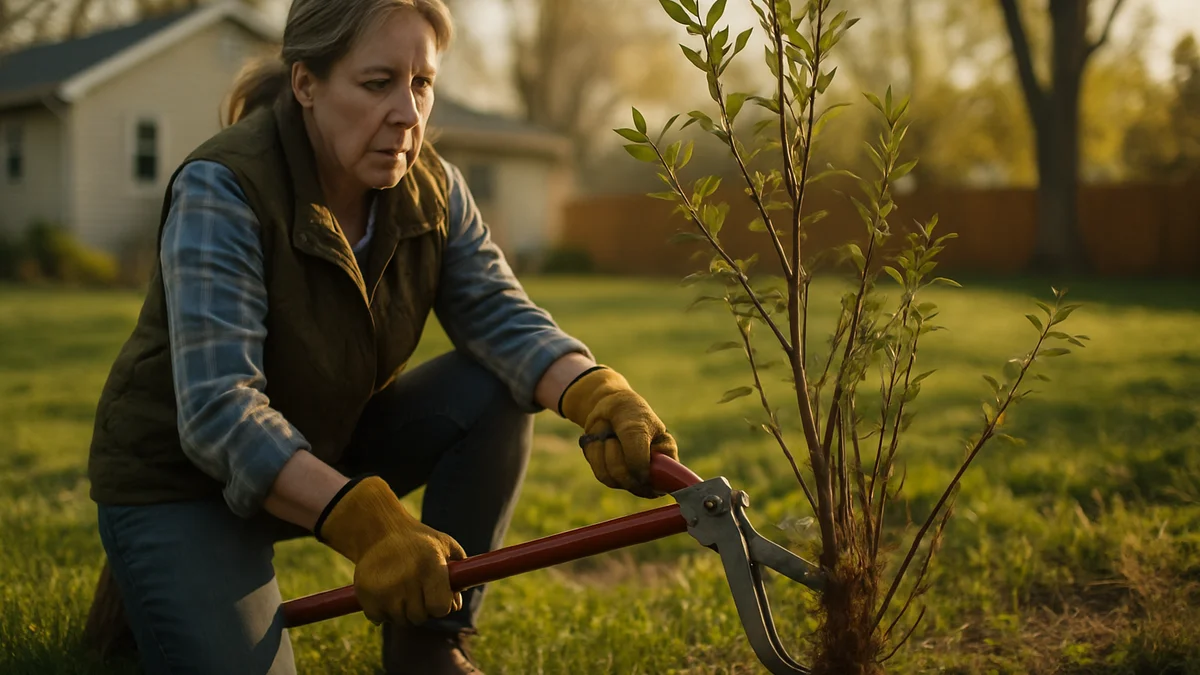
The previous owner of my friend Diane’s house left her a lot of nice things. A workshop, a paid-off fence, two mature oaks. They also left her a 40-foot hedge of common buckthorn that she has been battling for four springs straight. She texted me a photo last week of her forearm covered in scratches and wrote, “tell me this ends someday.” It does. But not in a weekend, not with one rental chainsaw, and not with the shortcut everybody on TikTok keeps promising.
If you have inherited a yard full of buckthorn. Or Japanese barberry, bush honeysuckle, burning bush, autumn olive, any of those shrubs the nursery sold your parents in 1982. You already know the internet gives you two tones. Either spray everything with triclopyr and move on, or spiral into guilt about herbicide runoff while the seedlings keep coming back. Neither tone helps a gardener who wants a real habitat, a happy mortgage, and a back that still works.
This is the plan I walk neighbors through when they ask. It is chemical-free, it is paced over three growing seasons so you do not burn out in April, and it is built around what actually grows in place of the invasive once it is gone. There is no magic. There is a calendar, a tool list, and the honesty that the first year is the ugly one.
FREE: Wildlife Garden Starter Guide
Get our 12-page PDF with the 25 best plants for pollinators, simple habitat tips, and a printable checklist — all 100% free.
No spam. Read our Privacy Policy.Why Buckthorn Is the Single Worst Shrub a Previous Homeowner Could Have Left You
Common buckthorn, the species tagged Rhamnus cathartica on the Minnesota DNR noxious weed list, was sold as a hedge plant across the Midwest and Northeast for decades. It is still quietly hiding in fencerow rows planted in the 1960s and 1970s. Mature plants reach 20 to 30 feet tall and up to 10 inches in trunk diameter, according to the Minnesota Department of Natural Resources. That is small-tree size, not shrub size, which is the first shock for anyone trying to yank one out by hand.
The harm goes further than taking up space. University of Minnesota Extension researchers found that buckthorn completely eliminates plant diversity in the understory over time. The dense leaf canopy shades out tree seedlings, spring ephemerals, and the native grasses that songbird nestlings actually eat. It also serves as the overwintering host for soybean aphid, which is why farm country loathes it as much as nature preserves do. Minnesota went as far as classifying common buckthorn a Restricted noxious weed, which means it is illegal to import, sell, or transport in that state. Several other states are moving the same direction.
And here is the part nobody tells you at the nursery: a single mature female plant pumps out thousands of black berries a year, each holding three to four seeds. Robins and starlings swallow the berries, fly to your yard, and deposit them in neat little fertilizer piles under your fence. That is why you can clear your neighbor’s property line and watch new seedlings pop up in your lawn the next May. You are not failing. You are simply downstream of somebody else’s hedge.
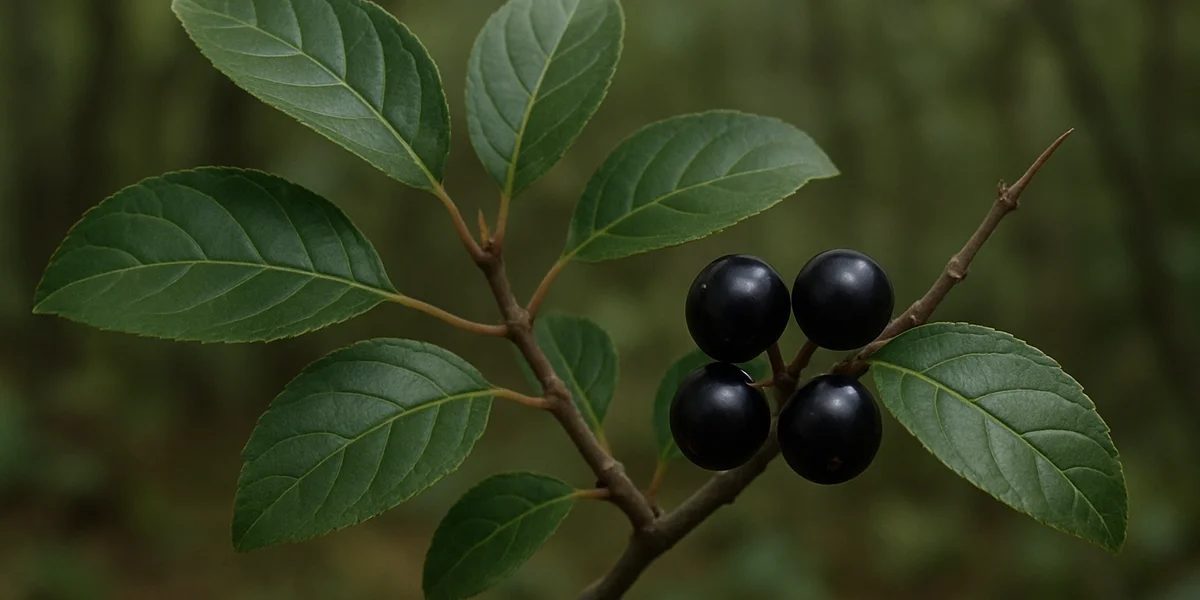
A quick gut-check: if you are staring at a shrub that still has green leaves in late October when everything else has dropped. Thorns at the twig tips, smooth gray bark, and glossy toothed leaves with three to five curving veins. That is almost certainly buckthorn. The late-fall green-up is actually a gift. It is the easiest time of year to pick it out from a native thicket, because natives around it will be bare.
How to Recognize Buckthorn Before You Start Yanking the Wrong Plant
Before a single root comes out, I want you to walk the property with a cup of coffee and just look. I have watched two separate neighbors accidentally kill a native chokecherry because they mistook it for buckthorn in the panic of cleanup weekend. The features to confirm before you commit:
- Leaves. Egg-shaped, finely toothed, dark glossy green. Three to five curving veins running from the leaf stem toward the tip. Leaves stay on the plant later than almost any native in a temperate yard. Mid-to-late October is often when the diagnosis becomes obvious.
- Twigs. The tip of each twig usually ends in a short straight spine, with two elongated brown scaly buds that look like a deer hoof pointing at the tip. That is where the name “buckthorn” comes from.
- Bark. Smooth gray to brownish, often with horizontal lighter-colored corky bumps called lenticels. Scratch a twig with a fingernail and you will see a distinctive orange-yellow sapwood underneath.
- Fruit. Round, pea-sized, shiny black drupes held in clusters. Female plants fruit in August and September, and the seeds inside remain viable in soil for about 2 to 3 years.
- Habit. Often multi-stemmed at the base, 6 to 25 feet tall in a yard setting, sometimes a single tree up to 30 feet if it has had decades.
If a shrub has any of these traits plus the late-fall green leaves, treat it as buckthorn. If something does not line up. Leaves are opposite, not alternate; berries are red, not black; twigs have no thorn tip. Pause and cross-check against a reference like Minnesota Wildflowers or your state extension service before you tug. Misidentification is how good natives die.
One last trick. Snap off a small twig. Buckthorn wood under the bark is a vivid orange-yellow, almost highlighter-colored. No native shrub in a Midwest or Northeast yard does that. If you see the neon sapwood, you have your target.
The Seed Bank Problem: Why “Just Cut It All Down” Fails in Year Two
Every buckthorn removal plan that fails fails for the same reason. Somebody rents a brush cutter in April, spends a weekend turning the property into a flat moonscape, takes a before-and-after photo, and considers the job done. Twelve months later the yard is a sea of eight-inch buckthorn seedlings and they are angrier and shorter than before.
The thing you cannot see from the surface is the seed bank. Buckthorn seeds deposited by birds over the last few years are sitting in the top inch or two of your soil, waiting for light. The moment you clear the canopy above them, they wake up. University of Minnesota and MN DNR guidance cites a seed bank viability window of roughly 2 to 3 years, which means your soil still holds two or three seasons’ worth of live seed even after you remove every standing plant.
Mature buckthorn is also a reproductive monster at the stump. A cut plant left alone will resprout from the root crown with three or four vigorous shoots the following year. Those shoots reach flowering size fast because they are powered by an established root system. Within two years you have replaced one 20-foot plant with a multi-stem thicket in the same footprint.
That is why this is a multi-year plan and not a weekend. The real work after the initial cutting is:
- Killing or smothering the stumps so they do not resprout.
- Scouting the soil surface in year one, year two, and year three for new seedlings from the seed bank.
- Replanting densely enough that the native shade starts competing with new germinants.
Skip any of those steps and you are planting a future buckthorn forest.
Your Three-Year Buckthorn Removal Timeline, Broken Down by Season
Here is the realistic calendar I actually hand people. You can adjust for your zone. Things happen about two weeks earlier in zone 6 than in zone 4. But the structure holds.
Year One, Spring (late March through May)
– Walk the yard and flag every confirmed buckthorn plant with orange marker tape. Count them. The count matters because it tells you how much weekend labor you are signing up for.
– Pull every seedling under a quarter inch of stem diameter by hand while the soil is still wet. Wear thick gloves; thorns at twig tips break skin. Bag seedlings to prevent reroot.
– Start cutting burning bush and Japanese barberry if you have them. Both drop viable fruit by June and you want them out before that happens, per Long Island Invasive Species Management Area guidance.
Year One, Summer (June through August)
– Cut the largest buckthorn trunks down to a 2-inch stump. Leave the stumps to expose in late summer.
– Cover each fresh stump with a thick black plastic bag secured with a rock or a stake, or an inverted empty tin can. The goal is total light blockage for 18 to 24 months. Friends of the Mississippi River and several Minnesota conservation districts document this cut-and-cover method as the most reliable chemical-free kill.
– Start a compost or a brush pile on the far side of your lot for the cut material. A waist-high brush pile doubles as winter cover for song sparrows and towhees, which is a consolation prize on a hot removal weekend.
Year One, Fall (September through November)
– This is the single most productive window of the whole project. Buckthorn is still green when maples, oaks, and dogwoods drop leaves, so every plant you missed in spring is obvious now.
– Use a weed wrench or an Uprooter on every stem between roughly 3/8 inch and 2 inches diameter. The leverage of these tools pops the root out cleanly when the soil is moist after a fall rain.
– Order native replacement stock from a local native plant nursery for next spring. Order now because good stock sells out by February.
Year Two, Spring through Fall
– Expect a flush of brand-new seedlings from the seed bank. Walk the cleared areas weekly for the first eight weeks after soil warms. Hand-pull every one you find. This is the make-or-break year.
– Check your covered stumps. Any stump that is pushing a sprout out the side of the bag is still alive. Cut and re-cover.
– Plant the native replacements in spring. Mulch heavily, 3 inches deep, to shade the soil and slow new germination.
Year Three and Beyond
– Seed bank drops off steeply in year three. You will still see occasional seedlings, especially under any remaining mature native trees where birds perch, but the number should be a fraction of year two.
– Maintenance becomes a 20-minute walk through the yard once a month with gloves and loppers.
– Uncover the old stumps. Any that are black and spongy are done. Any that still have white or yellow wood under the bark get re-covered for another season.
The honest math is that a suburban yard with a dozen mature buckthorn plants plus seed bank takes three to four growing seasons to be genuinely clean. It is not a sprint. It is the kind of project that pairs well with a podcast.
Hand Tools That Actually Pop Roots Out (Ranked by How Much Your Back Will Hate You)
You do not need a truck full of gear. You do need the right three or four items for the size of plants you have. Borrowing or splitting cost with a neighbor is normal and encouraged.
- Thick leather or puncture-resistant gloves. Non-negotiable. Buckthorn spines break skin and the sap can irritate. I keep two pairs. One dry, one for wet days. And wash them often.
- Bypass hand pruners. For seedlings under a quarter inch. Cleaner than yanking from the base if the root feels locked into clay.
- Folding saw with a 10-inch aggressive blade. Handles anything up to about 3 inches of trunk. Quieter than a chainsaw and safer for tight spaces near your house or a fence.
- Weed wrench or Uprooter. The single tool that changes this project. A weed wrench uses a long handle and a locking jaw to grip the base of a stem, and you lean back. The plant, root ball and all, comes straight out of the soil. Handles stems from about 3/8 inch up to roughly 2 inches. Expect to pay $150-200 new, or rent for the day from a soil and water conservation district in many states. Original Weed Wrench brand was discontinued but Uprooter and Extractigator make current versions.
- Chainsaw or brush cutter. For the 10 to 15 percent of plants that are beyond weed-wrench diameter. If you are not comfortable with a chainsaw, a pole saw or a neighbor with experience handles the big stuff without drama. This is also the right place to ask a local land stewardship nonprofit about a volunteer workday. Many groups will bring crews in exchange for a donation.
- Pulaski axe (optional). Useful only if you have dense, tangled roots around a stump after you cut the top off.
- Flags and marker tape. Boring but essential. You will not remember where plant number 14 was in July.
Skip the electric “root dissolver” gimmicks you see on gardening TikTok. There is no consumer product that kills a mature root system faster than light deprivation does, and most of those gels are either vinegar (which burns foliage but does not kill roots) or salt-based (which damages your soil chemistry for anything you plant afterward).
What to Do About Stumps When You Refuse to Spray Anything
This is the part most homeowners panic about because every extension brochure jumps straight to triclopyr on the freshly cut stump. Here is the chemical-free playbook, in order of reliability.
Method 1: Cut-and-cover with a tin can or black plastic bag. The cheapest, highest-success method. Cut the trunk cleanly to a flat stump 1 to 2 inches above ground level. Immediately fit a large empty tin can. Soup can, coffee can. Tight over the stump, or wrap a heavy-duty contractor trash bag around it and secure with zip ties or landscape staples. Leave it for 18 to 24 months. With no light, the stump starves out. Documented by the Metropolitan Council and several Minnesota watershed districts as reliable on stumps up to 4 inches.
Method 2: Girdle large trunks you cannot cut. If you have a 25-foot buckthorn tree where cutting is unsafe near power lines, girdle it in summer. Strip a 3 to 4 inch wide ring of bark all the way around the trunk, down to the white wood. The tree cannot transport sugars to its roots. Death is slower, 12 to 24 months. But the standing dead trunk becomes useful woodpecker habitat as it decays. Only girdle if the falling trunk will not damage anything.
Method 3: Repeat cutting every 8 to 10 weeks for three growing seasons. On stumps too numerous to cover, mow or loppers off every resprout as soon as the leaves harden off. This method starves the root system the slow way. It is the highest-labor option but it costs nothing. Works best on small stems.
Method 4: Controlled goat grazing. Not a joke, and increasingly popular on larger properties. Goats eat buckthorn, blackberry, and poison ivy down to nubs. Rent a 4-to-6 goat herd from a local grazing service for a week on a lot that is too overgrown to tackle by hand. Research on long-term effectiveness is still thin but on big properties the cost per acre is competitive with mechanical clearing.
Method 5: Sheet mulch and dense replant. The restoration move. After cutting the canopy and covering stumps, lay overlapping cardboard on the bare soil, 6 inches of wood chips on top, and plug in native shrubs and herbaceous plants at 3 to 4 foot spacing. The shade from the new planting within two seasons is what permanently suppresses the seed bank.
What I would avoid: pouring hot water, stump-grinding without follow-up, or burning the stump in place on a property with turf or structures nearby. Hot water scalds the surface but leaves the root system alive. Grinding alone removes the hardware but not the roots below grade. And burning is the fastest way to find out your homeowner’s insurance has an exclusion clause you did not read.
Native Shrubs That Fill the Same Gap and Actually Feed Birds
You need to replant. If you leave bare soil or lawn where the buckthorn used to be, the seed bank wins by year two and the yard looks empty for songbirds in the meantime. The job of the new plants is to do what buckthorn pretended to do. Fill vertical space, hold soil, and feed wildlife. But actually do it with native berries and insects birds can use.
This is where I cross-reference the excellent native replacement lists from Birds and Blooms, the Long Island Invasive Species Management Area, and local Audubon chapters. The shortlist I recommend to neighbors:
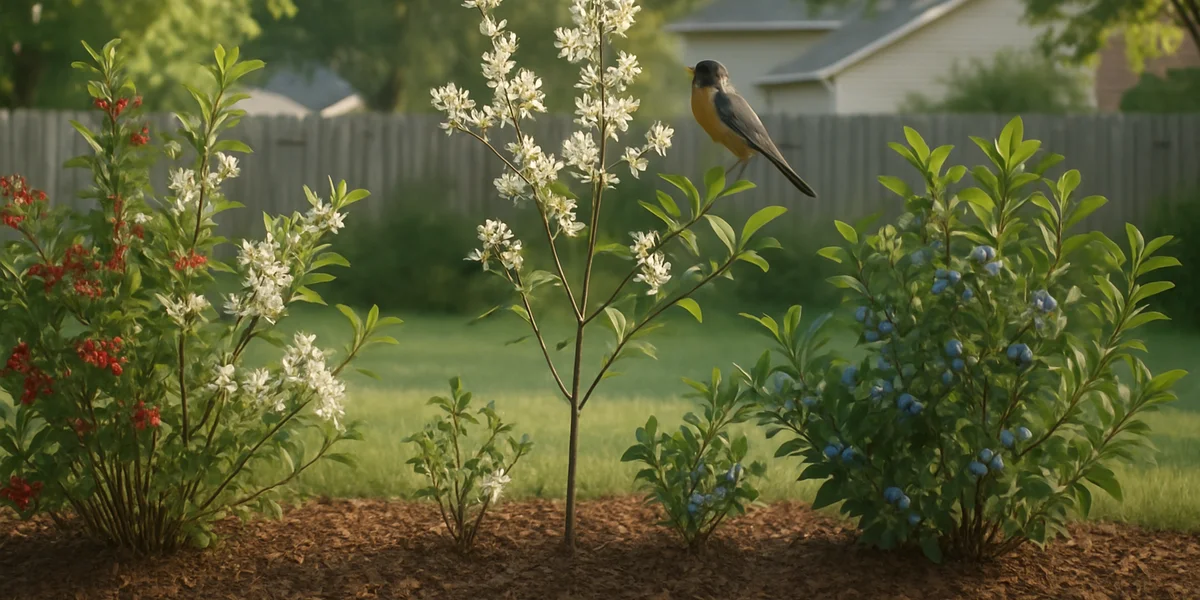
For the buckthorn spot (understory, 10 to 20 feet, partial shade tolerant): – Serviceberry Amelanchier canadensis or A. alnifolia. White spring flowers, blue-purple summer berries eaten by 40-plus bird species, good fall color. – American hawthorn Crataegus species. Dense branching, red persistent fruit that lasts into winter, excellent nesting cover. – Witch hazel Hamamelis virginiana. Late October to November bloom, feeds emerging insect pollinators other shrubs cannot. – American elderberry Sambucus canadensis. Fast-growing for a quick fill, July flowers for bees, purple-black berries for catbirds, thrashers, and waxwings.
For Japanese barberry or burning bush replacements (red fall color, 4 to 8 feet): – Red chokeberry Aronia arbutifolia, 5 to 10 feet, crimson fall leaves, red berries that hold through winter, deer-resistant. – Highbush blueberry Vaccinium corymbosum. Matures 5 to 8 feet, edible berries for you plus wildlife, scarlet fall color. – Red osier dogwood Cornus sericea. The red winter stem color that most gardeners think they need burning bush for, plus white flower clusters in spring. – Fragrant sumac Rhus aromatica. Low and spreading for slope erosion sites, clusters of red fuzzy fruits that hold into spring for returning robins.
For Japanese honeysuckle vine replacements: – Coral honeysuckle Lonicera sempervirens. Tubular red-orange flowers hummingbirds love, well-behaved twiner. – Virginia creeper Parthenocissus quinquefolia. Dense cover, brilliant red fall color, fruit for over 35 bird species.
A practical spacing note. Buy smaller stock than you think you need, 1-gallon plants establish faster than 5-gallon, cost a third as much, and catch up to the larger plants within three seasons. Cluster three of one species together rather than single-specimen dotting. Birds use patches, not scattered individuals.
If you are trying to stay on good terms with an HOA that only accepts tidier-looking plantings, our guide on curb appeal for native gardens that survive your HOA breaks down which of these replacements read as “intentional landscape” instead of “abandoned lot” from the street. Worth skimming before you plant anything visible from the sidewalk.
Companion Invasives Living in the Same Yard: Barberry, Honeysuckle, Burning Bush
Buckthorn rarely shows up alone. The same mid-century nursery trade that sold it also sold the other big five invasives, and they cluster in the same yards because the same landscape designers recommended the whole menu.
Japanese barberry (Berberis thunbergii). Prickly, compact, wildly invasive in Northeast and Midwest woodlots. Michigan Audubon notes it is a documented tick harborage. Dense barberry thickets hold higher blacklegged tick populations than native shrubbery does. Remove in early spring before fruit set, wear leather gloves, pull the whole root ball with a weed wrench. Bag all cuttings with any berries attached.
Bush honeysuckle (Lonicera maackii and Lonicera morrowii). The shrub honeysuckles, not the vine. Leafs out two weeks earlier than any native and drops leaves two weeks later, which is how it outcompetes understory wildflowers. Removal mirrors buckthorn: cut, cover the stump, monitor for resprouts. Berries are red and hold into winter. Birds eat them and spread the seed, same problem.
Burning bush (Euonymus alatus). Sold as “the fall color shrub.” Viable fruit drops in June, which is why LIISMA and other managers push for removal before the end of May each year. Cut low, cover the stump with black plastic, replant with red chokeberry or highbush blueberry for equivalent fall color that also feeds birds.
Autumn olive (Elaeagnus umbellata). Silvery leaf underside, huge red berry crops, favored by brown thrashers. Which is part of the problem. A single autumn olive can seed an entire fencerow. Cut and cover the stump, or for smaller plants, pull with a weed wrench. Replace with serviceberry or American plum.
Norway maple (Acer platanoides). Not a shrub, a canopy tree, but worth mentioning because it behaves like a shrub invader where it casts dense shade over what used to be your garden bed. Seedlings pull easily, but established trees need professional removal.
If you tackle all of these at once you will burn out. The order I recommend: tackle whichever is producing the most fruit this season first, because every year of unhindered fruiting adds to the seed bank. For most mixed yards in the upper Midwest, that ranking is buckthorn, then bush honeysuckle, then burning bush, then barberry. On the East Coast, barberry often outranks honeysuckle.
Realistic Questions We Get Before Anyone Starts a Removal Project
How long does it really take to be rid of buckthorn on a quarter-acre lot? Three full growing seasons for the initial adult population plus the first two seed bank cohorts. Year four and five you are mostly doing light maintenance. Maybe one Saturday per spring checking for stragglers. Smaller lots and properties with no nearby seed source (your neighbor’s hedge) finish faster. If your neighbor still has a mature hedge, plan on indefinite low-level maintenance, because their female plants will keep seeding your yard every fall.
Can I compost buckthorn brush? Stems and leaves, yes. They break down like any other woody material, and a brush pile in a corner of the lot provides winter songbird cover while it decays. Berries, no. Bag any branches with attached fruit and send them with curbside yard waste or municipal drop-off. Home compost piles do not reach the sustained heat needed to kill buckthorn seed.
What if I cannot afford a weed wrench? Many soil and water conservation districts lend weed wrenches free for the weekend. So do some county extension offices, Master Naturalist chapters, and land trusts. Call around before buying. If nothing is available, a 4-foot pry bar and a length of chain around the base will work on stems under about an inch. Slower, harder on your back, but workable.
Is there any case where herbicide is actually the right answer? Honest answer: yes. On properties larger than about an acre with mature trunks over 4 inches, or on a slope where pulling roots causes erosion, cut-stump treatment with triclopyr is the method most extension agents recommend. A chemical-free plan is realistic for a typical suburban lot. It becomes harder at acreage. If you go chemical, follow your state’s licensing rules, use a painter brush on the stump only (not broadcast spray), and never apply in windy conditions. None of that is a substitute for replanting afterwards. Removal without replacement is how you get a seed-bank explosion regardless of method.
Can I plant the natives the same season I cut the buckthorn? Yes, with one caveat. Give the cleared area 2 to 3 weeks after cutting before planting so you can see what new seedlings pop up and pull them. If you plant immediately, you shade your new plants with the first flush of buckthorn seedlings and the project gets confusing fast. A short breath between cut and plant makes the whole project easier to see.
Will removing buckthorn actually bring more birds back? Over a 3 to 5 year window, yes, and it is measurable. University ecologists studying buckthorn removal plots report measurable rebounds in understory nesting sparrows and warblers within three seasons once native shrub cover establishes. The gains are modest the first year, strong by year three. The patience pays off.
Closing Thought
Diane’s yard is deep into year three right now. The big hedge is gone. A row of serviceberry and two patches of highbush blueberry live where the buckthorn used to be. Last May she sent me a photo of a pair of gray catbirds nesting in the middle serviceberry. The first catbirds her property had produced in the eleven years she owned the place.
She still walks the yard twice a month in pulling gloves. She probably will for another year or two. But the shape of her weekends has changed. The project stopped being a battle and started being a habit, and when people ask her now what to do about their own inherited hedge, she tells them the thing she wishes someone had told her: it ends, just not on your schedule. Pick the tools, pick the weekend, pick the replacement plants. The yard you actually wanted shows up later. It does show up.
Additional authoritative resources:
For region-specific control details and legal status in your state, check the Minnesota DNR’s detailed buckthorn management page. The best single reference for chemical-free timing and tool choice. For pollinator-supportive replanting once the invasive canopy is down, the Xerces Society maintains a regional native plant list sorted by ecoregion. And to predict which bird species are likely to use your replanted shrubs within the first three seasons, the National Audubon Society’s native plants database is searchable by ZIP code.
Related reading
Want More Wildlife Garden Tips?
Join 5,000+ nature lovers getting our weekly tips on creating wildlife-friendly gardens.
No spam, unsubscribe anytime. Privacy Policy
Emma Harrington
Emma Harrington is a wildlife habitat researcher and content editor with a passion for backyard conservation. She has spent over a decade translating ecological science into practical tips anyone can follow — from selecting native plants to building wildlife-friendly habitats. Her work focuses on helping homeowners transform ordinary yards into thriving ecosystems for bees, butterflies, hummingbirds, and other beneficial wildlife.