
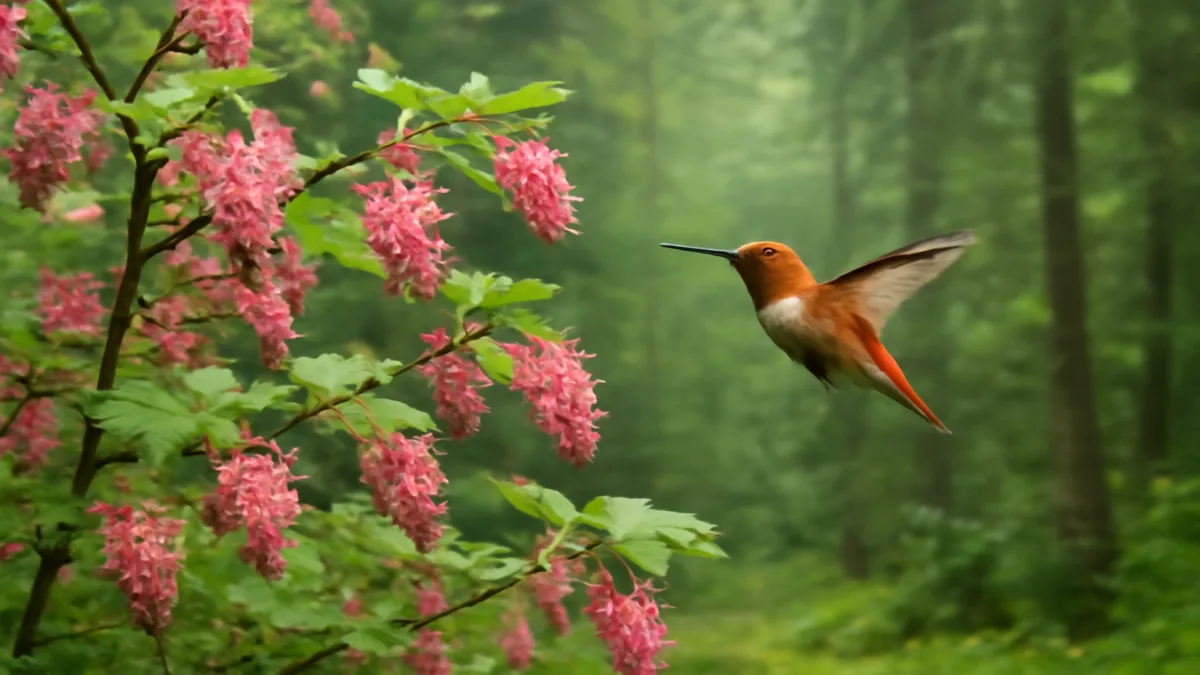
Choosing the right plants for hummingbirds is less about picking the prettiest flower at the garden center and more about understanding where you live, which hummingbird species pass through your yard, and how different layers of the landscape work together to feed and shelter these tiny travelers. A Ruby-throated Hummingbird in Ohio has very different needs from an Anna’s Hummingbird in coastal Oregon or a Black-chinned Hummingbird in the Sonoran Desert, and the plants that support them evolved alongside them over thousands of years.
If you’ve been gardening for a while, you already know that generic “hummingbird plant lists” tend to repeat the same dozen showy annuals, most of which struggle outside a narrow climate band. What actually works is a regional, layered approach. Trees for nesting, shrubs for cover and midseason nectar, vines for vertical foraging routes, and perennials at the front of the border for reliable blooms year after year.
This guide walks through five major U.S. regions and the native trees, shrubs, vines, and perennials that genuinely earn their keep. We’ll talk about bloom timing (critical for migration), plant height (critical for nesting), and how to stack species so your yard offers food from the first scout arriving in March through the last stragglers heading south in October.
FREE: Wildlife Garden Starter Guide
Get our 12-page PDF with the 25 best plants for pollinators, simple habitat tips, and a printable checklist — all 100% free.
No spam. Read our Privacy Policy.Why Region Matters More Than You Think
Hummingbirds are creatures of habit and instinct. They follow ancestral migration corridors, and the plants along those corridors bloom on a schedule that matches their arrival. When you plant a native that co-evolved with your local species, you’re plugging into that ancient calendar instead of fighting it.
There’s another reason region matters: nesting. A yard full of tubular flowers but no trees or shrubs is a restaurant, not a home. Female hummingbirds need small horizontal branches, usually 10 to 40 feet up, tucked into the understory where predators struggle to reach. That’s why this guide emphasizes trees, shrubs, and vines alongside the usual perennials.
“A hummingbird garden without woody plants is like a hotel with no rooms. Beautiful lobby, but nowhere to stay the night.” Think of trees and shrubs as the infrastructure, and flowers as the daily menu.
Before we dive into each region, here’s a quick snapshot of what species you’re likely hosting and which part of the landscape you should focus on first.
Regional Hummingbird and Plant Overview
| Region | Primary Hummingbird Species | USDA Zones | Signature Native Plant | Best Plant Layer to Prioritize |
|---|---|---|---|---|
| Midwest & North Central | Ruby-throated | 3–6 | Wild Columbine | Perennials + understory shrubs |
| Northeast | Ruby-throated | 4–8 | Trumpet Honeysuckle | Vines + perennials |
| Southeast & South Central | Ruby-throated (plus winter Rufous) | 6–9 | Red Buckeye | Trees + vines |
| Southwest & Desert | Black-chinned, Anna’s, Costa’s, Broad-tailed | 7–10 | Desert Willow | Drought-tolerant trees + shrubs |
| Northwest & Pacific Coast | Anna’s, Rufous, Calliope | 7–9 | Red-Flowering Currant | Early shrubs + vines |
Midwest & North Central: Plants for the Ruby-throated Corridor (Zones 3–6)
The Midwest is Ruby-throated country. These birds funnel up from the Gulf Coast in late April and early May, and they need plants blooming right when they arrive. Often while nighttime temperatures are still dipping below freezing. That’s why native perennials with evolutionary memory beat hothouse annuals every time.
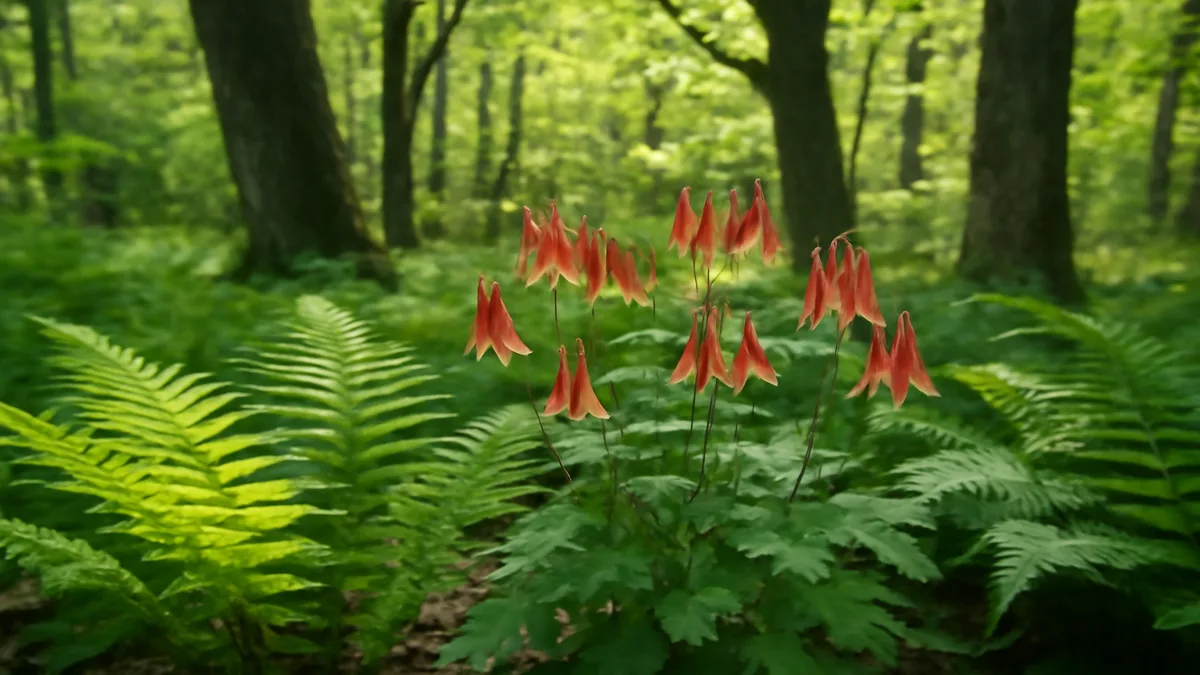
Wild Columbine (Aquilegia canadensis) is the first superstar. Its nodding red and yellow lanterns open in May, coinciding almost perfectly with Ruby-throated arrival. It tolerates part shade, reseeds gently, and thrives at woodland edges. Exactly where hummingbirds like to forage. Pair it with ferns and wild geraniums for a classic Midwestern spring combination.
Once summer kicks in, add Buttonbush (Cephalanthus occidentalis). This underused native shrub produces spherical, pincushion-like white flowers that smell faintly of honey and hum with pollinators. It loves wet feet, so if you have a low spot, rain garden, or pond edge, it’s perfect. Hummingbirds visit constantly, and the branches offer nesting cover.
For the late-summer and early-fall window. When juveniles are fattening up for their first migration, Great Blue Lobelia (Lobelia siphilitica) fills a critical gap. Its lavender-blue spikes bloom August through September in moist soil and are one of the few native perennials still producing nectar when most of the garden is winding down. If you want a full flower-focused companion piece, see our guide to the best flowers for hummingbirds.
Northeast: Layered Plantings for Forest-Edge Gardens (Zones 4–8)
Northeast gardeners have a secret weapon: the forest edge. Ruby-throated Hummingbirds love that transition zone between woodland and meadow, and you can recreate it on even a small lot by layering vines, perennials, and a few strategic shrubs.
Trumpet Honeysuckle (Lonicera sempervirens) is the vine to plant. Unlike its invasive Japanese cousin, this native behaves itself, blooms from May through October, and produces coral-red tubular flowers that hummingbirds cannot resist. Train it on a fence, arbor, or dead tree snag, and you’ll have activity all season.
Jewelweed (Impatiens capensis) is an overlooked annual that reseeds itself into moist shady corners. Its orange-yellow dangling flowers bloom from midsummer into fall. Right when juveniles are learning to feed. And it naturalizes into colonies that can feed dozens of birds a day. If you have a damp spot where nothing else grows, this is your answer.
Round out the Northeast palette with Butterfly Weed (Asclepias tuberosa). Yes, it’s famous for monarchs, but hummingbirds also work its bright orange clusters enthusiastically, especially on hot July afternoons when other nectar sources wilt. It’s drought-tolerant, deer-resistant, and lives for decades. For deeper reading on designing full pollinator habitats, the Audubon Native Plants Database lets you search by ZIP code.
Southeast & South Central: Trees and Vines for Subtropical Gardens
The Southeast has something most regions don’t: year-round hummingbird potential. Ruby-throated Hummingbirds nest here in huge numbers, and increasing reports show Rufous Hummingbirds overwintering as far east as Georgia and Florida. That means your plants need to work harder across more seasons.
Start with a Red Buckeye (Aesculus pavia). This small understory tree. Usually 15 to 25 feet at maturity. Produces foot-long panicles of red tubular flowers in April, perfectly timed for Ruby-throated arrival. It’s one of the single best trees you can plant for Southeastern hummingbirds and doubles as a beautiful specimen in dappled shade.
Crossvine (Bignonia capreolata) climbs 30 to 50 feet up trees, fences, or pergolas, exploding into red-and-yellow trumpet clusters in April. It’s evergreen in the Deep South, semi-evergreen further north, and provides both vertical foraging routes and nesting cover in a single plant.
For shady spots, Indian Pink (Spigelia marilandica) is unbeatable. Its upward-facing red tubes with yellow interiors look almost artificial, and they bloom May through July in the exact filtered-light conditions most Southeastern yards already have. Coastal gardeners should also consider Coralbean (Erythrina herbacea), a shrub-to-small-tree that produces striking red spike clusters and tolerates sandy, salty conditions where little else blooms.
Southwest & Desert: Drought-Tough Plants for Big Flight Paths
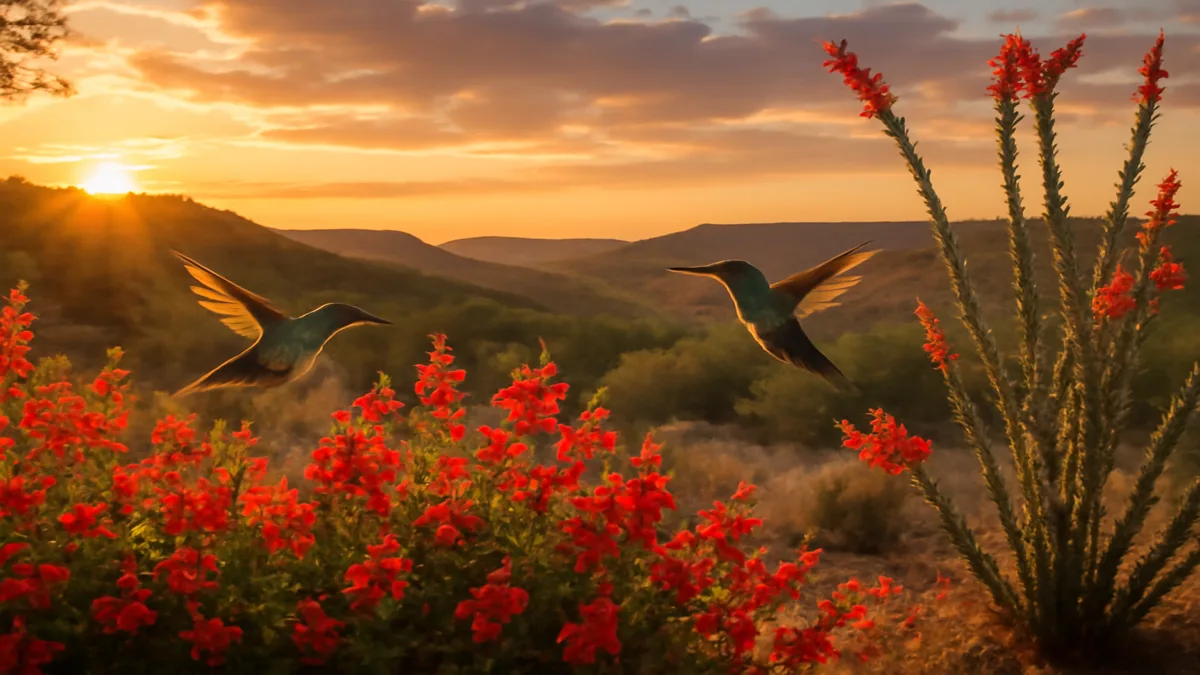
Desert hummingbirds are a different breed. Anna’s, Costa’s, Black-chinned, and Broad-tailed Hummingbirds navigate vast arid landscapes between sparse nectar sources, and they’ve evolved alongside plants that store water, bloom during monsoons, or flower on ancient internal schedules regardless of rain.
Desert Willow (Chilopsis linearis) is the anchor. Despite the name, it’s not a true willow. It’s in the trumpet-creeper family and produces orchid-like pink, purple, or white flowers from May through October. It grows 15 to 25 feet, tolerates drought once established, and is arguably the most important hummingbird tree in the Southwest.
Ocotillo (Fouquieria splendens) looks like a cluster of thorny walking sticks most of the year, but after spring rains it erupts into brilliant red flame-tips that stop migrating hummingbirds in their tracks. If you live in a true desert crossing zone (southern Arizona, New Mexico, West Texas), this plant supports the migration corridor itself.
For season-long coverage, layer in Autumn Sage (Salvia greggii). Which, despite the name, blooms red, pink, or purple from March through November. And Red Yucca (Hesperaloe parviflora), whose coral-red flower spikes rise four to five feet above drought-proof succulent rosettes. These two together form a hummingbird buffet on almost no water. Learn more about building a complete habitat in our pollinator garden design guide.
Northwest & Pacific Coast: Early Blooms for Rufous Migration (Zones 7–9)
The Pacific Northwest hosts one of the most dramatic migrations on the continent: Rufous Hummingbirds travel from southern Mexico to Alaska, passing through Oregon and Washington in late February and March. Earlier than almost any other species. If your garden isn’t blooming by early March, you’ve missed them.
Red-Flowering Currant (Ribes sanguineum) is the keystone plant. This six-to-ten-foot shrub produces pendant clusters of pink-to-red flowers in late February and March, exactly when Rufous scouts are pushing north. Native peoples and naturalists have long recognized this plant-bird relationship, and no Pacific Northwest garden is complete without one.
Orange Honeysuckle (Lonicera ciliosa) climbs 15 to 18 feet into trees and picks up where the currant leaves off, blooming from May into July with tubular orange flowers. It’s the West Coast cousin of Trumpet Honeysuckle and serves the same function. Vertical nectar highway plus nesting cover.
Finish with Sitka Columbine (Aquilegia formosa), the western relative of Wild Columbine. Its red-and-yellow nodding flowers bloom from late spring through summer, and it naturalizes beautifully under conifers, along stream banks, and in meadow edges. For research on Western hummingbird ecology, the Cornell Lab of Ornithology’s All About Birds is the definitive reference.
How to Layer Your Landscape (Not Just Fill a Flower Bed)
The single biggest mistake new hummingbird gardeners make is thinking flat. A true habitat works in vertical layers, each one providing something different. Here’s the sequence in the order you should build it:
- Canopy layer (20–40 ft): A native tree like Red Buckeye, Desert Willow, or a mature oak provides nesting branches and sheltered perches above the garden.
- Understory layer (6–15 ft): Shrubs such as Buttonbush, Red-Flowering Currant, or Coralbean offer secondary nest sites, cover from hawks, and midseason nectar.
- Vine layer (variable): Trumpet Honeysuckle, Crossvine, or Orange Honeysuckle stitch the canopy and understory together and extend foraging into vertical space.
- Perennial layer (1–4 ft): Columbine, Lobelia, Salvia, Jewelweed, and Indian Pink fill the accessible zone where most direct feeding happens.
- Ground layer (under 1 ft): Violets, wild strawberries, and other groundcovers support the insect populations hummingbirds depend on for protein. Yes, they eat tiny bugs, too.
When you plant across all five layers, your yard stops being a garden and starts being habitat. That’s the moment the birds start nesting, not just visiting.
Common Mistakes That Undo Good Plant Choices
Even the right plants can fail hummingbirds if the surrounding management is wrong. Watch out for these:
- Hybrid cultivars bred for color, not nectar. Many “improved” Salvia and Lobelia varieties produce little or no nectar despite flashy blooms.
- Neonicotinoid-treated nursery stock. Ask your supplier; treated plants can sicken hummingbirds and kill the insects they eat.
- Over-mulched beds with no bare soil. Hummingbirds gather cobwebs and fine plant fibers for nests, and sterile landscapes don’t produce them.
- Fall cleanup that strips every seedhead and stem. Leave standing perennials through winter; they host overwintering insects hummingbirds feed on in early spring.
- Monoculture plantings. Even 20 of the same plant can’t match the nutritional diversity of six different natives blooming in sequence.
For native plant sourcing and regional plant lists, the USDA Plants Database lets you verify whether a species is truly native to your county before you buy.
Fixing the 5 Most Common Hummingbird-Plant Issues
You don’t need to plant everything at once. In fact, you shouldn’t. Trees and shrubs establish better with focused attention, and you’ll learn more about your site by watching year one unfold. A reasonable sequence looks like: year one, plant your anchor tree and two foundational shrubs; year two, add vines and layer in perennials around the woody plants as they establish; year three, fill gaps based on what bloomed when, and add succession plants for any seasonal lulls you noticed.
Within three growing seasons, a small suburban yard can transform from a lawn with a feeder into genuine regional hummingbird habitat. The kind that produces nests, fledglings, and returning birds year after year. For more on the behavioral side of the equation, check our guide on how to attract hummingbirds beyond just planting.
Conclusion: Plant Where You Live
The best plants for hummingbirds aren’t the ones on a glossy seed-packet display. They’re the ones that were already thriving in your region long before your house was built. Native trees, shrubs, vines, and perennials, stacked in layers and chosen to bloom in sequence, outperform any generic “hummingbird mix” every single time.
Start small. Pick one signature plant from your region, get it in the ground this season, and build from there. By next spring you’ll notice more visits; by three years in, you’ll have nests.
Did this regional breakdown help you plan your garden? Share this article with another gardener who’s trying to move beyond feeders and toward real hummingbird habitat.
Solving the 5 Most Common Planting Problems
Even well-planned wildlife gardens run into predictable snags. The five issues below account for the majority of frustrated emails gardeners send to extension offices each year, along with the fixes that actually work. Try the simplest solution first and give any change at least two weeks before deciding it failed.
-
Problem 1: Birds ignore a newly installed feeder.
Solution: Most feeders take 2 to 6 weeks to be discovered. Move it within 10 feet of a shrub or small tree so birds have an escape perch, refill with fresh black oil sunflower seed (old seed goes rancid and smells wrong), and sprinkle a small handful on the ground below to signal a food source. Avoid hanging near reflective windows, which birds read as open sky. -
Problem 2: Squirrels empty the feeder within hours.
Solution: Install a weight-activated baffle or switch to a caged tube feeder sized for small songbirds only. Mount the feeder on a smooth metal pole at least 5 feet tall, 10 feet from any jumping platform, with a 15-inch stovepipe baffle below. Safflower seed and nyjer are naturally less attractive to squirrels than sunflower. -
Problem 3: Pollinator plants look healthy but attract no bees or butterflies.
Solution: Check whether the plants were pre-treated with neonicotinoid pesticides at the nursery; many big-box plants are, and the toxicity persists in pollen for months. Replace with plants labeled neonic-free or sourced from native nurseries. Also confirm you have at least three plants of the same species clustered together, since pollinators scan for color blocks, not single specimens. -
Problem 4: Birdbath water turns green or murky within days.
Solution: Scrub weekly with a stiff brush and a 1:9 vinegar solution, then rinse thoroughly. Keep water no deeper than 2 inches and place the bath in partial shade to slow algae growth. A small solar bubbler or dripper keeps water moving and cuts algae and mosquito larvae dramatically without electricity. -
Problem 5: Nest box stays empty season after season.
Solution: Confirm the entrance hole diameter matches your target species (1 1/8 inch for chickadees, 1 1/2 inch for bluebirds, 1 1/4 inch for house wrens). Mount 5 to 6 feet high on a pole with a predator baffle, facing east or southeast away from prevailing wind, with a clear flight path to the opening. Clean it out every fall after October 15.
If a fix does not resolve the issue after a full season, contact your state Cooperative Extension office or a local Audubon chapter. Both offer free identification and diagnostic help, and they track regional trends that national websites miss.
What I get asked the most
What is the single best plant for hummingbirds if I can only choose one?
It depends entirely on your region, which is exactly the point of this article. In the Midwest and Northeast, Trumpet Honeysuckle wins for its long bloom season and vertical habit. In the Southeast, a Red Buckeye tree outperforms everything else. In the Southwest, Desert Willow is unmatched. In the Pacific Northwest, Red-Flowering Currant is essential. Choose by region, not by popularity lists.
Do I need to plant trees and shrubs, or are flowers enough?
Flowers alone will attract visiting hummingbirds, but they won’t support nesting or migration stopover. Trees and shrubs provide nest sites, shelter from predators and weather, insect habitat for protein, and midseason nectar. If you want hummingbirds to live in your yard rather than pass through, woody plants are not optional. They’re the foundation that flowers decorate.
How long does it take for a new hummingbird garden to attract birds?
Most gardeners see a noticeable increase within the first season if they plant several species native to their region. Nesting behavior typically takes two to three years, as shrubs and small trees need time to develop the branch structure and cover females require. Early blooming species like Red-Flowering Currant or Wild Columbine accelerate results dramatically in year one.
Can I grow hummingbird plants in containers on a balcony or patio?
Absolutely. Autumn Sage, Red Yucca, Columbine, and compact Salvia cultivars all thrive in large containers. You won’t provide nesting habitat, but you will create valuable nectar stops, especially in urban areas where natural plants are scarce. Use pots at least 16 inches wide, choose native species when possible, and avoid any plant treated with systemic insecticides.
Are hybrid nursery plants as good as native species for hummingbirds?
Usually not. Many hybrids are bred for bloom size, color, or plant habit at the expense of nectar production, and some produce no nectar at all. Sterile or double-flowered cultivars are particularly poor choices. When possible, buy straight species natives from specialty native plant nurseries. They’ve co-evolved with local hummingbirds and deliver the nutrition those birds actually need.
Want More Wildlife Garden Tips?
Join 5,000+ nature lovers getting our weekly tips on creating wildlife-friendly gardens.
No spam, unsubscribe anytime. Privacy Policy
Emma Harrington
Emma Harrington is a wildlife habitat researcher and content editor with a passion for backyard conservation. She has spent over a decade translating ecological science into practical tips anyone can follow — from selecting native plants to building wildlife-friendly habitats. Her work focuses on helping homeowners transform ordinary yards into thriving ecosystems for bees, butterflies, hummingbirds, and other beneficial wildlife.