Three summers into ripping out lawn and replacing it with little bluestem, wild bergamot, and a pond-edge rush garden, Sarah posted a photo of her backyard to a local neighborhood Facebook group. The caption was simple: “Pollinator count this morning: 11 species.” Within six hours, she had 47 comments. Not from the HOA board members who had sent her two letters about “unkempt vegetation,” but from neighbors she had never met, asking what she was growing and where they could buy seeds.
That photo didn’t just earn likes. It changed the conversation in her neighborhood permanently.
The hardest part of rebuilding a yard as a wildlife habitat isn’t the physical labor. Though anyone who has spent a Saturday with a mattock knows that part is real. The hardest part is the invisibility of the work. You can see exactly what you’ve done. You can count the monarch caterpillars on the milkweed, track the year the goldfinches discovered the coneflowers, remember the morning a fox crossed the yard at 6 a.m. Your neighbors see a patchy lawn and some tall weeds. Your HOA sees a violation.
FREE: Wildlife Garden Starter Guide
Get our 12-page PDF with the 25 best plants for pollinators, simple habitat tips, and a printable checklist — all 100% free.
No spam. Read our Privacy Policy.The gap between what you know and what everyone else sees is a documentation problem. And it has a very practical fix.
The invisible harvest no one sees when they glance over your fence
A conventional lawn communicates one thing instantly: someone cut it recently. It signals effort, maintenance, intentionality. The HOA understands it at a glance.
A native garden communicates almost nothing at that same glance. Especially in its first two or three years, when native perennials are busy building root systems underground instead of putting on a show. The yard that looks “abandoned” in April is running a complex ecological operation that won’t fully surface until June. The “mess” in October is a seed bank for 17 species of overwintering insects. None of that is visible without context.
A gardener I know from the local Wild Ones chapter shared a story about her recent project. After six weeks of hard work planting 200 native plugs, her neighbor offered to help her clean up. All her neighbor saw was an empty lot.
This is the fundamental challenge of native gardening in a neighborhood setting: you are building something that operates on a timeline and a logic that most people can’t see. Documentation is the tool that makes the invisible visible. It gives the work a voice. And it earns you the recognition. From neighbors, from community, and sometimes from yourself. That three years of labor genuinely deserves.
Why a phone photo taken in your yard today is the single most powerful tool you have
You don’t need a professional camera. You don’t need a landscaping portfolio. What you need, right now, is a photo of your yard in its current state. Whatever that state is.
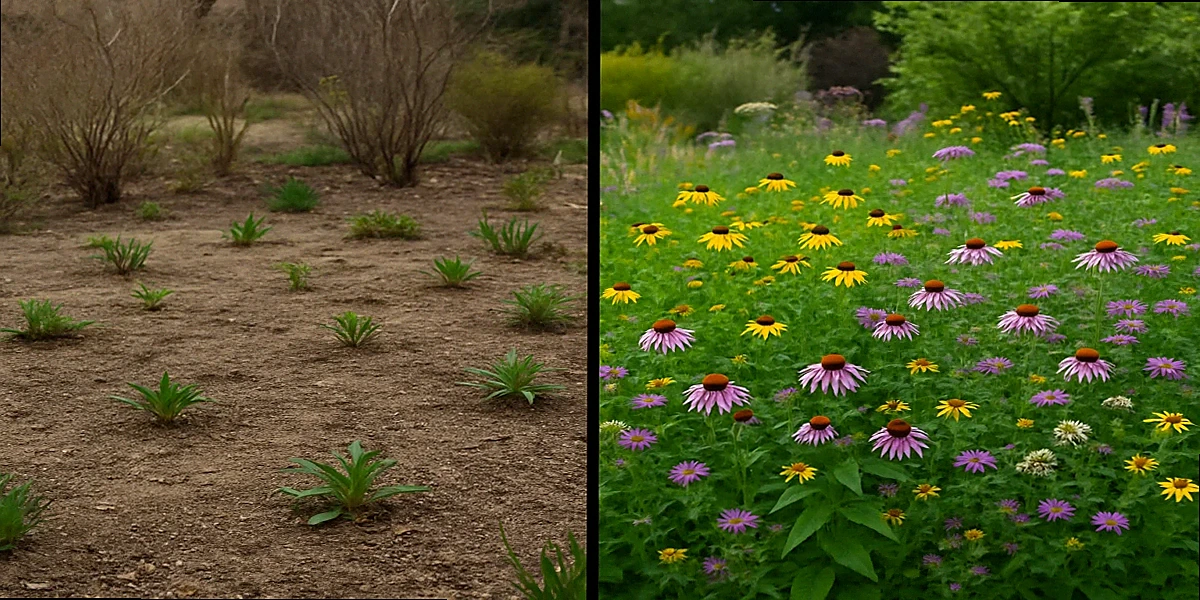
Here’s why the image you take today has disproportionate value: it is a record of a moment your future self cannot recreate. Native gardens change faster than most gardeners expect. A yard that is patchy and uncertain in April can be a full-canopy insect refuge by August. The transformation is dramatic. But you can only show it as a transformation if you have the “before.”
A native garden without documented progress is like a story with no beginning. The ending impresses no one because there’s no contrast to measure it against.
The photo system that works best for native gardeners is not complicated. It does not require apps, subscriptions, or photo editing skills. It requires three things: consistency, a fixed vantage point, and a season-aware eye for what actually matters to capture.
Practical rule: pick two spots in your yard. One from the street-facing view, one from an interior vantage point. And photograph both from the exact same position every month. Same spot. Same angle. Set a recurring monthly calendar reminder if that’s what it takes. That’s the whole system. Everything else is an add-on.
The four-season photo loop that turns a “messy yard” into an undeniable record
Native gardens are cyclical, and each season shows a different kind of evidence. A photo taken in March tells a story about structure and seed survival. A photo taken in July shows bloom density and pollinator activity. A photo taken in November shows ecological intention. The standing stems and seed heads that look like “neglect” to outsiders are in fact prime insect habitat, and a photo with a caption can make that legible.
Spring (March–April): Capture emergence. Native perennials break dormancy before most non-native plants, so early spring is when your yard looks most alive while neighbors’ lawns are still brown. Photograph the first green growth, any bulb-season interest, and any overwintering caterpillars you find in leaf litter. Spring is also when HOA letters tend to arrive. A photo of emerging wildflowers taken the day of an HOA letter is useful documentation.
Summer (June–August): Capture density, bloom, and wildlife. Summer is your strongest visual season. Photograph pollinator activity. Even a phone camera can capture a bee in flight if you’re patient. Get a shot of multiple species on one plant. Get the full-canopy view that shows the yard at its most intentional.
Fall (September–October): Capture the ecosystem in action. Birds foraging in seed heads, spiders in webs between goldenrod stems, the color of native grasses in their peak. This is also the season when you will be most tempted to “clean up”. The photos you take before any fall cleanup become the record of what you were intentionally leaving.
Winter (November–February): Capture structure. The silhouettes of cone stalks, the snow-covered seed heads of black-eyed Susan and coneflower, the bark of any native shrubs. Winter photography is your strongest argument against HOA complaints about “dead material”. A photograph of a field sparrow feeding on coneflower seeds in February is not an image of neglect.
What to photograph in each season: the 10 specific shots your future self will thank you for
Beyond the monthly overview shot, these are the specific images that become the most useful over time. For sharing, for HOA conversations, and for your own record of what you’ve built.
- Your wide-view shots from the street. At least twice a year: early spring and peak bloom. These are the images that document the yard as others see it.
- Close-up of your first bloom of each species. The first aster flower of September, the first fleabane of May. Over years, this becomes a phenology record. You’ll see your bloom window shift.
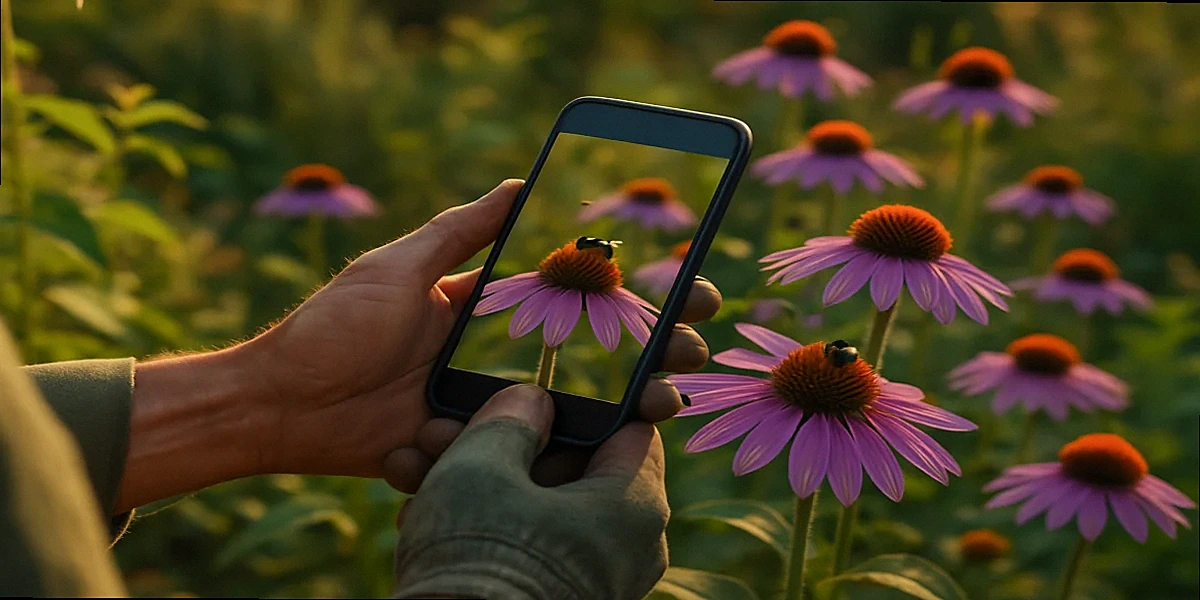
- Pollinator activity shots. Set your phone to burst mode and hold it near a flower for 30 seconds. You’ll get at least one usable shot. Even blurry bee photos confirm activity.
- Before-and-after of any new planting or removal. Before you plant anything or remove anything, take a photo. The habit takes 30 seconds and becomes invaluable.
- Wildlife encounters. Birds, toads, fireflies, monarch caterpillars, box turtles. These are the images that resonate most with neighbors and community.
- Soil and mulch shots. Showing your soil biology. Earthworms when you’re planting, good soil structure. Documents the underground ecology most people never think about.
- Water features with wildlife. If you have a birdbath, small pond, or rain garden, capture wildlife using it. A robin bathing or a dragonfly perching is an immediately legible image of ecological function.
- Root shots. When you transplant or divide, photograph the root system of your native plants. A little bluestem root ball at three years is strikingly deep.
- Scale reference shots. Put your hand, a boot, or a garden fork next to something to show scale. A coneflower taller than your hip communicates size in a way a standalone photo doesn’t.
- Your presence in the yard. One photo of you working, planting, or observing per season. In a year or two, these photos tell the story of someone who chose to do this work.
Where to share your native garden photos with people who actually understand what you built
The feedback loop from neighbors can be slow, unpredictable, and sometimes hostile. At least at first. Before that loop works, you need a community that already understands what native habitat gardening looks like and why it matters.
iNaturalist (inaturalist.org) is not just an ID app. Every observation you log with a photo becomes part of a searchable biodiversity record tied to your location. The app turns your backyard into a credentialed ecological record, not just a pretty photo album.
I’ve noticed that many people interested in native plants have a strong community. If you share a photo of your garden after four years, you can be confident that it won’t receive any comments suggesting you should mow your lawn.
Garden for Wildlife on Facebook (run by the National Wildlife Federation) connects over 100,000 habitat gardeners using the hashtag #GardenforWildlife to aggregate images from certified and uncertified habitat gardens across North America.
Homegrown National Park (homegrownnationalpark.org) runs a biodiversity map where you can log your property and its ecological impact. The map now includes over 170,000 acres of logged habitat. Your property’s entry becomes a public record of your participation in a continental restoration effort.
For a deeper dive into making your yard officially certifiable, read How to Get Your Backyard Certified as a Wildlife Habitat (NWF Guide). It walks through the NWF application process and what the sign in your yard actually does in your neighborhood context.
The visual packet that turns HOA disputes into a 15-minute conversation instead of a war
If you have received. Or expect to receive. An HOA notice about your native yard, documentation is your most effective tool. Not arguments. Not quoting state right-to-garden statutes. Not escalation. Documentation.
Here is what a one-page visual packet looks like, assembled from the photos you are already taking:
Page 1: Three photos in a row. Spring, summer, fall. Of the same corner of your yard. Underneath, one sentence: “This is the same corner photographed over three seasons. The plants are native perennials; the material left in fall is intact insect habitat.”
Page 2: Two wildlife photos with labels. A photo of a bee species visiting a native flower. A photo of a bird foraging in your seed heads. Underneath: “These were photographed in my yard in [month/year].”
Page 3: One authoritative source. Print a single paragraph from the National Wildlife Federation, the Xerces Society, or your state’s native plant society that describes the ecological function of the plants you’re growing. A printed page with a URL is more legible to an HOA board than a hyperlink.
A volunteer naturalist commented to me about the proactive steps she took, which included photographing 200 neighboring yards to demonstrate that non-manicured landscapes were a common sight in the area, thereby aligning her yard with community standards.
For a complementary approach to making your native yard pass the visual test that most HOA boards use, see Curb Appeal for Native Gardens: 5 Design Patterns That Survive Your HOA.
Using the NWF Garden for Wildlife Photo Contest to get your work formally recognized in 2026
The National Wildlife Federation’s Garden for Wildlife Photo Contest opens for submissions in August 2026. It accepts photos from any size habitat. Backyard, balcony, community greenspace. And the categories are designed around the kind of images that native gardeners are already taking: pollinators, wildlife, garden habitat, and habitat gardens during different seasons.
Entering this contest does several things that pure social sharing does not. It gives your photos a formal audience. It gives your garden a context. That it is part of a recognized movement with scientific and institutional backing. And if your photo places, it gives you a shareable credential that carries weight well beyond your neighborhood.
More immediately: submitting observations to iNaturalist throughout the spring and summer builds the species-count data that, by August, makes for a compelling contest entry. Start the observation habit now if you haven’t already.
What changes the morning a stranger stops in front of your yard and asks what you planted
It will happen. It may take two years. It may take four. But at some point. Usually on a high-bloom day in July, or a cold morning in November when your yard is the only one with birds in it. Someone will stop.
They might be a neighbor you’ve never spoken to. They might be a delivery driver. They might be another native gardener who recognized what they were looking at from the street. They will ask what you planted, or why your yard looks different, or whether the butterflies are always this active.
That moment is earned. The documentation you’ve been building is what makes you ready for that conversation. You can pull out your phone and show the “before” photo from three years ago. You can show the species list from iNaturalist. You can show the bloom calendar, the pollinator count, the monarch caterpillar you found on the swamp milkweed.
The documentation doesn’t just create a record. It creates a vocabulary for explaining what you’ve done in the 90 seconds that someone who doesn’t already speak your language will actually absorb.
A fellow Master Naturalist once captured a common sentiment among us gardeners. The pride of removing invasive plants is akin to how people pose with their catches after fishing. That pride reflects the hard work, and sharing our efforts helps others understand what we do.
Frequently asked questions about documenting your native garden
What app should I use to document wildlife and plant sightings?
iNaturalist is the strongest choice because it does double duty: ID assistance AND building a shareable, searchable biodiversity record tied to your location. Seek (by iNaturalist) is the faster camera-based ID version. PlantNet is useful for plant identification specifically. For birds, eBird integrates with a broader birding community. Any of these works. The key is consistency, not picking the perfect app.
Does keeping a photo record actually help in HOA disputes?
In most cases, yes. Particularly when the dispute is about “maintenance” rather than outright rule violations. HOA boards are not courts. They respond to optics and social pressure. A well-organized photo record of seasonal changes, wildlife activity, and intentional design choices reframes your yard from “neglected” to “managed for a different purpose.” New HOA rule changes in 2026 in several states have explicitly carved out protections for certified wildlife habitats, so documentation strengthens your position under those emerging statutes as well.
How do I find local native plant communities to share my progress with?
Organizations focused on native plants, like Wild Ones, have various chapters throughout the United States that frequently organize plant sales and garden tours. Many of these groups have embraced social sharing to document their activities, making for a great way to connect locally.
When is the best light to photograph a native garden?
The hour after sunrise and the hour before sunset (golden hour) produce the softest, most flattering light for garden photography. Midday sun creates harsh shadows and washes out flower color. Overcast days are surprisingly good for close-up shots of pollinators and plant detail because the diffuse light reduces glare. If you’re photographing birds, the magic hour light also tends to coincide with peak bird activity.
Can I enter the NWF photo contest if my garden isn’t certified yet?
Yes. The NWF Garden for Wildlife Photo Contest accepts photos from any habitat garden, certified or not. Certification through NWF’s Certified Wildlife Habitat program is a separate process. You can learn more in How to Get Your Backyard Certified as a Wildlife Habitat (NWF Guide). The photo contest and the certification program are both worth pursuing, but neither is a prerequisite for the other.
Your yard is already a record. You just haven’t started keeping it.
The work you’ve done. The weekends removing buckthorn, the careful sourcing of locally-genotyped natives, the decision to leave the seed heads standing through January. Is already a story worth telling. The gap isn’t in what you’ve done. It’s in what you’ve captured.
Start with your phone. Take a photo from the street and from the back corner of your yard this week. Label the file with the date. Do it again in four weeks. That’s the whole beginning.
In a year, you will have the most useful conversation-starter, HOA-silencer, and community-builder you have ever owned. And eventually, on a morning you can’t predict, someone will stop at your fence and ask. You’ll be ready.
Also see: How to Verify a Plant Is Truly Native to Your County. For building confidence that what you’re documenting is genuinely native. External resource: National Wildlife Federation, Garden for Wildlife.
Want More Wildlife Garden Tips?
Join 5,000+ nature lovers getting our weekly tips on creating wildlife-friendly gardens.
No spam, unsubscribe anytime. Privacy Policy
Emma Harrington
Emma Harrington is a wildlife habitat researcher and content editor with a passion for backyard conservation. She has spent over a decade translating ecological science into practical tips anyone can follow — from selecting native plants to building wildlife-friendly habitats. Her work focuses on helping homeowners transform ordinary yards into thriving ecosystems for bees, butterflies, hummingbirds, and other beneficial wildlife.