Have you ever stood in a garden center with a handful of seed packets, wondering which ones actually belong together. Or whether any of them are truly native to where you live? If so, you are in very good company. It’s one of the quietest struggles in the whole native plant world, and it catches nearly every beginner off guard.
This guide walks through five tested native plant combinations. One for each USDA zone from 5b to 9, plus a container version that works anywhere. That real gardeners have planted together and watched work over a full growing season. You’ll find exact species lists, a few spacing tips that are easy to get wrong, and some honest notes on what to expect in year one. Every recipe is small enough to start in a single weekend.
You don’t need a landscaping degree, and you don’t have to “design” anything. You just need a recipe that matches your zone, a patch of ground the right size, and a little patience while the soil slowly remembers what used to grow there.
FREE: Wildlife Garden Starter Guide
Get our 12-page PDF with the 25 best plants for pollinators, simple habitat tips, and a printable checklist — all 100% free.
No spam. Read our Privacy Policy.Why a native plant garden stalls in year one
One thing that frequently comes up among new native gardeners is a sentiment echoed by many experienced individuals: there’s often a steep learning curve that can be daunting, but it’s essential to persist and learn from those challenges.
“So often people are trying to enter the native plant world and the advice we give them is too dang complicated and expensive. They want ‘throw some seeds and see’ and we give them ‘invest in a water garden, research your keystone species, butterfly milkweed but not tropical butterfly milkweed.’ I wonder how many people get burnt out before they even get started.”
Most native plant guides are written by gardeners who are already fifteen years in. They have forgotten what it felt like to stand in the aisle holding three milkweed species and not knowing which one belonged in their yard. That gap between beginner and expert is where the native plant garden usually stalls.
There’s another quieter reason. Natives, unlike ornamentals, are not designed to look good on day one. A plant that evolved for a prairie spends its first season putting energy into its roots, and the above-ground part often looks modest or even sparse. A new gardener, expecting the full-color display of a nursery ornamental, assumes they did something wrong. They didn’t. The plant is doing exactly what a native plant does in year one.
A recipe. A pre-tested combination of species. Helps you bypass most of the early trouble. Someone else already killed plants to figure it out. You get to start from their result.
How native plants actually grow (communities, not solo specimens)
There’s an important piece of biology most articles skip. Native plants do not grow alone. In a real prairie, meadow, or woodland, you never see one coneflower standing in a wood-chip moat. You see coneflowers woven in with little bluestem, black-eyed Susan, and aster. All of them leaning on one another.
A community of seasoned native gardeners put it simply:
“With native gardening, they should be planted tightly together, with the little space remaining between planted with a native groundcover. The plants use each other for support.”
That single idea is what most “pollinator seed mix” packages at big-box stores get wrong. They sell you a flat collection of species without any sense of how those species are supposed to share the same soil. When each plant is expected to stand on its own. Widely spaced, surrounded by mulch. It has to fight weeds, bake in direct sun, and develop root structures without neighbors to lend support. A lot of them simply don’t make it.
A recipe, as I’m using the word here, is the opposite approach. It’s a small, pre-tested group of species that naturally grow together in the wild. When you plant them closely. Closer than the tag on each plug suggests. They behave the way they were meant to, rather than as isolated ornamentals.
Five native plant garden recipes by USDA zone
Each of the five recipes below comes from gardeners who shared exactly what they planted and what happened after. They’re organized by climate and setting so you can pick the one that matches your yard.
Recipe 1, The sidewalk “hellstrip” (Zone 5b)
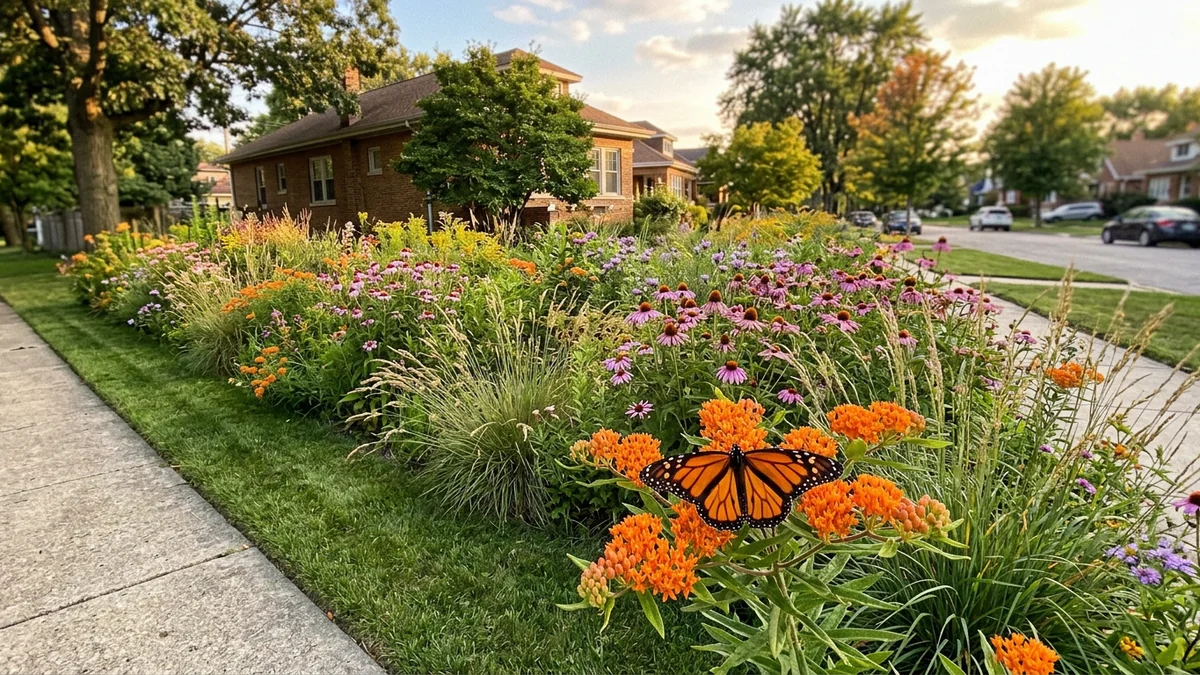
The narrow band of grass between the sidewalk and the street is the most hated patch of lawn in America. It’s too small for mowers, too hot in summer, and almost always the first piece of the yard any neighbor notices. With the right mix of plants, it also happens to be one of the most interesting places to put native species.
The plant list below was planted on a 40-square-foot strip in Central Iowa and tracked over three seasons:
- Whorled milkweed (Asclepias verticillata)
- Black-eyed Susan (Rudbeckia hirta)
- Little bluestem (Schizachyrium scoparium)
- Sky blue aster (Symphyotrichum oolentangiense)
- Butterfly milkweed (Asclepias tuberosa)
- American ipecac (Gillenia trifoliata)
- Prairie ragwort (Packera plattensis)
- Vanilla sweet grass (Anthoxanthum nitens)
The gardener explained the design choices this way:
“The 1-ft buffer on each side prevents most plants from flopping into the sidewalk and road, and keeping plants below 4 ft helps prevent flopping over too much.”
The species were chosen for two jobs. Staying under four feet so they wouldn’t fall into the sidewalk, and holding their own against the Bermuda grass that always tries to creep in at the edges. Little bluestem holds the soil. The two milkweeds feed monarchs. The asters bloom late in the season, filling the gap when everything else is fading.
Recipe 2, A shade garden under deciduous trees (Zone 7b)
If there’s a patch under a maple or oak where you keep killing hostas, the reason is usually timing, not soil. Spring ephemerals. Native woodland plants. Bloom before the tree canopy leafs out, then die back completely by early summer. Later-season shade perennials take over the space.
The following combination was tested in a zone 7b garden in New Jersey:
Early spring (March–April):
- Rue anemone (Thalictrum thalictroides)
- Dutchman’s breeches (Dicentra cucullaria)
- Virginia bluebells (Mertensia virginica)
- Woodland poppy (Stylophorum diphyllum)
- Bloodroot (Sanguinaria canadensis)
- Trilliums (Trillium grandiflorum, Trillium erectum)
Late spring into summer (May–August):
- Wild geranium (Geranium maculatum)
- Native Solomon’s seal (Polygonatum biflorum)
- Common blue violet (Viola sororia)
- Jacob’s ladder (Polemonium reptans)
A gardener described how the relay of species works:
“You can stagger this garden with some spring ephemerals, so that those are the first to pop. Then in early and late summer when they die, these summer plants here will be taking center stage.”
The trick is to plant the ephemerals among the summer plants rather than in separate beds. When bluebells and trilliums finish their bloom and disappear into the soil, the wild geraniums and violets covering the ground hide the fact that the ephemerals were ever there.
Recipe 3, The beginner pocket prairie (Zone 7a)
For anyone planting natives for the first time, this is the one I’d recommend. It’s a full-sun mini-meadow with a long bloom succession, no fussy ephemerals, and a structural backbone that holds together visually.
A zone 7a garden of about 200 square feet was planted with the following over three years:
- Butterfly weed (Asclepias tuberosa). Orange blooms, June–August
- Wild blue phlox (Phlox divaricata), April–May
- Blue wild indigo (Baptisia australis), May–June, provides structure
- Helianthus ‘First Light’. Dwarf sunflower, August–October
- Lanceleaf coreopsis (Coreopsis lanceolata), May–July
- Rough blazing star (Liatris aspera). Late summer, monarch magnet
- Autumn sage (Salvia greggii). All season, hummingbird-friendly
- Threadleaf agastache (Agastache rupestris), July–October
- Purple coneflower (Echinacea purpurea), June–September
After a few seasons, the gardener noted:
“Nothing here gets totally out of hand. Over the years as the seeds fall and new plants begin to emerge, just remove or gift the extra that pop up that you don’t want.”
The recipe has three features that beginners benefit from most: a long bloom succession so the garden is never bare, a structural backbone (the baptisia and echinacea don’t move year-to-year), and moderate self-seeders that fill gaps without taking over. If you only try one of these recipes, I’d suggest this one.
Recipe 4, The Rocky Mountain dry setup (Zone 6, arid)
For anyone in Colorado, Utah, New Mexico, or similar dry climates: forget the advice to “water generously.” Your plants shouldn’t need it once they’re established.
A Rocky Mountain foothills garden was built from the following xeric species:
- Fringed sage (Artemisia frigida)
- Dotted blazing star (Liatris punctata)
- Whole-leaf paintbrush (Castilleja integra)
- Nodding onion (Allium cernuum)
- Missouri goldenrod (Solidago missouriensis)
The gardener’s thinking, in their own words:
“My ‘starting patch’ is based off of what I see hiking. The small amount of space my surprisingly well-behaved goldenrod takes up is no big deal, and I really enjoy petting the leaves.”
It’s the smallest recipe on this list on purpose. Dry climates favor less density, more space between plants, and deep-taproot species like liatris, which can reach water that shallow-rooted plants can’t. One thing worth noting: paintbrushes are hemiparasitic. They quietly attach to the roots of nearby grasses or other plants, which means they need to be planted alongside a bunch grass or established perennial, not alone.
Recipe 5, The potted perennial trio (any zone)
This one’s for the renters, the apartment dwellers with small balconies, or anyone who simply doesn’t have a patch of ground to work with. The whole recipe fits into a single sixteen-inch pot.
- Autumn sage (Salvia greggii). Drought-tolerant, hummingbird-approved
- Purple coneflower (Echinacea purpurea). Bloom through first frost
- Autumn Joy sedum (Hylotelephium ‘Herbstfreude’). Structural all season
A friend at the local Wild Ones chapter articulated this idea well:
“I’ve done all three of those in containers but it never occurred to me to combine them all into one. Now I definitely am.”
The salvia and sedum hate overwatering. The coneflower tolerates it. Planted together, you’ve essentially calibrated the pot for benign neglect. Which is what happens to every container by mid-August anyway. In cold zones, this is also the only recipe you can safely overwinter by bringing the pot into an unheated garage.
Three mistakes that quietly sabotage a native plant bed
The good news is that most native plant failures follow one of three patterns, and each is easy to avoid once you know it’s there.
Planting too far apart. Every nursery tag says “space 24 inches apart.” For natives, that’s too much. A veteran gardener summarized the lesson:
“The spacing recommendations don’t really apply if you want to crowd out weeds. The stronger specimens may crowd out the weaker ones, but it’s not really a loss if they’ve done their job.”
A workable rule is to space native plugs at 60–70% of the tag distance. For seeds, sow more heavily than feels right. The plants will compete and the toughest ones will settle in.
Sowing seeds over cardboard that hasn’t decomposed. Sheet mulching. Laying cardboard over grass and covering with soil. Is a fine way to remove lawn. But it’s slow:
“The cardboard hasn’t had nearly enough time to break down to the point the roots can grow through it. That will take months, not weeks.”
Lay cardboard in the fall and plant the following spring. If you need to plant the same year, use a sod cutter instead.
Buying “wildflower” mixes from unvetted sources. This is the most common source of disappointment among new native gardeners. From the review pool:
“The description says annual and perennial flowers. NONE of mine came back.”
Some generic “native wildflower” mixes include non-native or even actively invasive species as fillers. Single-species packets from specialty native nurseries are a much safer path, especially for beginners.
How to check a plant’s native status for your exact county
The five recipes above cover zones 5b through 9, which is useful as a starting frame. But zones are a coarse tool. A plant can be native in one county of a given zone and non-native (or even invasive) in another.
A tool most beginners never find is BONAP, the Biota of North America Program. Its county query page generates a list of species genuinely native to the exact county you live in:
“How to use BONAP’s Query Page to generate your own county-specific native plant shopping list.”
The interface was built sometime around 1998 and looks it. But the data is the most accurate freely available reference, and it’s free. It’s worth spending fifteen minutes cross-checking the species in your chosen recipe against your county’s list before you order anything.
When you’re in the garden and see a plant you don’t recognize, the free iNaturalist app will identify it from a photo. The native gardening community uses it as a daily tool:
“Who is this little flyer with the holographic green eyes? iNaturalist.org will help. It’s FREE!”
Where native gardeners source their plugs and seeds
The biggest difference between a native garden that thrives and one that struggles is almost always where the plants came from.
Specialty native nurseries are the first choice of nearly every experienced native gardener. A few that come up often:
| Nursery | Why it’s recommended |
|---|---|
| Prairie Moon Nursery | Large Midwest selection, bulk plug discounts, detailed germination info per species |
| Midwest Natives | Similar stock to Prairie Moon, good for variety |
| Roundstone Native Seed Co | Native seeds sold by the pound, excellent for large areas |
| Izel Native Plants | Aggregator of regional nurseries, ships nationwide |
One native gardener who converted a 1,500-square-foot area shared:
“Most came from Midwest Natives or Prairie Moon in bulk. We did it over a few years and I dared not keep exact accounting, but I’d bet about $5k.”
That sounds like a lot, and it is. But that figure is spread across three growing seasons and more than 1,500 square feet, at an average of about $2 to $3 per plug. Smaller projects cost much less.
Big-box garden centers sometimes stock plants labeled as native, but it’s worth knowing that many of those plants have been treated with neonicotinoid pesticides, which can persist in the plant tissue for months and affect the pollinators you’re trying to attract. From the community:
“Never buy Asclepias from big box. Buy from local nurseries that grow organically.”
If a specialty nursery isn’t accessible, it’s reasonable to ask your local garden center whether their native plants are neonicotinoid-free. Some know the answer; many don’t.
What to expect in the first year (and why some plants will die)
Here’s the part most native plant articles leave out. In year one, some of your plants will die. That’s not failure. It’s normal.
A long-time native gardener described it well:
“Native gardens are a continually evolving journey. I no longer coddle plants, fence them, etc. The native garden is first and foremost for nature. And nature is in a constant state of change. Enjoy the journey, and remember to extend your love and gratitude to your plants in the moment.”
Some species will thrive. Others will quietly fade. A deer will almost certainly eat one of your favorites. An aggressive milkweed may spread further than you planned. None of that is failure. It’s the garden sorting itself out, choosing what grows best in your exact soil, light, and drainage.
The best response to this is to pay attention to what survives, and in year two, plant more of that. The recipe is a starting point. Your specific yard decides the rest.
A note on neighborhood reactions: native gardens sometimes read as “unkempt” to neighbors who are used to lawns. A clean mowed edge of a foot or two between your planting and any sidewalk goes a long way toward making the bed feel intentional. A simple “Certified Pollinator Habitat” sign from the National Wildlife Federation can also help reframe the space as a deliberate ecological choice, which tends to quiet most concerns.
Frequently asked questions
Can I simply scatter native seeds on the ground?
If the area is already weed-free and has bare mineral soil, yes. Many specialty nurseries sell broadcast seed mixes that work this way. If the area is grass or weeds, you’ll need to remove the existing cover first, either by solarizing for a full season, using a sod cutter, or hand-removing. Seeds sown onto competing vegetation almost always fail.
How do I check if a plant is native to my specific county?
The BONAP county query page is the most accurate free tool. You type in your county and it returns a list of species documented as native. The website is dated, but the underlying database is well-maintained and widely trusted by professional ecologists and native plant gardeners.
How long until the garden starts to look “finished”?
Most native perennials put down roots in year one and flower sparsely. Year two shows meaningful bloom. Year three is usually when the garden begins to look established and self-sustaining. If you’re impatient, supplementing with short-lived natives like black-eyed Susan or coreopsis in year one gives you a bit of color while the slower species develop.
Do native plants need watering forever?
No. After about 8–12 weeks of establishment watering in year one, most natives do well on rainfall alone. In extended droughts (more than two weeks without rain) a deep weekly soak helps, but regular irrigation actually harms drought-tolerant species like liatris, butterfly milkweed, and salvia.
What if my neighbors or HOA don’t like the way it looks?
This comes up often. Keeping a clean mowed edge around the planting, using a certification sign from a program like the NWF Certified Wildlife Habitat, and placing taller plants toward the back of the bed all go a long way toward signaling that the space is intentional. In most cases, a few visual cues is enough to shift how the garden reads.
The first year of a native plant garden is almost always slower and messier than what the Pinterest photos suggest. By the third year, though, the garden tends to start writing its own story. Plants that thrive spread, plants that don’t fade away, and the whole space quietly settles into the ecosystem that fits your yard.
If one of these recipes speaks to your zone and soil, take the plant list, order plugs from a specialty native nursery, and plant them a little closer than the tags recommend. Then give it time. Most of what makes a native garden successful happens below the soil in year one.
If this guide helped, feel free to share it with a friend who’s been standing in a garden center wondering where to start.
Related reading on animalhabitats.online:
- How to Create a Wildlife Corridor in Your Yard
- Plants That Attract Monarch Butterflies (Complete Migration Support Guide)
- How to Get Your Backyard Certified as a Wildlife Habitat (NWF Guide)
Related reading
Want More Wildlife Garden Tips?
Join 5,000+ nature lovers getting our weekly tips on creating wildlife-friendly gardens.
No spam, unsubscribe anytime. Privacy Policy
Emma Harrington
Emma Harrington is a wildlife habitat researcher and content editor with a passion for backyard conservation. She has spent over a decade translating ecological science into practical tips anyone can follow — from selecting native plants to building wildlife-friendly habitats. Her work focuses on helping homeowners transform ordinary yards into thriving ecosystems for bees, butterflies, hummingbirds, and other beneficial wildlife.