
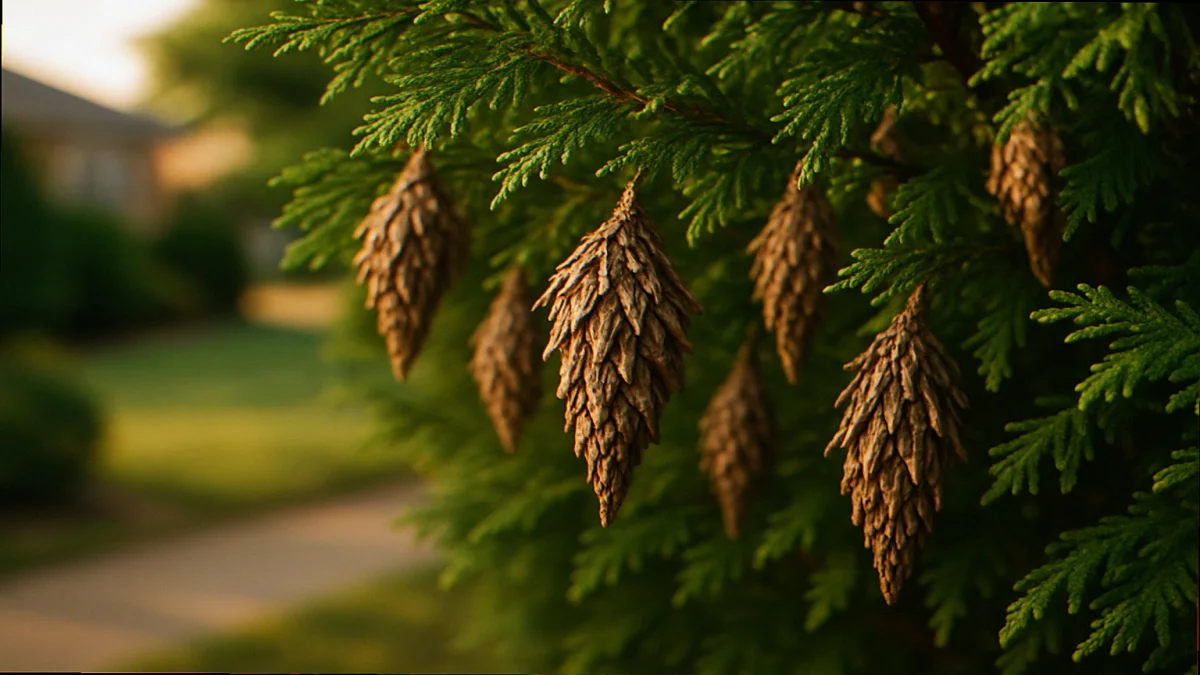
If your arborvitae or juniper is dropping needles in June, look for small spindle-shaped bags hanging from the branches. Those are bagworm larvae actively feeding, and a single untreated tree can be defoliated within two seasons. The most reliable fix is hand-picking the bags now, before the caterpillars finish their summer feeding cycle and reproduce. This guide walks through how to spot the damage, time the removal, and protect the tree without spraying anything that harms native pollinators or songbirds.
A neighbor down the street called me over to her side yard last week. Two of her three arborvitae looked fine. The middle one had a brown stripe running up the south face and what she thought were pinecones hanging from the dead patches. They were not pinecones. They were bagworm bags, each one stuffed with a caterpillar shredding her tree from the inside while she stood there squinting up at them. She had paid almost three hundred dollars for that hedge six summers ago, and she was about to lose it because the damage looked like winter burn until I poked one of the “cones” and it wiggled.
This is one of the quieter pains of suburban native gardening. You inherit a property line of evergreens from the previous owner, you plant your milkweed and bee balm in front of them, and then one summer the screen you depended on for privacy starts thinning and you cannot tell whether it is heat stress, root rot, or something eating it alive. Bagworms are almost always the answer for arborvitae, eastern red cedar, and juniper, because the bags look exactly like cones until you know what you are seeing.
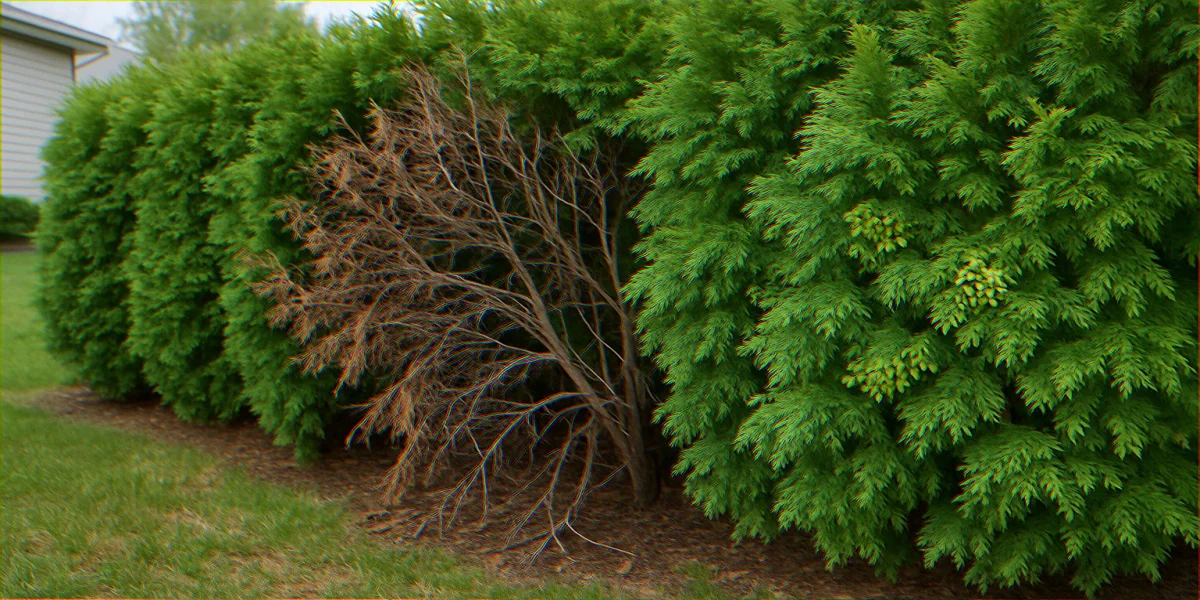
What does bagworm damage actually look like on an evergreen?
Bagworm bags are spindle-shaped, between half an inch and two inches long depending on the stage, and covered in fragments of the host plant. On arborvitae they look like miniature pinecones knit out of scaly needles. On juniper or eastern red cedar they look like fuzzy brown teardrops. The bag hangs by a silk thread from a twig and sways in the wind. Inside is a single caterpillar that pokes its head and front legs out to feed and drags the bag along the branch with it.
FREE: Wildlife Garden Starter Guide
Get our 12-page PDF with the 25 best plants for pollinators, simple habitat tips, and a printable checklist — all 100% free.
No spam. Read our Privacy Policy.The damage shows up as thinning at the tips of branches first, then progresses to brown patches where every needle on a twig has been chewed off. Severely infested arborvitae looks like someone draped sections of the tree in burlap. The brown does not come back. Once a section of arborvitae loses its needles to bagworms, the wood underneath rarely re-sprouts, which is why early detection is the whole game.
If you are not sure whether what you are seeing is a bagworm, snap a clear photo with the bag in profile and upload it to iNaturalist. The community will confirm the species within a few hours, often faster, and your sighting becomes a useful data point for state extension entomologists tracking outbreak years.
When do bagworm eggs hatch and start feeding?
Female bagworms overwinter as eggs inside last year’s bag. Each bag can hold between 500 and 1,000 eggs. Hatch begins when soil temperatures stabilize above about 55 degrees Fahrenheit, which corresponds to roughly mid-May in zones 6 and 7, late May to early June in zone 5, and as late as mid-June in cooler microclimates and northern states. Penn State Extension tracks the exact growing-degree-day windows for the mid-Atlantic each year.
The newly hatched larvae are tiny, around two millimeters long, and they immediately spin a starter bag out of silk. They feed through June and July, expanding the bag as they grow. By August the larvae stop feeding, anchor the bag permanently to a twig, and pupate inside. Adult males emerge in early fall as small dark moths, fly to bagged females, mate through a small opening in the bag, and the females lay eggs and die without ever leaving their bags. The eggs sit through winter and the cycle starts again.
This single-generation life cycle is your tactical advantage. If you remove every bag before mid-August, no eggs go into next year’s brood. Two clean seasons in a row will reset the population on your property as long as your neighbors are not running an unmanaged nursery upwind.
Hand-picking: the method that costs nothing and works
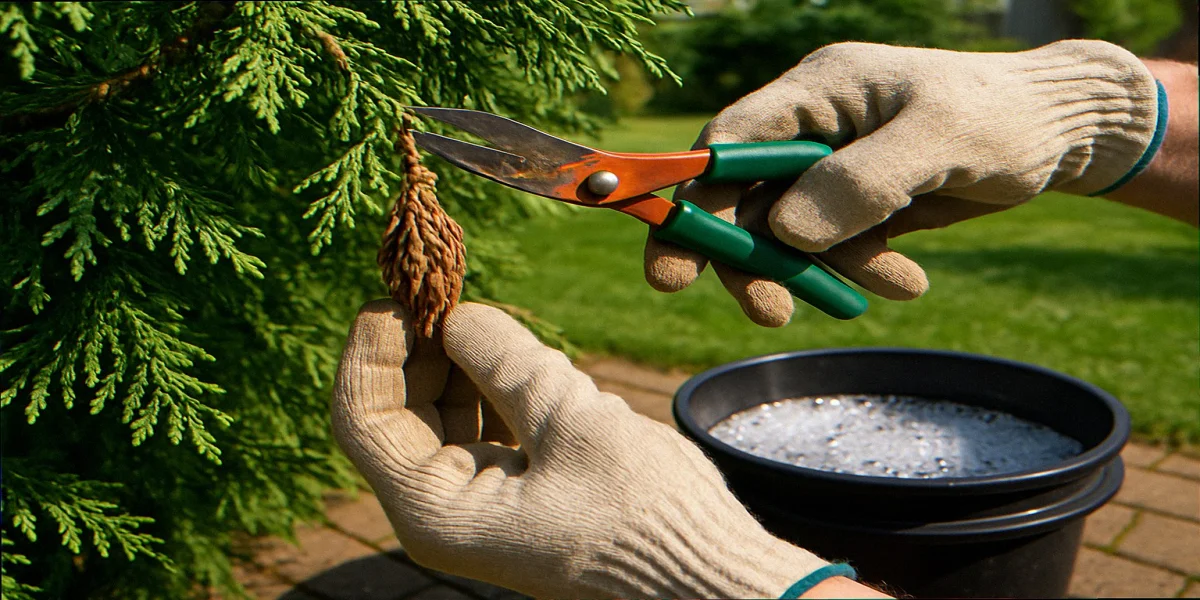
Hand-picking is the most effective bagworm treatment for a homeowner with one to ten infested shrubs. It is also the only method that does not put bees, parasitic wasps, or songbirds at any risk. The process is slow and a little tedious, and that is exactly why it works. You are physically removing every reproductive female from the tree.
The steps are simple. Bring a five-gallon bucket half full of water with a tablespoon of dish soap. Wear gloves because the silk anchor is surprisingly tough and you will be twisting bags off twigs for an hour. Snip the silk attachment with pruners rather than yanking, because yanking strips needles. Drop each bag into the soapy water. The soap breaks surface tension so the caterpillars cannot crawl out. Leave the bucket in the sun for forty-eight hours, then bag the contents and put them in the trash. Do not compost them. The eggs survive composting temperatures in most home piles.
Work the tree systematically from the bottom up and from the trunk outward. Bagworms anchor on smaller branches first, so the outer canopy and lower limbs usually carry the heaviest load. A headlamp helps for the interior branches because the bags blend into the shade. Plan for thirty to ninety minutes per arborvitae depending on infestation. Repeat the inspection every seven to ten days through July, because you will miss bags on the first pass no matter how careful you are.
What if hand-picking is too late?
If the bags are already over an inch long, mostly closed, and you can hear or see no caterpillar movement when you flick one, the larvae have likely pupated and Bacillus thuringiensis kurstaki. The soil bacterium sold as Bt. Will no longer work on them. Bt only kills actively feeding caterpillars. After pupation, hand-picking is still effective, but spraying is not.
If the larvae are still small and feeding, a single Bt application aimed at the foliage where the bags are concentrated is the next option. Bt is specific to caterpillars in the order Lepidoptera and does not harm bees, beetles, wasps, or birds. The catch is that it is non-selective among caterpillars. It will kill monarch caterpillars on nearby milkweed, swallowtail caterpillars on parsley, and any other native moth larvae that contact the treated foliage during the spray window. For that reason, spray only the affected evergreens, not as a broadcast, and only when wind is below five miles per hour and your milkweed beds are at least twenty feet away.
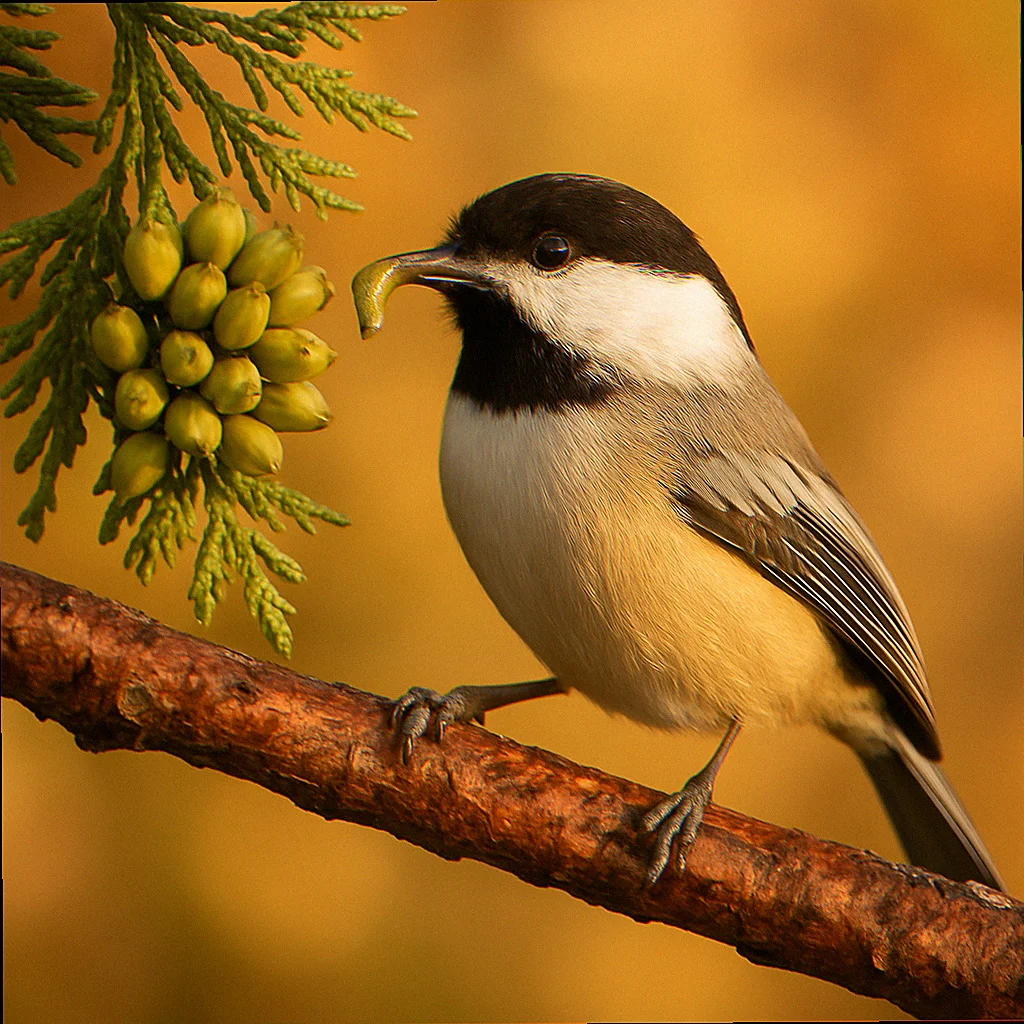
The third option is patience plus predators. Black-capped chickadees, tufted titmice, and white-breasted nuthatches eat bagworm larvae when they spot them, especially before the bag camouflage fills out. Audubon’s research on insectivorous songbirds shows that a breeding pair of chickadees feeds 6,000 to 9,000 caterpillars to a single brood. Backyard feeders with sunflower chips and a clean water source through the breeding season pull in more chickadees, which means a quieter bagworm year next summer. Mason bee houses with replaceable tubes also support the parasitic wasps that lay eggs inside bagworm larvae. See our guide on cleanable mason bee houses for the designs that do not double as wasp traps.
How to compare control methods at a glance
| Method | Timing window | Effective on | Risk to pollinators | Cost |
|---|---|---|---|---|
| Hand-pick into soapy water | June through mid-August | All stages including pupae | None | $0 |
| Bt (Bacillus thuringiensis) spray | Within 3 weeks of hatch | Small feeding larvae only | Kills all nearby caterpillars | $12 to $25 |
| Songbird and parasitic wasp support | Year-round habitat | Reduces future broods | None | $30 to $80 one-time |
| Broad-spectrum insecticide | Not recommended | Larvae and almost everything else | Severe. Bees, butterflies, beneficials | $25 to $60 |
The table tells the story I keep coming back to with native gardeners. The cheapest method is also the most effective and the safest for the pollinators you spent the last three years planting bee balm and mountain mint for. Hand-picking demands an hour of your time twice a week for a month. Sprays demand twenty dollars and your peace of mind every time a monarch lands in your yard for the rest of the summer.
The objection I hear most often
“My arborvitae is twelve feet tall. I cannot reach the top, and the worst damage is at the crown.” This is fair, and it is the one place I will tell you a pole pruner is worth buying. A six-foot fiberglass pruning pole with a rotating head reaches a fourteen-foot canopy from the ground. You snip the bag and it drops. Spread an old bedsheet under the tree before you start so the bags do not roll into your garden beds where you would have to crawl after them.
The second objection is the neighbor one. People do not want to be the person standing in their front yard with a bucket of soapy water picking what looks like pinecones off a tree for an hour every weekend in June. The simple fix is to do it at dawn. Bagworm caterpillars are most active in the morning, the bags are easier to spot in low-angle light, and your neighbors are still in their kitchens. If you are in an HOA-managed neighborhood and worried about the optics of a half-dead arborvitae sitting in your front yard while you work through the infestation, see our walkthrough on responding to an HOA letter about your native garden. The same talking points work when you have a sick tree and you need to buy a season to fix it.
The third objection is the physical toll. Standing with your head tipped back for an hour stiffens your neck the next morning. The fix is to break the tree into thirds, do one third per session, and put the bucket down at hip height on an overturned crate so you are not bending at the waist. None of this is glamorous. All of it works.
Skip the systemic insecticide. Here is why.
Imidacloprid and dinotefuran soil drenches are commonly recommended for bagworm in some commercial landscaping guides. They are effective on larvae. They are also neonicotinoids, and they translocate from the roots of the treated tree into pollen, nectar, and the guttation droplets that emerge from leaf tips after a humid night. Any pollinator visiting any flower on or near the treated property over the next twelve to eighteen months can be exposed.
Arborvitae itself does not produce nectar that bees forage, but the soil contamination radius of a single drench application can affect the milkweed, coneflower, and mountain mint planted within ten feet of the treated trunk, and the residues persist in the soil for at least a year. Xerces Society documentation on neonicotinoids details the exposure pathways. For a non-flowering tree like arborvitae, you have hand-picking and Bt and bird habitat. You do not need the systemic.
When the problem is bigger than one tree
Three signs tell you the infestation has spread beyond a single shrub and you are now managing a property-line problem.
- Bags appear on non-evergreen hosts. Bagworms are generalists. If you start finding bags on a sweetgum, sycamore, maple, oak, willow, or honeylocust on your property, the population has saturated the local evergreens and the moths are looking for new substrate. Hand-pick these new sites first because deciduous hosts are easier to access than mature arborvitae.
- Heavy bag load on adjacent properties. Walk your block on a Saturday morning. If you see bagworms on two or three other lots within a hundred yards, you are dealing with a neighborhood reservoir, not a yard problem. Talk to the neighbors. Most of them do not know what they are looking at. A printed photo and a five-minute conversation works better than anything else I have tried.
- New bags appearing in August. If you keep finding fresh small bags in late summer, the local larval population is desynchronized. Likely from drought stress causing staggered hatch. And you will need to extend your hand-picking schedule into early September.
For a saturated neighborhood reservoir, your county extension agent is the right call. Most state extension services maintain a bagworm advisory hotline during outbreak years and can confirm whether your area is in an active flare. Pair the report with iNaturalist observations from your yard so the entomologists have geo-tagged data to work with. Our piece on verifying native plants at the county level covers the same extension resources from a planting angle, and the contacts are interchangeable.
What changes after a clean season
One clean year on a single property does not guarantee a bagworm-free next year if your neighbors are unmanaged. Two clean years in a row, on the other hand, almost always does. The reproductive math is unforgiving for the moth. Every bag you removed in June and July took 500 to 1,000 eggs out of next year’s brood. Twenty bags off a single arborvitae translates to between 10,000 and 20,000 eggs that will not hatch in your yard next May.
The tree itself will not regrow brown patches where every needle was stripped, but it will fill in slowly from the green branches that remain. Arborvitae and juniper push new growth from the tips of living wood each spring. A tree that lost twenty percent of its canopy to bagworms one summer typically looks ninety percent recovered after three growing seasons. A tree that lost more than fifty percent is usually past the point of cosmetic recovery and is worth replacing with something more resilient. Eastern red cedar handles bagworm pressure better than ornamental arborvitae cultivars do, and it supports significantly more native bird species.
If you decide to replant, our guide on native plant garden recipes by USDA zone covers evergreen substitutions that fit common privacy-screen footprints, and the HOA-friendly curb appeal designs writeup handles the optics of a young replacement screen sitting next to a mature neighbor hedge while the new planting catches up.
Most importantly, you will look at the rest of your yard differently after a bagworm season. You will know what a bag looks like at ten feet from a single glance. You will check the tree every June without thinking about it. And the trade-off you made by leaving the parasitic wasps and chickadees alive. Instead of carpet-bombing the property with a systemic. Will start paying off in quieter and quieter bagworm summers, year over year.
FAQ
Can I just spray dish soap on the bags?
No. The bag silk is dense enough that contact sprays do not penetrate to the caterpillar inside. Dish soap is only effective once the caterpillar is submerged in the bucket. Trying to spray the bags in place is one of the most common mistakes and wastes a full feeding window.
Are bagworms the same as tent caterpillars?
No. Eastern tent caterpillars and fall webworm build large communal silk tents in the crotches of deciduous trees. Usually cherry, apple, or pecan. And feed in groups. Bagworms are solitary, build individual portable bags, and prefer evergreens. The two pests need different management and the tent caterpillars are largely cosmetic on healthy trees.
Do bagworms come back to the same tree every year?
Yes, until the population is exhausted. Female bagworms never leave their bags, so eggs are laid exactly where last year’s larvae fed. This is why early-season hand-picking on a known infested tree works so reliably. You are removing the entire next generation from a known location.
Will my tree survive bagworm damage?
Usually yes, as long as the canopy is not stripped past about fifty percent. Healthy arborvitae and juniper push new growth from living branch tips, and partial defoliation is recoverable over two to three growing seasons. Trees stripped past the halfway point rarely fully recover and are better replaced with something the local ecosystem supports more broadly.
Is it worth hiring a professional for bagworm removal?
For one or two tall trees with severe infestations, a certified arborist with a pole sprayer and Bt is reasonable in the early-hatch window. For everything else, the labor of hand-picking is the entire cost, and an afternoon of your time is much cheaper than a service call. If you do hire someone, confirm in writing that they will use Bt and not a systemic neonicotinoid.
Want More Wildlife Garden Tips?
Join 5,000+ nature lovers getting our weekly tips on creating wildlife-friendly gardens.
No spam, unsubscribe anytime. Privacy Policy
Emma Harrington
Emma Harrington is a wildlife habitat researcher and content editor with a passion for backyard conservation. She has spent over a decade translating ecological science into practical tips anyone can follow — from selecting native plants to building wildlife-friendly habitats. Her work focuses on helping homeowners transform ordinary yards into thriving ecosystems for bees, butterflies, hummingbirds, and other beneficial wildlife.