

Deer browsing on native plants stops fastest when you stack three habits over the next 14 days: ring the worst-hit beds with a 5-foot mesh polytape barrier, rotate two scent-based repellents on a five-day cadence, and replant the buffet rows with browse-resistant species like little bluestem, mountain mint, and amsonia. No 8-foot fence required. The first 72 hours break the doe’s nightly pattern; weeks two through six keep her from rebuilding it.
You have read the persona line in your own head all summer: an ongoing battle with deer. The hostas are gnawed to the crown. The new echinacea plugs are headless toothpicks by Wednesday. The two flats of butterfly weed from the conservation district sale went in on Saturday and were trimmed to nubs by Tuesday morning. The receipt is still in the kitchen drawer.
Most of the standard advice. Taller fence, blood meal, a motion light from the hardware store. Fails because it treats deer as a one-time intruder instead of a returning local. A suburban doe will visit the same five yards on the same loop for years. Break that loop and most of the damage stops. Miss that point and you spend three hundred dollars on netting that the same animal walks around the next week.
FREE: Wildlife Garden Starter Guide
Get our 12-page PDF with the 25 best plants for pollinators, simple habitat tips, and a printable checklist — all 100% free.
No spam. Read our Privacy Policy.The deer-pressure test you can do at dusk tonight
Before you spend a dollar on repellent, you need to know whether you have an occasional cut-through deer or a resident doe who has put your yard on her grocery route. The difference changes everything you do next.
Go outside roughly 30 minutes before sunset with a notepad and a flashlight. Walk a slow loop and check three things, in order.
- Fresh tracks. Cloven hoofprints, usually 2 to 3.5 inches long, in mulch, damp lawn edges, or the soft soil along a bed. Fresh tracks have crisp edges; tracks older than 48 hours look slightly rounded.
- Browse signature. Deer do not have upper incisors, so they tear plant tissue at a ragged 45-degree angle. Rabbits leave a clean diagonal cut. If your coneflower stems look ripped instead of clipped, it is deer.
- Bedding flattening. A 3-by-4-foot oval of pressed-down grass or mulch in a hidden corner, usually under a low evergreen or behind a shed. A resident doe will reuse the same bed within 20 feet for weeks.
If you find all three, you have a resident animal and you need the layered plan below. If you only find tracks but no bedding, you have a transient cutting through, and a single perimeter repellent will usually move the route within a week.

A note on timing. I run this walk on a Tuesday because that is when I usually have the energy to act on what I find before the weekend. The point is consistency, not the day of the week. A friend in the local Wild Ones chapter does the same walk every Sunday at first light and reports the dawn pass picks up more bedding sites than the dusk pass. Pick one and stick with it.
What’s actually pulling deer into your beds in June?
June is the toughest month for a native gardener with deer pressure because three forces line up at the same time, and almost none of them are inside your control.
First, deer fawns are 4 to 8 weeks old in early June, which means does are nursing and need 60 percent more daily calories than at any other point in the year. Field studies on white-tailed doe lactation put the daily intake spike between 4,500 and 5,200 kcal during peak nursing. They are foraging more aggressively and over longer hours than they will all year.
Second, woodland understory dries out in early summer. By mid-June in most of the Lower 48, the shaded forest browse a doe relied on in April has gone fibrous and lower in protein. Your watered, fertilized native bed, by contrast, is putting out tender new growth with protein levels in the 18 to 22 percent range. From the doe’s perspective, your yard is a salad bar that just opened.
Third, fawns are starting to taste solid food. Mom is teaching them where to eat. Whatever beds she hits in June will be on the route her female fawn inherits next spring. You are not just defending one season; you are defending the next three.
This is the part most generic advice misses. You are not in a fight with a stray deer. You are in a fight with a family’s grocery memory.
Browse-resistant native swaps that hold the line through summer
The fastest way to drop deer pressure by half is to change what is in the bed at all. Strong-scented natives in the mint family, grasses with sandpaper-rough leaves, and any plant with milky latex sap are passed over more often than not, even in heavily pressured yards.
The catch. And the persona-driven point that makes Sarah roll her eyes when she reads the typical list. Is that “deer-resistant” is never absolute. A starving December doe will eat goldenrod stems. The right framing is relative resistance. You are stacking the odds.
Here is the working list I rotate in any new bed in deer country.
| Native species | Why deer skip it | Zone / use | Resistance rating |
|---|---|---|---|
| Little bluestem (Schizachyrium scoparium) | Coarse, dry leaf blades | 3-9, sunny dry bed, structural | Strong |
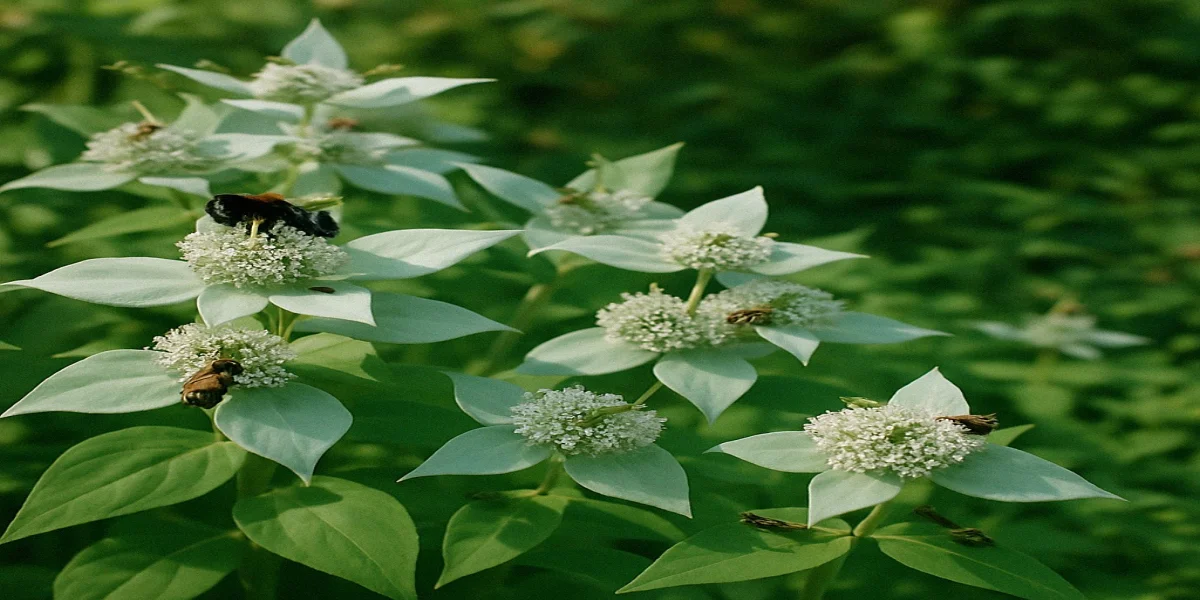
| Mountain mint (Pycnanthemum muticum) | Strong menthol aroma | 4-8, full sun border | Strong |
| Bluestar (Amsonia hubrichtii) | Milky sap, alkaloid-bitter | 5-9, mid-bed anchor | Strong |
| Wild bergamot (Monarda fistulosa) | Thymol-heavy oils | 3-9, sun to part sun | Strong |
| Anise hyssop (Agastache foeniculum) | Licorice aroma | 4-8, sun, dry well-drained | Strong |
| Eastern bee balm (Monarda bradburiana) | Aromatic foliage | 5-8, part shade | Moderate-strong |
| Butterfly weed (Asclepias tuberosa) | Milky cardiac glycosides | 3-9, sun, dry | Moderate (caged year 1) |
| Threadleaf coreopsis (Coreopsis verticillata) | Fine bitter foliage | 3-9, sun | Moderate |

What I have learned the hard way: the strongest single move is to plant mountain mint on the bed edge facing the deer’s approach path. The aroma carries a few feet on a still summer night, and the doe usually swings wide. Audubon has called mountain mint one of the most under-appreciated native plants for backyard ecology. It doubles as a deer break and one of the best pollinator magnets in the eastern half of the country.
For Sarah’s pragmatic-shopper paradox. Purist intent, big-box reality. Three of the species above are reliably available at Lowe’s, Home Depot, and Walmart in the spring and fall: little bluestem (often sold as Schizachyrium ‘Standing Ovation’), threadleaf coreopsis, and bluestar. Conservation district sales and Wild Ones chapter swaps are where you find the cultivar-free straight species and the more localized Monardas. I keep a list of both sources on my fridge.
For region-specific picks, our guide to native plants for dry shade under mature trees covers the species that double as deer-tolerant in shaded suburban yards, and our guide to sourcing natives when local nurseries are sold out is the next stop when the conservation sale is over.
How do you stop deer from getting used to scent repellents?
Every commercial repellent works for about 5 to 10 days before the local deer either ignore it or learn to crop under the spray line. The mistake people make is to keep using the same product and increase the dose. That is the slowest, most expensive path. The fix is rotation.
Use two products with different active modes and alternate them every 5 days. The point is to keep the doe’s nose guessing.
- Putrescent-egg-based repellents (Bobbex, Liquid Fence). Smell like predator urine to a deer. Persist 14 to 21 days through one rain.
- Capsaicin or garlic-based repellents (Plantskydd, Deer Out). Taste deterrent. Persist 28 to 60 days through several rains, but the price is higher.
The five-day rotation cadence is taken from University of Maryland Extension’s deer-control guidance and is the number that lined up with the rebound interval in my own yard the last three years. If you have a strong sunny week, spray the new growth on day 4 rather than day 5. The tender tip leaves are what they go for, and the older leaves still hold the previous round.
Two practical rules I now follow:
- Spray late afternoon, not morning, so the product is dry before the dusk visit.
- Re-spray after any rain over half an inch, regardless of which day of the cycle you are on.
A reader emailed last month to ask whether home-mix garlic-and-egg sprays work as well as the commercial versions. They do for about a week. After that, the protein in the egg breaks down, the spray sours, and you are spraying something that smells worse to you than it does to the deer. I have stopped recommending the kitchen mix unless someone is genuinely on a zero-budget month.
Comparing four motion deterrents past the honeymoon week
Every motion deterrent works in week one. That is the trap. The real question is which ones still work in week four, when the doe has classified the new noise or movement as background.
| Deterrent | Week 1 | Week 4 | Honest verdict |
|---|---|---|---|
| Motion-activated sprinkler (Orbit Yard Enforcer) | Strong | Moderate | Best, if you reposition weekly |
| Solar motion light | Moderate | Weak | Habituates fast; reserve for early warning |
| Ultrasonic spike | Weak | Weak | Skip. No real evidence past placebo. |
| Reflective scare tape on stakes | Strong | Moderate | Works if you move stakes every 7 days |
The pattern is consistent. Anything that surprises a doe stops working the moment she predicts it. The motion sprinkler holds up best because the water pattern shifts with wind and pressure, and a soaked doe walks off and remembers the wet, not the click. Move it every Monday to a new corner of the bed and you stretch the surprise window into months.
For a comparison of garden-protection netting that does not trap snakes, fledglings, or chipmunks, our wildlife-safe netting guide is the better starting point than the all-purpose plastic mesh from the big-box rack.
Layered defense for first-year native plugs that takes one afternoon
If you only had three hours on a Saturday to protect a new native bed, here is the order I would put them in.
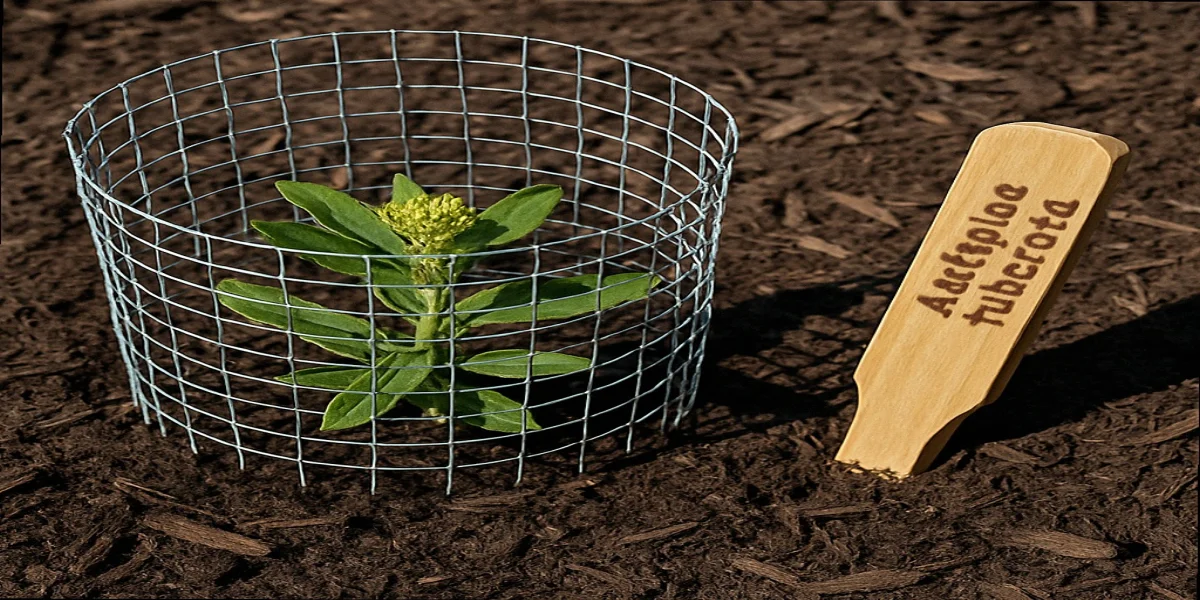
0:00 to 0:45, Cage the most expensive plugs. Half-inch hardware cloth, cut into 14-inch tall by 36-inch long strips, rolled into a 12-inch diameter cylinder, secured with two zip ties. One bamboo stake through the cloth into the ground. Total cost per cage runs about $2 to $3 if you buy a 50-foot roll. Cage every milkweed, every coneflower plug, every aster, every joe-pye weed. Skip the cages on plants from the deer-resistant table above.
0:45 to 1:30, Ring the bed with polytape. Five-foot tall electric-fence-grade polytape (no charger needed for this use) on 6-foot T-posts driven 18 inches into the ground at 4-foot intervals. Tie surveyor flagging or strips of an old white sheet every 6 feet along the tape. The tape is for visual psychology, not voltage. Deer hesitate at a clear line they did not see yesterday.
1:30 to 2:00, Spray the first repellent. Mix Bobbex per label, spray the new growth top and bottom of every leaf. Hit the lawn edge where deer enter, not just the plants.
2:00 to 2:30, Place the motion sprinkler. Aim it at the entry path you identified during the dusk walk. Battery-powered models work for 4 to 6 weeks per set on alkalines.
2:30 to 3:00, Walk the route a doe would take and check. Lie down behind the bed if you have to. The point is to see your defenses from her angle, not yours. The lights you can hide from her, the white reflective strips she will see, the cage outlines she will read as “structure.” That perspective alone has fixed more of my own bad placement than any product purchase.
Three hours, somewhere between $80 and $140 in supplies depending on how much you already own, and you have a layered defense that out-performs a single $400 mesh fence install in everyday June pressure. Most importantly, the layers can be reused next year.
The first-year plug economics matter to most readers I hear from. Our guide on telling native seedlings from weeds before you pull is the next defense layer. Even a perfect cage cannot protect a plug you accidentally yanked thinking it was an invader.
How do you answer the neighbor who calls your cages “junky”?
The single biggest reason people abandon a working deer plan is not the deer. It is the neighbor leaning over the fence to mention that the wire cages “really stand out from the street.” This is the Sarah trade-off in plain English: ecological purism that has to dress up enough to keep the suburban peace.
Three responses I now keep in my back pocket.
- Reframe the cages as temporary. “They come off in October when the plants are established.” This is almost always true for first-year plugs. The cage is a tool, not a fixture. Saying “October” lets the neighbor hear a finish line.
- Paint the cages dark brown or matte black. A $7 can of Rust-Oleum on the galvanized wire kills the shine and the cage disappears into mulch shadow from 10 feet away. Spray-paint outside the bed, let dry, then install.
- Add one intentional border element. A line of 4-inch river rock along the bed edge, a hand-lettered “Pollinator habitat” sign, or a 12-inch picket border. Any single signal that the bed is curated rather than abandoned blunts the “junk yard” framing immediately.
If a formal HOA letter shows up rather than a neighborly comment, our HOA letter response plan has the template I use, and a friend on our local conservation board used it last spring to defuse a Schedule of Violations notice in two emails.
One more practical move: invite the neighbor to look closely. Most people who complain about the look of a native bed have never seen a native bee at three feet. A 60-second tour at the right moment turns more critics than any explanatory yard sign I have tried.
What two weeks of consistent defense changes
If you start this plan on a Saturday and hold the cadence, here is roughly what to expect by the second Saturday.
- Days 1 to 3. Browse continues on caged and uncaged plants both. The doe is still on her old route. Do not panic.
- Days 4 to 7. First confused track patterns appear. The doe enters but turns back at the polytape or at the wet patch from the sprinkler. Some plants she had been hitting daily get skipped for a night.
- Days 8 to 14. The pattern breaks. You will count fewer fresh tracks during your dusk walks. The cages around milkweed and aster are intact. The mountain mint border is humming with native bees. The first new echinacea bud opens.
- Weeks 3 to 6. Maintain the rotation. The doe is now grazing a yard three doors down. This is not your problem; it is suburb math.
- October. Pull the cages. Most plugs have rooted in deep enough that the next year’s deer pressure is one-third what it was.
The honest line that does not show up in most “deer-resistant” posts: your yard does not become deer-proof. It becomes a less-attractive option than the neighboring yards. That is enough.
FAQ
Can I use cayenne pepper instead of a commercial repellent?
For short-term spot use, yes. Mix 2 tablespoons of cayenne and a teaspoon of dish soap into a gallon of water and spray. It washes off in the first rain, so plan to reapply after every storm. For sustained defense across a full bed, commercial putrescent-egg products outlast it five to seven times longer.
Will a sprinkler bother my dog or the songbirds?
Yard Enforcer-type sprinklers fire a 3-second burst. Dogs learn the zone within a day and route around it. Songbirds at feeders 8 to 10 feet away are not in the trigger arc. Place the unit at lawn level facing the bed, not aimed at perches.
Do I need to worry about ticks if deer keep visiting?
Tick load tracks deer presence over years, not nights. The right tick precaution is your own. Long pants tucked into socks, permethrin-treated yard clothes, a tick check after every dusk walk. Stopping deer from browsing your plants does not change the tick math next door.
What about deer-resistant cultivars of native plants?
Some are reliable (the Pycnanthemum straight species, Amsonia hubrichtii). Others, like double-flowered echinacea cultivars, lose the strong taste of the straight species and become more attractive, not less. When in doubt, plant the straight species. Our guide to reading wildflower seed labels covers how to verify what is actually in the bag.
How tall does a real deer-proof fence need to be?
Eight feet is the floor. Slanted 7-foot double fences work because the depth confuses the leap. Anything under 6 feet is a speed bump. Cost for an 8-foot wire fence around a typical backyard runs $1,800 to $4,000 installed. That number is the reason most of us stack layered defenses instead.
Want More Wildlife Garden Tips?
Join 5,000+ nature lovers getting our weekly tips on creating wildlife-friendly gardens.
No spam, unsubscribe anytime. Privacy Policy
Emma Harrington
Emma Harrington is a wildlife habitat researcher and content editor with a passion for backyard conservation. She has spent over a decade translating ecological science into practical tips anyone can follow — from selecting native plants to building wildlife-friendly habitats. Her work focuses on helping homeowners transform ordinary yards into thriving ecosystems for bees, butterflies, hummingbirds, and other beneficial wildlife.