
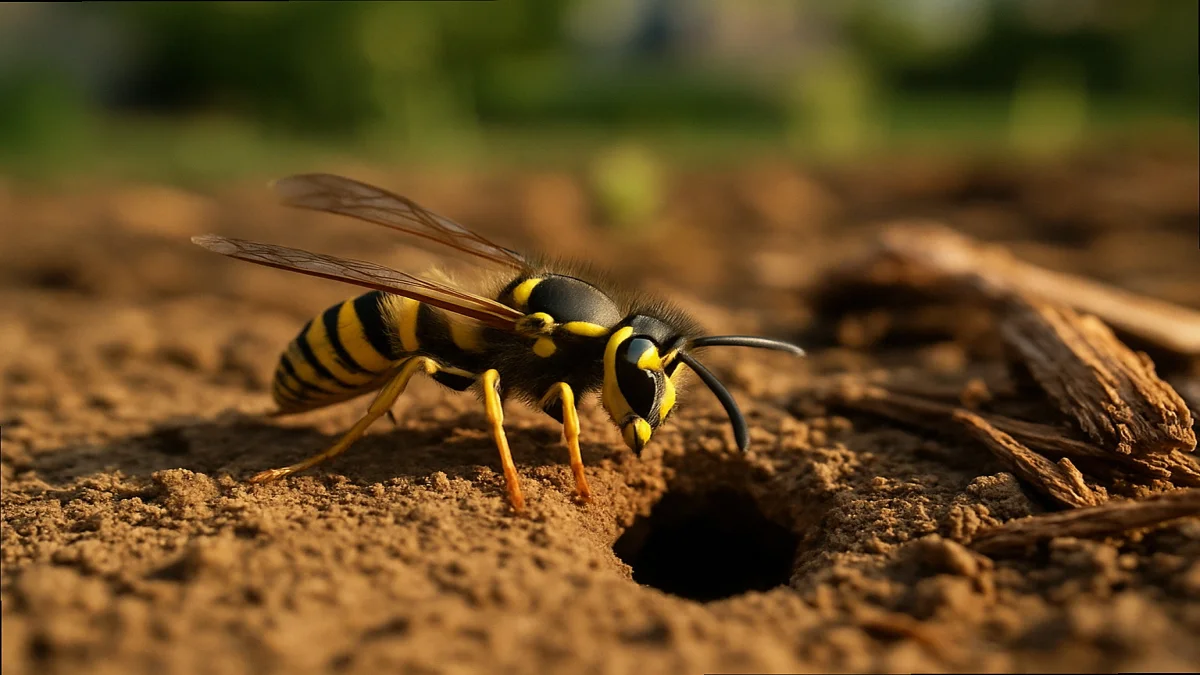
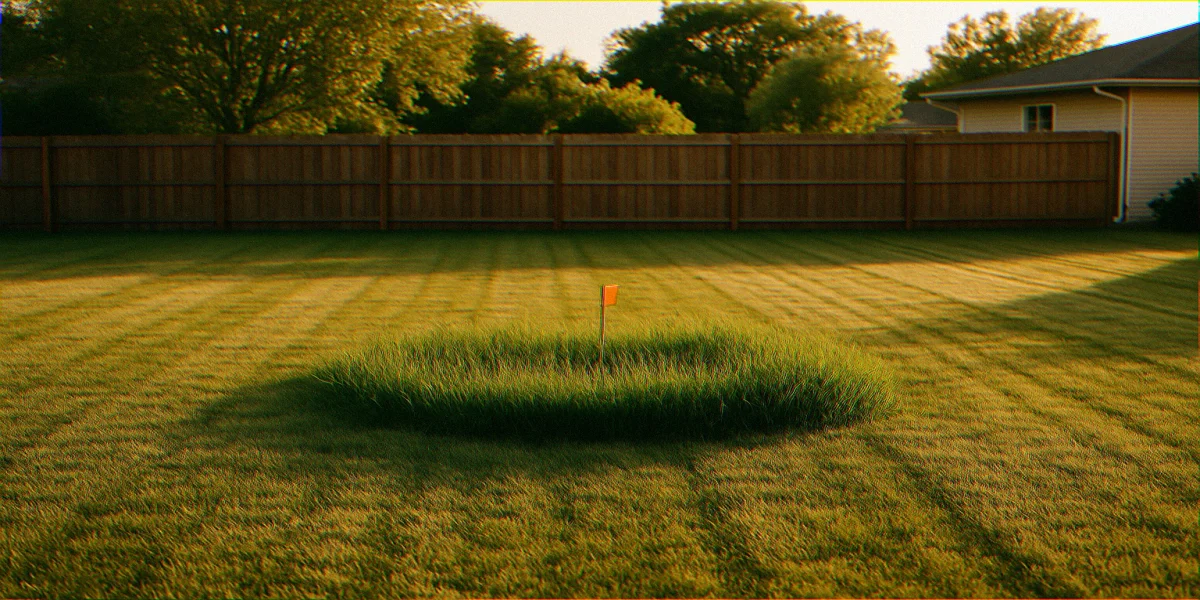
If a colony of yellow jackets has set up under your lawn, a five-minute walk before you start the mower is what stops a hospital trip. Look for steady traffic of striped wasps slipping in and out of a single dime-sized hole, usually in dry, sunny soil along a bed edge or near a stump. Mark the spot, give it a six-foot buffer, and mow that pass last. Or skip it for the week.
I learned this the hard way two summers back. I had walked the back beds that morning, refilled the bird bath, and never glanced at the strip between the rain garden and the old stump. The first pass with the mower set off something I still hear about from my neighbor. A column of Vespula maculifrons rising out of the ground like smoke. Eight stings between the elbow and the jaw before I made it to the porch. The nest had been there for weeks. I just had not looked.
The five minutes that save a mowing day
A surveyed yard is a calmer yard. That is the short version. The longer version is that ground-nesting yellow jackets are not random. They pick the same kinds of sites year after year, and once you know what those sites look like, you can clear a half-acre in the time it takes to drink a coffee. The Penn State Extension entomology team puts it bluntly: vibrations near a nest, such as a lawn mower or hedge clippers, can trigger a defensive response. The trigger is mechanical, not personal. You did not “anger” the nest. You shook it.
That distinction matters because it sets the strategy. You are not trying to kill the colony. You are trying to know where it is so the vibrations of your work never reach it. For most of June and July, that is enough. You do not need a beekeeping suit, a dust applicator, or a contractor. You need a slow walk and a roll of marking tape.
FREE: Wildlife Garden Starter Guide
Get our 12-page PDF with the 25 best plants for pollinators, simple habitat tips, and a printable checklist — all 100% free.
No spam. Read our Privacy Policy.This is the angle that gets lost when people search “how to get rid of yellow jackets.” Most of the top results assume you have already been stung and want a corpse count. The smarter play. And the only one that fits a yard you are converting to native habitat. Is to find the nest before the colony has any reason to notice you.
Why June is the window you don’t want to miss
Yellow jacket colonies follow a predictable arc. A single overwintered queen emerges in late April or May, builds a small starter comb the size of a golf ball, and lays the first eggs herself. By mid-June those first four to seven workers have hatched and taken over foraging. The queen retreats inside and becomes an egg-laying machine. From that point on, the colony doubles roughly every two to three weeks.
In numbers: a June nest you find on the eighth might hold 30 workers. The same nest on August 1 will hold 1,500. By Labor Day it can hold 3,000 to 5,000, and in warmer southern yards the ground-nesting Vespula squamosa can push past 100,000 in a single colony. The math is the whole reason June matters. A nest you find now is a nest you can decide to leave alone for the season. A nest you find in late August is one you have already been walking past for two months.
The other reason is temperament. Workers in early summer are still focused on protein for the brood. Caterpillars, flies, aphids. They are predatory and useful in a yard that is converting to natives, because they are eating the things that eat your milkweed. Defensiveness ramps up in late summer when the colony shifts to producing reproductives and resources tighten. A colony you locate and leave in June will mostly ignore you. The same colony in September will not.
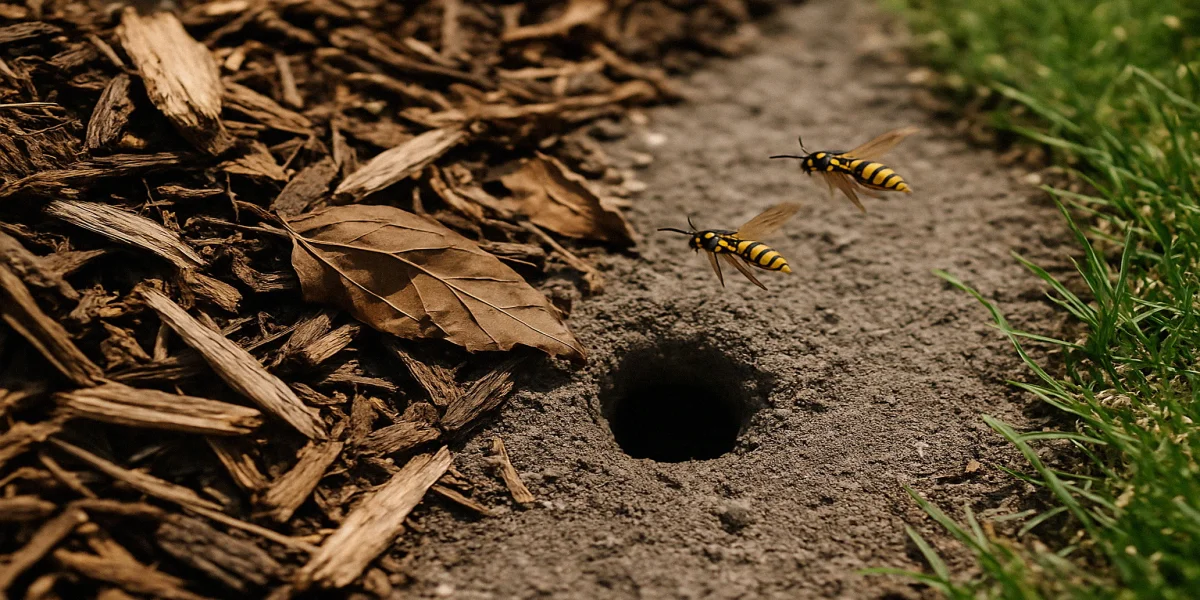
What does a ground-nest entrance actually look like?
The answer in one sentence: a small round opening in bare or thin-grass soil, usually between the diameter of a pencil eraser and a quarter, with one to four wasps visible within any 30-second window of daytime observation.
The details matter, so let me draw the picture more carefully. The hole itself is almost never freshly excavated soil. Yellow jackets are opportunists, not engineers. They move into pre-existing voids: an old chipmunk burrow, a rotted root channel, a gap under a flagstone, the cavity left when a fence post pulled out. The entrance is usually the original hole, not something the wasps dug. So you are not looking for a “dirt volcano” the way you might for a wasp-mimic ground bee. You are looking for a small dark opening in shaded or partly shaded soil where wasps come and go in a near-straight flight line.
Three patterns repeat in suburban yards:
- Bed-edge sites. The strip where mulched bed meets lawn is the single most common location I find nests. It is dry, sun-warmed, and the mulch hides the entrance.
- Stump and root-collar sites. Any tree stump older than two years has internal voids. Yellow jackets find them. So do bumble bees, which are protected and look superficially similar. More on telling them apart in a minute.
- Hardscape gaps. The seam where a paver patio meets soil, the void under a porch step, the space between landscape timbers. These are easy to miss because you are not looking down.
If you do not see wasps within 60 seconds of standing still and watching a suspicious hole during midday, it is probably not active. If you see one wasp, watch another 30 seconds. Solitary ground bees use similar entrances and are non-aggressive, and you do not want to confuse the two. Yellow jackets enter at speed and exit at speed. Mining bees and bumble bees are slower and visit flowers more than the hole itself.
How do you survey a yard without getting stung?
Time of day matters more than equipment. Foragers are most active between mid-morning and mid-afternoon. Roughly 10 a.m. to 2 p.m. on a sunny day above 65°F. That is the worst time to disturb a nest, but the best time to observe one from a distance. You want the traffic visible. You also want enough light to see hole-sized openings in dim soil.
The routine I use now takes about six minutes for a quarter-acre lot:
- Start at the property line opposite the house. Walk a loose grid, five steps apart, looking at the ground 8 to 10 feet ahead.
- At each pass, pause for 10 seconds and listen. An active nest in dense brush gives off an audible hum that is much lower-pitched than a single wasp wing-beat.
- Pay extra attention to anywhere you cannot easily see soil. Under low-hanging native grass, behind perennial clumps, along the back side of mulched beds.
- If you see a wasp land and disappear, do not approach. Mark the location from where you stand with a piece of pin flag, a length of bright string tied to the nearest plant, or by dropping a tennis ball.
- Step back and watch for 60 more seconds from 15 feet. Repeated traffic at the same point is the confirm. One wasp passing through is not.
What I no longer do: poke anything with a stick, kick at openings, or use a flashlight at night to look. The night-light approach is a popular tip that does not pay off. Yellow jackets are not phototactic, the flashlight just illuminates you from below, and any vibration on the soil at that range can wake the colony.
If your yard has children or off-leash dogs, do the survey first thing on a warm morning before they go outside. The same readers who keep a list of toxic plants in their yard already think this way. The survey is just one more line item on the spring/summer safety check.
Where yellow jackets hide that most homeowners miss
The bed-edge and stump sites are the obvious ones. The four locations below are the ones that catch experienced gardeners off-guard:
| Hidden location | Why it gets missed | Detection clue |
|---|---|---|
| Inside a compost pile | You think you would notice, but the entry is usually on the back face you never see. | Wasps emerging from gaps in the bin slats, not the top. |
| Under shed corner or deck joist | Entrance is shaded; flight path is short and tucked. | A worn dirt path in the grass right next to a foundation gap. |
| Inside a brush pile or stacked firewood | “Wildlife brush pile” advice rarely warns you about this. | Wasps repeatedly entering one specific gap in the stack. |
| Old rodent hole at base of a tree | Visually identical to an inactive burrow. | A single dead leaf vibrating at the lip from wing-beats. |
The compost pile catches me out more than anything else. If you are turning compost in June and July, do the same five-minute observation on the pile itself. Stand 10 feet away and watch the back face for a full minute before approaching with the fork.
Brush piles are the other one to flag. Native gardening pages. Including this one. Happily recommend brush piles as winter habitat for chipmunks and overwintering insects. That advice stands. The honest footnote is that an aging brush pile, two to three years old, is a likely yellow jacket site, and the same reasons it sheltered chipmunks in February make it appealing to a wasp queen in May.
Should you remove a nest or leave it alone?
The default answer most homeowners reach for is “kill it.” That is the answer the pest-control industry wants you to reach for. It is rarely the right answer for a yard that is being managed for wildlife.
Three things to weigh:
- Location and traffic. A nest under the back fence with a six-foot buffer can be left alone for the season. A nest within four feet of a doorway, a play set, or a path you take daily probably cannot.
- Stinging allergies in the household. If anyone in the home has a confirmed wasp allergy, the calculation changes immediately. Mark, rope off, and call a licensed local applicator who uses targeted dust rather than blanket spray. This is one of the rare cases where the chemical-free instinct should yield.
- Time of year. A nest located in June can usually be left in place. The colony will die naturally with the first hard frost in October or November, and only the new queens overwinter. A nest located in August is a 5,000-individual problem you will be living with for two more months.
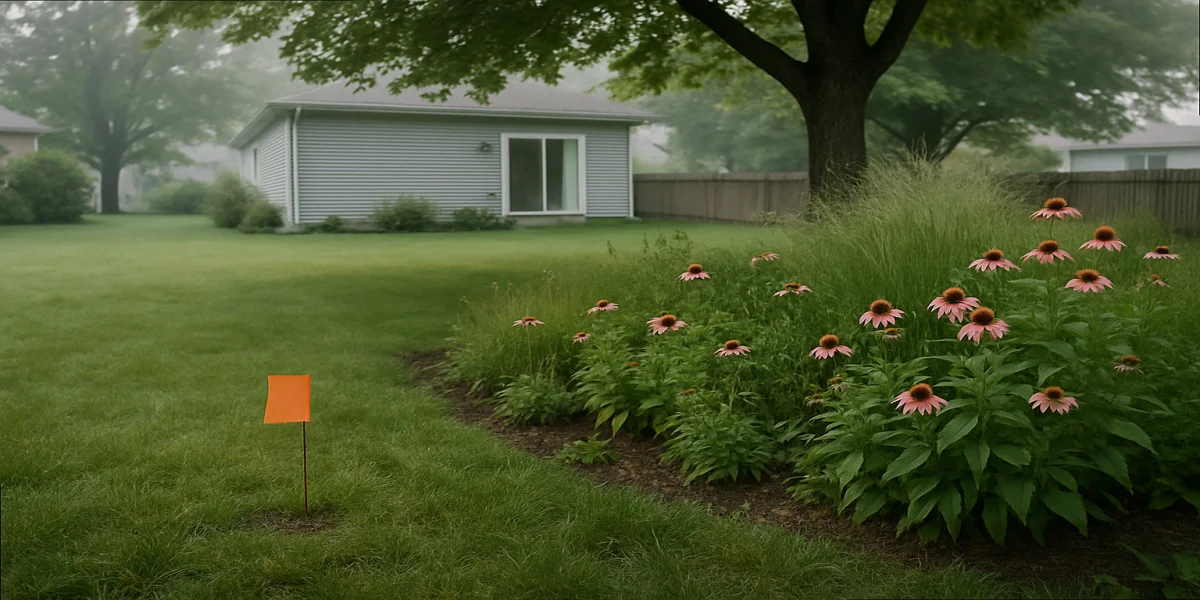
If you decide to leave a nest, the cheap fix is psychological more than physical: route around it. I drive a pin flag at six feet from the entrance and tie surveyor’s tape between flags to outline a no-mow ring. Mowing the rest of the yard at low rpm, with the deck on the highest cut, keeps the vibrations down enough that a buffered nest will leave you alone in nearly every case I have seen.
If you decide to remove a nest yourself, the only method I recommend to anyone without protective gear is the two-quart pot of soapy water at dusk approach used by a fellow Master Naturalist I know. After full dark, when foragers are inside, pour two quarts of water mixed with a generous pour of dish soap directly into the entrance and step back fast. The soap coats the wax cuticle, the wasps drown, and there is no residue to harm soil microbes or pollinators that visit the next morning. I would not call it pleasant. It is the least-bad option if removal is required and a professional is not.
Whatever you do, do not light a fire near the entrance, do not pour gasoline, and do not use the foaming canned “wasp killer” sprays on a ground nest. They are formulated for aerial nests where the foam falls down. On a ground nest the foam clogs the entrance, panics the colony, and they exit through the side voids you did not know existed. The University of Maryland Extension covers the chemistry of this in their social wasps resource page; it is worth reading before any removal decision.
What big-box “wasp killer” sprays don’t tell you
The label on the most common red can in the lawn-and-garden aisle promises a 20-foot stream and a kill in 30 seconds. Three things the label does not say in equal print:
First, the active ingredients are pyrethroids. Typically prallethrin, lambda-cyhalothrin, or a combination. Pyrethroids are also highly toxic to native solitary bees, bumble bees, and ground-nesting mason bees. The same overspray that hits a yellow jacket entrance is sitting on the leaves of whatever you planted to attract pollinators. You spent two years and a lot of money on those plants. A single overzealous spray on a windy day can undo it.
Second, runoff. Pyrethroids bind to soil particles and persist for weeks. Rain moves them. A treated yellow jacket nest entrance four feet from a stormwater inlet sends those active ingredients into the nearest creek, where they are extremely toxic to aquatic invertebrates. The same insects that feed the fish and amphibians the rest of your yard is trying to support.
Third, the kill-time claim is technically true for the wasps that contact the spray but ignores the foragers that were not home. Those foragers return to a destroyed nest and become defensive in an unfamiliar way: they cluster on the spray bottle, the porch, the dog. A spray-killed colony at noon means a porch-stranded population at sunset.
None of this means the products do not work. It means the cost is broader than the label admits, and for a yard you are managing for habitat, the cost is in the wrong currency. The cleaner approach is the survey-and-route approach above. If a nest must come out, dusk-and-soap or a licensed applicator who uses spot-treated dust beats a spray can almost every time.
The pattern here is the same one we discussed in how to handle Japanese beetles without hurting native pollinators and removing aphids from milkweed without killing monarch caterpillars. Broadcast solutions are blunt, and a yard built for wildlife pays a tax on every one of them.
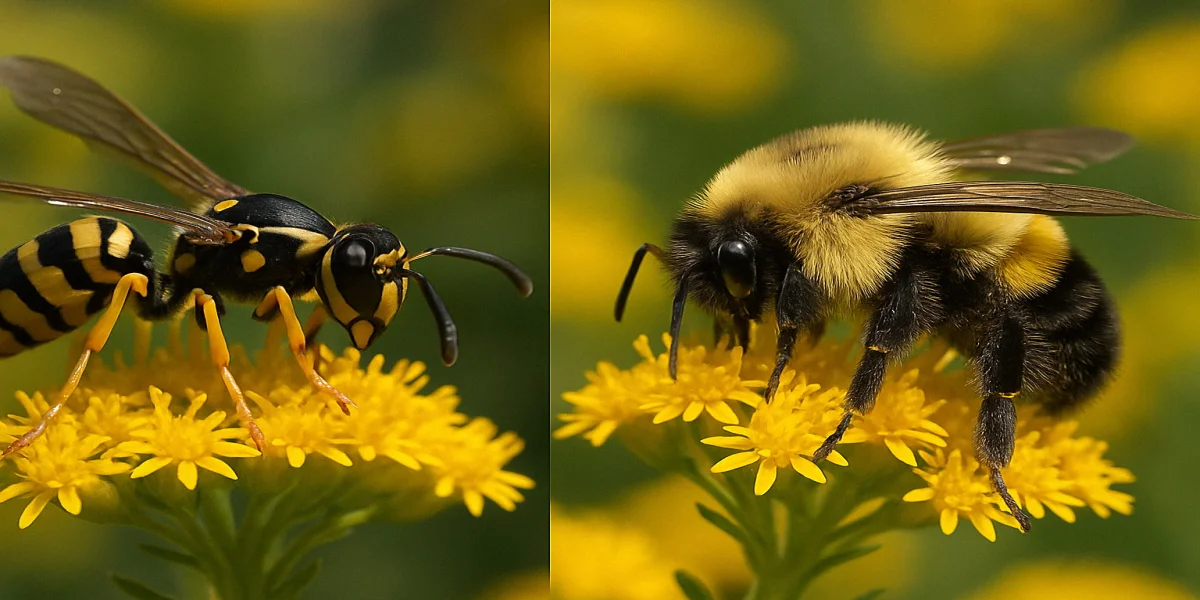
Telling yellow jackets from bumble bees and other look-alikes
This deserves its own short section because the cost of getting it wrong is dead bumble bees, and bumble bee populations are already in steep decline. The fast field marks:
- Yellow jackets. Smooth, almost shiny body. Bright yellow and black bands with sharp edges. About a half-inch long. Body looks “wet” rather than fuzzy. Flight is fast, straight, and silent at distance.
- Bumble bees. Heavily furred body, yellow patches more diffuse, often with orange-red bands depending on species. Larger and rounder. Audible buzzing at distance. Slower, more meandering flight.
- Eastern carpenter bees. Also fuzzy on the thorax but shiny on the abdomen. Hover in place near wood structures. Do not nest in soil.
- Bald-faced hornets. Actually a yellow jacket relative. White on black instead of yellow. Build the gray paper aerial football nests, not ground nests.
If you find a ground nest in early spring, before mid-May, it is far more likely to be a native bumble bee colony. Those queens emerge before yellow jacket queens. And bumble bees nest in pre-existing rodent burrows that look identical to the yellow jacket entrances described above. A May or early-June ground nest where you see fuzzy, slow, audibly buzzing visitors is almost certainly bumble bees and should be left alone entirely. They will move on by August.
This is also why the “kill it on sight” advice fails native gardens. The same hole that contains a yellow jacket nest in late summer was very likely a bumble bee colony two months earlier. A homeowner who learns to identify the visitors before deciding has a different relationship with the yard than one who reaches for the can.
A calm yard is a watched yard
What changes after one June survey: the next time you push the mower out, you walk a known map of your own property. You know that the corner by the rain garden has been clear three weeks running. You know the stump in the back is buffered with flags. You know the bed edge along the south fence had traffic last Saturday and you have given it a wide pass since. Mowing stops being a thing you do with a knot in your stomach. It becomes a thing you do because the yard is a yard and you live in it.
That is the real payoff for the five-minute walk. It is not really about avoiding stings, although it does that. It is about owning the space. People who plant for wildlife often describe it as building a quieter, more careful version of suburban habitat, and that quietness comes from knowing what is where. The yard becomes legible. You stop mowing through surprises.
For households that have been getting HOA letters about messy native beds, this matters in a second way too: an HOA argument is easier to win when you can point to specific, intentional, mapped management choices. “I am not mowing the southwest corner this month because I have a wasp colony I am letting expire naturally rather than spray” is a different conversation than “I just have not gotten around to it.”
The work compounds. The same patrol that catches a yellow jacket nest catches the rabbit nest you would have shredded with the trimmer, the brood ball of a beetle you do not want to harm, the fawn the doe parked while she fed. A yard learned slowly is a yard you stop damaging by accident. That is the whole project.
FAQ
How early in the season can I find a yellow jacket ground nest?
You can sometimes spot the founding queen alone in May, but the easier window opens in mid-June after the first workers emerge. Before workers are flying, there is no traffic to see. The queen is inside and only leaves briefly. By the second week of June in most of the continental United States, an active nest will have visible repeating traffic during midday.
Will my dog set off a ground nest?
It is possible, yes. Dogs digging at an entrance, urinating directly on one, or repeatedly running over the spot can absolutely trigger a defensive response. The most common scenario in suburban yards is a dog sniffing an entrance for several seconds, which the colony reads as the same vibration profile as a foraging mammal. If you have located a nest, fence the dog away from a 10-foot circle.
Do yellow jackets pollinate plants?
Not significantly. Adult workers feed on nectar and sugary fruit and will incidentally move some pollen, but they are not effective pollinators in the way bees are. Their ecological role in a yard is as predators of caterpillars, flies, and other soft-bodied insects. Which makes them useful in unconverted-lawn corners but less so where you are deliberately raising monarchs or other lepidoptera.
What month do ground-nesting yellow jackets die off?
In most of the United States, the worker population collapses with the first hard frost. Typically late October through mid-November in USDA zones 5 through 7, later in the South. The colony does not survive winter. Only newly mated queens overwinter alone, in protected sites well away from the original nest. The same hole almost never hosts a colony two years in a row.
Are bald-faced hornet nests the same problem?
Same family, different habit. Bald-faced hornets build aerial paper nests in shrubs and tree branches, not in the ground. They are easier to spot well before mowing season is a concern, but the same survey-and-buffer logic applies. Locate, mark, route around, and let frost handle the colony naturally if it is more than a few feet from foot traffic.
If I find a nest in a brush pile, do I have to dismantle the pile?
No. A brush pile with an active colony in late June can be left as habitat for the rest of the season. Rebuild or relocate the pile after the first hard frost, when the workers are dead and the pile is safe to handle. You keep the winter habitat function and you avoid the wasps. Both wins.
Want More Wildlife Garden Tips?
Join 5,000+ nature lovers getting our weekly tips on creating wildlife-friendly gardens.
No spam, unsubscribe anytime. Privacy Policy
Emma Harrington
Emma Harrington is a wildlife habitat researcher and content editor with a passion for backyard conservation. She has spent over a decade translating ecological science into practical tips anyone can follow — from selecting native plants to building wildlife-friendly habitats. Her work focuses on helping homeowners transform ordinary yards into thriving ecosystems for bees, butterflies, hummingbirds, and other beneficial wildlife.