

The first time an HOA letter shows up about your native plant garden, you read the word “violation” and your stomach drops. Three years of careful planning, a few hundred dollars in plugs, and now an envelope is telling you the milkweed and little bluestem you fought to establish are an “unkempt nuisance.” Take a breath. The letter is not the verdict. It is the opening of a conversation, and the homeowner who responds well almost always keeps the garden.
This guide is the five-step response plan I wish I had handed to my own copy three years ago, when I was sitting at the kitchen table re-reading the same sentence and wondering if I should just rip everything out. Spoiler: I did not, and the garden is still there. The plan below works because it is built on three things HOAs cannot easily argue against: documented “cues of care,” specific covenant language, and a paper trail that makes selective enforcement look bad.
Why HOAs Send These Letters (And Why Yours Probably Will Not Hold Up)
Almost every HOA covenant was written between 1985 and 2005, when “neat” meant a 2-inch lawn, foundation evergreens, and a row of mulch. Native plants were not on the radar. Most violation letters cite three vague phrases pulled from those decades-old documents: “unkempt,” “noxious weeds,” or “fails to maintain a neat appearance.” Those phrases are subjective, and that is the weak point in their case.
FREE: Wildlife Garden Starter Guide
Get our 12-page PDF with the 25 best plants for pollinators, simple habitat tips, and a printable checklist — all 100% free.
No spam. Read our Privacy Policy.Twelve states now have laws on the books protecting some form of pollinator, native, or low-water landscaping from HOA enforcement: Florida, Texas, Colorado, Maryland, Minnesota, Nevada, California, Hawaii, New Mexico, Maine, Vermont, and Illinois. Even when no state law applies, the federal Fair Housing Act and most state HOA acts require enforcement to be uniform, written, and not arbitrary. If your HOA has let the cul-de-sac neighbor keep an unmowed weed patch for two summers and is only writing you, the selective enforcement defense is real.
What HOAs actually want, in my experience sitting through eight board meetings as a homeowner witness, is two things: assurance that the property values will not drop and assurance that they will not get a second complaint from the same neighbor. Both are solvable without ripping up a single plant.
The four most common violation phrases (and what they actually mean)
- “Unkempt or weedy appearance”: a visual judgment, not a botanical one. Fixed by mowed edges, defined borders, and signage.
- “Noxious or invasive weeds”: only enforceable if the specific plant is on your state’s official noxious weed list. Native milkweed, asters, and goldenrod are not on those lists.
- “Plants exceeding 12 inches in height” or a fixed-height rule: often a leftover from lawn-only covenants. Many states now consider these unenforceable against pollinator habitats.
- “Plants not approved by the Architectural Review Committee”: the strongest claim against you, but only if the ARC was actually consulted at install. Retroactive enforcement is harder.
Step 1: Do Not Reply Yet. Document Everything First (Within 48 Hours)
The single biggest mistake people make is firing off an emotional reply within an hour. Once your defensive response is on paper, the board has it forever. Spend the first 48 hours doing five things in this order.
Walk the perimeter of your yard with your phone and take 30 to 40 photos. Get wide shots from the street, mid shots showing the bed transitions, and close-ups of any signage, edging, or paths. Date-stamp them by checking the file metadata. These become Exhibit A if the dispute escalates.
Walk the same perimeter on five other lots on your street and photograph anything that violates the same covenant: dead shrubs, weedy lawns over 4 inches, unraked leaf piles, dog spots, peeling fences, mulch volcanoes around trees. You are building the selective enforcement file. Twelve photos of other lots, dated, is usually enough to give an HOA board pause.
Pull your county GIS aerial imagery for your lot over the last five years. Most county sites let you scrub through historic aerial layers. If your “violation” is visible in 2022, 2023, and 2024 imagery and no one complained, the recent letter looks pretextual.
Take a single iNaturalist photo of every distinct plant in the disputed bed. The free iNaturalist app identifies and timestamps each one. Print the list. You now have a botanical inventory you can attach to your response, which is something the HOA’s complaining neighbor almost certainly does not have.
Print your full plant list and check each one against your county’s record on the Biota of North America Program (BONAP) native plant atlas. Highlight every species native to your county. This list becomes your single strongest exhibit. For a county-by-county verification walkthrough, see our guide on how to verify a plant is truly native to your county.
Step 2: Read the Covenants Like a Lawyer (The Five Clauses That Matter)
Pull the CC&R (Covenants, Conditions, and Restrictions) document, the bylaws, and the rules and regulations. These are three separate documents in most HOAs. Print them. Use a yellow highlighter. You are hunting for five clauses, in this order.
Find the violation procedure clause. It usually starts “In the event of a violation” or “Upon receipt of a complaint.” This tells you how many days you have to respond, whether a hearing is mandatory, whether fines can begin before the hearing, and whether the board must respond to your written reply. Most procedures give 30 days. Some require a hearing if the homeowner requests one in writing. Knowing the timeline is power.
Find the enforcement standard clause. Look for the word “uniform” or “consistent.” This is your selective enforcement hook. Then check whether the document defines “unkempt” or “neat appearance” anywhere. Almost no covenant defines these terms with measurable standards, and that ambiguity is your friend.
Find the architectural approval clause. Did you actually submit plans when you installed the garden? Most homeowners did not, but neither did the four neighbors with concrete fountains and gravel xeriscapes. If retroactive approval is possible, this is the path of least resistance.
Find the wildlife or environmental clause. About one in six modern HOAs now includes language permitting “wildlife habitat” or “pollinator-friendly landscapes.” If yours has any such clause, you are 80 percent of the way home. Even a clause about “rainwater management” or “tree preservation” can be leveraged because most native gardens reduce runoff and shade soil.
Finally, find the amendment process. You will not need this for round one, but if the board denies your response, you can rally enough neighbors to amend the covenant itself. In a 100-home HOA, you typically need 51 percent of owners to amend. After three failed restrictive enforcement attempts, 51 percent is easier than it sounds.
What state law adds on top
Check whether your state has any of these statutes. Florida 720.3075 prohibits HOAs from banning Florida-friendly landscaping. Texas Property Code 202.007 protects drought-resistant landscaping. Maryland Real Property 2-119 protects low-impact, pollinator, and rain gardens. Minnesota 515B.3-102 protects managed natural landscapes. If your state is on this list, paste the statute number into your response letter and watch the board’s tone shift overnight.
Step 3: Build the “Cues of Care” Defense in Under a Weekend
This is the part of the playbook that wins quietly, without any letters. The framework comes from landscape architect Joan Nassauer, who published the original “Cues to Care” research in 1995. Her finding, validated across three decades, is that messy-looking ecological landscapes become socially acceptable when you add a small set of visual signals that signal human intention. Six cues do most of the work.
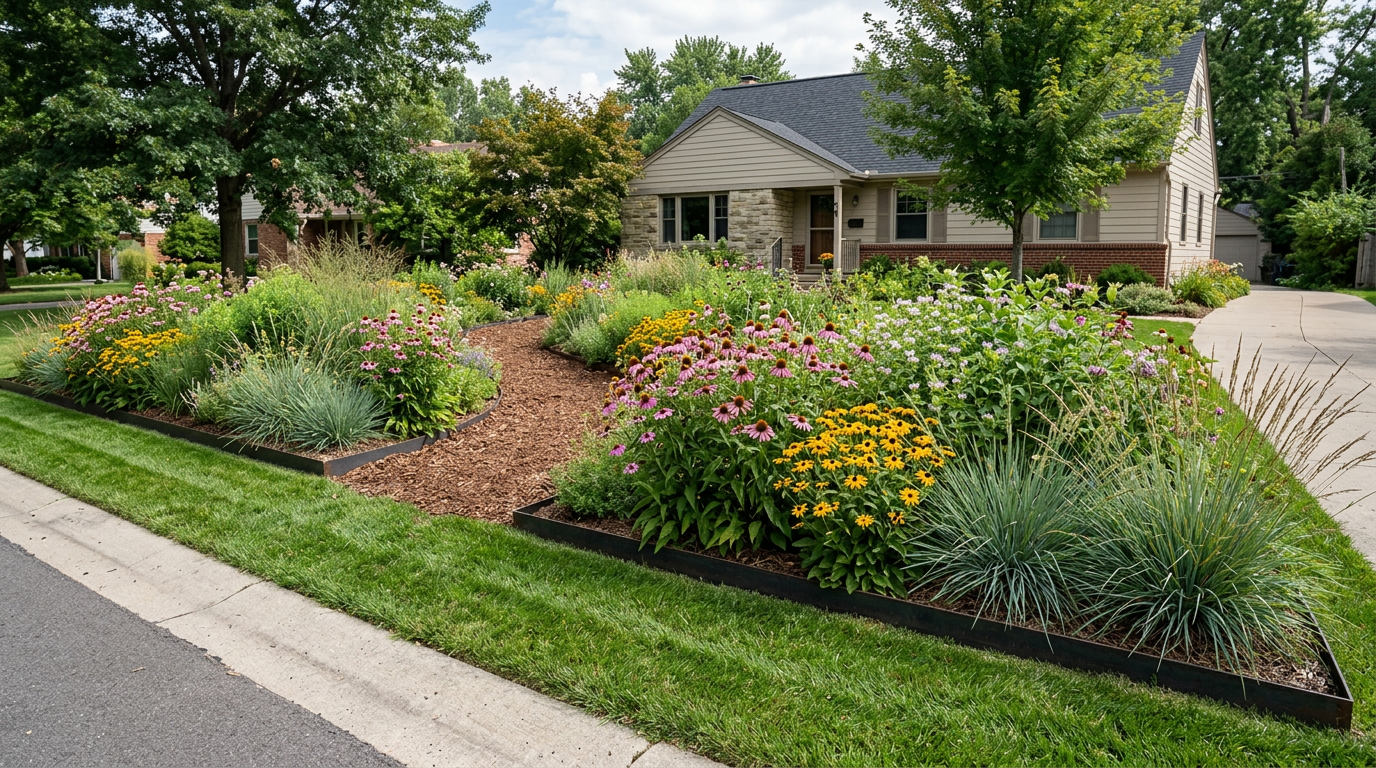
The first cue is the mowed edge. A 3-foot strip of regularly mowed turf around any native bed is the single strongest signal that the bed is intentional, not abandoned. A 6-foot strip is even stronger. If your beds float in the middle of unmowed grass, your neighbor reads “weed lot.” If they are surrounded by a crisp mowed band, the same beds read “garden.”
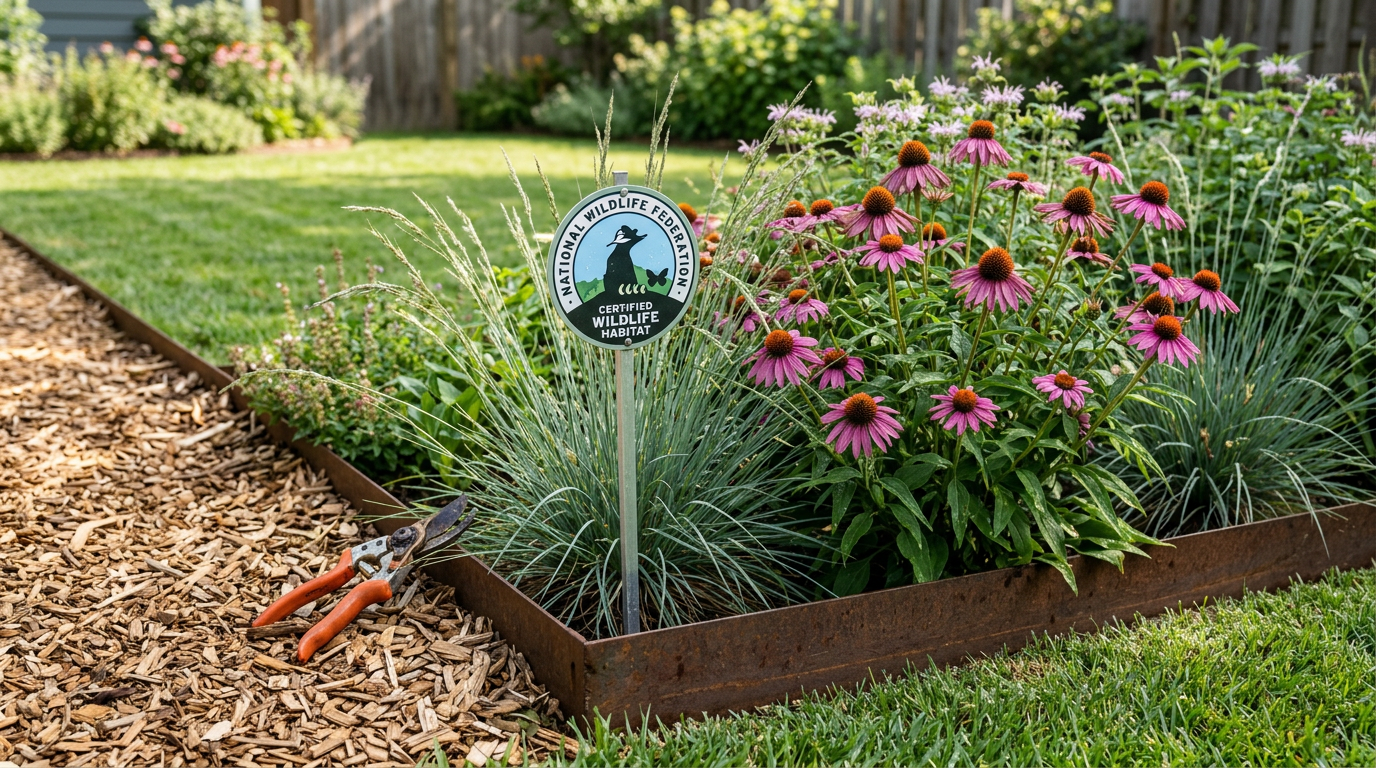
The second cue is the defined border. Steel landscape edging buried 4 inches deep costs about $32 for a 16-foot section at Home Depot or Lowe’s; a curb-stop concrete block alternative is around $1.85 per piece at the same stores. If you prefer the local nursery route, a bed of $2 to $3 plugs from a native nursery still benefits from a $40 edge. The edge is non-negotiable.
The third cue is the path. A single 30-inch wide footpath through or alongside the bed converts the visual from “abandoned” to “garden.” Wood chips dumped free from a tree-service crew via the ChipDrop platform work as well as $4-per-bag mulch from a box store. The path tells every passerby that someone walks here and tends this space.
The fourth cue is the plant in masses. Three echinacea scattered through a bed read as weeds. Twelve echinacea in a cluster read as a planting. Group at minimum five of any one species. If your existing garden has scattered singletons, transplant them in a single afternoon to create masses. The plants are healthier and the bed looks intentional.
The fifth cue is signage. The National Wildlife Federation Certified Wildlife Habitat program certifies your yard for $20 and ships a metal sign for an extra $30. The sign is the single most effective HOA-disarming object I have ever installed. The NWF brand reads as official, the sign reads as intentional, and it transforms a “weed lot” into “Sarah’s certified wildlife habitat.” A complementary Pollinator Pathway sign from Pollinator Pathway adds a second layer. For the full certification walkthrough, see our guide on how to get your backyard certified as a wildlife habitat.
The sixth cue is the seasonal cleanup signal. One pass with hand pruners in late winter to cut last year’s stems to 12 inches, plus one pass with the mower around the perimeter every 10 days, sends a constant “this is tended” message. The total time investment after the first weekend is roughly 25 minutes per week.
What this costs at three budget levels
- Tight budget ($85 total): ChipDrop free wood chips, $32 steel edging, $20 NWF certification, $30 NWF sign. Time: one weekend.
- Mid budget ($220 total): Adds curb-stop concrete blocks for a more permanent edge, a Pollinator Pathway sign, three large hand-painted plant ID tags.
- Premium ($475 total): Adds a low Belgian-block stone border, a wider 3-foot crushed-granite path, and a professional landscape designer’s one-hour consultation, often $75 to $125 in most markets.
Step 4: Write the Response Letter (Template Below)
You are now ready to write the response. The tone is firm, polite, and grounded in documents the board cannot dispute. Mail one paper copy via certified mail with return receipt requested, $4.45 at the post office, and email a second copy to the property manager and every board member individually. Paper plus email is the gold standard. The certified mail receipt is your proof of timely response if the dispute escalates.
The letter has seven sections in this order: heading, statement of receipt, factual record, covenant interpretation, cues-of-care commitment, request for resolution, and signature. Keep it to two pages. The shorter and more factual it reads, the harder it is to dismiss.
Response letter template
[Date]
[Property Manager Name]
[HOA Name]
[Address]
Re: Response to Notice of Violation dated [Date], Property at [Address]
Dear [Board / Property Manager Name],
I am writing in response to the notice dated [Date] regarding the landscaping at [Address]. I appreciate the board’s attention to community appearance and am committed to resolving any concern.
For the record, the planting in question is a managed wildlife habitat installed [Date]. Attached as Exhibit A is a botanical inventory of [X] species, [X] of which are documented native to [County] per the Biota of North America Program. Attached as Exhibit B is a photographic record demonstrating active maintenance, including mowed perimeter, defined borders, a managed footpath, and intentional plant groupings, consistent with the visual “cues of care” framework recognized in landscape design literature.
A review of Article [X], Section [X] of the CC&Rs cites “unkempt appearance.” The attached photographs document the opposite. Article [X], Section [X] further requires enforcement to be uniform; Exhibit C includes dated photographs of [X] other lots within the community displaying conditions comparable to or in excess of those cited.
The planting also satisfies [State statute number, if applicable] regarding [pollinator / drought-tolerant / managed natural landscaping].
To proactively address any remaining community concern, I commit to the following within [30] days: [list 2 to 3 specific cues-of-care additions, e.g., installation of steel edging along the south face, mounting of the NWF Certified Wildlife Habitat sign at the bed entrance, a 6-foot mowed perimeter strip].
I respectfully request that the violation be dismissed upon completion of these improvements. I welcome a board walkthrough at your convenience and have invited a representative from [local Native Plant Society chapter / Wild Ones chapter] to attend.
Sincerely,
[Your Name]
[Address] · [Phone] · [Email]
Enclosures: Exhibit A (Botanical Inventory) · Exhibit B (Site Photographs) · Exhibit C (Comparable Properties)
The template works because every claim is paired with an exhibit. Boards retreat when they realize they would have to argue against documents in writing. Most violations are resolved at this stage without a hearing.
Step 5: Show Up to the Board Meeting With Allies
If the board does request a hearing, do not go alone. Three allies, in this order of impact, change the room.
Ally one is a representative from your local Wild Ones chapter or your state Native Plant Society. Wild Ones runs a free Native Garden Designs program and many chapters will send a member to speak at HOA meetings. Their presence converts your case from “one weird neighbor” to “a movement with experts.”
Ally two is a neighbor with a traditional yard who supports your garden. Even one. Neighbors carry more weight with a board than any outside expert. Ask them in advance to say one sentence: “I live three doors down and I want to go on record that this yard improves the neighborhood.”
Ally three is a printed packet for every board member. Include: the cover letter, the botanical inventory, the comparable-property photos, the relevant state statute, and a one-page summary from the Homegrown National Park HOA toolkit. Pre-staple it. The act of handing a 12-page packet to each board member shifts the room from “complaint” to “case.”
Speak for three minutes maximum at the meeting. Lead with property values (cite the Penn State 2014 study showing native landscaping increases home value by 5 to 11 percent compared to lawn), pivot to maintenance (your garden requires no irrigation, no fertilizer, no mowing in the bed), and close with a specific ask (dismiss the violation, allow 30 days to complete the cues of care). Then sit down.
When the HOA Will Not Budge: Three Escalation Paths
About 8 percent of cases reach the point where the board votes to enforce despite a strong response. You still have three paths.
Path one is the state HOA ombudsman or the state attorney general’s HOA division, available in 16 states. Filing a complaint is free and the state has authority to investigate selective enforcement. Many boards back down at the first state letter.
Path two is mediation. Most state HOA acts now require mediation before litigation, and a $250 to $500 mediation session usually settles. Bring the same packet. Mediators are not landscape experts but they respond strongly to documented uniform-enforcement failures.
Path three is small claims court. If the HOA has fined you, you can dispute the fines in small claims for the cost of filing, typically $50 to $100 in most jurisdictions. Boards spending lawyer fees to defend a $200 fine against a documented record almost always settle.
For the rare case that reaches actual lawsuit territory, the Wild Ones legal resource page maintains a referral list of lawyers experienced with native plant cases, and several offer free initial consults.

Three Sources Sarah Should Bookmark Before the Next Letter
If you are reading this before any letter has arrived, congratulations. You have time to build the file in advance. Three resources do most of the prep work for you.
The NWF Cues of Care page walks through Nassauer’s original framework with a printable checklist. Save the PDF.
The Homegrown National Park “Planting Native in Your HOA Community” toolkit includes a sample homeowner letter, a sample board-presentation slide deck, and links to all 12 state statutes. This is the single most useful free document in this space.
The Wild Ones Ordinance and HOA Help page lists every active municipal ordinance protecting native plants by state and gives you a template to lobby your municipality for one if yours does not have it yet.
If you are still in the early planning stage and looking for budget-friendly ways to source plants that will be both native and visibly intentional, our roundup on the five most affordable native plant sources gets you started for under $100. For rain-related stormwater claims on your side of the response letter, the three-zone rain garden recipe is what most state statutes actually reference.
Personal Note From My Own Yard
The first letter arrived in July of the second summer. I had spent the spring transplanting plugs of Asclepias tuberosa, Penstemon digitalis, and three different little bluestem grasses across what used to be a 700-square-foot fescue lawn. The plants were small, the bed looked sparse, and from the curb it honestly did read as “lawn that someone gave up on.” A neighbor I had never spoken with complained.
I made every mistake the first 48 hours. I emailed the property manager a defensive paragraph. I argued. I sent photos of monarchs without context. The board responded with a hearing date. That was the moment I stopped and rebuilt the response from scratch using the framework above.
In a single weekend in August, I installed 80 feet of $32 steel edging, dumped a free ChipDrop load to lay a 30-inch path, mowed a 4-foot perimeter strip, and ordered the NWF Certified Wildlife Habitat sign. Total spend: $94. I rewrote the response letter as a two-page document with three exhibits. The hearing lasted 14 minutes. The violation was dismissed.
The second letter, eighteen months later, came from a different neighbor about the same yard. The board sent it to me with a cover note that read, in effect, “we logged it but it is in compliance.” That cover note is the response plan working in retrospect. The cues of care have done the talking on every complaint since.
FAQ
Can my HOA actually force me to remove native plants?
Only if your CC&Rs specifically and unambiguously prohibit the species or category, and only if the enforcement is uniform and procedurally correct. Vague phrases like “unkempt” or “neat appearance” are rarely sufficient on their own when challenged with a documented cues-of-care defense. In 12 states with specific statutes protecting pollinator or drought-tolerant landscaping, the HOA cannot force removal at all. Check your state code before assuming the worst.
How long do I have to respond to an HOA violation letter?
Most CC&Rs give 14 to 30 days for a written response, but the exact window is in your covenant document, usually in the violation procedure section. Some states, including California and Florida, set statutory minimums regardless of what the covenant says. Respond by certified mail well before the deadline. A timely written response also preserves your right to a hearing in most jurisdictions.
What if the HOA fines me before I can respond?
Most state HOA acts require notice and an opportunity to be heard before fines can be assessed. If a fine appears on your account before you have had a hearing or your written response has been answered, you have grounds to dispute the fine on procedural grounds alone. Document the timestamp, request a copy of the board’s enforcement minutes, and reference your state’s HOA statute in writing.
Do I need a lawyer for a native plant dispute?
For roughly 90 percent of cases, no. The documented response packet, cues-of-care additions, and a board-meeting appearance with allies resolves the dispute. A lawyer becomes useful only if the HOA files a lien, levies repeated fines, or escalates to actual litigation. At that point, look for an attorney with HOA or land-use experience; Wild Ones maintains a referral list and many state native plant societies do as well.
Will adding mulch and a path really change the board’s mind?
Yes, more reliably than any other intervention I have seen. Joan Nassauer’s original 1995 research showed that the same ecological planting was rated 38 percent more visually acceptable by neighborhood juries when even one cue of care was added. With four or more cues, acceptance approached lawn-equivalent levels. Boards respond to the same visual signals neighbors do. The path, the edge, the mowed perimeter, and the sign do most of the work.
The Quiet Win
The five steps above turn what feels like a confrontation into a paperwork exercise. Document, read the rules, build the cues of care, write the response, show up with allies. Almost every native plant garden survives the first letter, and the surviving ones tend to multiply on the street as neighbors notice the goldfinches and the monarchs.
If a letter is sitting on your kitchen counter right now, set it down. Take the 48 hours. Walk the yard with your phone. Pull the covenants. The garden you built is not the problem. The framework is already on your side, and once you have the file assembled, the rest is just typing.
Want More Wildlife Garden Tips?
Join 5,000+ nature lovers getting our weekly tips on creating wildlife-friendly gardens.
No spam, unsubscribe anytime. Privacy Policy
Emma Harrington
Emma Harrington is a wildlife habitat researcher and content editor with a passion for backyard conservation. She has spent over a decade translating ecological science into practical tips anyone can follow — from selecting native plants to building wildlife-friendly habitats. Her work focuses on helping homeowners transform ordinary yards into thriving ecosystems for bees, butterflies, hummingbirds, and other beneficial wildlife.