
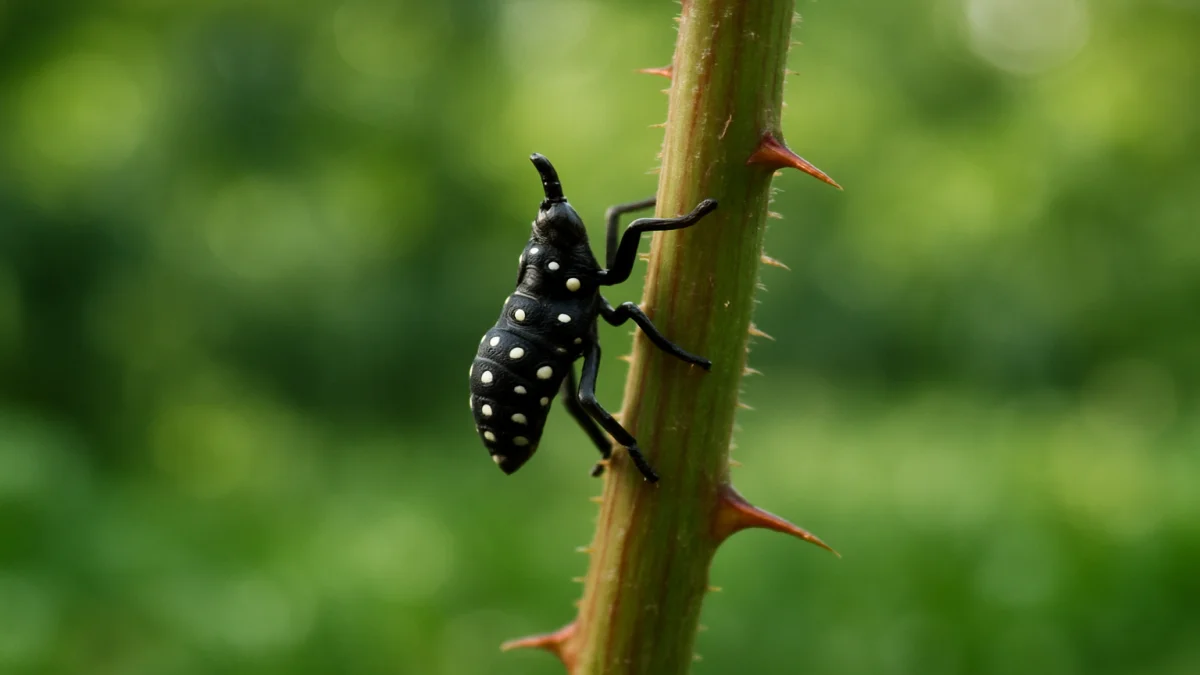
The little black dots on your rose canes are not ticks. They are not spiders either, even though they look like both. If you live anywhere from Richmond to Albany this spring, the odds are good that those tiny crawlers with faint white flecks are first-stage spotted lanternfly nymph hatchlings, and they are waking up right now across nineteen states. What you do in the next four weeks matters more than anything you will do all summer, because the first nymphs are small, slow, and easy to kill with nothing more than a garden glove and a bucket of soapy water.
Most of the advice circulating on neighborhood Facebook groups is outdated, exaggerated, or flat-out dangerous to the birds and bees you have worked years to attract. State entomologists at Penn State, Maryland Extension, and Ohio State have published updated guidance for the 2026 hatch, and their recommendations have shifted noticeably from the panic era of 2018. Spotted lanternfly is still a serious agricultural problem, but in a backyard with no grapevines, the picture looks different than the headlines suggest.
This guide walks through what the nymphs look like at each stage, which homemade remedies waste your time, which ones actually knock back populations, and how to protect your pollinators while you do it. Everything below is drawn from university extension sources and current state agriculture department guidance, not from viral posts.
FREE: Wildlife Garden Starter Guide
Get our 12-page PDF with the 25 best plants for pollinators, simple habitat tips, and a printable checklist — all 100% free.
No spam. Read our Privacy Policy.Why 2026 could be the worst year yet for backyard lanternfly sightings
New York’s Department of Agriculture issued a blunt warning in late March: downstate winter temperatures never dropped cold enough, for long enough, to kill the egg masses that overwintered on tree trunks, lawn furniture, and firewood. The same pattern held across the mid-Atlantic corridor and into parts of Ohio and southern New England. When egg masses survive winter, the nymphs that hatch in April and May emerge in numbers that dwarf previous seasons.
A 2024 study from New York University added a second wrinkle. Kristen Winchell, an assistant professor studying urban ecology, documented that spotted lanternflies in heat-island neighborhoods of Manhattan and Queens lived up to five months longer than their rural counterparts. Warmer asphalt, longer autumn warmth, and degraded native ecosystems all compound the advantage. Cities become year-round nurseries for a species that evolved in much colder Asian winters.
Fox Weather, citing multiple state agriculture departments, reported that the 2026 surge is expected across at least twenty-one states, with New York, New Jersey, Connecticut, Virginia, Maryland, Ohio, and Pennsylvania taking the hardest hit. Each surviving female can lay one to two egg masses with thirty to sixty eggs each. A yard with a dozen missed egg masses last fall can easily produce five hundred hatchlings this spring.
Reality check: Ohio State Extension estimates that only about two percent of egg masses on mature trees are within scraping reach from the ground. The goal is not eradication. The goal is knocking down the reachable population so the rest of the food web can absorb what is left.
For the typical homeowner this does not mean doom. It does mean the April hatch is going to be visible in more yards, for more weeks, than last year. Vigilance in late April and May saves a great deal of trouble in July and August.
How to spot the four nymph stages before they damage your maple
Spotted lanternflies go through four nymphal instars between hatch and adulthood. Each stage looks different enough that most homeowners misidentify at least one of them the first time they see it. Getting comfortable with the visual progression is the single most useful skill for anyone living in a quarantine county.
First instar (late April through late May)
These are the ones that get confused with ticks. Bodies are roughly one-eighth of an inch long, jet black, with a fine dusting of white pinpoint spots that you may not notice without a phone camera zoom. They move slowly, climb almost anything vertical, and cluster on tender new growth. Rose canes, grapevine shoots, and tree-of-heaven seedlings are all early favorites. If you see a procession of specks marching up a stem in single file, you are almost certainly looking at first-instar nymphs.
Second and third instars (mid-May through June)
Same black-and-white pattern, but the body roughly doubles in size at each molt. By the third instar they are closer to a quarter inch long and the white spots are visible without magnification. At this stage they start appearing on a wider range of hosts, including silver maple, willow, black walnut saplings, and hops. They also hop aggressively when disturbed, which is how a single tap on a branch can reveal two dozen of them you never saw while standing still.
Fourth instar (mid-June through July)
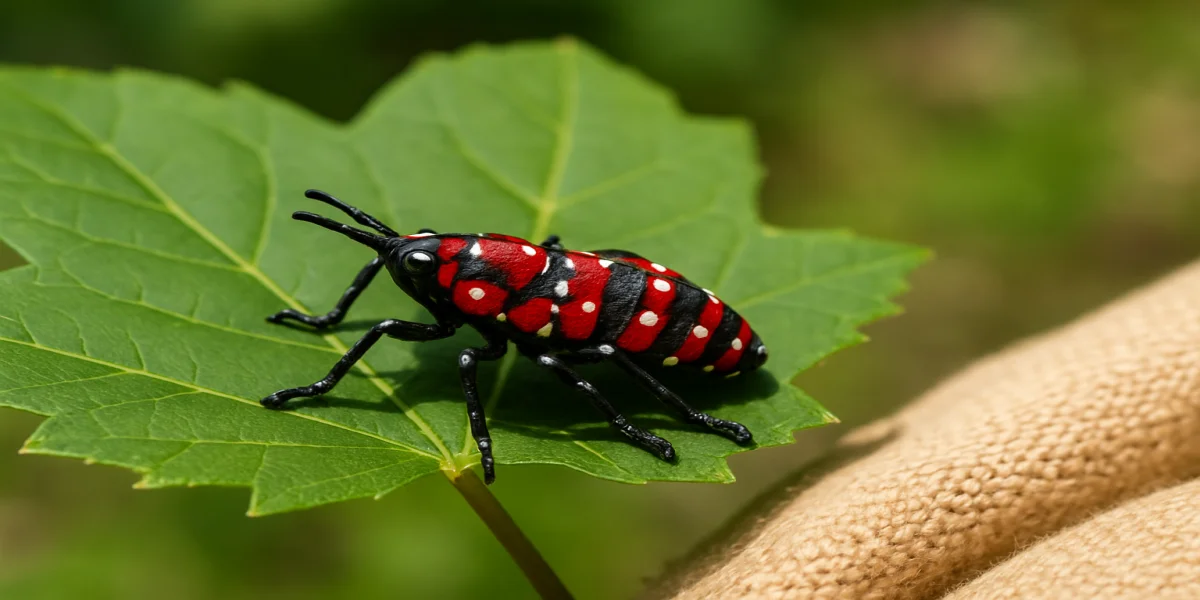
The dramatic color change happens here. The body shifts from black with white spots to a vivid red background with black bands and white flecks, about a half inch long. This is the stage most people finally recognize because it is the one that ends up on news broadcasts. It is also the last practical window for mechanical control before adults emerge, mate, and start laying the next generation.
Adults (July through the first hard frost)
Gray forewings with black spots at rest, a full inch long, with striking red underwings that flash when they leap. Adults prefer woody trunks and branches over tender growth, which means they cluster on tree bark in impressive numbers by late summer. By that point, hand removal becomes a losing battle and the focus shifts to egg-mass scraping in the fall.
Knowing the stages lets you time your response. The early nymph window is the cheapest, safest, and most effective time to act. Waiting until the red-and-black fourth instar stage is like trying to mow the lawn after the grass has gone to seed. You can still do it, but you missed the easy version.
The tree of heaven connection and why every homeowner should know it
If there is one fact about spotted lanternfly that every homeowner should memorize, it is this: the insect is almost obsessively drawn to a single invasive tree called tree of heaven, or Ailanthus altissima. Removing or treating that tree does more to reduce your yard’s lanternfly population than any spray on the market.
Tree of heaven is the plant that grows in sidewalk cracks, vacant lots, highway ramps, and the fencerow of almost every older neighborhood. It has compound leaves that look superficially like sumac or black walnut, smooth gray bark, and a distinctive rancid-peanut smell when the leaves or bark are crushed. It grows fast, reseeds aggressively, and is already on the invasive-species watchlist in most eastern states. Spotted lanternfly co-evolved with tree of heaven in its native range, and the adult females appear to need compounds from the tree’s sap to lay viable eggs.
That means two practical things for your yard. First, if you have tree of heaven on or near your property, you have a lanternfly amplifier. Every other control measure you take will be swimming upstream as long as that tree stands. Second, tree of heaven looks enough like native species. Staghorn sumac, black walnut, even ash. That many homeowners hesitate to remove a tree they are unsure about. University of Maryland Extension specifically recommends contacting an extension office or a certified arborist before cutting, because a misidentified removal is a waste and can trigger invasive regrowth from the roots. If you want to verify whether a tree is truly native to your county before cutting, your state extension or BONAP database is the place to start.
- Crush a leaf between your fingers. Tree of heaven smells like rancid peanut butter. Sumac smells grassy. Walnut smells sharp and citrusy.
- Check the leaflets. Tree of heaven has a small tooth at the base of each leaflet, a feature sumac and walnut both lack.
- Look at bark texture. Young tree of heaven has smooth gray bark with pale vertical stripes, like a stretched-out deer hide.
- Photograph it and send the image to your state extension office if you are unsure. Every state with a lanternfly quarantine has a free plant ID line for this exact question. The BONAP North American Plant Atlas is also a useful cross-reference for native range maps.
- Never cut tree of heaven down without treating the stump with a labeled herbicide. Cut-and-leave produces dozens of root suckers within a season.
If you do not have tree of heaven yourself, your closest one may be on a neighbor’s property, along an alley, or behind a fence. Walk the perimeter in May when the leaves are fresh. One conversation with a neighbor can remove a lanternfly factory from three yards at once.
What actually kills spotted lanternfly nymphs in a backyard (ranked)
Not every control method is equally useful. The table below ranks the options that extension specialists consistently recommend, from cheapest and safest to more involved. Start at the top and only move down if infestations persist.
| Method | Best for | Cost | Wildlife-safe? | Effectiveness |
|---|---|---|---|---|
| Stomp and hand-crush | All nymph stages, adults at rest | Free | Yes | High at low densities |
| Soapy water in a spray bottle | First and second instar on stems | Under five dollars | Yes if rinsed off plants | High on direct contact, zero residual |
| Shop vacuum with a long wand | Clusters on trunks or siding | One-time tool cost | Yes | High when numbers are manageable |
| Circle traps on host trunks | Nymphs climbing up maples, willows | Twenty to forty dollars per tree | Yes with wildlife barrier | Moderate, passive, effective over weeks |
| Insecticidal soap spray | Heavy nymph clusters on reachable foliage | Ten dollars per bottle | Moderate, avoid flowers | High on contact, no residual |
| Neem oil | Shaded foliage with repeat applications | Fifteen dollars | Moderate, avoid bees | Moderate, repels more than kills |
| Natural pyrethrin spray | Stubborn infestations on woody stems | Fifteen to twenty dollars | Lower, harmful to aquatic life | High on contact, limited residual |
| Professional systemic treatment | Orchards, large ornamental trees | Two hundred dollars and up | Depends on product | High, long residual, not for flowering trees |
A few practical notes that the table cannot capture. Soapy water works because surfactants break the water tension on the insect’s respiratory pores, drowning it within 10 to 30 seconds. A mix of one tablespoon of mild dish soap in a quart of tap water is enough. Stronger concentrations can burn tender foliage, so test a leaf first and rinse off any blossoms within an hour of spraying.
Circle traps deserve a closer look because they are the one tool that keeps working while you are at the grocery store. Penn State Extension publishes free plans for a traditional funnel design that intercepts nymphs as they climb tree trunks searching for new foliage. The trap funnels them into a collection bag with no adhesive, which means birds, bats, and squirrels cannot get stuck. Mount the opening about four feet off the ground on host trees. Tree of heaven, silver maple, black walnut sapling, willow. Starting in the last week of April. Empty the bag every 3 to 5 days into a bucket of soapy water.

Professional systemic insecticide treatments are sometimes recommended for landscape maples or a cherished black walnut, but they should never be applied to flowering trees. Systemics move into nectar and pollen, which means the same honeybees and native mason bees you have been trying to attract will take a lethal dose. Reserve systemics for trunks of species that do not bloom while bees are active, and hire a licensed applicator who understands the timing.
Five popular lanternfly control methods that do not work
Every spring a new batch of DIY videos recirculates on social media. Some are harmless. Others damage plants, kill beneficial insects, and leave the homeowner no closer to lanternfly control. Extension specialists have been clear about which ones to skip.
1. Sticky bands without a wildlife barrier
Plain adhesive bands wrapped around tree trunks catch lanternfly nymphs, but they also catch songbirds, nuthatches, downy woodpeckers, bats, squirrels, tree frogs, and the very mason bees you installed a bee house for. Penn State Extension now recommends using sticky bands only when they are covered with a chicken-wire cage that blocks vertebrates and larger pollinators. Unshielded bands were responsible for multiple documented bird mortalities during the 2019 to 2022 seasons.
2. Household vinegar sprays
The appeal is obvious: a gallon of vinegar costs three dollars and feels satisfying to use. The problem is that acetic acid at concentrations strong enough to kill a lanternfly will also burn leaves, scorch soil microbes, and harm other soft-bodied beneficials within range. University of Maryland Extension specifically warns against vinegar sprays because they damage host plants without materially reducing lanternfly populations.
3. Strong dish soap at full concentration
A light concentration, around one tablespoon per quart, works well. A strong concentration, such as undiluted dish soap sprayed directly, kills the insect but also defoliates tender plants and rinses into the soil where it harms earthworms. The insect dies just as fast at the safer dilution, so there is no reason to escalate.
4. Pressure washers
A pressure washer aimed at a tree trunk can knock nymphs loose, but it also strips bark, damages bud tissue, and compacts the soil around roots. The insects, meanwhile, simply climb back up. Save the pressure washer for the deck and use a hand-held sprayer for the tree.
5. Stomp-only campaigns as a complete strategy
Stomping is fine, satisfying, and recommended by every extension service. It is also insufficient as a stand-alone strategy once numbers climb into the hundreds. A yard with serious pressure needs circle traps, an honest conversation about any nearby tree of heaven, and egg-mass scraping in the fall. The see-it-squish-it message is a starting point, not a complete plan.
Quick tip: The fastest way to tell whether a home remedy is credible is to check whether your state extension office endorses it. Every state with a lanternfly presence maintains a free plant-health hotline staffed by people whose job is answering exactly this question.
If a method hurts birds, bees, soil, or bark without materially cutting lanternfly numbers, it is not worth the time it saves. The methods above fall into that category.
When to stop, when to call, and what to report to your state
Most homeowners in established quarantine counties no longer need to formally report sightings. Ohio’s Department of Agriculture announced in March 2026 that Lucas County, along with most of the northeastern quadrant of the state, has moved off the active reporting list because populations are established. The same is true for much of Pennsylvania, New Jersey, Maryland, and Delaware.
That does not mean reporting is useless. It means the reporting priority has shifted. State agriculture departments now want to hear about:
- First confirmed sightings in counties not yet on the quarantine map
- Any adult lanternfly outside the eastern corridor, especially along transportation routes in the Midwest and upper South
- Egg masses on commercial vehicles, RVs, or firewood that appears to have been transported interstate
- Large die-offs of grapevines or black walnut saplings that may be the first signal of a damaging infestation
- Unusual life-stage observations, such as second-instar nymphs appearing weeks earlier than expected in your area
Reporting routes are state-specific but consistent in shape. Every affected state has a webpage under its Department of Agriculture with a photo-submission form, a phone hotline, or both. Most also have a smartphone-friendly form. A quick search for “spotted lanternfly report” plus your state name reliably lands on the right page. Citizen-science platforms such as iNaturalist are also used by state entomologists to track range expansion in real time.
Stop calling your county extension when you are simply finding typical numbers in a known infested county. Those reports flood the system and prevent staff from responding to the novel sightings that actually matter. Start calling when something feels off. A population where there should be none, a tree species you did not expect them on, or unusual timing.
Protecting backyard pollinators while you knock back lanternflies
If you have invested in a pollinator garden, a bee house, or a certified wildlife habitat, the last thing you want is a lanternfly response that sets you back three seasons. The principles below let you go after the pest without losing the ally.
Spray only what you can see, when it is still cool
Early morning, before bee activity begins, is the safest window for any foliar spray. Mid-morning through late afternoon is peak native-bee foraging time. Direct contact with an insecticidal soap kills the lanternfly on the leaf and then dries to inert residue within an hour. Bees that visit that leaf later in the day are not harmed. Spraying at peak bloom or peak bee activity, with any product including soap, is the most common way well-intentioned yards damage their own pollinator populations.
Skip sprays entirely on flowering plants
If the lanternflies are on a plant that is in bloom, pick them off by hand or knock them into a bucket of soapy water. Never spray a blooming milkweed, coneflower, aster, bee balm, or vegetable flower. This one rule, consistently followed, resolves the pollinator question in most backyards.
Keep tree-of-heaven removal away from nesting season
Cavity-nesting birds. Chickadees, nuthatches, wrens, screech owls, the full cast list. Are in active nest-building or incubation from mid-March through July across most of the lanternfly corridor. If you are removing a small tree of heaven, a late-winter or late-fall cut protects you from accidentally destroying a nest inside a snag or hollow. Larger trees should be assessed by an arborist who can confirm that no active cavity is present before the saw comes out.
Scrape egg masses by hand, not with chemical knockdowns
Egg masses look like a smear of grayish putty roughly an inch long, often on the shaded side of a tree trunk or under eaves. A plastic credit card, a small container of rubbing alcohol, and ten minutes on a fall afternoon remove thirty to sixty eggs per mass. This is pollinator-neutral work. There is no drift, no residue, and no collateral damage. Every mass you remove in October saves an ounce of spring trouble.
Feed the birds that eat lanternflies
Not every backyard bird will touch spotted lanternflies, but a growing list of native species documented by the National Audubon Society will. Chickens, guinea fowl, catbirds, northern cardinals, blue jays, and yellow-bellied sapsuckers have all been documented feeding on adults and fourth-instar nymphs. Maintaining a diverse habitat. Water sources, native shrubs, and clean feeders. Gives birds the energy to keep experimenting with new food sources. A yard that supports a broad songbird population will, over the long run, suppress lanternfly numbers in a way that no spray schedule can match.
For homeowners who already maintain a wildlife corridor or a certified backyard habitat, the good news is that the habits you have already built. Diverse plantings, minimal spray use, water features. Are also the habits that keep lanternfly pressure manageable. The bird population, the predatory insects, and the spiders all pitch in. Your job is to remove the amplifier (tree of heaven) and intervene on the nymphs you can reach.
For more on integrating pest management with pollinator gardening, the Xerces Society publishes a regularly updated guide at xerces.org that walks through product-by-product risk assessments.
Conclusion
The spring of 2026 is shaping up to be a loud one for spotted lanternfly, but loud does not mean hopeless. The nymphs hatching this week are the easiest lanternflies you will encounter all year. Small, slow, and vulnerable to a ten-cent spray of soapy water. Removing or treating any tree of heaven within fifty feet of your property knocks the amplifier out of the system. Circle traps on host trunks in late April catch nymphs you will never see otherwise. Skipping vinegar, pressure washers, and uncovered sticky bands protects the birds and bees you have been working years to attract. And paying attention in October, when the egg masses go down, erases tomorrow’s problem before it starts.
If this helped, share it with a neighbor who still has a tree of heaven by the fence line. Their yard is your yard’s problem, and a five-minute conversation saves both of you a difficult summer.
Read next: How to Control Mosquitoes in Your Yard Without Harming Bees, Birds, or Bats
What I get asked the most
Can spotted lanternfly nymphs bite or sting people or pets?
No. Spotted lanternfly nymphs and adults have piercing mouthparts designed for plant sap, not skin. They do not bite, sting, or transmit disease to humans or pets. They also do not infest homes the way termites or carpenter ants do, though they sometimes crawl up siding and windows in large numbers.
Will a spotted lanternfly infestation actually kill my maple, oak, or fruit trees?
Grapes and black walnut saplings are the only plants where lanternflies have been documented to directly cause death. Mature maples, oaks, and most fruit trees tolerate feeding pressure without long-term harm. The bigger issue is honeydew, the sugary excretion that coats leaves and attracts sooty mold, which can reduce photosynthesis if left untreated on a heavily infested tree.
What do I do with a dead spotted lanternfly nymph after I crush it?
Anywhere. Drop it into a bag, a compost pile, or the soapy bucket you are using to collect them. Dead nymphs pose no risk of re-animation, contamination, or spread. The only spread risk comes from living adults or egg masses hitching rides on vehicles.
Does the rubbing alcohol method work on eggs laid on firewood?
Yes, and it is the single most important time to use it. Firewood moved in winter or early spring is the main long-distance vector for spotted lanternfly. Scrape any suspect masses on firewood into a jar of rubbing alcohol before the wood enters your yard or a campground. Never move uninspected firewood across a quarantine line.
Is there anything that prevents spotted lanternfly egg-laying in the fall?
Prevention is difficult because females lay on almost any vertical surface. Bark, fence boards, lawn furniture, grill covers, vehicles, brick walls. The most effective preventive action is removing or treating nearby tree of heaven, since that tree appears to be necessary for successful egg production. A yard without tree of heaven within a few hundred feet typically sees noticeably fewer egg masses by the next spring.
Want More Wildlife Garden Tips?
Join 5,000+ nature lovers getting our weekly tips on creating wildlife-friendly gardens.
No spam, unsubscribe anytime. Privacy Policy
Emma Harrington
Emma Harrington is a wildlife habitat researcher and content editor with a passion for backyard conservation. She has spent over a decade translating ecological science into practical tips anyone can follow — from selecting native plants to building wildlife-friendly habitats. Her work focuses on helping homeowners transform ordinary yards into thriving ecosystems for bees, butterflies, hummingbirds, and other beneficial wildlife.