
A neighbor two doors down swears she has never seen a Baltimore Oriole in her yard. Same trees, same latitude, same kind of backyard you probably have. The yard across the street from hers gets two or three orioles every year, like clockwork, from the third week of April until the first of June. The difference is not luck. It is the first weekend. In oriole country, the people who miss the opening window of migration usually miss the whole season.
Grape jelly for orioles is half the reason that second yard works, and it is also the thing most people get quietly wrong. Wrong jelly, wrong container, wrong amount, wrong location. Any one of those mistakes can turn a brilliant flame-orange songbird into a bird that flies past and keeps going. This guide walks through the April setup step by step. The timing, the brand on the shelf, the feeder that does not draw hornets by Memorial Day, and the small warnings no one tells you about until a bird gets into trouble.
None of this is expensive. You can do the whole setup for under forty dollars, and once you learn the rhythm you will recognize the first oriole the moment its whistle hits the yard.
FREE: Wildlife Garden Starter Guide
Get our 12-page PDF with the 25 best plants for pollinators, simple habitat tips, and a printable checklist — all 100% free.
No spam. Read our Privacy Policy.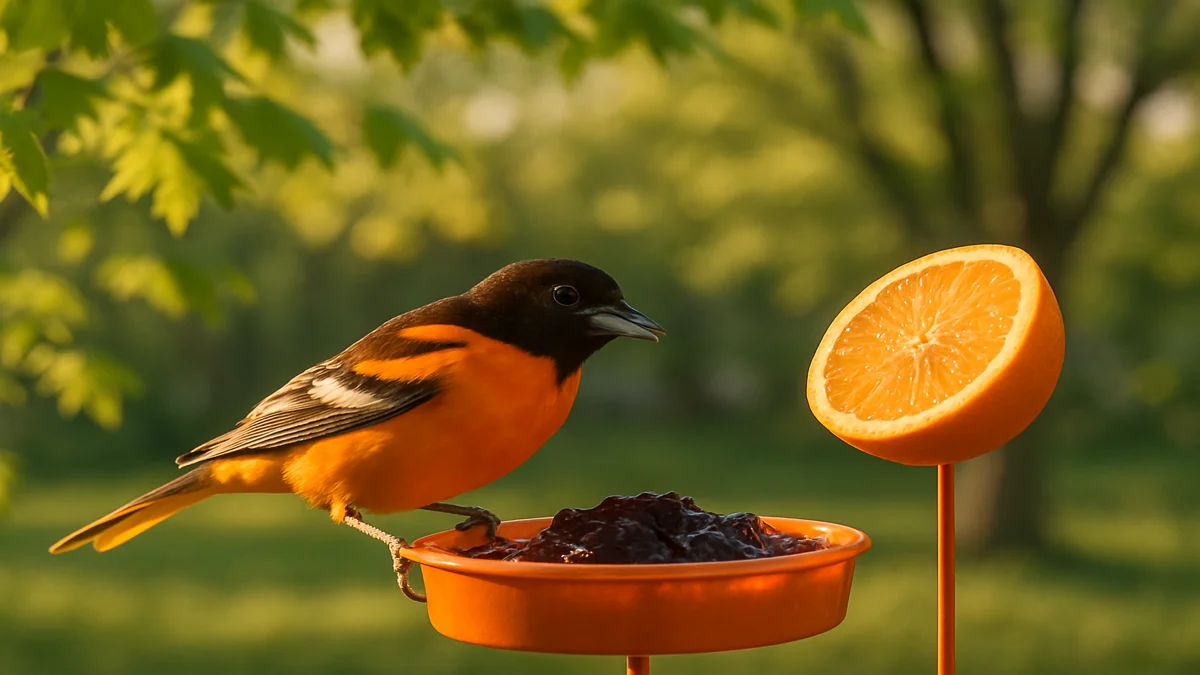
The first weekend orioles arrive is the only one that matters
Baltimore Orioles move north on a tight schedule. The first yards to see them are along the Gulf Coast in late February or early March, Texas, Louisiana, the Florida panhandle. The wave then rolls north roughly one or two states per week. By late March and early April orioles are through Arkansas, Tennessee, and the Carolinas. The Ohio Valley and Mid-Atlantic usually see them in the second or third week of April. Most of New England, the upper Midwest, and southern Canada see them late April through the first ten days of May.
The rule every seasoned feeder-watcher repeats: put your feeders out one to two weeks before you expect the first arrival. If your part of the country peaks at the first of May, your jelly dish should be hanging by April 20. If you wait until you actually see an oriole, you have already missed the window. The bird has already flown past looking for a food source, found one four houses down, and settled there for the rest of the spring.
A migrating oriole burns through fat reserves fast. The birds that arrive at your latitude in late April have flown thousands of miles, often crossing the Gulf of Mexico in a single overnight push. They are hungry, tired, and looking for the brightest, sweetest signal they can spot from above. Orange halves and a bowl of grape jelly hanging in the open is exactly that signal. Miss the first weekend and the orioles on that first push will already be paired with a yard by the second.
- Gulf Coast (TX, LA, FL): feeders out by early March
- Mid-South (AR, TN, GA, SC): feeders out by mid-March
- Mid-Atlantic + Ohio Valley: feeders out by the first weekend of April
- Great Lakes + New England: feeders out by April 15
- Upper Midwest + southern Canada: feeders out by April 25
If you are already past those dates, the second-best day to hang your feeder is today. There is a smaller but real return wave of late migrants through the first half of May in most of the country.
The jelly on your kitchen shelf probably will not do
Most people reach for whatever grape jelly is in the refrigerator. A lot of those jars should stay where they are. There are two mistakes that repeat every spring, and both of them are easy to prevent once you know what to look at on the label.
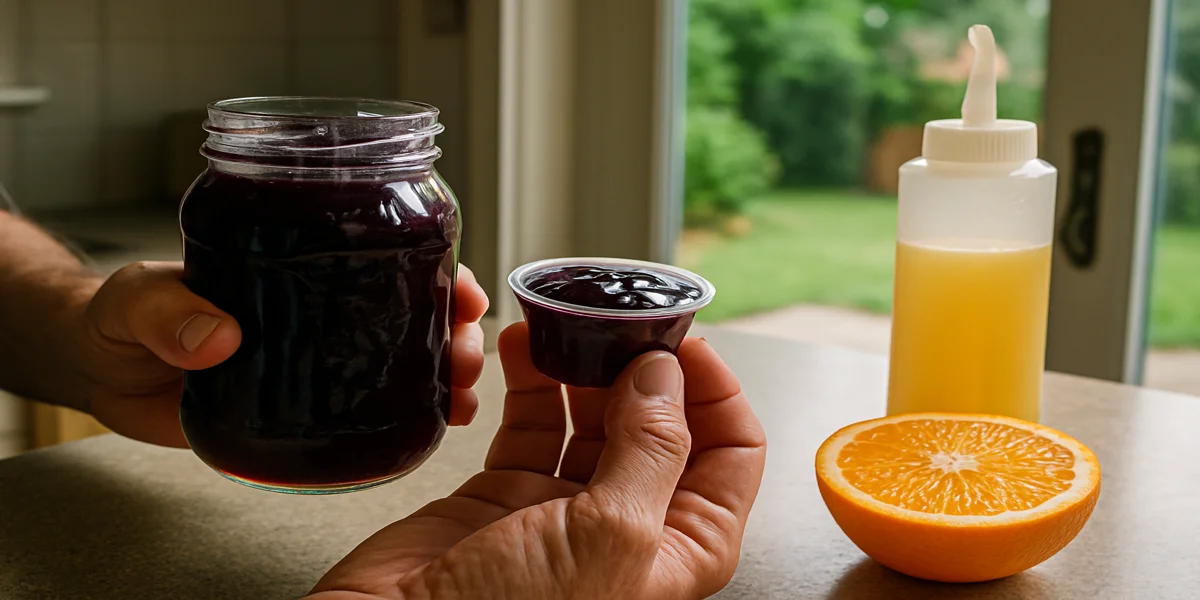
Mistake one: jam instead of jelly. Orioles want jelly. The smooth, clear, strained version. Jam has fruit pieces and pectin chunks that trap bird feet and feathers. “It has to be basic grape jelly, not a jam” is one of the most consistent rules from experienced oriole-feeders. A jar labeled “grape spread” or “grape preserves” is not the right product either.
Mistake two: sugar-free or “light” jelly. This one is not a taste issue. It is a safety issue. Sugar-free jellies are often sweetened with xylitol or aspartame, and xylitol in particular is toxic to birds. It can trigger a rapid insulin drop, seizures, and death. Wildlife rehabilitation clinics have been admitting hummingbirds that got into the wrong feeder and orioles that were fed reduced-sugar products by well-meaning homeowners. The rule is simple: regular sugar, nothing else. No stevia, no “naturally sweetened with fruit juice,” no sugar-free anything.
The brand most commonly recommended by people who have fed orioles for decades is Welch’s Natural Grape Jelly. The squeezable bottle version without high-fructose corn syrup. The ingredient list should be grapes, sugar, pectin, and citric acid. Nothing else. The squeeze bottle also happens to be the easiest way to refill a small dish without making a mess on the feeder pole.
A quick reality check on what you are actually putting out: jam and jelly are more than fifty percent sugar by weight. Natural flower nectar that an oriole would normally drink is somewhere between twelve and thirty percent sugar. The bird is getting a concentrated burst when it visits the dish, which is why how much you offer matters as much as which brand you buy.
Half full, not one bit more (the feather-matting accident nobody warns you about)
This is the section nobody warns new oriole-feeders about, and it is the one that causes real harm.
Grape jelly is sticky. Very sticky. A small bird that lands too enthusiastically on a full dish can get jelly onto its breast feathers, its belly, the underside of its wings. Once those feathers mat together, the bird cannot thermoregulate properly, cannot waterproof itself in rain, and cannot fly efficiently. In serious cases, the bird cannot lift off at all.
One documented case from a longtime bird rehabber involved a Red-breasted Nuthatch found completely sunk into a jelly dish, “only the beak and eyes were sticking out.” The bird survived, but only after hours of warm-water baths to dissolve the jelly out of every feather. Hummingbirds have been admitted to rehab clinics in worse shape. Some did not survive.
The prevention is simple. Follow these three limits every time you refill:
- Never fill the jelly cup more than halfway. A teaspoon or two is plenty. You can refill twice a day during peak migration if you want. That is still safer than one big pour.
- One-quarter cup per day is a practical upper limit for a single dish, even in a yard full of orioles. Birds self-satiate on sugar quickly and do not need more.
- Choose a dish with a raised lip or a narrow opening instead of a flat saucer. A narrow jelly cup forces the bird to pick at the surface with its beak instead of stepping onto the jelly.
If you do see a bird with jelly on its feathers, bring it gently indoors, place it in a box with a soft cloth, and call a licensed wildlife rehabilitator. Do not try to wash a wild bird yourself. The stress of the washing can kill a bird faster than the jelly will.
The other reason to keep portions small: grape jelly spoils fast in direct sun. Bacteria grows, fruit flies show up, and by the second hot afternoon you have a fermented puddle that no self-respecting oriole will touch. Small amounts, refilled often, is the whole game.
Three feeders that hold jelly without the hornets taking over
An open saucer of jelly will work in April. By the third week of May it will be owned by hornets, yellowjackets, ants, and fruit flies, and every oriole will have left for a cleaner yard. A purpose-built oriole feeder solves almost all of that. Three designs have earned their reputation.
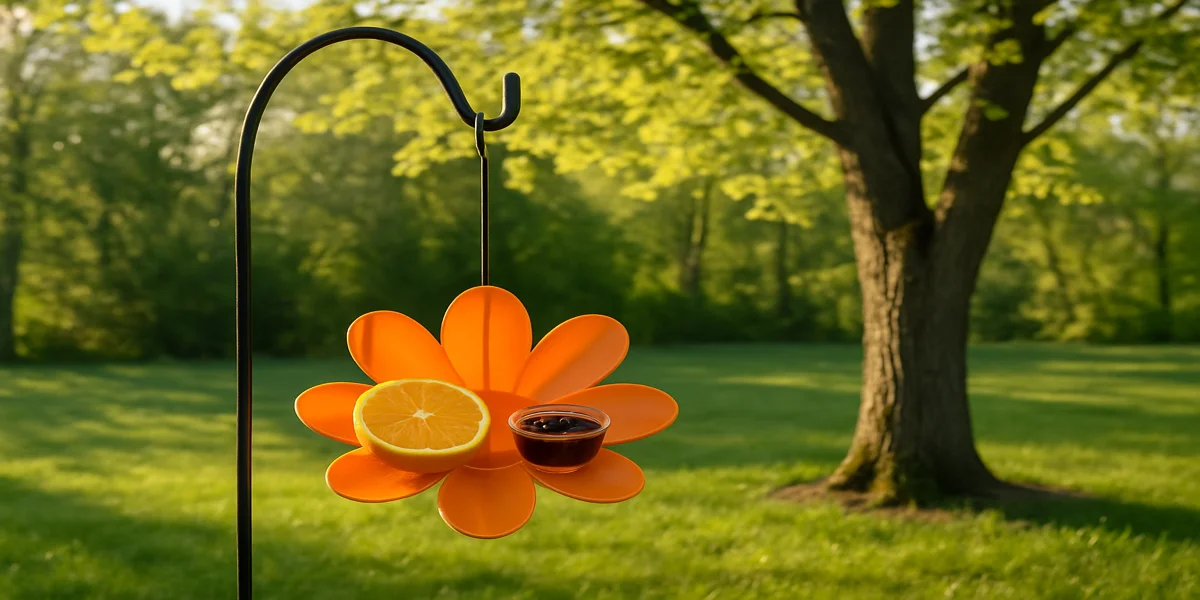
The flower-shaped jelly feeder. The most common style. Orange plastic petals form a base, with a small glass or plastic jelly cup in the center and four or six spikes for orange halves. The Birds Choice model is the best-known version. It is easy to clean, easy to refill, and the orange color is visible from a long distance. Orioles are strongly drawn to orange, which they associate with ripe fruit.
The three-in-one combination feeder. Naturesroom and similar brands make a feeder with a jelly cup, a small nectar reservoir, and orange spikes in the same unit. This is a good choice for a single hanging spot where you want to offer everything at once. The nectar reservoir lets you add oriole-friendly sugar water (four parts water to one part sugar, boiled and cooled, no dye) alongside the jelly.
The roofed double feeder. DutchCrafters and a few Amish-workshop brands sell a double jelly dish with a weather roof. This matters more than it sounds. A heavy spring shower in an open dish turns the jelly into a watery puddle that spoils inside six hours. A roofed feeder keeps the jelly usable through storms and extends the time between refills from one day to two or three.
Whichever feeder you pick, wash it every two or three days in warm weather. Jelly residue is what draws wasps and ants. A five-minute scrub with dish soap and a bottle brush, rinsed clean, resets the yard every few days. A small ant moat. A little water cup that hangs above the feeder on the same hook. Stops the column of ants that will otherwise find the jelly within 48 hours.
Where to hang the feeder so an oriole actually feels safe enough to stop
Placement does most of the work. A perfect jelly in the wrong spot gets ignored. A decent jelly in a great spot gets a returning pair every year.
Orioles want three things in a feeder location:
- A tall perch tree within sight, ideally within 30 feet. Orioles prefer elms, maples, cottonwoods, willows, and sycamores. Nests hang from the outer edge of a slender upper branch, typically between ten and thirty feet off the ground. If you have a mature deciduous tree in your yard, hang the feeder where the oriole can see both the tree and the feeder from the same perch.
- Visible from above. An oriole scanning from the sky is looking for the orange-color signal. A feeder half-hidden under a pergola or deep on a shaded porch is invisible from fifty feet up. Open airspace above the feeder matters more than you think.
- Safe from windows and cats. Hang the feeder at least ten feet away from any large window, or within three feet of it. The middle distance is the window-strike zone. Keep it high enough on a shepherd’s hook that a housecat cannot reach it.
A few subtler rules that show up in year two and three:
- Avoid the hottest afternoon sun. A feeder that bakes from 1 p.m. to 5 p.m. ferments the jelly daily. Morning sun plus afternoon shade is the sweet spot.
- Raccoons and bears will take down a low feeder. Use a shepherd’s hook at least five feet off the ground, with baffles if your region has bears.
- Water within sight sells the yard. A shallow birdbath near the feeder. Even a saucer on the ground. Gives orioles a reason to stay, not just eat. Related reading: how to choose a birdbath that actually attracts birds.
If your yard does not have tall trees yet, a temporary stand-in works: hang the feeder from a tall pole or a second-story deck corner, as high up as you can reach. The height suggests “safe perch” even when the trees are still young.
The mid-spring disappearance is not your fault
Here is the phone call every oriole-feeder makes to a neighbor around the last week of May: “They were here every day for a month and then they vanished. Did I do something?” The answer is almost always no.
Baltimore Orioles go quiet when they start nesting. The female weaves a sock-shaped pouch, often in the outer branches of a nearby shade tree, between about ten and thirty feet up. She lays four or five pale, streaked eggs, and incubation takes roughly two weeks. For about twelve to fourteen days after hatching, the parents are feeding chicks. During those chick-rearing weeks, the adult diet switches almost entirely from sugar to protein. Caterpillars, beetles, spiders, other soft-bodied insects. Jelly and nectar simply do not build baby birds.
So the parents stop visiting the feeder. They are still in your yard. They are fifty feet up in the maple, pulling caterpillars off oak leaves and shuttling them to an unseen nest. If you listen for the fluted whistle in the early morning, you will usually still hear them. You just will not see them at the jelly.
This disappearance typically lasts three to five weeks. Sometime in late June or early July, once the fledglings are foraging on their own, the adults and young will usually filter back to the feeder for a second feeding burst before fall migration. If you remove the feeder during the “disappearance” because you assume the season is over, you miss the return.
- Keep the feeder clean but lightly filled from late May through late July. A spoonful of jelly every two days is enough.
- Add a mealworm dish nearby. Live or rehydrated dried mealworms give adults a protein source to bring back to the nest. For a related hummingbird nectar rhythm, see the guide on how to choose and maintain a hummingbird feeder.
- Leave yarn and short plant fibers in a suet cage. Orioles weave with whatever fiber is available. A small offering in April can end up in the nest by June.
When to cut the jelly (and what the babies actually need)
One scenario does call for ending jelly feeding early: when a parent bird starts feeding jelly directly to nestlings or fledglings.
Chicks need protein to grow. A diet of sugar-heavy jelly to a two-week-old fledgling is the equivalent of feeding a toddler nothing but frosting. It can cause developmental problems and, in extreme cases, death. If you see an adult oriole repeatedly carrying sticky beakfuls of jelly toward a nest or toward a begging fledgling perched on a branch, take the jelly down for a week. Replace it with:
- Orange halves. Safer than jelly, still colorful, still attracts adults, but much less likely to end up in a chick’s throat in sticky quantity.
- A mealworm dish. Dried mealworms rehydrated in warm water for ten minutes become soft enough for chick-feeding and provide actual protein.
- Grape halves. Fresh grapes cut in half offer the same sugar cue as jelly, minus the stickiness.
You can bring the jelly back after the fledglings are fully independent, usually two to three weeks after you first see them hopping around the yard. By then the adults have often started refueling for the southward push, and a small jelly dish is exactly what they want.
One more thing to watch for: a single bird that parks at the jelly dish for hours. That is a sign of over-dependence, especially in a yard where natural food (insects, fruit, nectar flowers) is sparse. The fix is not more jelly. It is planting a native fruit-bearing shrub, a native caterpillar host plant, or simply leaving a few dandelions and violets to bloom. The full backyard strategy is covered in more detail in how to attract birds to your yard.
August is for banking fat, not for showing off
The last piece of the oriole calendar is the one most people forget entirely. Orioles that spent May and June nesting in your neighborhood will come back to feeders in August. They are not raising chicks anymore. They are not even pairing. They are fattening up for a flight that may take them as far as Colombia or Venezuela for the winter.
The August push is short and easy to miss. Females and juveniles usually begin migration first, sometimes by mid-August. Males follow through late August and the first days of September. In most of the Eastern and Central US, orioles are essentially gone by the weekend after Labor Day.
What the August birds want is exactly what the April birds wanted: simple, clean jelly and orange halves, refilled daily. The difference is that you will see a lot of juveniles. Duller yellow-olive birds, not the flame-orange adults. Alongside the returning parents. The juveniles are learning the feeder from their parents. Those are the birds most likely to remember your yard and return next April. Skip August and you effectively restart your yard’s oriole population from zero every spring.
A short August checklist:
- Keep the jelly dish clean and half-full through Labor Day.
- Expect dull, streaky juveniles. They are not “something else.”
- Keep hummingbird nectar up too. Ruby-throated hummingbirds are often at jelly feeders in August, drinking the sticky edges (another reason to keep portions small).
- Take the feeder down no earlier than two weeks after your last confirmed sighting. Late migrants from further north pass through into mid-September in the northern tier.
Two seasons of consistent August feeding is usually enough to establish a yard as a predictable stop. From year three on, the same orioles. Or their offspring. Will come back on roughly the same week every spring. Longtime feeder-watchers have documented banded orioles returning to the same jelly dish for five, six, even eight years running.
A quick April budget and shopping list
The whole setup, done once, costs less than a single night out at a restaurant. Here is the practical list:
- One flower-shaped or roofed oriole feeder: $15-30
- One squeeze bottle of Welch’s Natural Grape Jelly: $4-5
- A small bag of oranges (for halves): $4-6
- Optional: a bag of dried mealworms: $8-12
- Optional: a shepherd’s hook and an ant moat: $15-20
- Optional: a shallow bird-safe water saucer: $0-15
First-year total: usually $30-45. In year two you only need the jelly and the oranges, so the running cost is about ten dollars a season. For a wild, copper-orange songbird that whistles from the top of your shade tree every morning for six weeks in spring, that is probably the best ten dollars you will spend on the yard all year.
Reader questions I’ve answered before
Do Baltimore Orioles like oranges or jelly better?
Both, and for slightly different reasons. Orioles are drawn from the air by the color orange, so an orange half is a better billboard. Once they land, many of them prefer jelly because it delivers concentrated sugar faster. The most attractive setup pairs both. An orange half with a small jelly cup in the center. Which is exactly why most purpose-built oriole feeders are designed that way. If you have to choose just one, start with oranges for the first week to catch migrating birds’ attention, then add jelly once they have visited.
How much grape jelly should I put out at once?
A teaspoon to two tablespoons at a time, per dish. Never fill a jelly cup more than halfway. About a quarter cup per day total is plenty for a single feeder, even when multiple birds visit. Small portions are safer for the birds (less risk of matting feathers), keep fresher (jelly spoils in hot sun within hours), and attract fewer wasps and ants.
What happens if orioles eat sugar-free jelly?
It can kill them. Most sugar-free jellies contain xylitol, aspartame, or similar artificial sweeteners. Xylitol in particular causes a rapid insulin crash in birds, which can lead to hypoglycemia, seizures, and death. Only use regular grape jelly with real sugar in the ingredient list. Avoid anything labeled “light,” “reduced sugar,” “sugar-free,” “diet,” or “no sugar added.”
Do I need a special feeder, or will a regular dish work?
A shallow ceramic dish, a clean jar lid, or half an orange peel will all work for April and early May. By late May the open dish becomes a wasp magnet and an ant highway, and most people switch to a purpose-built oriole feeder. The flower-shaped design with a jelly cup plus orange spikes is the most common and the easiest to clean. A roofed feeder keeps jelly fresh through spring rainstorms. Whatever you use, scrub it with warm soapy water every two or three days.
Why did the orioles stop coming after a few weeks?
Almost always because they are nesting. From late May through early July, the adults are feeding chicks an insect-heavy diet and avoiding sugar sources. This disappearance typically lasts three to five weeks. Keep the feeder clean with a small amount of jelly. They often return in late June or early July with fledglings in tow, and then again in August to fatten up for fall migration. If you remove the feeder during the quiet weeks, you miss the second wave of visits.
The short version
Put the feeder out one to two weeks before the orioles are expected in your region. Use real-sugar grape jelly, never sugar-free, never jam. Fill the cup no more than halfway, a teaspoon at a time. Hang it in view of a tall deciduous tree, in morning sun and afternoon shade, ten feet or more from any window. Clean the dish every two or three days. Do not panic when the birds vanish in late May. They are nesting, not leaving. Keep the dish lightly filled through August so juvenile orioles can learn the location before migrating south. Do that for two consistent seasons and a pair of Baltimore Orioles will start looking for your yard the same week every April.
Reference: Baltimore Oriole Life History, Cornell Lab of Ornithology.
Related reading
Want More Wildlife Garden Tips?
Join 5,000+ nature lovers getting our weekly tips on creating wildlife-friendly gardens.
No spam, unsubscribe anytime. Privacy Policy
Emma Harrington
Emma Harrington is a wildlife habitat researcher and content editor with a passion for backyard conservation. She has spent over a decade translating ecological science into practical tips anyone can follow — from selecting native plants to building wildlife-friendly habitats. Her work focuses on helping homeowners transform ordinary yards into thriving ecosystems for bees, butterflies, hummingbirds, and other beneficial wildlife.