
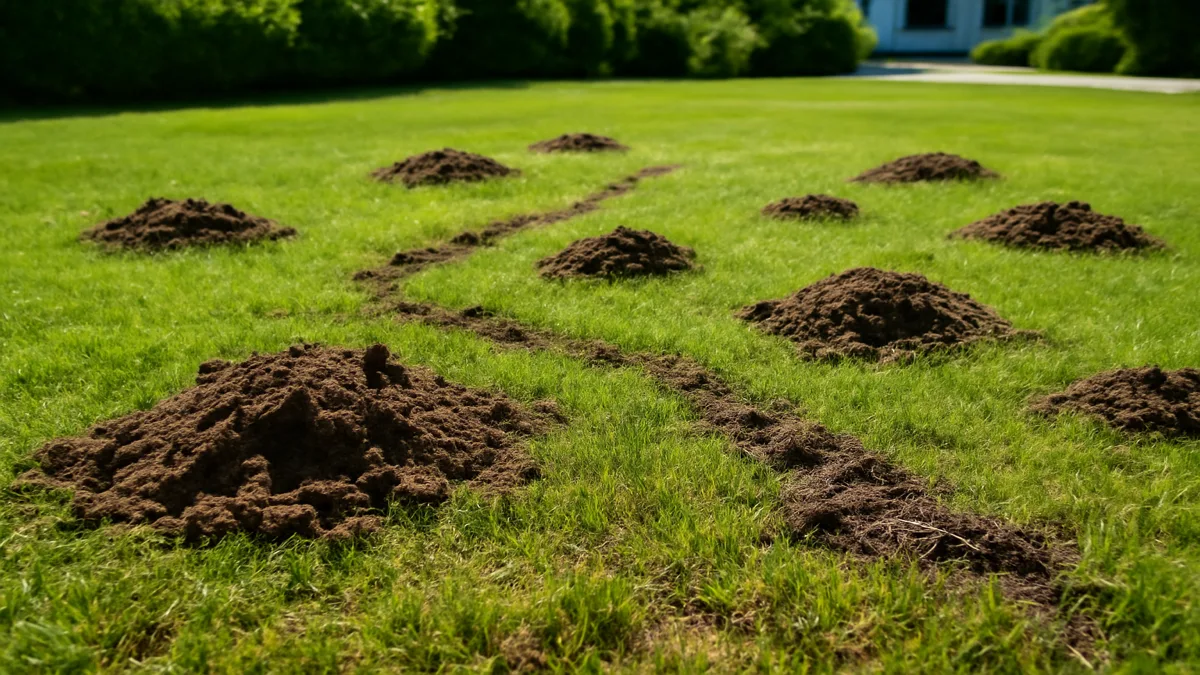
You step outside with your morning coffee, ready to admire the lawn you have been coaxing into shape all spring, and there it is: a winding ridge of raised earth cutting straight across the grass like someone dragged a garden hose underneath the turf. A little further on, a fresh mound of loose soil sits where yesterday there was a tidy patch of mulch. If you have spent any time gardening past the age of forty, you already know the culprit without having to ask. Moles have moved in.
Before you reach for the smoke bombs, the mousetraps, or that jug of something unpronounceable at the hardware store, take a breath. Moles are frustrating, yes, and their tunnels can wreck a lawn you have worked hard on. But they are not rats, they are not plagues, and they are not the villains the internet makes them out to be. In fact, once you understand what they are doing down there, you may decide you do not want them gone so much as you want them to move along on their own terms.
This guide is for the gardener who would rather outsmart a mole than kill one. It is long because the problem is more nuanced than most pest-control blogs admit, and because at this stage of life you have probably learned that shortcuts in the garden rarely hold. We will cover what moles actually do, how to tell them apart from gophers and voles, what genuinely works to push them out, what is a waste of money, and what is flat-out cruel or illegal. By the end you should have a plan that respects the animal, protects your yard, and keeps your conscience intact.
FREE: Wildlife Garden Starter Guide
Get our 12-page PDF with the 25 best plants for pollinators, simple habitat tips, and a printable checklist — all 100% free.
No spam. Read our Privacy Policy.Why Moles Are Actually Good for Your Garden (Really)

Here is the part nobody tells you at the garden center: moles are some of the best free labor your yard will ever see. They are insectivores, not herbivores, which means they are not down there eating your tulip bulbs or gnawing the roots off your hostas. That is voles, a completely different animal with a similar-sounding name, and we will get to them in a minute. Moles are after protein, and their favorite meals are exactly the creatures you have been trying to get rid of for years.
A single mole can eat 70 to 100 percent of its body weight in insects every single day, sometimes clearing 50 grubs in a few hours of hunting. That menu includes Japanese beetle grubs, which are the larvae that chew your lawn from underneath and grow up to skeletonize your roses. It includes cutworms, wireworms, and the soft white grubs that attract skunks and raccoons to dig up your turf at night. A healthy mole population in the neighborhood is often a sign that the soil is alive, rich, and biologically active. That is not a failure of your yard. That is a compliment.
Their tunneling, which feels like vandalism when you trip over a ridge with the lawnmower, is actually aerating your soil. Those galleries let oxygen, rainwater, and nutrients penetrate down to root level in a way no mechanical aerator can replicate. Earthworms follow the tunnels. Beneficial fungi spread through them. In a well-managed organic garden, a transient mole is doing the same work a landscape company would charge you two hundred dollars for.
None of that changes the fact that you do not want a superhighway of tunnels running under your putting-green lawn. It just means the goal should be to encourage them to keep moving, not to wage chemical warfare in your own backyard. If you already think of your garden as an ecosystem, and you are probably reading this because you do, then moles deserve the same patient, ecological treatment you would give a pollinator garden or a backyard wildlife corridor.
Mole, Gopher, or Vole? Reading the Signs Correctly
Before you spend a dime on any repellent, make sure you are actually dealing with a mole. Half the advice online is useless because the homeowner was fighting the wrong animal the whole time. The three most common underground suspects in North American yards leave very different calling cards, and the treatment for each is completely different. If a sign is ambiguous, uploading a clear photo to iNaturalist usually returns a confident species ID within 24 hours.
Moles leave raised tunnels, the serpentine ridges of lifted sod that you can trace across the lawn with your shoe. Their mounds, when they make them, are round, symmetrical, and volcano-shaped, with soil pushed up from directly below in fine clumps. You will rarely see a hole at the top, because the mole seals it from inside. Damage to plants is usually incidental, caused by roots being lifted into air pockets rather than by chewing.
Gophers, found mainly in the western and central United States, leave fan-shaped or kidney-shaped mounds, not volcanoes, with a visible plug off to one side. They do eat plants. If your perennials are wilting suddenly and you find them pulled partway into the ground, that is a gopher, not a mole. Voles, meanwhile, do not make mounds at all. They create surface runways in the grass, shallow troughs about two inches wide where the turf has been worn down, and they chew bark off the base of young trees and shrubs in winter.
| Sign | Mole | Gopher | Vole |
|---|---|---|---|
| Mound shape | Round volcano, no visible hole | Fan or kidney, plug to one side | No mounds |
| Surface tunnels | Raised ridges across lawn | Rarely | Open runways in grass |
| Plant damage | Minimal, indirect | Severe, plants pulled down | Chewed bark, clipped stems |
| Diet | Insects, grubs, worms | Roots, bulbs, tubers | Grass, bark, seeds |
| Active season | Year-round | Year-round | Year-round, visible in winter |
Once you have confirmed moles, you can stop worrying about your bulbs and start thinking about the real issue: food supply. Because moles are not here for your garden. They are here for what is eating your garden.
Eliminate Their Food Source First
If you remember one thing from this entire article, let it be this: a mole without a meal will not stay. Every successful long-term mole strategy begins with reducing the grubs and soil insects in your lawn. Repellents and barriers are support players. Food removal is the lead.
The two most reliable organic tools for this are beneficial nematodes and milky spore. Beneficial nematodes, specifically Heterorhabditis bacteriophora, are microscopic worms you mix with water and spray over the lawn in the early evening when the soil is warm and moist. They hunt down grub larvae and kill them from the inside within 3 to 5 days, knocking out roughly 70 to 80 percent of the grub population over a 14-day window. One application in late spring and another in early fall will dramatically reduce the grub population over two seasons.
Milky spore is a naturally occurring bacterium that targets Japanese beetle grubs specifically. It is slower to establish, sometimes taking two or three years to build up in the soil, but once it does it can keep grub populations suppressed for a decade or more. Think of it as a long-term investment in a quieter yard. When the grubs disappear, the moles lose their reason to stay, and they move on to more productive hunting grounds, usually within a few weeks.
Avoid the temptation to spread broad-spectrum grub killers like imidacloprid or trichlorfon. They do kill grubs, but they also kill earthworms, beneficial beetles, and the soil microbes your plants depend on. Worse, systemic neonicotinoids travel up into flowers and harm bees and other pollinators. You do not want to trade a mole problem for a silent spring. Your local cooperative extension service can point you to products that target grubs without nuking the rest of the soil food web; the national extension system maintains state-by-state directories that are worth bookmarking.
Castor Oil and Commercial Repellents

Castor oil is the old-fashioned mole repellent, and for once the folk wisdom holds up. Moles hunt by smell and touch, and castor oil apparently makes their tunnels unpleasant to be in and their prey unappetizing to eat. It does not hurt them. It simply convinces them the neighborhood is not worth the trouble.
The homemade recipe is straightforward. Mix three tablespoons of pure castor oil with one tablespoon of liquid dish soap, then dilute that concentrate in a gallon of water and apply with a hose-end sprayer over the affected area. Water it in with another inch of irrigation so it penetrates down to tunnel depth. Reapply after heavy rain and every three to four weeks during active season. It works best as a boundary treatment, pushing moles out of a defined area rather than trying to saturate a whole acre.
If mixing your own feels like one more chore, the commercial versions are reasonably priced. MoleMax granules and Tomcat Mole Repellent both use castor oil as the active ingredient and typically run fifteen to twenty-five dollars for a bag that covers five thousand square feet. Read the label, because some formulations are pellets you broadcast with a spreader and others are concentrates you apply through a hose sprayer. Neither is magic, but in my experience they buy you genuine breathing room while the nematodes or milky spore do their slower work underneath.
“The goal with moles is not eradication. It is displacement. Remove their food, make the tunnels smell wrong, and give them a direction to travel. They will take it. They have no loyalty to your yard, only to the worms in it.”
What About Sonic Repellers, Barriers, and Plants?
Walk into any big-box garden center in April and you will see a wall of battery-powered or solar-powered stakes that promise to drive moles out with ultrasonic vibrations. The research on these is mixed at best. University extension trials from Michigan, Nebraska, and elsewhere have found success rates in the forty to sixty percent range, which is another way of saying they work about as well as a coin flip. Some homeowners swear by them. Others plant them in a tidy row and watch the moles tunnel serenely around the stakes.
If you want to try them, buy one or two and place them directly in active tunnel runs, not randomly in the lawn. Active runs are the ones that refill with soil within twenty-four hours after you flatten them with your foot. Inactive runs, the ones the mole has abandoned, can be vibrated all day long to no effect. Keep your expectations modest and your receipt handy.
Physical barriers, on the other hand, work reliably when installed correctly. For a prized bed or a small vegetable garden, you can dig a trench around the perimeter twenty-four inches deep and line it with quarter-inch hardware cloth, bending the bottom edge outward into an L-shape so moles cannot tunnel underneath. It is labor intensive, but for raised beds and new plantings it is often the difference between a garden and a frustration. The same technique protects against gophers in the western states, and the USDA publishes free guidance sheets on wildlife-proof fencing dimensions if you want official numbers for your zone.
Certain plants are reputed to repel moles through smell or toxicity. The evidence is more anecdotal than scientific, but interplanting them costs almost nothing and adds beauty besides.
- Daffodils. The bulbs contain lycorine, which most burrowing animals avoid, making them perfect border plantings.
- Alliums. Ornamental onions and garlic send sulfur compounds into the soil that moles find off-putting.
- Marigolds. The roots release alpha-terthienyl, which suppresses nematodes and some soil insects, indirectly reducing mole food.
- Castor bean. Strikingly architectural, but genuinely toxic to people and pets, so skip it if children or dogs use the yard.
- Fritillaria imperialis. Crown imperial bulbs give off a skunky odor that deters both moles and voles.
Use these as part of a layered strategy, not a silver bullet. A ring of daffodils will not save a grub-rich lawn, but combined with nematodes and castor oil it reinforces the message that this yard is not worth the commute.
A Step-by-Step Plan You Can Actually Follow
If you are the sort of gardener who likes a checklist, here is the sequence I would follow on a typical suburban lot with fresh mole activity. Work through the steps in order, and do not skip the diagnostic ones. The biggest waste of money in mole control is treating for the wrong animal or treating before you know what is under the soil.
- Confirm it is a mole. Walk the yard, identify raised ridges and volcano mounds, rule out gophers and voles using the comparison table above.
- Find the active runs. Step down gently on several ridges to flatten them, mark the spots with golf tees, and check back in twenty-four hours. The tunnels that are repaired are where the mole is currently working.
- Attack the food supply. Apply beneficial nematodes in late spring and again in early fall. Start a milky spore program if Japanese beetles are a known problem in your region.
- Apply castor oil. Treat the perimeter and active areas with a castor-oil spray or granule, watered in well. Reapply every three to four weeks and after heavy rain.
- Reinforce with plants. Tuck daffodils, alliums, and marigolds into bed edges, entry points, and anywhere new tunnels tend to appear.
- Protect prized areas with barriers. Install hardware cloth around vegetable beds, new tree plantings, and any bed where you cannot tolerate disturbance.
- Be patient. Give the plan four to six weeks before judging results. Moles typically abandon a low-food yard within that window.
If you are also battling other yard pests, the same stepwise philosophy applies. Many gardeners who tackle moles end up using similar food-source logic to control mosquitoes without harming bees and birds or handle spotted lanternfly nymphs in the yard.
What NOT to Do (Even If Your Neighbor Swears By It)
Every town has a retired fellow on the cul-de-sac who will corner you at the mailbox and explain, at length, how he solved his mole problem with a garden hose, a stick of gum, and a jar of mothballs. Listen politely, then ignore every word. Most of the classic home remedies are some combination of useless, cruel, and illegal, and some are genuinely dangerous to the humans applying them.
Smoke bombs and gas cartridges are sold at hardware stores and marketed as mole killers. They release carbon monoxide or sulfur compounds into the tunnels, suffocating everything underground including earthworms, beneficial insects, and any other wildlife sheltering there. Several states restrict or ban their use near property lines, and the fumes can seep into basements, crawl spaces, and well heads. The kill is also slow and inhumane, which is a detail the packaging does not dwell on.
Flooding tunnels with a garden hose is a method that shows up in viral videos every spring. It almost never works, because mole tunnel systems are vast and largely drain away. What it does do is waste hundreds of gallons of water, compact your soil, and, in the rare case it corners the animal, drown it slowly. It is cruelty dressed up as a folk remedy.
Chewing gum in tunnels is an urban myth with surprisingly persistent legs. The theory is that moles eat the gum, cannot digest it, and die. In reality moles do not eat gum, they are insectivores, and the gum sits in the tunnel until it rots. Save the Juicy Fruit for your grandchildren.
Mothballs outdoors are flatly illegal under federal pesticide law in the United States. The active ingredient, naphthalene or paradichlorobenzene, is registered only for enclosed indoor use against fabric pests. Dumping them into tunnels puts toxic chemicals into your soil and groundwater, and carries real fines if a neighbor or inspector spots them. Do not do it. If a product label does not list outdoor rodent or mole use, it is not legal for that purpose, no matter what the internet says.
When to Call a Professional
Most residential mole situations can be handled with the approach above and a little patience. Occasionally, though, you will face a genuine infestation: multiple animals, extensive tunnel networks across a large property, damage to irrigation lines or structural slabs, or a case where the moles have been undisturbed for years and simply will not move. In those situations, a licensed wildlife control operator is worth the money.
Expect to pay two hundred to five hundred dollars for a professional assessment and initial treatment, with follow-up visits billed separately. Ask specifically whether they use live exclusion methods or lethal traps, and if you prefer the humane route, say so up front. Reputable operators will work with your preferences. Ones who cannot, or who push poison bait as a first option, are not the right fit for a garden-minded homeowner.
A good pro will also spot related issues you may have missed, like a grub-heavy lawn feeding the whole problem, drainage issues creating ideal tunnel conditions, or signs of voles and gophers you mistook for mole damage. Think of the fee as paying for a second set of eyes, not just labor.
Reader questions I’ve answered before
How long does it take for moles to leave after I treat for grubs?
In most yards, moles begin moving on within two to four weeks after the grub population drops noticeably. Beneficial nematodes start killing grubs within a few days but take a couple of weeks to meaningfully reduce the population. Milky spore is much slower, sometimes a full season or two. Combine grub treatment with a castor-oil repellent and you will usually see the mole activity decline within a month.
Will castor oil hurt my pets or my vegetable garden?
No. Castor oil at the dilutions used for mole repellent is non-toxic to dogs, cats, and humans, and it is safe around edible plants. It is the same oil used in cosmetics and, historically, as a laxative. Do not let pets drink concentrated castor oil straight from the bottle, obviously, but a sprayed lawn or garden is entirely safe to walk, play, and harvest from.
Do mothballs really repel moles?
No, and using them outdoors is illegal in the United States. Mothballs are registered pesticides approved only for enclosed indoor use against clothes moths and similar fabric pests. Placing them in mole tunnels releases toxic naphthalene or paradichlorobenzene into your soil and groundwater, and it does not reliably deter moles anyway. Skip this one completely.
Are moles blind?
Not entirely, though it is a common assumption. Moles have tiny eyes covered by a thin layer of skin or fur, and they can detect light and dark but little else. They navigate and hunt almost entirely by touch and smell, using sensitive whiskers on their snouts and a specialized organ called an Eimer’s organ to sense vibrations from prey. Their poor eyesight is exactly why scent-based repellents like castor oil work as well as they do.
Should I fill in the tunnels, or leave them alone?
Flatten the raised ridges with a lawn roller or by stepping on them, especially before mowing so you do not scalp the turf. You do not need to fill them in with soil; the tunnels will collapse naturally over a few weeks once the mole is no longer maintaining them. For mounds, scoop the loose dirt into a wheelbarrow and use it to top-dress thin spots in the lawn or garden. Think of it as free, pre-aerated topsoil courtesy of your former tenant.
Keeping moles out of your yard without killing them is less about winning a battle and more about changing the conversation. You are not trying to prove the yard is yours. You are gently, persistently, repeatedly telling the mole that there is nothing here worth staying for. Reduce the grubs. Apply the castor oil. Plant the daffodils. Protect what matters with hardware cloth. Ignore the mothballs and the chewing gum and the smoke bombs. Give it a few weeks. In almost every case, the moles move on, the tunnels collapse, the lawn recovers, and you are left with a garden that is a little healthier, a little more alive, and a little more yours than it was before.
Want More Wildlife Garden Tips?
Join 5,000+ nature lovers getting our weekly tips on creating wildlife-friendly gardens.
No spam, unsubscribe anytime. Privacy Policy
Emma Harrington
Emma Harrington is a wildlife habitat researcher and content editor with a passion for backyard conservation. She has spent over a decade translating ecological science into practical tips anyone can follow — from selecting native plants to building wildlife-friendly habitats. Her work focuses on helping homeowners transform ordinary yards into thriving ecosystems for bees, butterflies, hummingbirds, and other beneficial wildlife.