
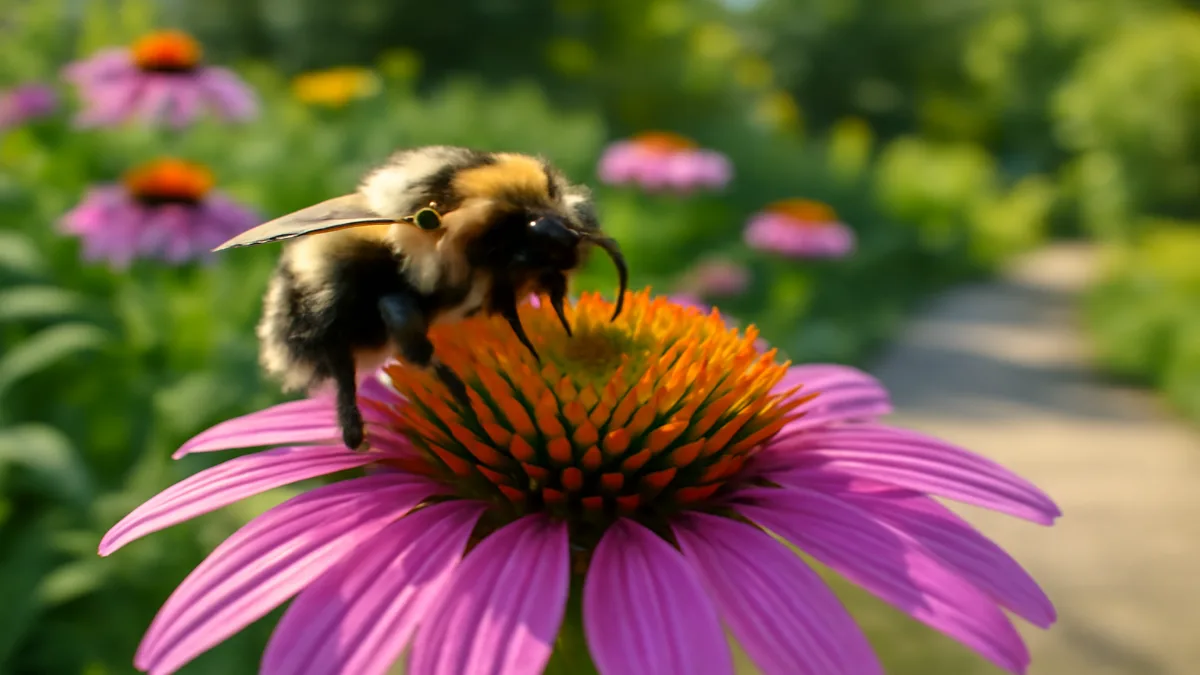
If you love the idea of a buzzing, blooming garden but cringe every time something yellow and black flies past your ear, this guide was written specifically for you. Millions of adults over 40 are sitting on beautiful yards they barely use, convinced that inviting pollinators means signing up for painful stings, panicked grandchildren, and ruined backyard dinners. The truth is almost the opposite of what most of us were taught as kids. And once you understand it, gardening for bees becomes one of the most peaceful, rewarding things you can do with your property.
Here is the single most important fact to start with: the insects that have stung you at picnics, chased you away from garbage cans, or built papery nests under your eaves were almost certainly not bees. They were wasps. Usually yellow jackets or paper wasps. Real bees, especially the native species that pollinate most of North America, are astonishingly gentle. In fact, about 90% of native bee species are solitary, meaning they have no hive to defend, no colony to protect, and essentially no reason to sting you unless you physically squeeze one in your hand.
This guide will show you how to attract bees safely, confidently, and without turning your patio into a no-go zone. You will learn how to tell a friendly pollinator from an aggressive wasp, how to position plantings so bees stay in their corner and you stay in yours, what to wear and when to work outside, and exactly what to do in the rare event that you are stung. By the end, you will understand why the fear most of us grew up with was mostly misplaced. And why a bee-friendly yard is actually a safer, more enjoyable yard for everyone, including the grandkids.
FREE: Wildlife Garden Starter Guide
Get our 12-page PDF with the 25 best plants for pollinators, simple habitat tips, and a printable checklist — all 100% free.
No spam. Read our Privacy Policy.Why Most Bee Fear Is Actually Wasp Fear
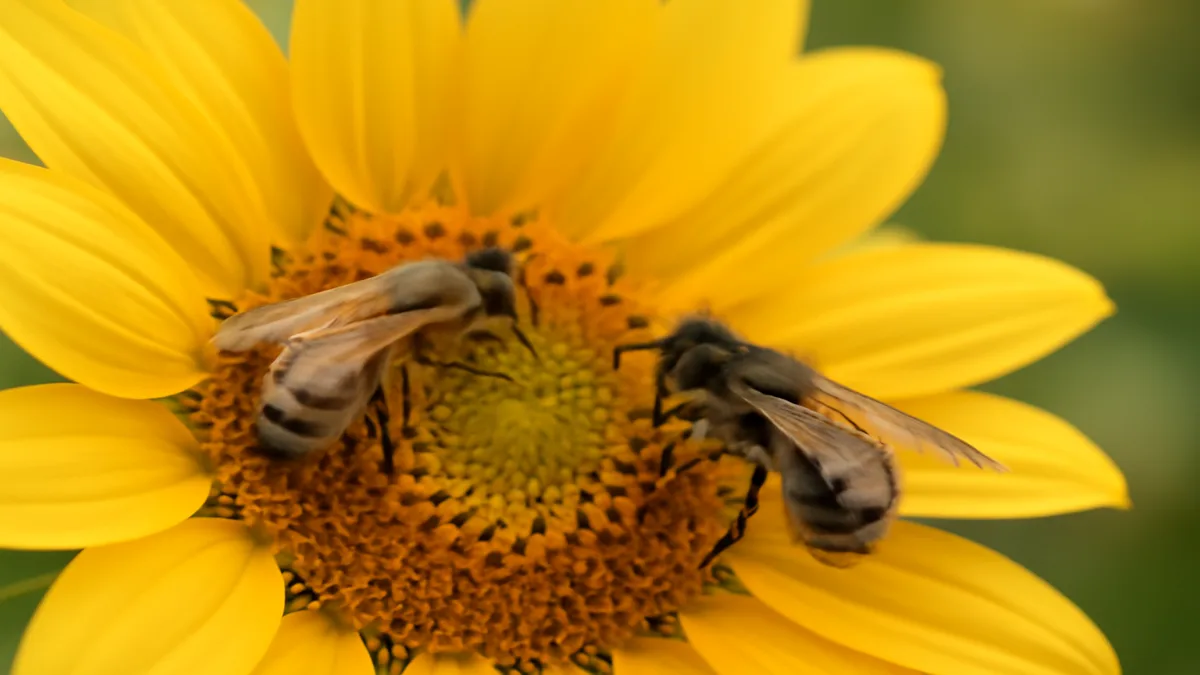
Ask ten people over 40 to describe the worst sting of their life and at least eight of them will describe a wasp, not a bee. The confusion is understandable. Both insects buzz, both are yellow-and-black, and both can deliver a painful jab. But their behavior, diet, and temperament could hardly be more different. Wasps are predators and scavengers. They hunt other insects, steal meat from your hamburger, and get increasingly aggressive as summer wears on and their colonies grow desperate for food. Bees are vegetarians. They eat pollen and nectar. A bee foraging on a flower has no interest in your sandwich, your soda, or your skin.
Wasps are also built for combat. Their stingers are smooth, so they can sting repeatedly without dying. Honeybees, by contrast, have barbed stingers that tear out of their body on use. Meaning a honeybee sting is literally a suicide act, reserved strictly for hive defense. Solitary native bees rarely sting at all. Many species, like male carpenter bees and all male bees generally, physically cannot sting because the stinger is a modified egg-laying organ present only in females. Knowing which insect is which changes everything about how you feel in your own backyard.
Bee vs Wasp: A Visual Identification Guide
Before you plant a single flower, spend a weekend learning to tell your garden visitors apart. This one skill will eliminate more anxiety than any other advice in this article. Bees tend to look soft, round, and slightly clumsy in flight. Wasps look like tiny fighter jets. Streamlined, shiny, and purposeful. Once you have seen the difference, you cannot unsee it.
| Insect | Body | Legs | Temperament | Sting Risk |
|---|---|---|---|---|
| Honeybee | Golden-brown, fuzzy, rounded | Thick, pollen-dusted | Gentle while foraging | Low (stings once, then dies) |
| Bumble Bee | Large, very fuzzy, black and yellow | Thick, often yellow with pollen | Calm, slow fliers | Very low unless hive threatened |
| Mason Bee | Small, metallic blue or green | Slim, no pollen baskets | Extremely docile | Males: none. Females: nearly zero |
| Carpenter Bee | Large, bumblebee-like, shiny black abdomen | Thick | Males hover and investigate, females focus on wood | Males cannot sting at all |
| Sweat Bee | Tiny, often metallic green | Slim | Gentle, attracted to perspiration | Very mild sting, rare |
| Yellow Jacket (WASP) | Smooth, shiny, bright yellow and black | Skinny, dangle in flight | Aggressive, especially near food and trash | High. Stings repeatedly |
| Paper Wasp | Smooth, long, narrow waist | Long and dangling | Defensive of nests under eaves | High if nest approached |
Notice the pattern. Fuzzy, round, and pollen-covered means bee. And bee means safe. Smooth, shiny, and narrow-waisted means wasp, and wasps are the ones worth being cautious about. Carpenter bees are a particularly common source of fear because the males aggressively hover and chase, but those dramatic males are completely stingless. The females can sting but almost never do; they are too busy boring into weathered wood to lay eggs.
Safe Gardening Practices for People Who Are Nervous Around Bees
Once you know what you are looking at, the next step is simply learning how to share space. Bees are predictable creatures with predictable schedules, and a few small habit changes will let you garden, weed, and relax among them without incident. I have maintained a heavily pollinator-planted yard for more than fifteen years and have been stung exactly twice in that time. Both times by wasps I had unknowingly disturbed, never by a bee.
The simplest rule is to match your activity to bee behavior. Bees are cold-blooded and sluggish in cool temperatures. Early morning, before the sun has warmed the flowers, is the safest and most peaceful time to deadhead roses, pull weeds around lavender, or trim borders. Late evening, after the sun dips, is nearly as calm. The middle of a hot sunny afternoon is when flowers are busiest. Not a dangerous time, but a loud, active time when nervous gardeners may feel overwhelmed.
- Work early morning or late evening when bees are slower and less active.
- Wear closed-toe shoes to protect against accidentally stepping on ground-nesting bees.
- Skip perfume, cologne, and scented lotions. Strong floral scents can confuse bees into investigating you.
- Move calmly and slowly near blooming plants; jerky motion triggers defensive responses.
- Never swat at a bee. Crushing one releases alarm pheromones that call others.
- If a bee lands on you, freeze and blow gently on it. It will lift off within seconds.
- Wear light colors. Bees associate dark colors with predators like bears and skunks.
That last point surprises people. Dark clothing, especially black and dark brown, can make some bees (and many wasps) more defensive. If you plan a long gardening session in a pollinator bed, pastel shirts and pale hats are not just cooler in the sun, they are genuinely less likely to attract attention.
How to Attract Bees Without Inviting Them Onto Your Patio
The fear of creating a “bee zone” that overtakes your entire outdoor life is one of the biggest reasons people avoid pollinator gardening. But bees do not wander randomly. They go where the flowers are, and they stay there. This means you have an enormous amount of control over where in your yard the bee activity happens. With thoughtful layout, you can have a thriving pollinator habitat and a sting-free patio simultaneously.
Think of your yard in zones. The zone where humans live. Patio, pool, grill, deck, play area. Should be planted with foliage, ornamental grasses, and non-flowering shrubs. The zone where pollinators live. A dedicated corner, a far border, a strip along the fence. Gets the nectar-rich flowering plants. Keep at least ten feet of buffer between the two zones, and bees will essentially never cross into your living area. They have no reason to. There is nothing there for them.
- Map your “human zones” first: patio, dining area, pool, kids’ play space, dog run.
- Identify a “bee corner” at least 10 feet from those zones. Ideally at the edge of the property.
- Cluster flowering plants tightly in that corner, not scattered throughout the yard.
- Keep walkways lined with foliage plants like hostas, ferns, or boxwood rather than flowering species.
- Add a shallow water dish with stones inside the bee corner so they drink there, not at your pool.
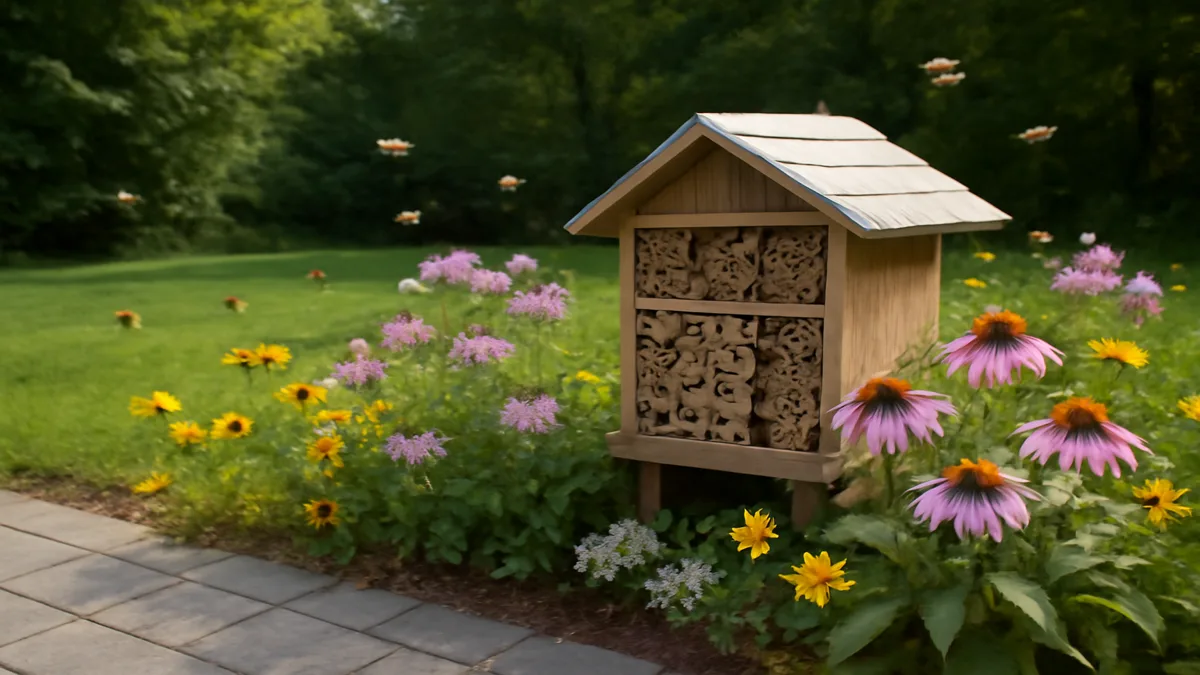
- Install a solitary bee hotel on a fence post in the pollinator zone. These bees do not defend their nests.
- Use a low hedge or trellis as a visual divider, which encourages bees to stay on their side.
This layout strategy is how professional pollinator garden designers handle properties with nervous homeowners or young grandchildren. It works. For more on which species to plant and how to sequence blooms across seasons, see our detailed guide to bee-friendly flowers, which covers varieties proven to be pollinator magnets without being human nuisances.
“The safest yard is not the one without bees. It is the one where bees have a clearly defined home. Give them a dedicated corner with flowers, water, and shelter, and they will spend their entire lives ignoring you completely.”
Solitary Bees: The Gentle Giants You Have Never Heard Of
When most people picture a bee, they picture a honeybee in a box hive, or a cartoon bumblebee bouncing between daisies. But honeybees are not even native to North America. They were imported by European settlers. The real heroes of American pollination are the roughly 4,000 species of native solitary bees: mason bees, leafcutter bees, mining bees, sweat bees, and many more. These are the bees you want in your yard.
A solitary bee does not live in a colony. Each female builds her own tiny nest in a hollow stem, an abandoned beetle tunnel, or a sandy patch of soil, lays a few eggs, and dies. There is no hive to guard, no queen to protect, and no swarm instinct. Ninety-eight percent of solitary native bees will never sting a human in their entire lifetime, and many species (like all male carpenter bees) physically lack the equipment to do so. This is why bee hotels are such a wonderful addition to a nervous gardener’s yard. They attract stingless and near-stingless pollinators in huge numbers.
If you want to go further, consider building or buying a bee hotel. A well-designed hotel hosts mason bees in spring, leafcutter bees in summer, and provides free professional-grade pollination for your vegetable garden. Our walkthrough on how to build a bee hotel covers materials, placement, and maintenance in depth. The Xerces Society, which is the leading authority on native pollinator conservation, also maintains excellent species guides you can consult at xerces.org.
Who Is Actually at Risk. And Who Is Not
It is worth being honest about who should take extra precautions. For the vast majority of adults, a bee sting is a brief sharp pain followed by a few hours of mild swelling and itching. Uncomfortable, but no more dangerous than a paper cut. For a small minority, it can be a genuine medical event. Knowing which category you are in matters.
Approximately 3% of adults have a true systemic bee or wasp allergy, meaning a sting can trigger anaphylaxis. A life-threatening reaction involving swelling of the throat, difficulty breathing, and a crash in blood pressure. If you have ever had an unusually severe reaction to any stinging insect, talk to an allergist and ask about an EpiPen prescription before you start a pollinator garden. People with this allergy can absolutely still garden and enjoy pollinators, but they should do so with a plan.
The other major risk is mistaking a ground-nesting yellow jacket colony for bees. Yellow jackets build hidden nests in old rodent burrows, under woodpiles, and inside wall voids. They are wasps, not bees, and they are genuinely dangerous when disturbed. A lawnmower passing over their entrance can trigger hundreds of stings. If you see a steady stream of smooth-bodied yellow-and-black insects flying in and out of a single hole in the ground, do not investigate further. Call a pest professional. This has nothing to do with pollinator gardening, but it is important context.
Finally, if a honeybee swarm settles in your attic, a wall, or a large tree right next to your home, do not panic and do not spray. Call a local beekeeper. Most will remove a swarm for free and relocate it. Honeybees in the wrong place are a nuisance; honeybees in a hive box are pure gold.
What Bees Actually Want: A Brief Overview
The mechanics of attracting bees are covered in depth in our pollinator garden master guide, but the short version is simple. Bees need three things: food, water, and shelter. Give them all three, and they will arrive on their own.
- Single-petal flowers, not double cultivars. Doubles are often sterile and have little accessible pollen.
- Purple, blue, yellow, and white blooms. Bees see these colors best; red appears dull to them.
- Clusters of the same species. Bees forage more efficiently when they can stay on one plant type.
- A bloom sequence from early spring through late fall so food is always available.
- A shallow water dish with pebbles so bees can drink without drowning.
- Absolutely no pesticides, especially neonicotinoids, which kill bees even in trace amounts.
- Bare ground patches for ground-nesting species, and hollow stems or bee hotels for cavity nesters.
The USDA maintains a useful overview of pollinator habitat practices and species lists at the USDA Pollinators program page, which is worth bookmarking if you want region-specific guidance.
The Most Common Fears. And Why They Are Usually Wrong
Let me address the specific worries that come up again and again when I talk to neighbors about planting for pollinators. These fears are real, and they feel urgent, but almost every one of them is based on a misunderstanding of bee behavior.
“Bees attack in swarms.” Honeybees only swarm when a hive splits. And a swarm in transit is actually remarkably docile, because the bees have no hive yet to defend and their bellies are full of honey for the journey. Random flying bees in your garden will never “swarm” you. That fear is pure Hollywood.
“Bees in my flowers will sting me.” A foraging bee is laser-focused on nectar and pollen. You could stand an inch from a bee working a lavender stem and she would not acknowledge your existence unless you physically grabbed her. I have accidentally touched foraging bees dozens of times while deadheading. Not once has one turned on me.
“My pets will get stung.” Dogs and cats occasionally do get stung. Usually on the nose or paw from snapping at a bee, or from stepping directly on a ground nest. Train pets to ignore flying insects, keep an eye on dogs that are “bug hunters,” and be aware of where ground-nesting activity happens in your yard. Cat owners generally have nothing to worry about; cats are too smart to snap at bees more than once.
“What about the grandkids?” Here is a statistic worth repeating: far more children are stung by yellow jackets at picnics, parks, and near trash cans than by garden bees. Kids running through flower beds are not at meaningful risk from foraging bees. They are at risk from stepping on hidden wasp nests in the lawn. Teaching children to recognize the difference between a fuzzy bee and a shiny yellow jacket is one of the most practical safety lessons you can give them.
If You Do Get Stung: A Calm, Practical Response
Even the most careful gardener occasionally gets stung. It happens. Here is how to handle it without drama.
If the insect was a honeybee, it will have left its barbed stinger embedded in your skin, along with a tiny venom sac that continues to pump for up to a minute. Do not pinch it with tweezers. That squeezes more venom in. Instead, use a fingernail or the edge of a credit card to scrape the stinger out sideways. Wash the area with soap and water. Apply an ice pack for ten to fifteen minutes to reduce swelling. An oral antihistamine (like diphenhydramine) or a topical hydrocortisone cream will handle the itch and inflammation that follows.
For bumblebees, carpenter bees, and wasps, there is no stinger to remove. They keep theirs. Just wash, ice, and treat the reaction. Most healthy adults are fully back to normal within a day.
The only time a sting is a medical emergency is if it triggers anaphylaxis: hives spreading far from the sting site, swelling of the face or throat, difficulty breathing, dizziness, or a rapid drop in blood pressure. These symptoms usually begin within minutes. If they appear, use an EpiPen if you have one and call 911 immediately. For people without known allergies this reaction is rare, but it is the one scenario where every minute counts.
What NOT to Do: Common Mistakes That Make Things Worse
Finally, a few things to actively avoid. Because well-meaning homeowners often do more harm than good when they try to “solve” a bee situation on their own.
- Do not kill bees you see in your yard. Pollinator populations have crashed dramatically in recent decades, and every individual bee matters. A bee on a flower is doing you a favor, not a threat.
- Do not spray pesticide on a hive. Especially a honeybee hive. It is dangerous (the chemicals blow back on you), it is ineffective (you will miss many bees), and in some states and municipalities it is actually illegal to kill honeybees.
- Do not try to DIY-remove a hive or large nest. Call a local beekeeper for honeybees, a pest professional for wasps or hornets. The cost is modest and the risk of doing it yourself is significant.
- Do not avoid planting flowers out of fear. A flowerless yard is a lonelier, duller, and ecologically poorer yard. The small risk of a sting is vastly outweighed by the beauty, biodiversity, and free vegetable pollination you gain.
- Do not confuse native solitary bees with aggressive wasps. If you spray a mason bee hotel thinking it is full of wasps, you have just destroyed dozens of gentle pollinators for no reason.
The mindset shift that helps most is simple: bees are not your enemy, and they are not looking for a fight. They are tiny, hardworking creatures trying to collect enough pollen to feed the next generation. Share your space with them thoughtfully and they will share theirs with you. Peacefully, productively, and probably for decades to come.
Frequently Asked Questions
Are all bees aggressive if I get close to their nest?
No. Only social bees. Honeybees and to a lesser extent bumblebees. Defend their nests. The roughly 90% of bee species that are solitary have no colony to protect and will not attack even if you stand right next to their nesting site. Mason bees, for example, will calmly continue working while you watch from inches away. Only social wasps and honeybee colonies respond defensively to close approach.
Will a bee hotel in my yard increase my risk of being stung?
Almost the opposite. Bee hotels attract solitary species like mason and leafcutter bees, which are among the gentlest insects on Earth. Males of many species cannot sting at all, and females only sting if physically trapped against your skin. A bee hotel is actually one of the lowest-risk ways to invite pollinators into your yard, and it reliably boosts fruit and vegetable yields if you have a garden.
What is the difference between a bee sting and a wasp sting?
Honeybee stingers are barbed and tear out on use, meaning a honeybee can only sting once and will die shortly afterward. The stinger keeps pumping venom for up to a minute, so you should scrape it out immediately. Wasps (and bumblebees, though they rarely sting) have smooth stingers and can sting repeatedly. Wasp venom tends to produce more intense immediate pain, while honeybee venom often produces more prolonged itching and swelling.
Is it safe to have a bee-friendly garden if I have young grandchildren visiting?
Yes, with sensible layout. Keep flowering plants at least ten feet from play areas, patios, and walkways, and concentrate pollinator plantings in a defined corner of the yard. Teach the children to recognize fuzzy bees as friendly and to avoid shiny yellow-and-black wasps, especially near trash cans and sugary drinks. Statistically, children are far more likely to be stung by yellow jackets at picnics than by garden bees, so a well-designed pollinator garden is not a meaningful added risk.
What should I do if a swarm of honeybees lands in my yard?
Do not panic and do not spray. A resting swarm is essentially a group of bees looking for a new home, and they are remarkably gentle because they have no hive to defend and are full of honey. Call a local beekeeper or your state beekeeping association. Most will remove the swarm for free and give the colony a good home. Swarms usually move on within 24 to 72 hours on their own even if left alone, but a beekeeper removal is the best outcome for both you and the bees.
Want More Wildlife Garden Tips?
Join 5,000+ nature lovers getting our weekly tips on creating wildlife-friendly gardens.
No spam, unsubscribe anytime. Privacy Policy
Emma Harrington
Emma Harrington is a wildlife habitat researcher and content editor with a passion for backyard conservation. She has spent over a decade translating ecological science into practical tips anyone can follow — from selecting native plants to building wildlife-friendly habitats. Her work focuses on helping homeowners transform ordinary yards into thriving ecosystems for bees, butterflies, hummingbirds, and other beneficial wildlife.