
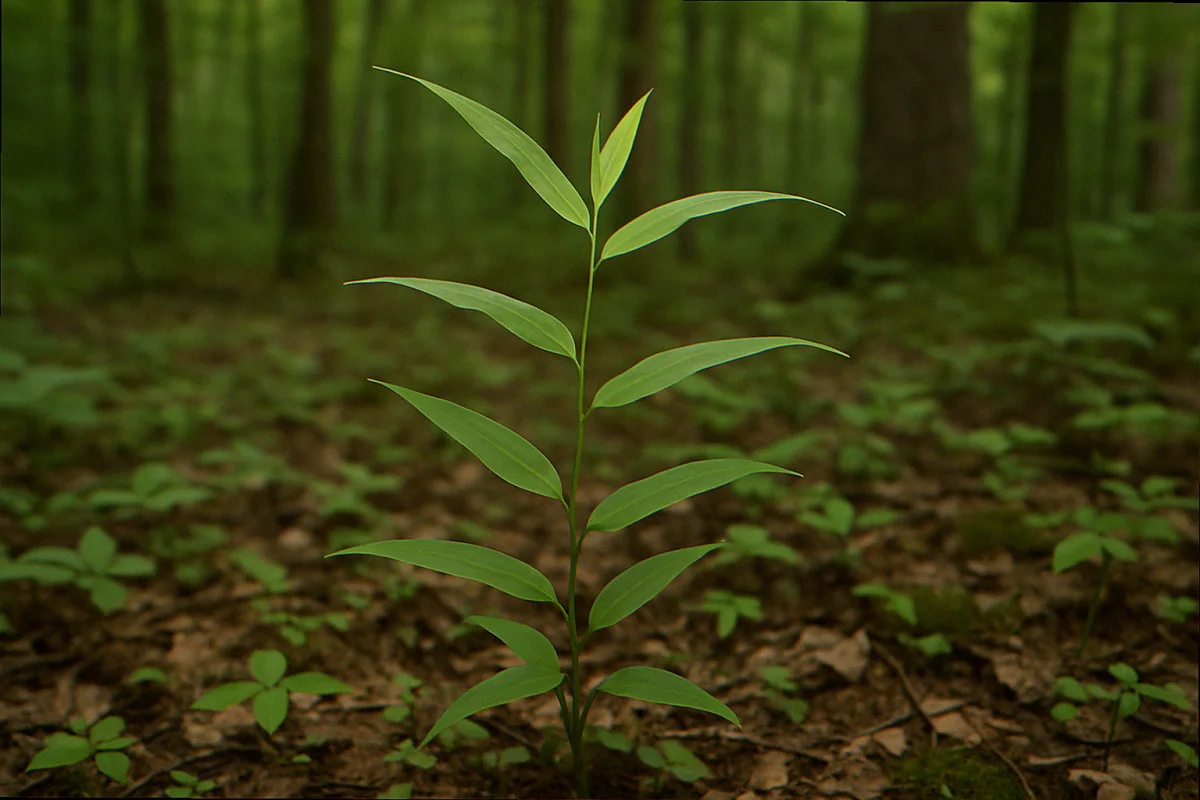
Quick answer: Japanese stiltgrass (Microstegium vimineum) looks like a delicate bamboo seedling with a silvery midrib stripe and slants left or right at the base. Pull it by hand or mow at 2 inches just before it flowers in late August or early September. Catch it in May and June while the roots are shallow, and a single hard summer of pulling can break a yard infestation that has been compounding for years.
A neighbor mentioned the new “soft grass” in her shade bed last weekend and asked if it was a fresh patch of fescue spreading in from the lawn. It was not. It was Japanese stiltgrass, and it had already pushed three feet into the bed she spent two years restoring with woodland natives. That is exactly how this plant wins: it looks too thin and too pretty to be the thing eating the forest floor of the eastern United States.
For anyone trying to keep a backyard ecosystem intact, stiltgrass is the most frustrating kind of opponent. It is not loud. It is not thorny. It does not bite. It just shows up where the deer have grazed, where a tree came down last winter, where the mulch ring around a new oak has thinned, and it carpets the ground in a single growing season. By the time the seed heads appear in September, it is already too late for that year, and the soil is now banking seed for the next half-decade.
FREE: Wildlife Garden Starter Guide
Get our 12-page PDF with the 25 best plants for pollinators, simple habitat tips, and a printable checklist — all 100% free.
No spam. Read our Privacy Policy.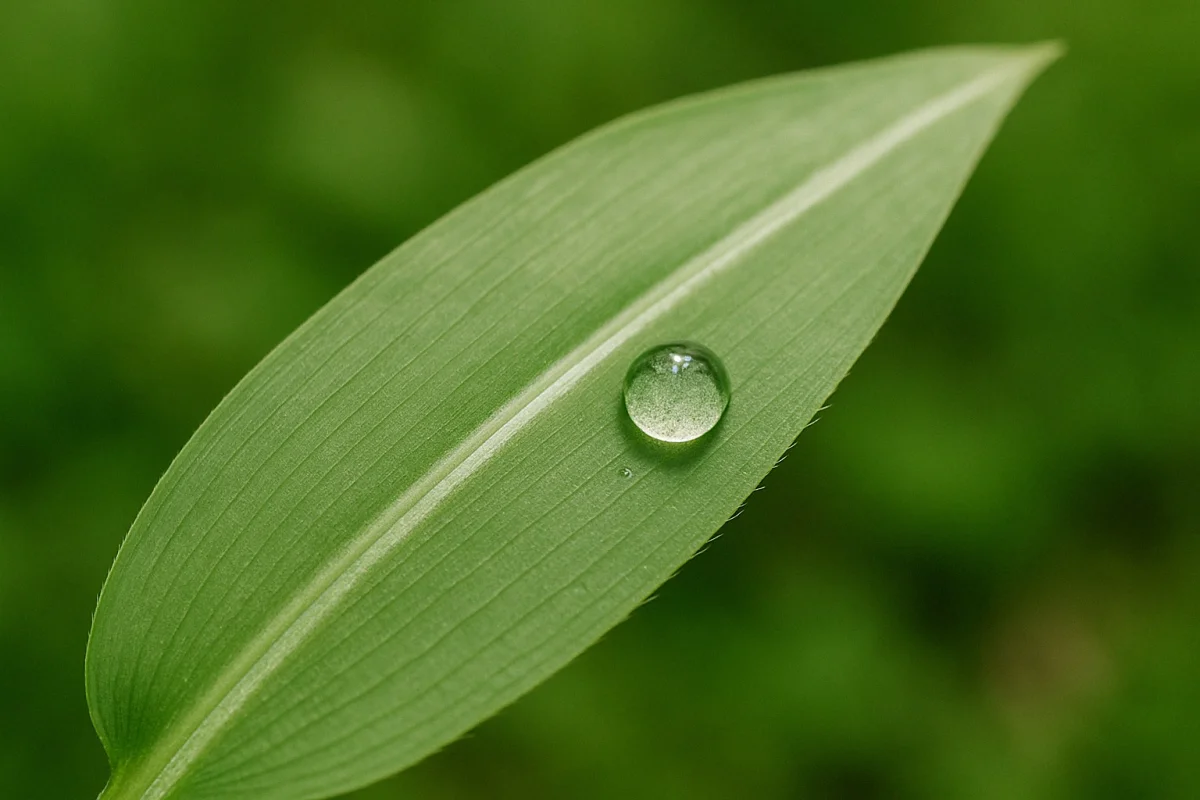
What does Japanese stiltgrass actually look like in May?
The identification window most people miss is the seedling phase, which runs from mid-April through early June across USDA zones 5 to 8. At that stage the plant is between 1 and 4 inches tall, the leaves are bright lime-green, and the seedlings look almost identical to young crabgrass or fescue volunteers. The difference is in three details that take about ten seconds to check.
First, the leaf shape: stiltgrass leaves are lance-shaped, broader than fescue, and only 2 to 3 inches long at maturity. Second, the midrib: there is a silvery, almost reflective stripe running down the leaf, but it is offset to one side of center instead of running down the middle. Third, the stem: by the time the plant is 6 inches tall, the lower stem joints lean sideways and prop the plant up at an angle, which is where the common name “stiltgrass” comes from.
The National Park Service identification sheet recommends pulling one stem and looking at the base. If the plant snaps cleanly out of the soil with a thin, shallow white root, you are looking at stiltgrass. Native woodland grasses like deertongue or bottlebrush grass have much deeper, more fibrous root systems and resist a clean pull.
Why a quiet little annual is the worst invasive in your shade beds
Stiltgrass was introduced to Tennessee around 1919 as packing material for porcelain. It has since spread to 26 states and now covers an estimated 17 million acres of eastern forest understory. It is an annual, which sounds harmless, but each plant produces 100 to 1,000 seeds per season, and those seeds remain viable in the soil for five to seven years. A single season of inaction creates a five-year cleanup problem.
The ecological damage is not just visual. Stiltgrass changes soil chemistry, raising pH and shifting microbial communities in ways that make it harder for native woodland plants to re-establish even after the grass is removed. It also creates a thick thatch layer that prevents acorn and seed germination for the oaks, sugar maples, and trillium that the rest of the wildlife garden depends on. Cornell University’s Integrated Pest Management program rates it among the top three invasive plants threatening northeastern forests.
For Sarah, the woodland gardener who has been steadily converting her shaded back third into a native understory of foamflower, wild ginger, and Christmas fern, stiltgrass is the invasive that punishes patience. The native plants she babied for three years to fill in will get suffocated in a single August if she does not catch the grass first.
How do I tell stiltgrass apart from native deertongue and crabgrass?
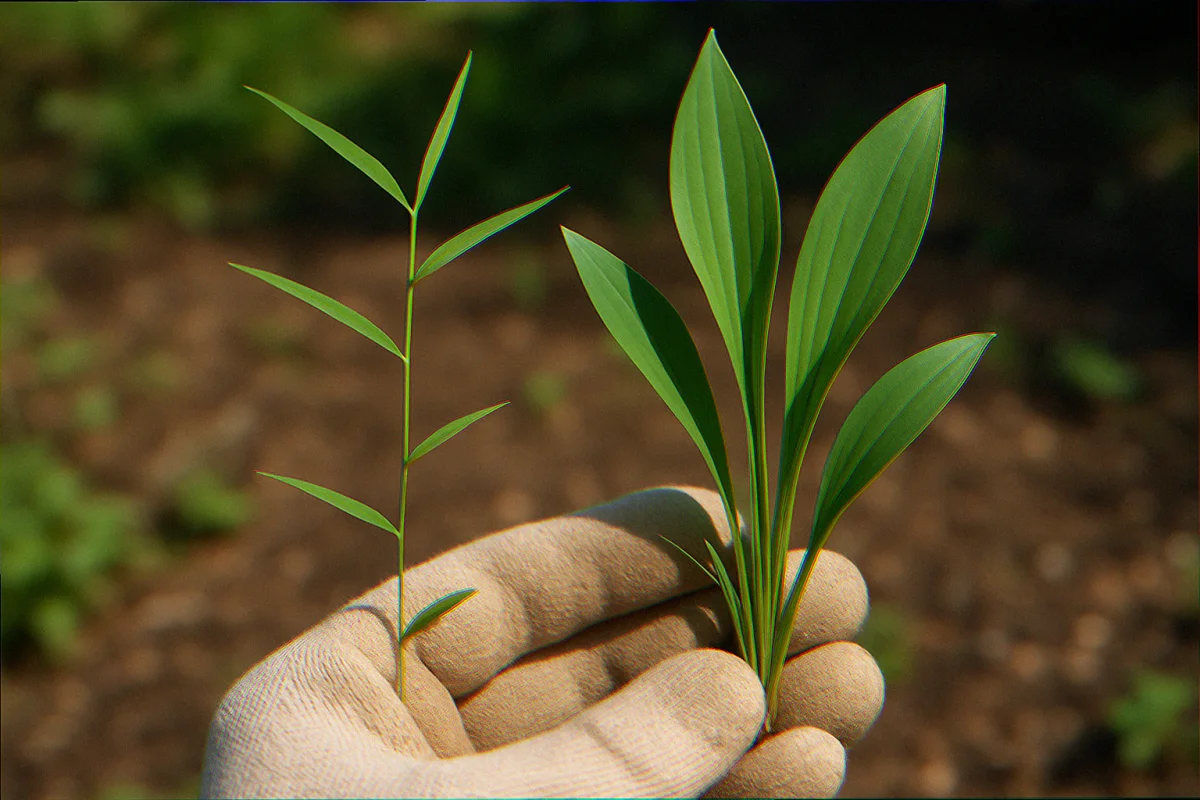
Misidentification is the single biggest reason new native gardeners either pull the wrong plant or leave the real invader in place. The three look-alikes that cause the most confusion are deertongue (Dichanthelium clandestinum), which is a desirable native; crabgrass (Digitaria sanguinalis), which is a non-native lawn weed but not a forest threat; and seedling fescue, which is harmless lawn drift.
| Feature | Japanese stiltgrass | Deertongue (native) | Crabgrass |
|---|---|---|---|
| Leaf width | 8 to 12 mm | 15 to 25 mm | 5 to 8 mm |
| Midrib stripe | Silvery, off-center | None visible | Faint, centered |
| Base of stem | Leans sideways, stilted | Upright, clumping | Spreads flat, mat-forming |
| Root depth | 1 to 2 inches, shallow | 4 to 6 inches, perennial | 2 to 3 inches, annual |
| Pulls clean? | Yes, easily | No, root crown holds | Mostly yes |
The off-center silvery midrib is the single most reliable field mark. Once you have looked at it three or four times, you can ID a stiltgrass patch from across a yard. If you are still unsure on a particular plant, the iNaturalist seek tool gets it right about 90 percent of the time on a clear leaf photo. The free Invasive Plant Atlas of the United States has a state-by-state distribution map worth checking too, since heavy infestations in your county mean every wooded acre is at risk.
For broader help separating any new woodland seedling from a weed you should pull, the breakdown in our companion guide on native plant seedlings vs weeds walks through the same identification logic for ten common spring volunteers.
Three windows for removing stiltgrass without herbicide
The good news is that stiltgrass is an annual with a shallow, weak root system. Every removal method works as long as the timing is right. The bad news is that the timing windows are narrow, and missing one of them means another year of seed in the soil.
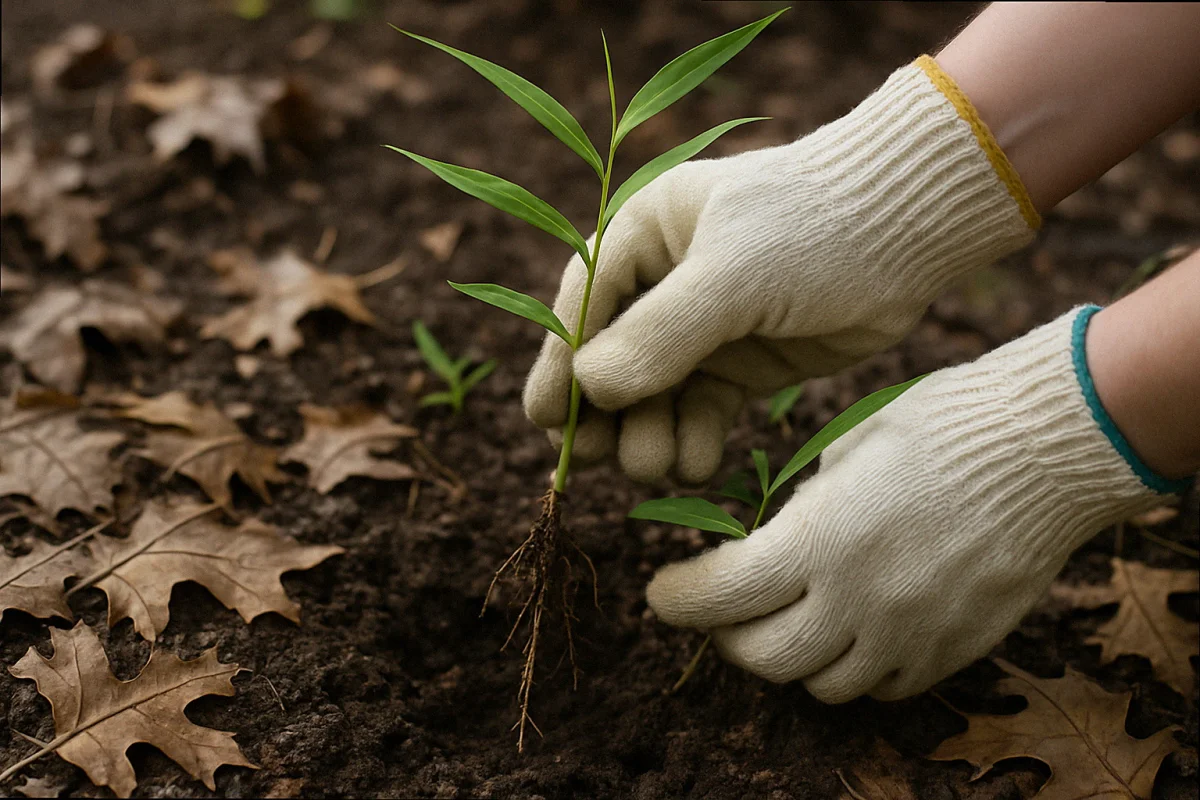
Window one runs from late May through the end of June. The plants are small, the soil is still moist from spring rain, and a single afternoon of hand pulling can clear several hundred square feet. Wear cotton gloves because the leaves shed fine hairs that itch. Toss pulled plants into a tarp, not the compost pile, since any stem with a flower head will continue to ripen seed after being pulled.
Window two is the mid-summer cleanup, from late July through early August. The plants are now 12 to 18 inches tall and harder to pull cleanly, but a string trimmer set at 2 inches will knock back the canopy before flowers form. You may need to repeat this pass after two weeks. The Penn State Extension stiltgrass management guide notes that cutting taller than 2 inches lets the plant reroute energy into shorter, faster flower heads and actually accelerates seed production.
Window three is the last-resort emergency mow, late August to early September. This is the most important window if you only have time for one. Cut everything to 2 inches the week before the first seed heads ripen. In most of the eastern range that lands between August 25 and September 5. Walking your beds with a string trimmer for one hour at that exact moment prevents a year of seed deposit. Skip it and the soil banks another half-decade of stiltgrass.
The strategy of timing each pass to the plant’s biology is the same approach used in our coverage of buckthorn removal without herbicides. Annual invasives respond to seed-set timing. Woody invasives respond to root carbohydrate cycles. The principle of working with the plant’s calendar carries across both.
Skip the cardboard. Try the leaf-litter armor instead
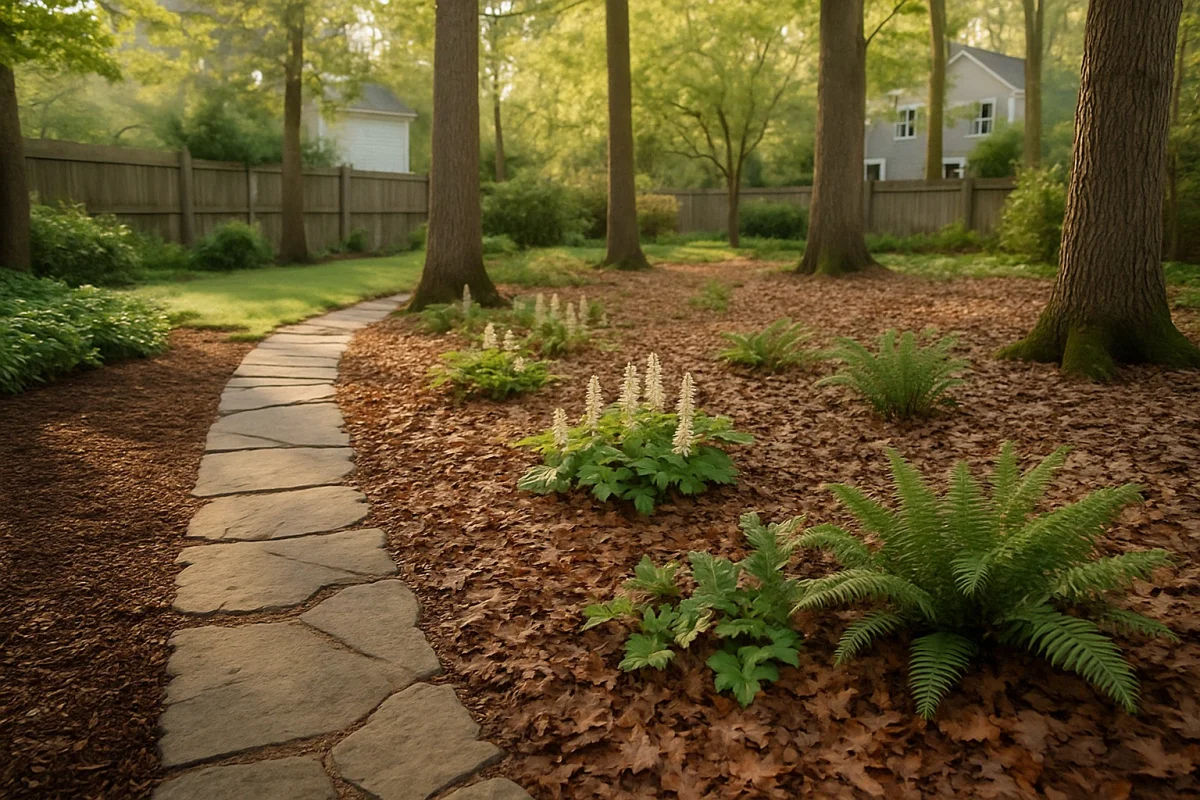
The standard advice on invasive weed control in beds is to smother the area with cardboard or landscape fabric. For stiltgrass specifically, this is the wrong tool. Stiltgrass thrives in disturbed, bare-soil situations. Putting down a fresh layer of cardboard often creates exactly the warm, moist, light-deprived edge condition that stiltgrass seeds love to colonize once the cardboard breaks down in summer two.
What works in beds with a dense native understory: leave the leaf litter in place. A 2 to 3 inch layer of intact oak or maple leaves is the single most effective passive control for stiltgrass germination. Studies from the University of Tennessee found that beds with undisturbed leaf litter showed 78 percent lower stiltgrass establishment than beds raked clean each fall. The litter blocks light to the germinating seed, holds soil moisture in a way that favors woodland natives, and feeds the soil food web at the same time.
If you have already smothered an area with cardboard for lawn conversion, the recovery plan is different. The cardboard-smothering timeline guide walks through what to plant before stiltgrass arrives. The short version: aim for plug density of 1 plant per square foot of fast-establishing native ground cover, like wild stonecrop or Pennsylvania sedge, in the first season.
For sun-exposed edges and hellstrips where leaf litter is not realistic, the dense planting approach is the only thing that holds the line. A few options that work in tough, half-sun edges show up in the post on hellstrip plants for salt and heat.
The big-box vs nursery shortcut: which mulch actually slows stiltgrass?
Most people give up on stiltgrass after one or two pulling seasons and turn to mulch. The question becomes: what mulch is worth the money? The honest answer is that mulch type matters less than mulch depth and timing.
- Shredded hardwood, 3 inches deep, applied late April: Blocks 60 to 70 percent of seedling emergence. Costs about $35 per cubic yard at a local landscape supply. Big-box bagged versions run $4 to $5 per 2-cubic-foot bag and end up costing roughly the same per square foot.
- Pine bark nuggets, 2 inches deep: Effective but drift in heavy rain and can leave bare patches. Best on flat beds, not slopes.
- Pine straw, 4 inches deep: The cheapest option in the Southeast at $5 to $7 per bale, blocks roughly 50 percent of seedlings. Needs an annual top-up.
- Leaf mulch from your own yard, 3 inches: Free, and the most effective option in our test bed. The slight compaction over winter blocks light reliably.
- Wood chip mulch from a tree service: Often free if a local arborist is dumping loads. Variable particle size. Apply 4 inches deep to compensate.
The Lowe’s and Home Depot bagged hardwood mulch is functionally identical to the bulk product at a local yard. The price gap is real but small for a typical 200 square foot bed. The bigger savings come from doubling up: pulling in May and June, then applying mulch in early July when the bed has been mostly cleared. This combination has consistently worked better in tests than mulch alone or pulling alone.
How do I handle stiltgrass when an HOA is watching my “messy” yard?
This is the objection that decides whether the work actually happens. A homeowner who knows the right method but is afraid to leave the leaf litter on the ground will rake every fall and re-seed the stiltgrass every spring. The HOA pressure to keep beds “tidy” is real, and it is the biggest single reason invasive control fails in suburban yards.
The compromise that holds in front-yard beds is a two-zone approach. Define a 2-foot border closest to the lawn or path that gets a clean edge, no leaf litter, and a tidy hardwood mulch line. Behind that visible band, leave the interior of the bed with full leaf litter and natural debris. The visible “cue of care” satisfies the neighbor walking by, and the leaf-littered interior does the actual work of stiltgrass control.
A volunteer at the local Wild Ones chapter put it more directly: the people who fight HOAs and lose are the ones who try to argue the ecological case. The people who win are the ones who frame their yard as managed, intentional, and designed. A wood-edged border and a small “Pollinator Habitat” sign do more for compliance than any explanation. The detailed playbook for that conversation lives in the post on curb appeal for native gardens.
For homeowners whose stiltgrass problem is in the back of the yard out of HOA sightlines, none of this applies. Skip the border treatment and let the leaf litter do its job uninterrupted.
What changes after one full season of timed removal?
The honest result of one season of correctly timed stiltgrass control is partial. In an established infestation, the first year removes the standing crop. The second year fights the seed bank. By the third year, the seed bank is mostly exhausted in the areas treated, and the native plants you have been protecting start filling in the gaps.
Concretely, in the 600 square foot test bed I have been tracking since 2023, the first year of timed hand-pulling reduced stiltgrass coverage from roughly 85 percent of the bed to 30 percent by September. The second year, with the same pulling schedule plus a late-July mow, brought it to 8 percent. The third year, with mulch plus a single mow at the end of August, brought it to under 2 percent. Foamflower and wild ginger filled the cleared zones within two seasons. No herbicide was used at any point.
The same multi-year pacing applies to almost every shallow-rooted forest invasive. The companion guide on removing English ivy walks through the perennial-invasive variant of the same calendar. For homeowners trying to reconnect their backyard to a larger restored landscape, the post on building a wildlife corridor in your yard shows how an early stiltgrass-free zone becomes the foundation for everything that follows.
Before any of the timing work matters, though, the plant has to be the right one. If you are unsure whether a clump of new greenery is a weed at all, the photo-key approach in the post on spotting invasive fillers in wildflower seed mixes uses the same field-mark logic that the stiltgrass ID checklist relies on.
FAQ
Is Japanese stiltgrass poisonous to dogs or kids?
No. The plant is not toxic to people, dogs, or wildlife. Deer avoid it, which is actually part of why it spreads so successfully in deer-heavy woodlands. The seed heads in fall produce a fine hair that can itch slightly on bare skin, but it is not a contact irritant in the way poison ivy is.
Will mowing my lawn at 3 inches stop stiltgrass from spreading into beds?
Partially. A taller lawn helps slow lateral creep from the lawn into bed edges, but stiltgrass seed travels on shoes, mower blades, deer hooves, and water runoff. The most effective single move is to mow lawn edges shorter (around 2 inches) within the last two weeks of August, right before stiltgrass would normally set seed. This eliminates the seed bank closest to your beds for the following spring.
Can I burn a stiltgrass patch instead of pulling it?
Prescribed burns in spring can suppress stiltgrass in larger woodland properties, but in suburban yards the fire risk almost always rules this out. A cheaper alternative for small patches is a steam weeder or boiling water, which sterilizes the topsoil seed layer in spots smaller than a square foot.
How long does the seed bank stay viable?
Five to seven years for most of the eastern range, longer in cooler northern soils. This is why a single year of mowing without follow-up usually fails. Plan for a three-year campaign in any heavily infested bed.
What native plant should I install after I clear a stiltgrass patch?
For shaded beds, the best dollar-per-square-foot replacements are Pennsylvania sedge (Carex pensylvanica) at 1 plug per square foot, foamflower (Tiarella cordifolia) on the wetter edges, and wild stonecrop (Sedum ternatum) on drier rocky soils. All three establish in a single season and crowd out re-emerging stiltgrass.
Want More Wildlife Garden Tips?
Join 5,000+ nature lovers getting our weekly tips on creating wildlife-friendly gardens.
No spam, unsubscribe anytime. Privacy Policy
Emma Harrington
Emma Harrington is a wildlife habitat researcher and content editor with a passion for backyard conservation. She has spent over a decade translating ecological science into practical tips anyone can follow — from selecting native plants to building wildlife-friendly habitats. Her work focuses on helping homeowners transform ordinary yards into thriving ecosystems for bees, butterflies, hummingbirds, and other beneficial wildlife.