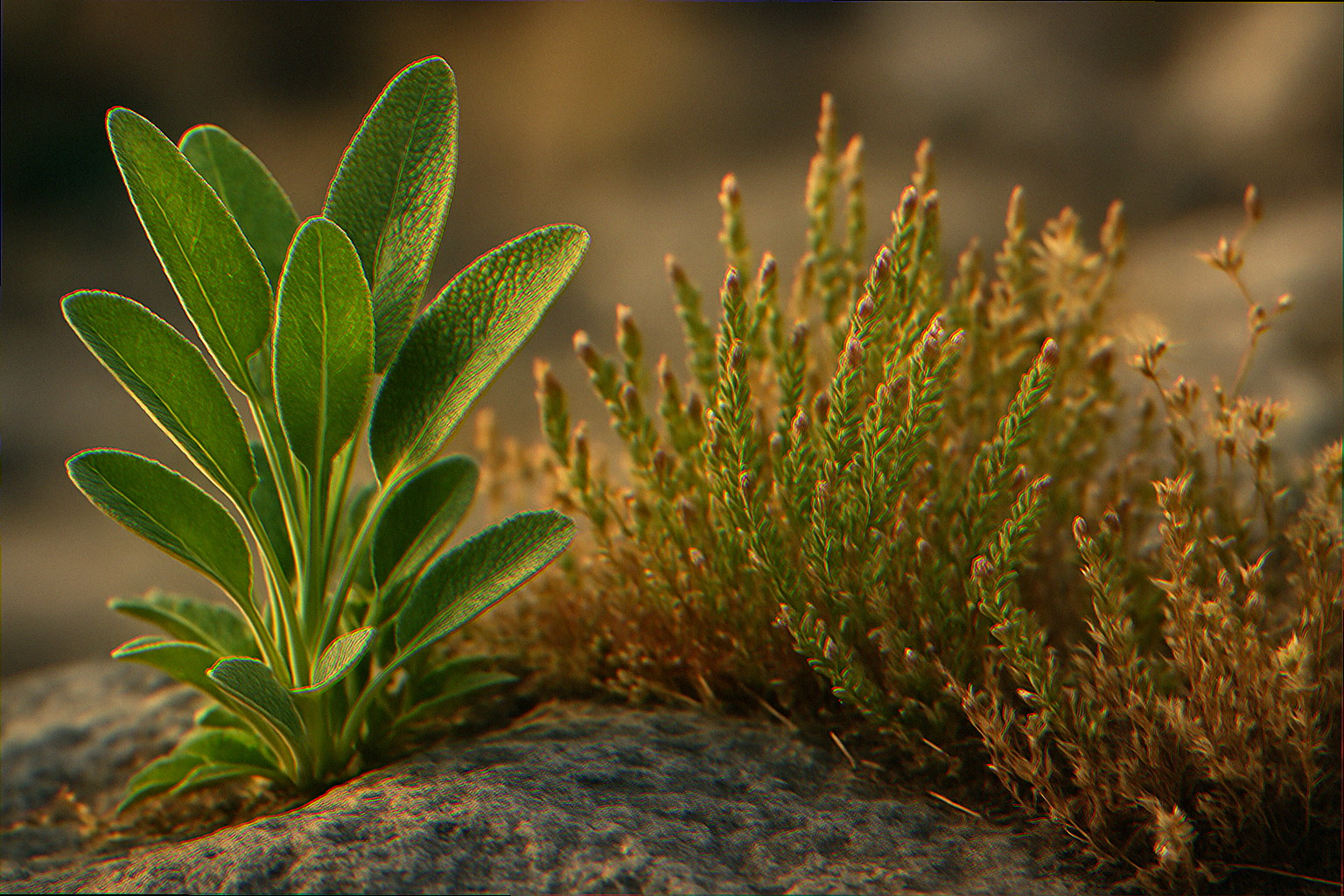
It’s no secret which area of your yard likely brings you the most frustration each summer. The strip between the sidewalk and the curb is often a harsh environment, suffering from intense sunlight, winter salt from snowplows, and foot traffic from dog walkers. I’ve seen others describe their own experiences with such strips in a way that resonates: one mentioned having a hellish section that gets battered by heat, pollution, and foot traffic. If you’ve found yourself in May with nothing but dead coneflowers and a half-empty bag of mulch, this article is just for you.
The good news is that the hellstrip is not a yard problem. It is a microclimate problem. Treat it like a yard, and almost every native you love will fail there. Treat it like the harsh, salty, compacted little prairie it actually is, and a short list of tough natives will reward you with bloom from May through October. Below are nine of those plants, the layout pattern that keeps the strip looking intentional instead of abandoned, and the script for handling the code letter or the HOA email if one shows up.
There’s a wealth of information in this guide, drawing from various extension recommendations, the Ecological Landscape Alliance, and insights from gardeners who have been transforming challenging strips for years. It’s worth reading all the way through, especially since the most valuable section for many may be the layout rule included toward the end, rather than just the plant list.
FREE: Wildlife Garden Starter Guide
Get our 12-page PDF with the 25 best plants for pollinators, simple habitat tips, and a printable checklist — all 100% free.
No spam. Read our Privacy Policy.The Hellstrip Is Where Native Plants Go to Die. Here Is Why That Strip Is Brutally Different From the Rest of Your Yard
Step off your porch and walk to the curb with a soil probe. The reading is going to surprise you. In most American suburbs the dirt in the hellstrip is somewhere between forty and seventy percent compacted construction sand and rubble, dumped there when the sidewalk was poured and never amended again. The pH skews alkaline because of decades of road salt leaching, the organic matter is often under two percent, and the soil temperature in July routinely runs ten to fifteen degrees hotter than your back lawn because the asphalt on one side and the concrete on the other are radiating heat into it from both directions.
That is before you add the deicing salt. A single winter’s worth of plowing in a snowy region can push sodium and chloride levels in roadside soil to three or four times what most ornamental perennials can tolerate. By April those salts are still sitting in the top six inches of soil, waiting to dehydrate the roots of anything you plant before its first leaf opens. The plants you bought at the big-box store last Memorial Day, the ones labeled “full sun, drought tolerant,” were almost certainly not bred for salinity that high.
Foot traffic finishes the job. Every shortcut a pedestrian takes across the strip compacts the soil another fraction. Every dog that lifts a leg adds nitrogen and pH stress in a concentrated burst. By the time you are out there in mid-summer with the watering can, you are not maintaining a garden. You are running a triage clinic.
What Actually Kills Plants in That Strip (It Is Not Just Drought)
Most articles about the hellstrip lead with drought tolerance. Drought matters, but it is rarely the first thing that kills a new planting. Here is the actual order of operations, based on what shows up in extension call logs and gardening forum post-mortems each summer.
- Salt burn in late winter. Roots that survived the December freeze get desiccated by chloride still sitting in the soil in March. Symptoms look like winter kill but are chemical.
- Compaction failure at root depth. Plants put on green growth in April, then collapse in June because their roots hit a layer of impenetrable sub-base they cannot push through.
- Heat island stress. Soil temperature climbs past ninety degrees in July, cooking shallow roots faster than the plant can transpire.
- Salt drift in summer. If your strip is along a street that gets brined again in early winter, salt buildup is cumulative year over year.
- Drought, finally. By August the plant that survived all the above might still die from a missed week of water during a heat dome.
Notice that pure drought tolerance is the last item. A plant labeled “drought tolerant” but not also “salt tolerant” and “compaction tolerant” will fail in a hellstrip even if you water it perfectly. This is why a yarrow planted in your back border thrives, while the identical yarrow planted in the strip dies in twenty months.
The Three Hellstrip Mistakes Most People Make in Their First Spring
Before getting to the plant list, it is worth naming the three errors that show up in almost every first attempt. If you skip nothing else in this article, skip these.
The first mistake is starting with potted nursery plants instead of plugs or bare-root liners. A four-inch potted plant from the garden center has a dense, compact root ball already grown in light, fluffy potting soil. When you transplant it into the dense, brick-like soil of the strip, the roots simply circle inside the original root ball and never penetrate outward. By August the plant is essentially still in its pot, just without the pot. Plugs and bare-root liners adapt faster because they have less coddled root mass to begin with.
The second mistake is amending the planting hole with rich compost. This sounds intuitive but actually makes the problem worse in a hellstrip. A pocket of fluffy compost surrounded by compacted, salty native soil acts like a bathtub. Water collects in the pocket, salt concentrates around it, and roots refuse to leave the easy zone for the harder soil beyond. The plant becomes root-bound inside its own planting hole. The current best practice from urban horticulture extension agents is to amend the entire bed in a thin top layer rather than each individual hole, or to amend nothing and let the plant adapt to what is actually there.
The third mistake is planting in mid-summer because that is when the local nursery has its best inventory. A native plug installed in July faces every hellstrip stress at maximum intensity simultaneously. The same plug installed in late September, or the following March before the soil bakes, has months to push roots into the difficult substrate before the heat hits. If you only have one window per year, take the early-spring or early-fall window. Skip the summer planting trip entirely.
The Six-Inch Rule: Why Anything Over Two Feet Will Get You a Letter
Before plants, the regulation. Most American municipalities classify the strip between sidewalk and curb as public right-of-way owned by the city or county, not by the homeowner. You are responsible for maintaining it, but you do not technically own it, and most jurisdictions reserve the right to dig it up at any time for utility work without compensating you for plantings.
The two regulations that actually trigger code-enforcement letters in this zone are the height limit and the sight-triangle rule. Most cities cap unmown vegetation in the right-of-way at somewhere between eight and twenty-four inches, with the most common limit being twelve inches at maturity. Anything that grows taller during peak season is technically a violation, even if it is a beloved native. The sight-triangle rule is the second trap: at any intersection, alley mouth, or driveway, a triangular zone extending fifteen to thirty feet back from the curb must be kept under thirty inches tall so drivers can see pedestrians and cross traffic.
This is why a meadow of tall liatris and joe-pye weed, beautiful as it is, is the wrong design language for the strip. The fix is not to abandon natives. The fix is to choose natives that mature under twenty-four inches in the main strip, taller plants only in the section away from any intersection, and to keep a clean six-inch buffer of mulched soil along the curb edge. That clean edge signals intent to neighbors and gives the salt a place to land before reaching plant crowns.
Quick check before you plant: Search “[your city name] right-of-way landscaping” and look for the actual ordinance number. Most cities now publish a permitted-plant list and a height table on the public works page. The whole exercise takes ten minutes and prevents the most common reason these gardens fail socially.
Nine Native Plants Tough Enough for the Strip Between the Sidewalk and the Curb
Below are nine plants chosen for the same three traits: documented salt tolerance, low mature height that respects right-of-way limits, and a track record in compacted urban soil. Native ranges are noted because no single plant list works for the whole country. Cross-reference each species with BONAP for your county before buying.
1. Pussytoes (Antennaria neglecta and Antennaria plantaginifolia)
A four-to-eight-inch ground cover that forms silver-green mats and produces small fluffy white flowers in May. Pussytoes shrugs off road salt, foot traffic, and compacted soil better than almost any native ground cover. It is the host plant for the American Lady butterfly, which gives you a real ecological return on a plant most people walk past without noticing. Native through most of the eastern and central United States, hardy to zone 3.
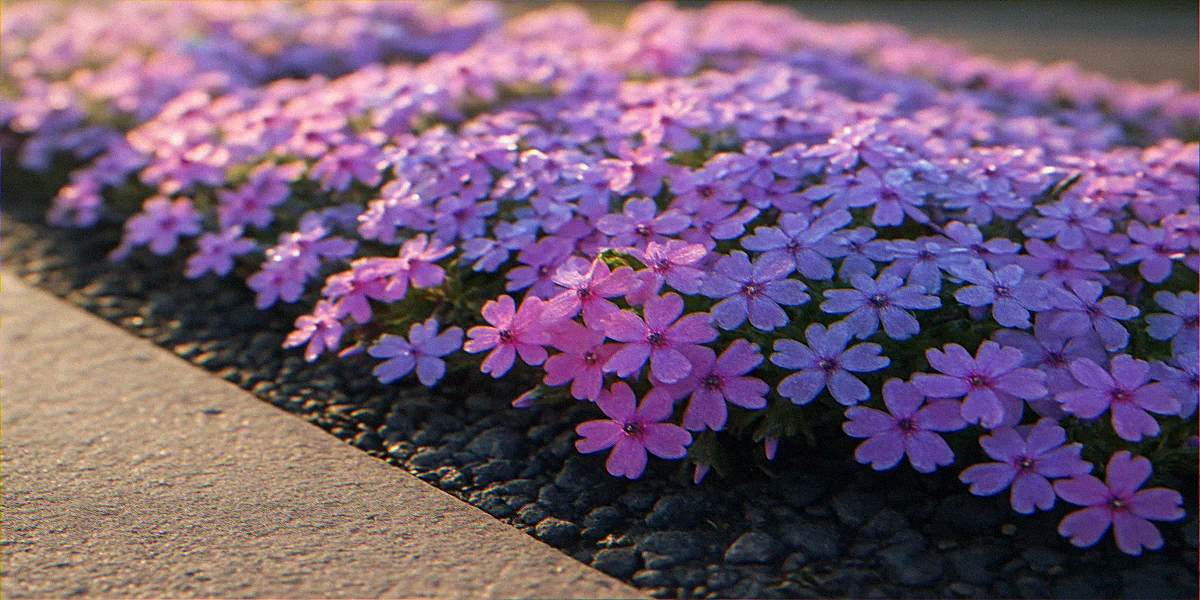
2. Moss Phlox (Phlox subulata)
A two-to-six-inch evergreen mat that explodes into a sheet of pink, purple, lavender, or white blooms for two to three weeks in April or May. Moss phlox has been growing on rocky, dry, alkaline outcrops for millennia, which translates almost perfectly to the hellstrip environment. It is one of the few plants that earns the salt-tolerant rating from multiple state extension services. Native to the central and eastern United States.
3. Threadleaf Coreopsis (Coreopsis verticillata)
An eighteen-to-twenty-four-inch fine-textured perennial that blooms yellow from June through August and keeps blooming if you shear it once in mid-summer. It is unfazed by drought, compacted soil, and moderate salt exposure, and it stays under the typical right-of-way height cap if you choose the straight species or compact selections like ‘Zagreb’. Native to the southeastern and central United States.
4. Little Bluestem (Schizachyrium scoparium)
A two-to-three-foot warm-season bunch grass that turns copper-pink in autumn and holds its color through the winter. Plant it only in the section of strip away from intersection sight triangles. Little bluestem is the workhorse of dryland prairie restoration and tolerates compaction, salt, drought, and wind. Native nearly everywhere in the contiguous United States.
5. Butterfly Milkweed (Asclepias tuberosa)
An eighteen-to-thirty-inch deep-taprooted perennial that produces clusters of bright orange flowers in June and July and is one of the most important monarch host plants in the eastern half of the country. Once established, the taproot lets it find moisture far below the compacted layer where shallow-rooted plants give up. Plant it only from a plug or bare root, never from a divided clump, because the taproot does not transplant well. Native through most of the eastern and central United States.
6. Pennsylvania Sedge (Carex pensylvanica)
A six-to-twelve-inch fine-bladed sedge that forms a soft, loose lawn alternative in part shade. If your strip is shaded by a street tree, this is your ground-layer plant. It tolerates moderate salt, light foot traffic, and the dry shade conditions that kill most cool-season turf grasses. Native to the eastern half of the United States.
7. Aromatic Aster (Symphyotrichum oblongifolium)
A twelve-to-twenty-four-inch late-blooming perennial that produces clouds of lavender flowers from late September through hard frost, exactly when most of the rest of your yard has gone quiet. Aromatic aster is one of the more salt-tolerant asters and stays naturally low, which keeps it inside most height ordinances. Native through most of the central United States.
8. Prairie Dropseed (Sporobolus heterolepis)
A two-to-three-foot fine-textured grass that smells faintly like buttered popcorn when it blooms in late summer. Use it as a soft, repeating element in the parts of the strip away from intersection sight lines. Prairie dropseed tolerates drought, salt, and compacted soils, and it is the most graceful native grass for a formal-leaning planting. Native through the central and eastern United States.
9. Wild Petunia (Ruellia humilis)
A twelve-to-eighteen-inch summer bloomer that produces lavender-purple trumpet flowers from June through September. It tolerates the worst the hellstrip has to offer, reseeds itself politely into bare spots without becoming aggressive, and supports several native bee species. Native to the central and southeastern United States.
How to Lay Out a Hellstrip So It Reads as Intentional, Not Abandoned
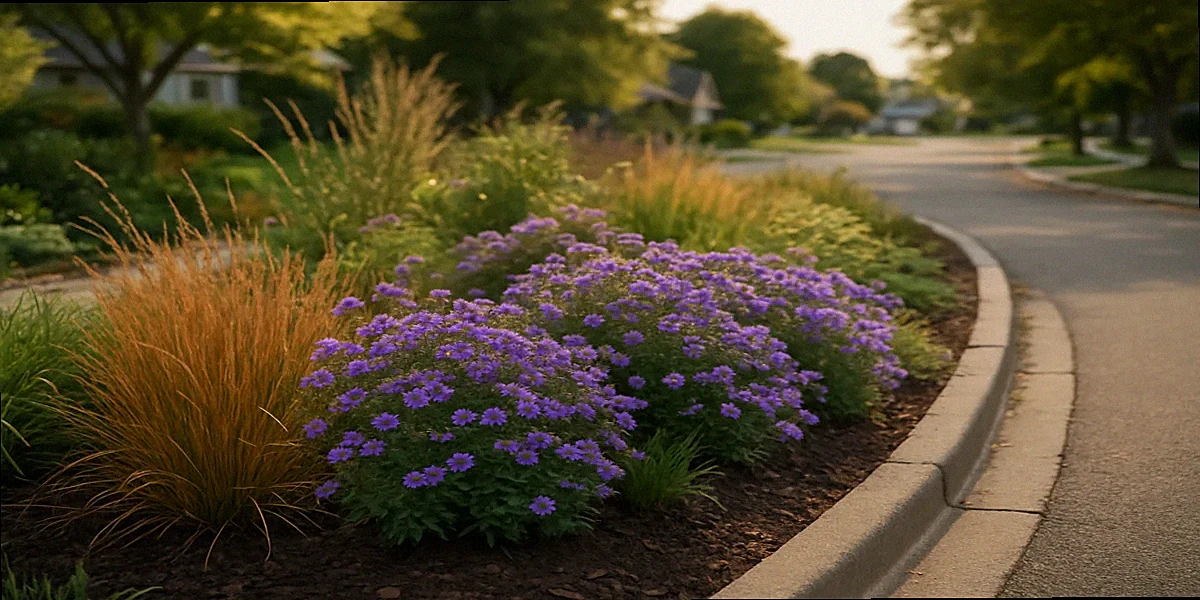
This is the section that decides whether you get neighbor compliments or neighbor complaints. The plants matter, but the layout matters more. The pattern that consistently reads as intentional uses three layers and one rule.
The first layer is a clean curb edge. Keep a six-inch strip of dark mulch or gravel directly along the asphalt. This catches salt before it reaches plant crowns, gives plowed snow a place to land, and visually frames the planting as a designed bed rather than untended weeds. The second layer is a low ground-cover mat: pussytoes, moss phlox, or Pennsylvania sedge depending on your light conditions. This layer signals to the eye that the bed is fully planted rather than struggling. The third layer is the bloom and structure layer: drifts of three or five plants of butterfly milkweed, threadleaf coreopsis, wild petunia, and aromatic aster, with little bluestem or prairie dropseed used only in sections well away from intersections.
The one rule is repetition. A strip that reads as intentional uses three to five species repeated in waves down its length, not fifteen species each appearing once. Repetition signals design. Variety without repetition signals chaos. The same plant repeating every eight to ten feet down the strip will look more like a magazine garden than a curated mix of one of everything.
| Layer | Function | Plant Examples | Mature Height |
|---|---|---|---|
| Curb buffer | Catch salt, frame the bed | Dark hardwood mulch or pea gravel | 0 inches |
| Ground mat | Read as fully planted | Pussytoes, moss phlox, Pennsylvania sedge | 2-8 inches |
| Bloom drifts | Color and pollinator value | Butterfly milkweed, threadleaf coreopsis, wild petunia, aromatic aster | 12-24 inches |
| Structural accents | Repetition and winter interest | Little bluestem, prairie dropseed | 24-36 inches (away from intersections only) |
One more layout note: leave a clear pedestrian shortcut where one is already happening. If the dog walkers are cutting across the same six feet every day, fight that battle and you will lose. Pave it with stepping stones, gravel, or a small flagstone path and design around the traffic line. The bed will look more intentional and the plants will stop getting trampled.
But My City or HOA Says I Cannot Do This. What Now?
This is a common hurdle that often derails many hellstrip projects before they even get off the ground. A regular reader wrote in to say they received a code violation letter just two weeks after starting their conversion project, despite planting butterfly milkweed and coreopsis. They were cited for the height of a coneflower that only reached eighteen inches! Such letters can feel like a personal attack, but it’s crucial to approach them without taking it too personally.
Here is the response that works in most jurisdictions, in order. First, before planting, look up the actual ordinance number. Search “[your city name] right-of-way landscaping ordinance” or “[your city name] weed ordinance height.” Most cities post a permitted-plant list, a height table, and a sight-triangle diagram on their public works page. Read the actual document, not someone’s summary. The rule is almost always more permissive than rumor suggests.
Second, if your city has a registered native or pollinator garden program, register before you plant. More than seventy United States cities now have explicit programs that exempt registered pollinator and native plant gardens from the standard weed-ordinance height limit. Registration usually takes one form and a small site sketch and grants you a defensible status if a complaint comes in.
Third, if a code letter does arrive, respond in writing within the deadline rather than ignoring it. Reference the ordinance number, attach a list of the species you planted with their mature heights, attach photos of your six-inch curb buffer and clean edges, and request a site visit. Code-enforcement officers are trained to issue notices on visual impression. A factual, polite response with documentation will resolve almost every first-letter situation without escalation.
HOA situations are different from municipal ones. HOAs operate on covenants you signed, and the path forward is usually proposing a native-plant amendment to the architectural review committee. The most effective amendments piggyback on whatever language your HOA already uses for “ornamental beds” and add native species to the approved-plant list rather than carving out a separate native exception. Use Illinois’s 2024 Native Homeowner’s Landscaping Act and similar Maryland, Minnesota, and Colorado state laws as precedent: state-level law in those jurisdictions now overrides HOA prohibitions on native plantings.
What Changes the First Summer After You Plant: A Realistic Timeline
Set expectations honestly. Year one, the strip will look sparse. The plugs are putting their energy underground, building the deep root mass that will let them survive year two. You will water once a week through the first summer if rain is short, you will see almost no bloom from the bunch grasses, and the strip will be the least photogenic part of your yard. This is normal. The same pattern shows up in every native installation, but in a hellstrip the contrast with the rest of your garden is sharper.
Year two is the bloom year. Butterfly milkweed will produce its first real flowering, threadleaf coreopsis will fill out and flower for two months straight, moss phlox will form a continuous mat, and aromatic aster will throw a late-September show that surprises you. Pollinators arrive that summer in numbers you will be able to count from your kitchen window. Year three is the maintenance year, when the planting needs editing rather than installing: divide drifts that have grown too dense, replace anything that died, refresh the curb-buffer mulch, and stop watering entirely except in extended drought.
By year three you will also be able to walk a neighbor through the bed and explain what every plant is and why it is there, which is the social moment that converts the planting from a personal project into a neighborhood example. The hellstrip stops being the strip you avoid and becomes the most-photographed slice of your yard. The same square footage that killed three coneflowers in 2024 will be feeding monarch caterpillars and skipper butterflies in 2027.
For more on the curb-appeal design language that protects native plantings from neighbor complaints, see our guide on five design patterns that survive your HOA. For an authoritative overview of right-of-way planting law and best practices, the Ecological Landscape Alliance maintains a comprehensive design guide worth bookmarking.
Frequently Asked Questions
How wide does my hellstrip need to be for native plants to work?
Three feet is the comfortable minimum. Anything narrower than two feet will not give plants enough root volume to survive the salt and compaction load. If your strip is under two feet, consider gravel and a single drift of moss phlox rather than a layered planting.
Do I need permission from the city before planting hellstrip plants?
It depends on your jurisdiction. Some cities require a no-cost permit, some only require you to follow the published height and species rules, and some have no restriction at all. The ten-minute search of your city’s right-of-way ordinance is the only reliable way to know. Skipping that step is the most common reason these projects fail socially.
Can I just throw down a wildflower seed mix instead of planting plugs?
The honest answer is almost never. Hellstrip soil is too compacted and too inhospitable for direct seeding to work reliably. Most pre-mixed wildflower packets also contain a high percentage of non-native filler species, several of which are documented invasives in different regions. Plugs and bare roots survive at far higher rates and let you control exactly which species you are planting.
Will a native hellstrip lower my property value?
The available data, including a 2023 Penn State study on perceived value of native landscapes in suburban appraisals, shows the opposite. A well-designed native streetside planting reads as cared-for and increases curb-appeal scores in real-estate listings. The key word is “well-designed,” meaning a clean edge, repeated species, and visible intent. An untended-looking patch of weeds does the opposite.
What do I do if my dog or my neighbor’s dog uses the hellstrip as a bathroom?
This is the one variable you cannot fully solve. Plant heavier mulch and a denser ground cover at the corners where dogs are most likely to stop, leave a small gravel patch at the most-used spot rather than fighting it, and rely on the salt-tolerant ground-cover layer to absorb the nitrogen load without dying. Pussytoes and Pennsylvania sedge handle this stress better than almost any flowering perennial.
Conclusion
The strip between your sidewalk and the curb does not have to be the patch of yard that makes you feel like you have failed at gardening. It just has to be designed for what it actually is rather than what you wish it were. Choose plants bred by evolution for salt, drought, and compaction. Stay under the height ordinance. Keep a clean curb buffer. Repeat three to five species in waves rather than collecting one of everything. And register your planting with whatever native-garden program your city offers before the first complaint arrives.
If this guide saved you from another summer of dead coneflowers, share it with the gardener you know who is staring at a brown patch by their sidewalk this week. Native plant conversion happens one strip at a time, one neighbor at a time, and the hellstrip is the most visible square footage on the block. That is its biggest difficulty and its biggest opportunity.
Related reading
Want More Wildlife Garden Tips?
Join 5,000+ nature lovers getting our weekly tips on creating wildlife-friendly gardens.
No spam, unsubscribe anytime. Privacy Policy
Emma Harrington
Emma Harrington is a wildlife habitat researcher and content editor with a passion for backyard conservation. She has spent over a decade translating ecological science into practical tips anyone can follow — from selecting native plants to building wildlife-friendly habitats. Her work focuses on helping homeowners transform ordinary yards into thriving ecosystems for bees, butterflies, hummingbirds, and other beneficial wildlife.