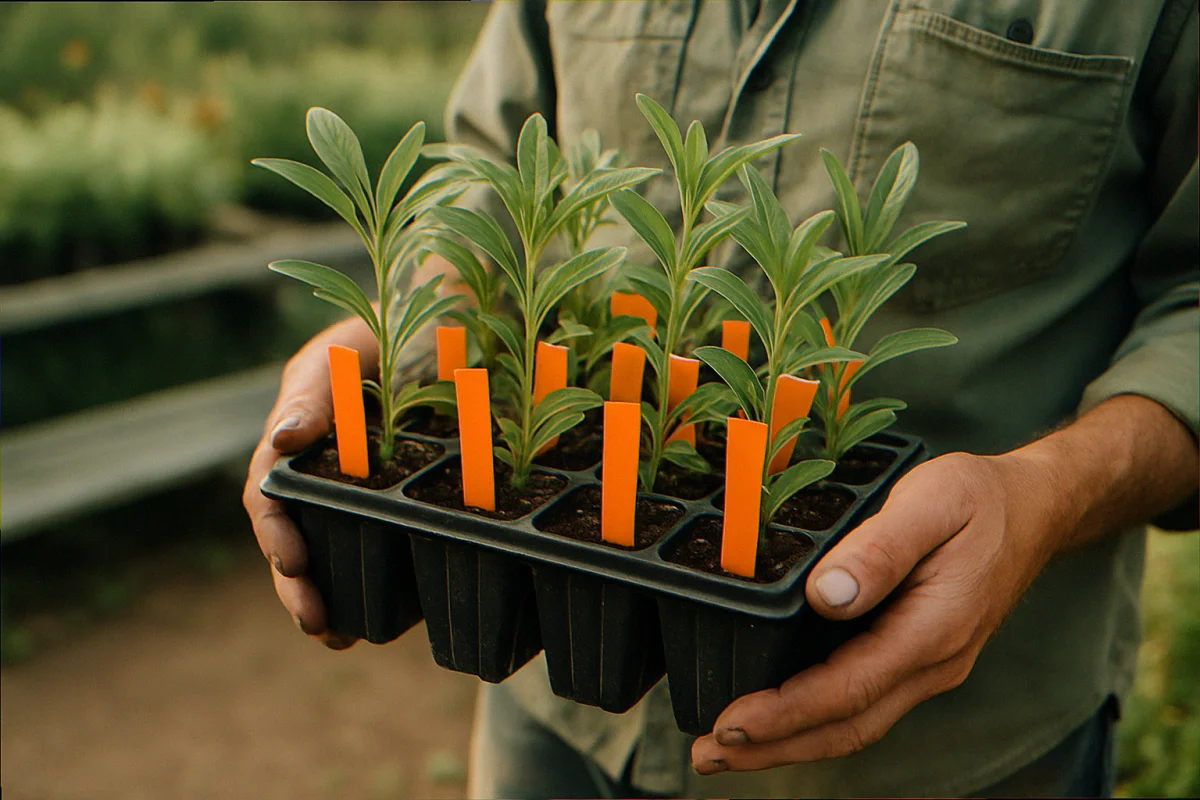
If your local native nursery is sold out of butterfly weed and Prairie Moon won’t restock until fall, the fastest legitimate sources are your state’s conservation district seedling sale, the regional chapter of Wild Ones, and a handful of small Midwest and Mid-Atlantic growers who never appear in Google’s first page. Stack three of these as a wait-list, not one as a hope.
The first time I tried to buy Asclepias tuberosa in May for my front bed, every nursery within a 90-minute drive was sold out and the online catalogs all said “back in stock 2027.” A reader emailed last month asking the same thing about wild bergamot: she’d watched five regional growers close their carts between February and April, and the only “milkweed” left at her local big-box was actually a tropical species that would freeze out by Thanksgiving. That gap between what we want for the yard and what’s actually on the shelf is the real reason so many native gardens stall after year two.
This isn’t a supply problem you can solve by trying harder on Amazon. It’s a structural mismatch between a market that doubled in three years and a growing season that takes eighteen months to produce a plug. The good news is there’s a whole tier of suppliers most homeowners never find. And a few seasonal rhythms that, once you learn them, mean you’ll never miss a window again.
FREE: Wildlife Garden Starter Guide
Get our 12-page PDF with the 25 best plants for pollinators, simple habitat tips, and a printable checklist — all 100% free.
No spam. Read our Privacy Policy.Why is butterfly weed so hard to find this spring?
Demand for true natives has roughly doubled every twelve to eighteen months since 2022, according to tracking by the Xerces Society pollinator program. Production has not. A milkweed plug starts as a stratified seed in October, becomes a transplantable plug eight to ten months later, and reaches sellable size only in its second spring. That means every plant you see on a nursery bench in May 2026 was scheduled into a tray in fall 2024. Before the demand spike showed up in regional sales data.
So when Prairie Moon, Prairie Nursery, and your county’s three native specialists all sell out by early April, it isn’t because they’re hoarding. It’s because the only way to scale faster would have required them to predict, two years ago, that you’d be hunting for Asclepias incarnata right now. Small growers can’t take that risk on speculative inventory, so they grow conservatively, sell out fast, and you get the catalog message that’s now a meme: “Sold out. Check back in fall.”
The supply gap is sharpest for the keystone species the Doug Tallamy crowd has been (correctly) pushing for a decade: oaks, milkweeds, goldenrods, asters, native bergamots, and the regional ecotypes of common species that actually evolved with your local bee population. Generic cultivars from big-box stores remain plentiful, which is exactly the trap most homeowners fall into after a third dry hole.
When do the best native nurseries actually run out?
If you’ve been shopping in May and wondering where everything went, you’re roughly nine to twelve weeks behind the actual sourcing calendar. Here’s how the year actually breaks down at most regional native growers:
| Window | What’s actually happening | Your move |
|---|---|---|
| Mid-Jan to early Feb | Conservation district sales open for online orders; spring catalogs go live | Place orders before Valentine’s Day; pickup is March-April |
| Late Feb to mid-March | Mail-order specialty growers (Prairie Moon, Izel, Pinelands) start filling fast | Add 3 wait-lists; pay deposits where required |
| April | Most keystone species (Asclepias, Monarda, Eutrochium) gone from popular catalogs | Pivot to plant swaps and conservation district pickups |
| May to August | Mostly slim pickings at retail; small growers restocking weekly with whatever’s ready | Direct-message growers about cancellations and walk-in stock |
| September to early November | Fall plant sales by chapters of Wild Ones and native plant societies; divisions abundant | Best window of the year for free or near-free plants |
The October-November sale window is the one almost no first-year native gardener knows about. Local chapters of Wild Ones hold fall swaps and dig-your-own events where the entry price is sometimes literally just showing up. I’ve come home from one with thirty plugs, three divided clumps of Eutrochium maculatum, and a shovel handed back covered in clay.
The conservation district seedling sale nobody talks about
Every county in roughly 40 US states runs a soil and water conservation district that holds an annual native plant and tree seedling sale, almost always with online ordering between mid-January and early March. Bare-root tree seedlings run $1 to $2 each. Plugs of Asclepias syriaca, Liatris spicata, Monarda fistulosa, and Rudbeckia hirta typically run $3 to $5. Minimum orders are usually low. Sometimes just 10 plants per species.
The catch: most districts don’t market beyond a county newsletter, a static webpage, and an emailed flyer to last year’s customers. If you’ve never bought from yours, you almost certainly haven’t seen the sale notice. Search “[your county] conservation district plant sale” in January. If nothing comes up, try the neighboring counties. Many districts let out-of-county residents order, and a few sell to anyone within the watershed.
State forestry programs run a parallel track. State forestry offices sell bare-root native trees and shrubs in bundles of 25 to 100 for windbreaks, riparian buffers, and habitat plantings. Pennsylvania, New York, Wisconsin, Iowa, Minnesota, North Carolina, and most other states with a serious forestry program will ship to homeowners. Bundles of 25 serviceberry, red osier dogwood, or hazelnut typically come in under $30, which is roughly what one container-grown shrub costs at a garden center.
For verifying that the species you want is regionally appropriate before placing an order, the gold standard is checking your county’s flora through the same county-level data set South Carolina extension agents rely on. We covered the workflow for that in detail in how to verify a plant is truly native to your county, which pairs well with this article since district sales sometimes include species that are native to the state but not to your specific ecoregion.
How do plant swaps and seed shares actually fill the gap?
If money’s tight or the shipping windows are wrong, plant swaps and seed shares solve roughly 60 percent of the supply problem for established gardeners. A swap works because mature gardens overflow with divisions: a single five-year clump of Pycnanthemum tenuifolium produces eight to twelve transplantable divisions in fall, and a healthy patch of Asclepias syriaca seeds itself so aggressively that the gardener is usually relieved to give plugs away.
To plug in, the steady channels are:
- Your regional Wild Ones chapter. Roughly 75 chapters across the US. They run spring and fall swaps, often paired with educational walks.
- State native plant society chapters. Massachusetts NPS, Maryland NPS, Indiana NPAW, and equivalents in most states hold member-only and public swaps.
- Master Naturalist program local cohorts. Members frequently have surplus from restoration sites or their own propagation projects.
- Master Gardener seed libraries. Many cooperative extension offices run seed libraries that include native species, with check-out and return-the-seed rules.
- Local pollinator pathway groups. Especially active in New England, the Mid-Atlantic, and the Great Lakes. They share seeds, plugs, and labor.
Propagating from a single gifted plant is also realistic. The seven-step propagation calendar from our article on propagating and sharing native plants with neighbors this spring walks through which species divide cleanly versus which need cuttings or layering. If you can get one healthy clump of Monarda fistulosa from a swap, you’ll have four to seven plants within two seasons without buying anything.
Hunt down regional growers Google won’t show you
The top of the Google results for “buy native plants” is almost entirely the same eight retailers, half of which sell either mislabeled seeds or non-local ecotypes. The actual supply tier you need lives one or two layers deeper. Three search patterns I rely on:
Pattern one: the Wild Ones chapter directory. Each chapter maintains a vetted list of regional growers in their bioregion. The list is usually a PDF buried under “Resources.” A neighbor I know from the local Wild Ones chapter found three growers within driving distance this way that she’d never heard of after eight years of gardening.
Pattern two: state extension recommendations. Land-grant universities publish “Where to buy native plants in [state]” pages that list small regional growers. The Penn State Extension system, NC State, Cornell, Iowa State, and most others maintain these. They update slowly but the listed growers are vetted for actually selling true natives.
Pattern three: the BONAP and iNaturalist cross-reference. When you know the exact regional ecotype you want, search the species on iNaturalist research-grade observations filtered to your county. Then search the scientific name plus your state on the small growers’ sites. The growers who carry that exact regional ecotype tend to be the ones serious enough to be worth a wait-list.
The smaller specialty growers worth tracking, Prairie Nursery in Wisconsin, Izel Native Plants out of Pennsylvania (mostly wholesale-volume but takes retail orders), Possibility Place in Illinois, Sugar Creek Gardens in Missouri, North Creek Nurseries (wholesale only but their plants end up at independents), Toadshade in New Jersey, Pinelands Nursery. Rarely advertise. They sell out fastest in February and March, restock in trickles, and sometimes ship outside their main region in fall.
Build a wait-list strategy with three suppliers, not one
The single biggest mindset shift for sourcing natives reliably is treating it like restaurant reservations instead of grocery shopping. You don’t show up hungry at 7pm and hope a table is open. You book three places three months out, confirm two days before, and pick whichever one actually came through.
Practically, that looks like:
- One mail-order specialty grower (Prairie Moon, Prairie Nursery, or Izel). Order in January for spring shipment.
- One conservation district sale. Order in February for March-April pickup.
- One wait-list at a regional in-person nursery. Call in February and ask to be notified when your target species are pot-up ready.
For my own front bed sourcing this past year, I paid a $20 deposit at a regional nursery in February for spring pickup, ordered seven plugs from a conservation district sale, and joined a Wild Ones chapter swap in October. Total spend was under $90 for forty-two plants. The same plants bought retail in May would have run roughly $380, assuming I could have found them. Which, the year before, I could not.
If your budget is the binding constraint, the deeper sourcing tactics in native plant garden on a budget stack neatly on top of the wait-list approach. Pair them and you can get to a hundred plants for under $200, which is roughly what a single 2-gallon cultivar oak costs at a chain nursery.
What if the temptation to substitute is winning?
Here’s the objection nobody handles honestly: when you’ve waited three months, watched two catalogs sell out, and the bed is sitting bare in May, the temptation to grab the closest-looking cultivar from a big-box bench is enormous. Most “just this once” substitutions end up as the permanent plant. So this is the section where I’m going to argue against my own ecological-purist tendencies.
Two real options:
Option one: plant a one-season cover. If the bed has to look intentional now, sow buckwheat (Fagopyrum esculentum) or annual phacelia (Phacelia tanacetifolia) thick. Both are non-native annuals, both die at first frost, both feed pollinators heavily through summer, and neither sets viable seed for next year if you cut them before they ripen. You buy yourself one season of intentional-looking color, hand the bees real nectar, and don’t get locked into a non-native perennial. Seed cost is under $15 for a bed-sized patch.
Option two: accept a non-invasive ornamental for one or two slots, label it in your records, and replace it within three years. A pragmatic catch like an Allium bulb or a non-invasive native cultivar (a “nativar”) is not the same ecological failure as planting Bradford pear. Mark the spot, plan the replacement, and don’t beat yourself up. The purism stays useful only if it survives contact with a tired May afternoon.
What you want to avoid is the third path most homeowners default to: a generic “wildflower mix” from a big-box rack. Those mixes contain non-native filler species and sometimes invasive seeds at high enough concentrations to seed your yard with problems for a decade. We broke down how to read the label and spot the filler ratios in wildflower seed mix labels: spot the invasive fillers. If you’re shopping for natives at a big-box for any reason, the verification routine in how to buy real native plants at Lowe’s and Home Depot without getting burned is the second pass that should run before anything goes in the cart.
If you’re tempted to skip the patience and try to rescue plants from a development site near you, that’s a legitimate move, but the legality varies wildly by state and you need landowner permission in every single case. The walkthrough in plant rescue 101 covers how to do it without ending up on someone’s trespass complaint.
What does a three-year sourcing plan actually look like?
Year one is the worst year. You’ll source maybe 30 to 40 percent of what you wanted, half of those will be the wrong size or arrive late, and the rest of the bed will be either bare or planted with a cover crop. This is normal and not a failure. Native gardens get gradually better the more roots are in the ground; they almost never look “done” in their first season.
Year two is the inflection. You’ll know which suppliers came through. You’ll have one fall swap under your belt. The conservation district will recognize your name. The garden volume from your year-one plants will start producing divisions of its own. The proportion you’re growing from your own propagation versus buying goes from zero to roughly 20 percent.
Year three is when the math flips. By the third spring you’ve propagated, divided, swapped, and ordered enough that filling new beds costs almost nothing in cash and mostly costs time. A reader who set up a three-year sourcing plan in 2023 told me she filled a new 200-square-foot pollinator bed in 2026 for under $40 in direct cost. And that was just plug pots and a bag of compost.
The growth pattern of native plants themselves reinforces this. We covered the “sleep, creep, leap” rhythm in sleep, creep, leap: understanding your native plants’ growth; the year-three explosion of root mass and seedling production is also when your sourcing strategy gets reinforced by the plants you already have.
If the bed you’re trying to fill is for monarchs specifically, the milkweed sourcing calendar matters even more, because timing the plug arrivals with the monarch migration north is a separate puzzle. The article on aphids on milkweed without killing monarchs covers the early-season trouble most milkweed growers run into the first year. And if you’re new to stratifying seeds yourself. Which is the cheapest sourcing route of all. The steps in cold stratify native seeds are a worthwhile two-month winter project that pays back at the rate of about $0.05 per resulting plant.
FAQ
What’s the single best place to buy native plants online if I only pick one?
For most of the eastern US, Prairie Moon Nursery in Minnesota sells the widest range of seeds and bare-root plants for the broadest customer base, with reliable shipping and accurate species labels. Their seed catalog ships year-round and their bare-root plants ship in spring and fall. Order seeds in October-November and bare-root plants in early February; both windows close fast.
Are conservation district plant sales open to anyone or only landowners?
Most conservation district sales are open to any resident of the county, regardless of whether you own land or rent. A smaller number restrict sales to landowners or to people in the watershed. Check your local district’s order form for the eligibility line, but in the majority of cases, an apartment renter buying ten milkweed plugs is welcomed.
Are “nativars”. Cultivated varieties of native species. Okay if I can’t find the straight species?
Nativars are a compromise, not an equivalent. Some, like compact cultivars of Rudbeckia fulgida, still feed pollinators reliably. Others, like double-flowered echinacea, are nearly sterile and offer little nectar reward. As a one-year placeholder while you wait for the straight species, a nativar is defensible. As a permanent solution, the ecological cost adds up over a decade.
How do I tell if an online seed seller is legitimate or selling invasive filler?
Read the label for the percentage of “other crop” and “weed seed”. Both should be near zero. Look for a “Pure Live Seed” rating, the scientific names of every species (no “wildflower mix” without names), and a geographic origin statement for the seed. Avoid sellers who hide the species list behind the purchase. The breakdown in our seed mix article walks through the exact red flags.
Can I order from a native nursery in a different state and still get plants suitable for my yard?
Sometimes, with caveats. For widespread species like Asclepias tuberosa or Rudbeckia hirta, a Minnesota-grown plug usually does fine in Ohio or Missouri. For species with strong regional ecotypes, Liatris, Solidago, many Carex sedges. A plug grown 800 miles from your yard may bloom at the wrong time for your local pollinators. When in doubt, prioritize a grower within 300 miles of you.
Want More Wildlife Garden Tips?
Join 5,000+ nature lovers getting our weekly tips on creating wildlife-friendly gardens.
No spam, unsubscribe anytime. Privacy Policy
Emma Harrington
Emma Harrington is a wildlife habitat researcher and content editor with a passion for backyard conservation. She has spent over a decade translating ecological science into practical tips anyone can follow — from selecting native plants to building wildlife-friendly habitats. Her work focuses on helping homeowners transform ordinary yards into thriving ecosystems for bees, butterflies, hummingbirds, and other beneficial wildlife.