
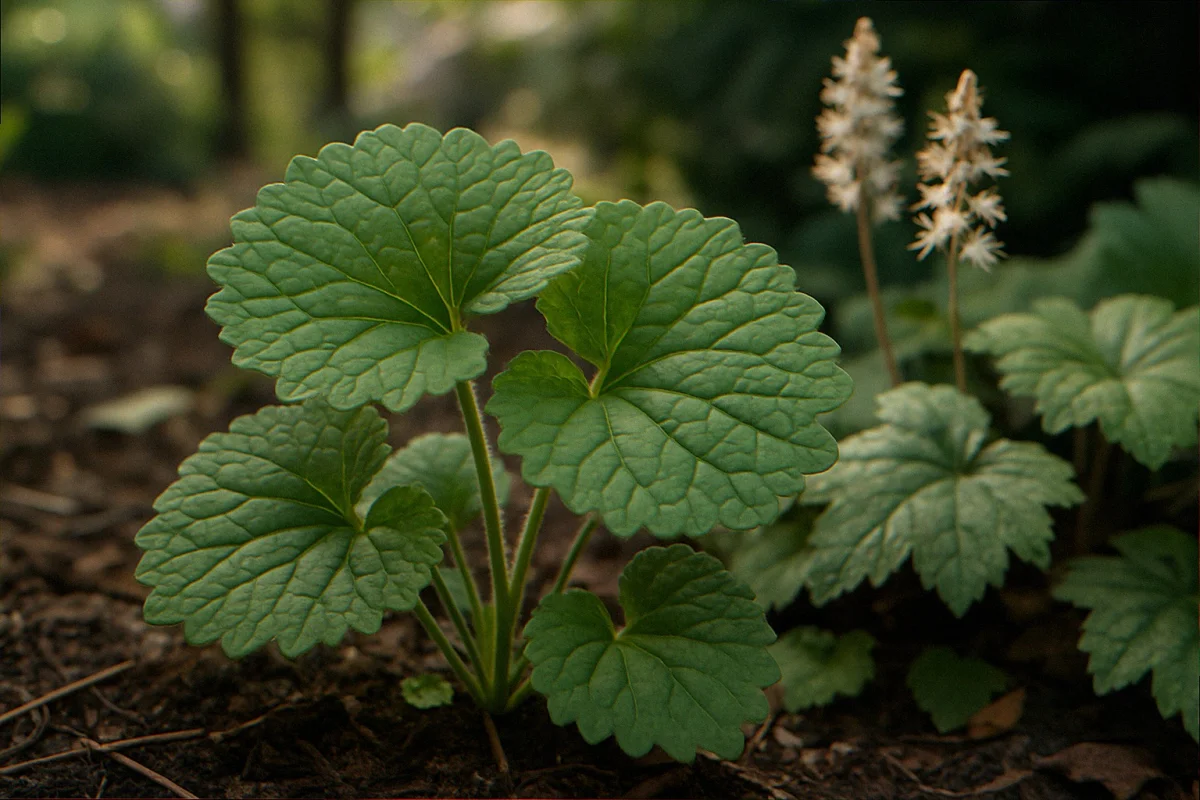
Six invasive plants. Garlic mustard, lesser celandine, Bradford pear, burning bush, Japanese honeysuckle, and crown vetch. Are routinely confused with native species in yards across the eastern United States. You can tell them apart in under two minutes using a single ID test per species: leaf-crush smell, root tuber check, leaf-stem arrangement, or flower shape. This guide walks through the field test for each, what to do if you already planted one, and how to keep the next mistake from reaching your bed.
The frustrating part is that the impostor often looks more intentional than the native. Bradford pear has the tidy oval crown a code officer loves. Burning bush throws a redder fall color than the native viburnum it imitates. Crown vetch sprawls into the kind of pink mat that fills a hellstrip in one season. Sarah-style ecological purism does not protect you from this. The look-alikes were bred or selected to win at curb appeal, and they were sold for decades before invasive listings caught up. A reader emailed last month after pulling what she thought was foamflower for three years; it was garlic mustard, and she had been spreading the seed every time she yanked.
Quick answer: The single most reliable two-minute ID for these six invasives is the crush-and-look test. Crush a leaf. Garlic mustard smells like garlic, foamflower has no scent. Lift a clump. Lesser celandine has fingernail-sized bulbils on the roots, marsh marigold does not. Snap a stem. Burning bush has corky wings, native viburnum is smooth. Look at the flower, Japanese honeysuckle is white turning yellow on a paired stalk, coral honeysuckle is red-orange on a terminal whorl. Crown vetch leaves end in a small bristle, native legumes end in a leaflet.
What does an invasive look-alike actually look like in your yard?
An invasive look-alike is a non-native plant that shares enough visual cues with a desirable native that a casual observer. Including an experienced gardener at a busy nursery. Will mistake one for the other. The mimicry is rarely complete. There is almost always one obvious tell: a smell, a stem feature, a flower geometry, a root structure. The problem is that you have to know to look.
FREE: Wildlife Garden Starter Guide
Get our 12-page PDF with the 25 best plants for pollinators, simple habitat tips, and a printable checklist — all 100% free.
No spam. Read our Privacy Policy.The pattern repeats across regions. Garlic mustard sprouts in a shady bed and gets mistaken for a young native woodland species. Lesser celandine emerges in early spring along a stream bank and gets read as marsh marigold. Bradford pear gets confused with serviceberry because the white spring blooms are similar from across a yard. Burning bush gets confused with native viburnum because the fall color is the obvious feature people remember. Japanese honeysuckle climbs the same trellis as native coral honeysuckle and the leaves are the same general shape. Crown vetch fills the same ecological niche as native partridge pea and the foliage looks similar from ten feet away.
The six covered here were selected because they are the look-alikes most often actively planted by homeowners who thought they were buying or rescuing a native. That is a different category from invasives that arrive on their own, like Japanese stiltgrass or buckthorn. Those are covered in a separate guide on stiltgrass identification and the multi-year buckthorn removal plan. The plants in this article are the ones you might have welcomed in.
Why do big-box plant tags fool experienced gardeners?
A garden center plant tag is a marketing document, not a botanical record. The vendor writes the common name on the tag and the buyer reads it as a confirmation of species. There is no legal requirement that the common name match the Latin binomial. There is no penalty for selling a plant labeled “wild honeysuckle” that turns out to be Lonicera japonica rather than Lonicera sempervirens. The fellow Master Naturalist I trade plants with calls this “honest greenwashing”. Nobody intends the deception, but the supply chain rewards vague labels.
Three structural problems make the look-alike confusion worse. First, the nursery trade ships plants out of state and the seller often does not know the local invasive status. Burning bush is a noxious weed in Massachusetts and a popular landscape shrub in Texas, sold from the same wholesale grower. Second, cultivar names obscure species. A tag that says “Magnus Coneflower” gives you the cultivar but not always the species, so a buyer assumes Echinacea purpurea when it could be an interspecific hybrid. Third, retail staff turnover is high enough that nobody on the floor can vouch for a plant’s identity beyond what the tag says.
The countermeasure is to do the ID test in the parking lot before the plant ever gets into your trunk. The same field tests that work in your yard work in the cart aisle. Five seconds with a leaf and a fingernail is faster than the eventual removal job. For seed packets, the same principle applies, and the specific labels-to-distrust pattern is covered in the guide on spotting invasive fillers in wildflower mixes.
Garlic mustard vs foamflower: the leaf-crush test
Alliaria petiolata. Garlic mustard. Is a biennial European invader that has colonized hardwood forests from Maine to Minnesota and well into the Southeast. In its first year it forms a low rosette of kidney-shaped to triangular leaves with scalloped margins. In year two it bolts to two or three feet tall with small four-petaled white flowers. The first-year rosette is the form most often mistaken for a native, and the native it most often gets confused with is Tiarella cordifolia, foamflower, a shade-tolerant ground cover with similarly shaped lobed leaves.
The field test takes five seconds. Pinch a leaf between thumb and forefinger and crush it. Garlic mustard smells unmistakably of garlic. A sharp, sulfurous, kitchen-pantry smell that fills your nose. Foamflower is essentially scentless when crushed; you get a vague green note and nothing more. There is no overlap in the smell test. If you crush a leaf and smell garlic, you have garlic mustard, full stop.
Two backup tells. Garlic mustard’s leaf veins radiate from the petiole in a roughly palmate pattern with deep notches; foamflower has a more reticulated vein pattern and a heart-shaped base where the petiole meets the leaf. Garlic mustard typically grows as a single rosette without runners; foamflower spreads by stolons and forms colonies with visible aboveground connections between plants. The USDA PLANTS database entry for Alliaria petiolata lists county-level occurrence data if you want to confirm whether it has been recorded near you.
Lesser celandine vs marsh marigold: check the tubers
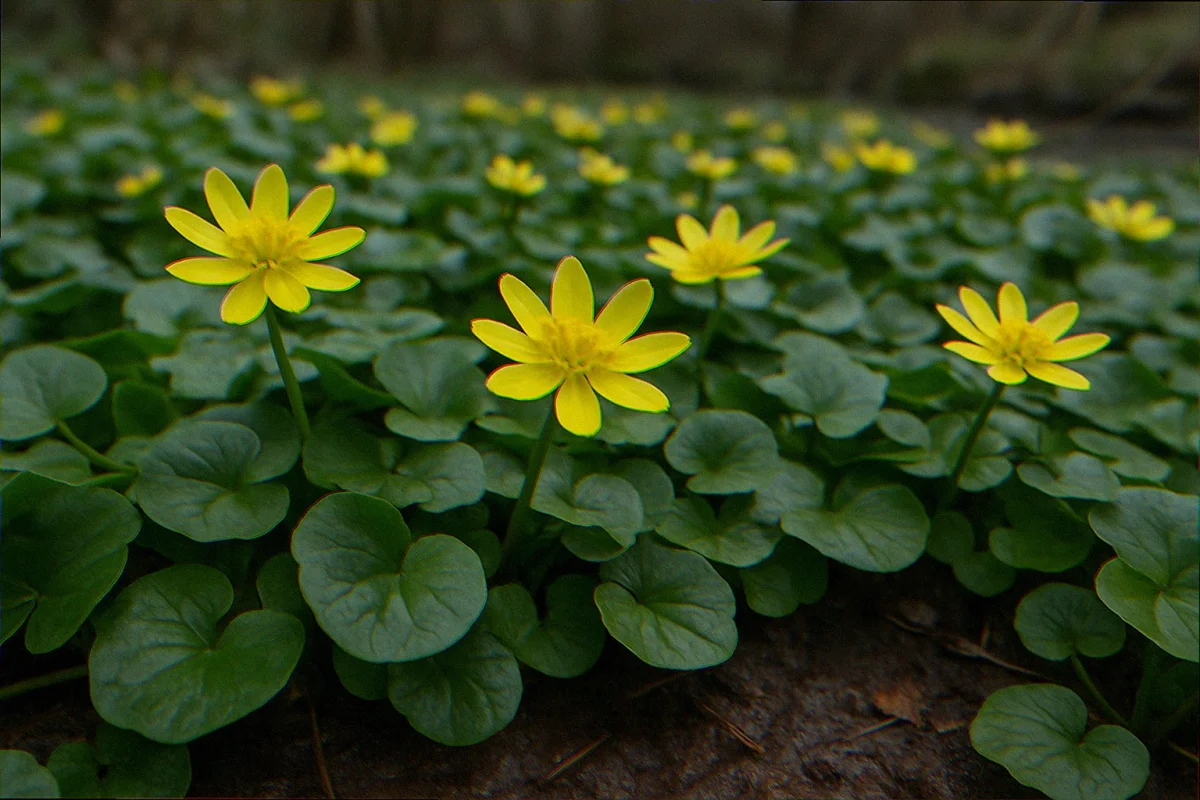
Lesser celandine (Ficaria verna, formerly Ranunculus ficaria) is a low-growing buttercup-family plant that emerges in late winter and early spring with glossy heart-shaped to kidney-shaped leaves and bright yellow eight-petaled flowers. It carpets floodplains, lawns, and woodland edges in dense mats that smother spring ephemerals. Marsh marigold (Caltha palustris) is the native it impersonates: similar yellow flowers, similar shiny leaves, similar wet-feet habitat.
The ID is in the roots. Lift a clump with a hand trowel and shake the soil off. Lesser celandine produces white, finger-shaped tubers along the roots and tiny pale bulbils where the leaves meet the stems. Marsh marigold has fibrous roots only. No tubers, no bulbils, nothing that looks like a small white peanut. The tuber test is decisive. It is also the reason lesser celandine is so hard to eradicate once established: every tuber fragment regrows.
Three more tells if you are checking without lifting the plant. Lesser celandine flowers have eight to twelve petals; marsh marigold has five to seven. Lesser celandine grows in dense low mats that suppress everything around them; marsh marigold grows as discrete clumps with bare ground between. Lesser celandine fades by late May and disappears underground until next spring; marsh marigold persists through summer as a less showy clump of leaves. If you spot a yellow buttercup-style flower in your yard in March or early April, do the root check before you decide what it is.
| Invasive | Look-alike native | Decisive test | Best ID window |
|---|---|---|---|
| Garlic mustard | Foamflower | Crush a leaf. Smells like garlic | April–May rosette |
| Lesser celandine | Marsh marigold | White finger-tubers on the roots | March–April bloom |
| Bradford pear | Serviceberry | Crush a flower. Fish/ammonia smell | Early spring bloom |
| Burning bush | Mapleleaf viburnum | Look for corky wings on the stem | Year-round on stems |
| Japanese honeysuckle | Coral honeysuckle | White-to-yellow paired flowers, fragrant | May–July bloom |
| Crown vetch | Partridge pea | Leaf ends in small bristle, not leaflet | June–August bloom |
Bradford pear, burning bush, and Japanese honeysuckle: three impostors in one walk
These three are the ones most likely to be hiding in your existing landscape because they were planted intentionally by previous owners. None of the three were classified as invasive when they were sold most heavily in the 1980s and 1990s. All three are now restricted or banned in at least one state, and the federal and state invasive plant councils continue to expand the listings.
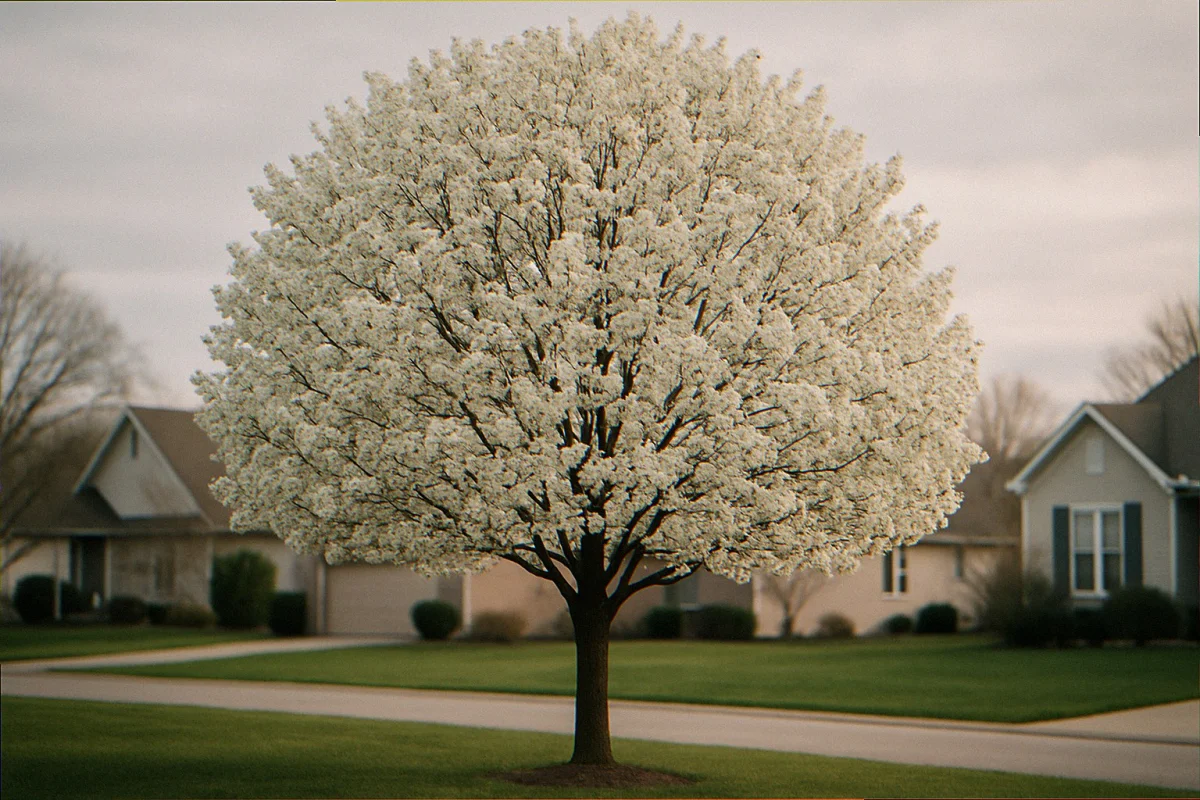
Bradford pear (Pyrus calleryana, including the cultivars Bradford, Cleveland Select, Aristocrat, and Chanticleer) is the easiest to ID and the most aesthetically painful to remove. The clincher is the flower smell. Crush a single white spring blossom between your fingers and lift it to your nose. Bradford pear smells like rotten fish or stale urine. Distinctive and unmistakable. Native serviceberry (Amelanchier species), which has similar white spring flowers and a similar oval crown when young, has a faint sweet honey smell or no smell at all. The flower-smell test takes three seconds and is decisive. A second tell: Bradford pear has thorny seedlings appearing in surrounding lawn within five years of bloom, because the cultivars cross-pollinate and produce fertile, thorned offspring. Native serviceberry has no thorns.
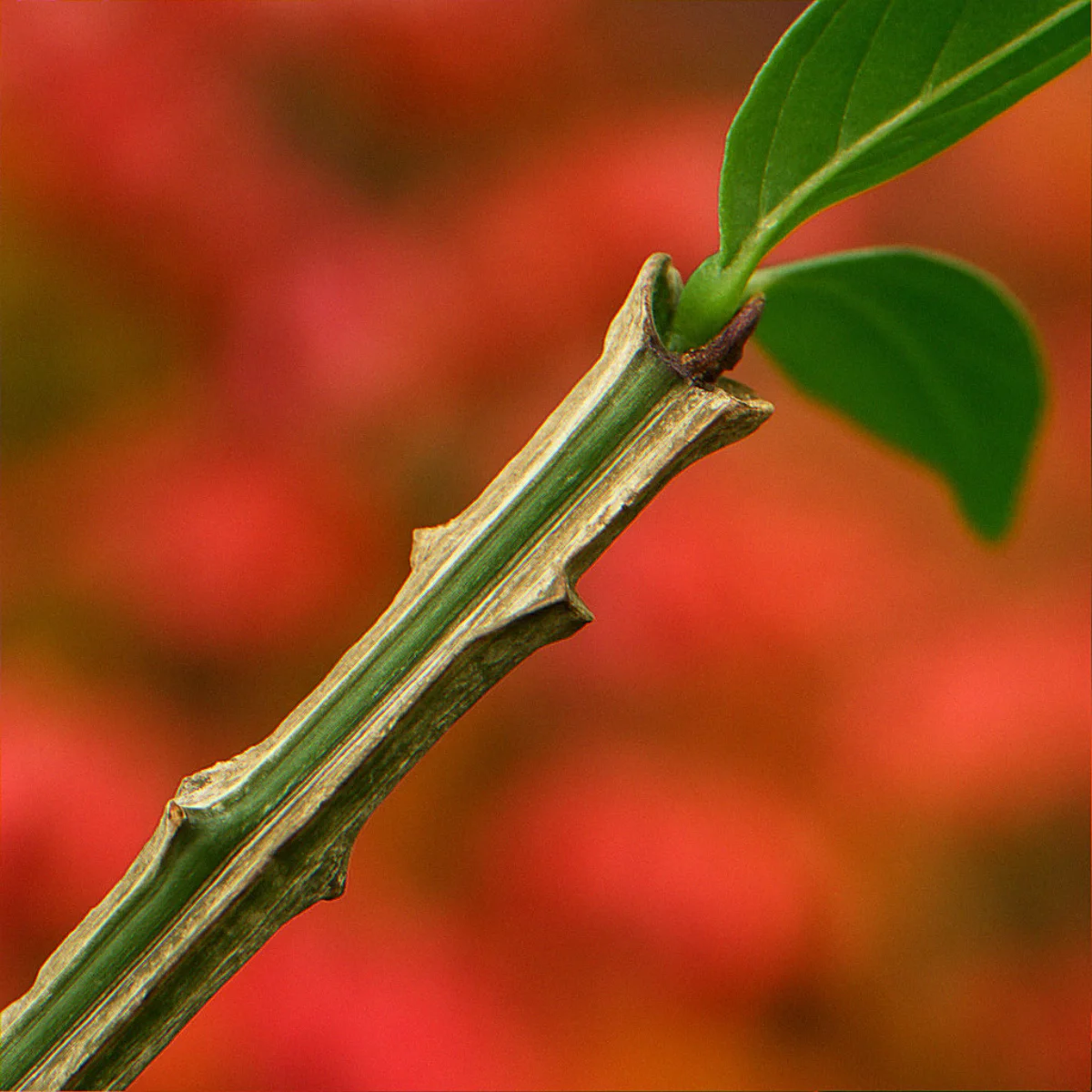
Burning bush (Euonymus alatus) is identifiable in any season by the corky wings. Flat, papery ridges that run lengthwise along the green and brown stems. Snap a small branch and look at it from the side; the wings are obvious. Native mapleleaf viburnum and other native viburnums never have these stem wings. Fall color is not a reliable ID. Both burning bush and native viburnums turn red. But the wings are. A reader who emailed about a hedge she planned to keep “because the fall color was beautiful” did the wing check and found she had three burning bushes in a row planted by the prior owner. She replaced them with native witherod viburnum over two seasons.
Japanese honeysuckle (Lonicera japonica) vs coral honeysuckle (Lonicera sempervirens) is decided by the flower. Japanese honeysuckle has tubular two-lipped white flowers that age to yellow, growing in pairs from the leaf axils, with a strong sweet fragrance. Coral honeysuckle has tubular red-to-orange flowers (sometimes yellow inside) in terminal whorls of three to five, with little or no fragrance. The fragrance test alone is enough. If a honeysuckle vine smells strong at dusk, it is Japanese honeysuckle. A second test: Japanese honeysuckle has fused, joined leaves only at the flower clusters; the leaves below are separate. Coral honeysuckle has fused, perfoliate leaf pairs (joined at the base around the stem) where the flowers emerge. The fused-leaf check works year-round.
Crown vetch and Japanese spirea: the pink-flower trap
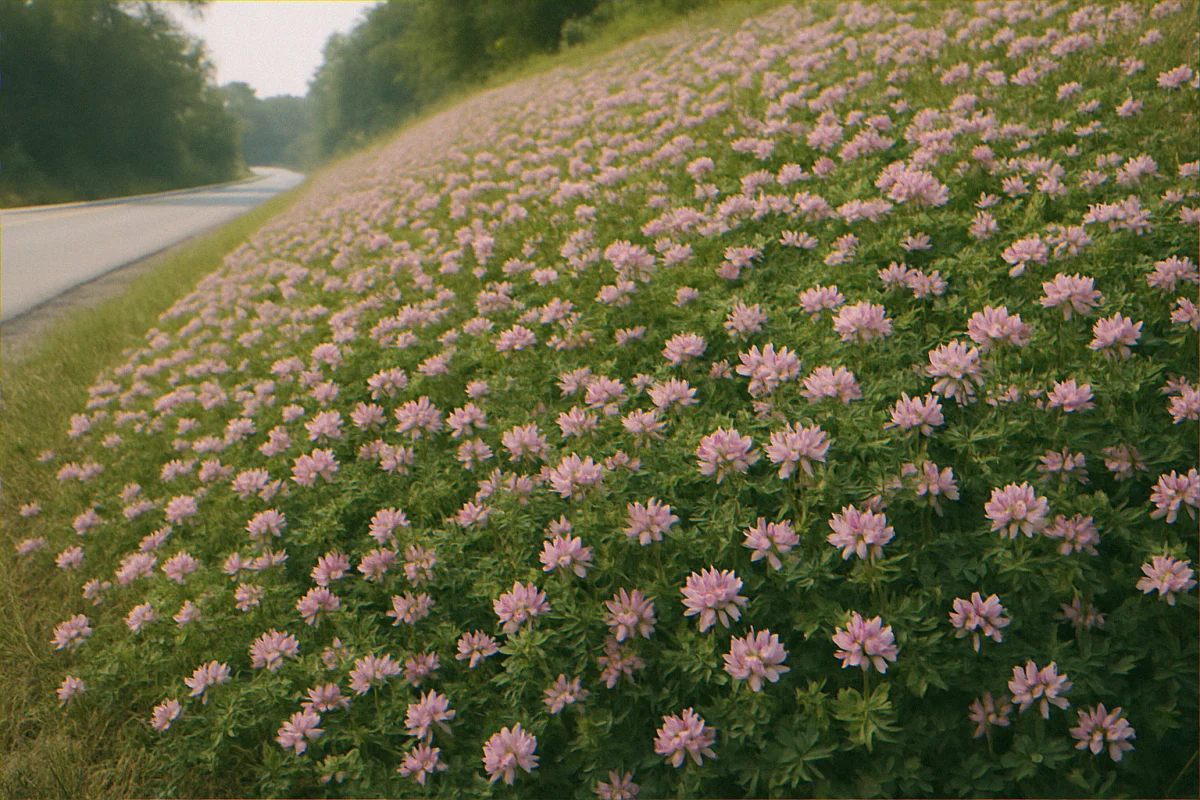
Crown vetch (Securigera varia) was planted on highway embankments across the eastern United States in the mid-twentieth century as erosion control. It spread aggressively and now blankets fields, road shoulders, and hellstrips with a pink-and-white pea-flower mat. Sarah-style native gardeners who want a low-maintenance pollinator ground cover sometimes plant crown vetch by accident. It shows up in “wildflower” seed mixes and in budget bare-root assortments labeled “pollinator mix.”
The leaf-tip test is the fastest. Crown vetch leaves are pinnately compound with many leaflet pairs, and the leaf ends in a small bristle or hair, not a final leaflet. Native pea-family plants like partridge pea (Chamaecrista fasciculata) and showy tick-trefoil (Desmodium canadense) end in a terminal leaflet that matches the rest of the leaflets in shape and size. Hold a leaf flat in your palm and look at the tip. If it ends in a tiny hair or thread, it is crown vetch.
Japanese spirea (Spiraea japonica) is the other pink-flower impostor that gets planted intentionally. It mimics native meadowsweet (Spiraea alba or Spiraea tomentosa) and is sold widely at chain nurseries as the cultivars “Goldflame,” “Magic Carpet,” and “Anthony Waterer.” The flower color is the easiest tell, Japanese spirea produces flat-topped pink or magenta flower clusters; native meadowsweet produces white or rose-pink flowers in upright pyramidal panicles. A second tell is the new growth color. Japanese spirea cultivars push lime green, gold, or bronze new growth that fades to dull green; native meadowsweet new growth is plain green from the start. If a shrub in your yard had startling chartreuse new leaves in spring and now has flat pink flowers, you have Japanese spirea.
For mapping where each of these has been confirmed in the wild, the iNaturalist observation map is the fastest sanity check. You can filter by species and zoom to your county to see whether anyone within fifteen miles has logged it. The companion guide on verifying a plant is truly native to your county covers the BONAP and state extension cross-check workflow.
What if I already planted one. How bad is the cleanup?
This is the question that stops most people from doing the ID test in the first place. The honest answer is that cleanup difficulty varies enormously by species, and three of the six are genuinely manageable within a single growing season.
Garlic mustard is the easiest. Hand-pull the rosettes before they bolt to flower, get the root, and bag the plants for trash (do not compost). One spring of diligent pulling will knock back ninety percent of a small infestation. The seed bank in soil persists for five to seven years, so plan on annual sweeps. Lesser celandine is harder because of the tubers. Pull what you can, sift the soil through hardware cloth to catch the tubers and bulbils, and bag everything. Two to three seasons of effort is realistic for a backyard patch.
Crown vetch and Japanese honeysuckle are mid-difficulty. Both have extensive root systems and will resprout from fragments. Cut to the ground in early summer, smother with cardboard and mulch, and recheck monthly. Japanese spirea is easy. Dig out the shrub and roots, fill the hole with native soil, and replant with native meadowsweet from a regional nursery. Bradford pear is the hardest because of the seedlings spreading across the landscape, but the parent tree can be removed in a single day with a chainsaw and a stump-grinding pass; the offspring sprouts get pulled annually. Burning bush is easy to remove physically but the cardboard-and-cut-back approach works only if you are willing to wait two seasons.
The replacement question matters more than the removal question. Pulling an invasive without filling its niche leaves bare ground that the next invasive will exploit. Pick the native swap before you start the removal. A side note: if your invasive came from a chain nursery and is mislabeled on the tag, some state extension programs accept the tag as evidence of mislabeling and have pursued the seller. The workflow is documented in the post on buying real natives at Lowe’s and Home Depot.
What changes once you can spot them on sight
The shift is smaller than you might expect and more permanent than you might expect. You will not stop visiting nurseries. You will not throw out the existing plants you love that turn out not to be native. What changes is that the ID test becomes muscle memory. Crush, sniff, look at the stem, look at the flower base. The whole sequence takes under ninety seconds per plant. After three or four months of practice you will run it without thinking, the way an experienced birder runs through field marks without naming the steps.
The yard-level change is that the rate of accidental introductions drops to near zero. New plants get tested in the cart aisle. Volunteer seedlings get tested before they get pulled. See the guide on telling native seedlings from weeds before you pull for the protocol. Plants gifted by neighbors get tested before they go in the ground. The yard does not become a fortress, but it stops being a vector for the next regional invasion. The Sarah goal. A homegrown national park that supports county-specific natives. Gets one degree closer because the impostors stop sneaking in.
The community-level change is that you become the person at the plant swap who catches the mislabeled donation before it spreads to ten other yards. That is more impact than any single bed conversion. The fellow gardeners I know who have built this skill say the most satisfying moment is the first time they call out a mislabeled plant at a Lowe’s display and the staff member writes down the species and pulls the rest of the stock. It happens more often than you would think.
FAQ
How do I know if my mystery yellow spring flower is lesser celandine or marsh marigold?
Lift a clump with a hand trowel and look at the roots. Lesser celandine has white finger-shaped tubers and tiny pale bulbils where the leaves meet the stems. Marsh marigold has only fibrous roots. The tuber test is decisive. As a second check, count the petals. Lesser celandine has eight to twelve, marsh marigold has five to seven.
Is burning bush definitely invasive in my state?
Burning bush (Euonymus alatus) is regulated or banned in Massachusetts, New Hampshire, Connecticut, Maine, and several other northeastern states. It is invasive but not yet regulated across much of the Midwest and Mid-Atlantic. Check your state’s noxious weed list or the USDA PLANTS profile for current legal status before you decide to keep or remove an existing shrub.
What month is best for the leaf-crush ID on garlic mustard?
April and May, when first-year rosettes are full-sized but have not yet bolted to flower, and second-year plants are flowering but still tender. The garlic smell is strongest when leaves are fresh and turgid. Late summer leaves are often dried out and the smell is weaker, which can lead to false negatives.
Can I keep a Bradford pear if I promise to keep it pruned?
Pruning controls the tree’s shape but does nothing about the seed problem. Bradford pear cultivars cross-pollinate with each other and produce fertile, thorned offspring that establish in surrounding lawns, fields, and forest edges within a five-to-ten-mile radius. The seedlings are the real ecological cost. A mature pruned Bradford pear is still a seed source.
Are there any honeysuckles that are safe to plant?
Native coral honeysuckle (Lonicera sempervirens), American honeysuckle (Lonicera dioica), and yellow honeysuckle (Lonicera flava) are safe regional natives that support hummingbirds and native pollinators. Avoid Japanese honeysuckle (Lonicera japonica), Amur honeysuckle (Lonicera maackii), Tatarian honeysuckle (Lonicera tatarica), and Morrow’s honeysuckle (Lonicera morrowii). All four are listed as invasive across most of the eastern United States.
Want More Wildlife Garden Tips?
Join 5,000+ nature lovers getting our weekly tips on creating wildlife-friendly gardens.
No spam, unsubscribe anytime. Privacy Policy
Emma Harrington
Emma Harrington is a wildlife habitat researcher and content editor with a passion for backyard conservation. She has spent over a decade translating ecological science into practical tips anyone can follow — from selecting native plants to building wildlife-friendly habitats. Her work focuses on helping homeowners transform ordinary yards into thriving ecosystems for bees, butterflies, hummingbirds, and other beneficial wildlife.