
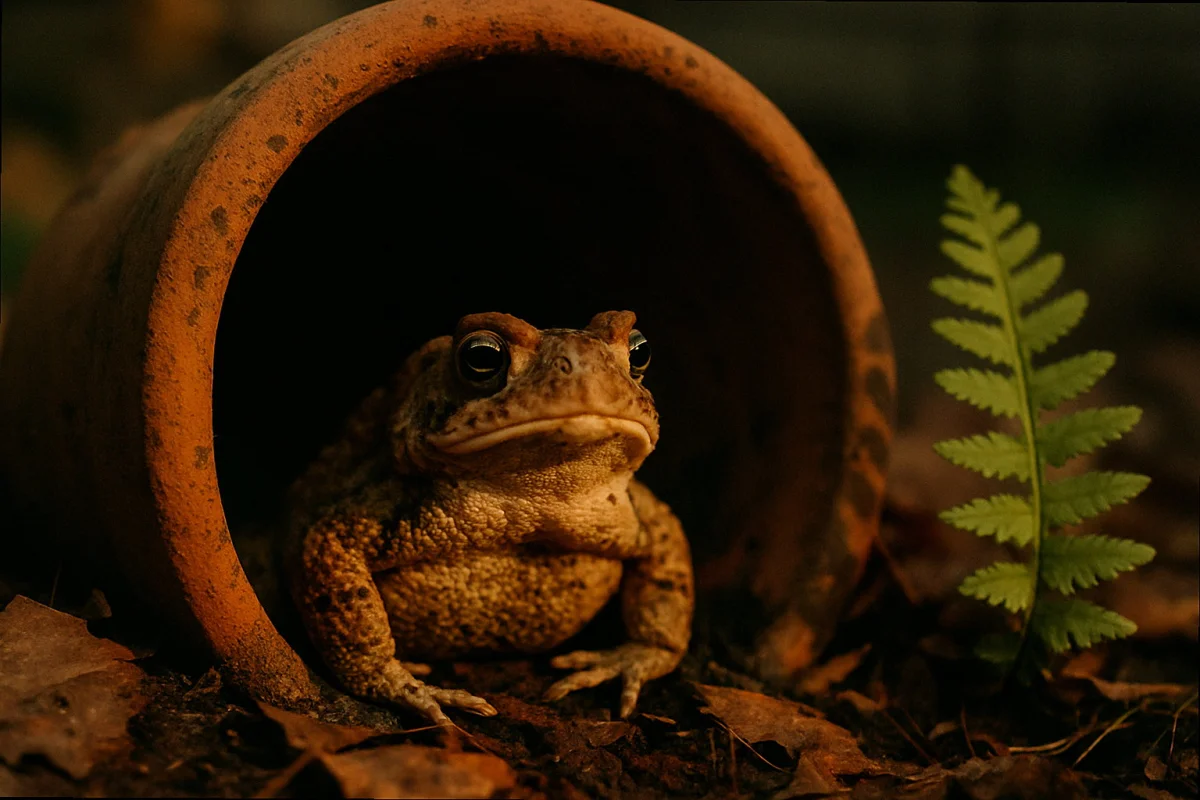
Quick answer. A toad house is a half-buried, shaded clay pot with a doorway notched into the rim, placed in the dampest, shadiest corner of your yard within ten feet of leaf litter and a shallow water saucer. A single American toad that moves in eats roughly 10,000 slugs, beetles, ants, and mosquito larvae per season, for the cost of one fifteen-dollar terracotta pot. Most empty toad houses fail because the placement is wrong, not the build.
The slug damage you noticed on your hostas in May was not random. It started when something stopped eating them. In most suburban yards that something was an American toad (Anaxyrus americanus), and the reason it left is almost always habitat: no cover, no moisture, no safe daytime hideout. A toad house gives you the missing piece back. It is the cheapest, lowest-effort wildlife habitat you can build, and the one that pays you back the fastest in slugs you do not have to fight, mosquito larvae you do not have to spray for, and a small dusk ritual that quietly resets your nervous system after a long day.
I am writing this because the question I get most often in late spring is some version of “I tried a toad house last year and nothing came.” The build is not the problem. The placement is. And the gap between a toad house that sits empty for three summers and one that gets a tenant in eight weeks is about six small decisions, none of them expensive.
The Slug War You Quietly Lost This Spring
Hostas chewed to lace. Marigold seedlings vanished overnight. The young echinacea you babied through winter showing slime trails at dawn. If your spring looked like that, you were not lazy. You were simply outnumbered by a population that has no native predator left in your yard.
FREE: Wildlife Garden Starter Guide
Get our 12-page PDF with the 25 best plants for pollinators, simple habitat tips, and a printable checklist — all 100% free.
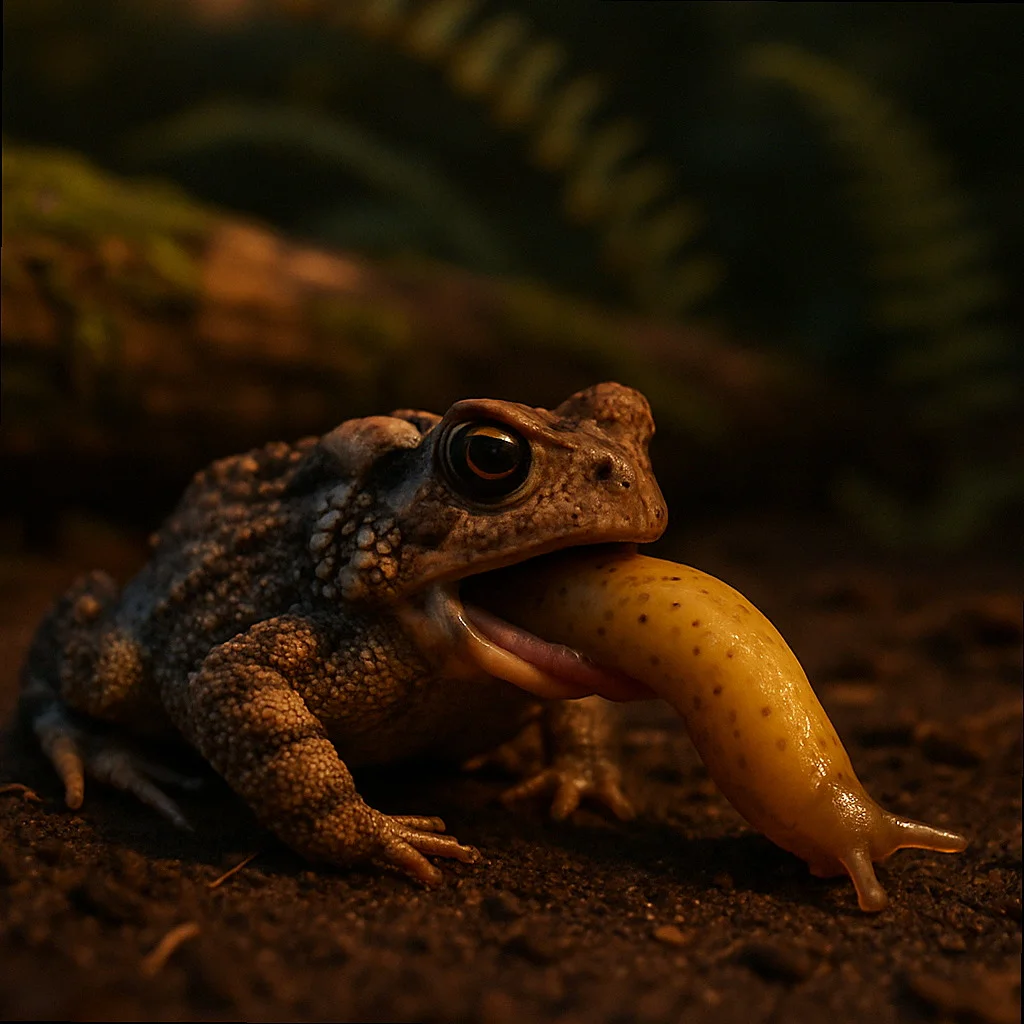
No spam. Read our Privacy Policy.A reader emailed last month to put it bluntly: “I have spent more money on Sluggo Plus than I did on the plants it was supposed to protect, and I still lost the bed.” That math is grim, and it is not unusual. Penn State Extension data on slug populations in disturbed garden beds runs into the tens of slugs per square meter on damp summer nights. Iron phosphate baits work, but they cost about $12 per pound and need re-application after every rain. A single resident toad eats more slugs in one night than a $50 bag of bait will kill in a week, and the toad shows up to work every dusk without an invoice.
The deeper frustration, the one you might not put into words, is that the slug war is a symptom of a yard that quietly stopped functioning as a habitat. The dragonflies are fewer. The little brown bats over the porch light are gone. Slugs are filling the vacuum because nothing is eating them. A toad house is a small move that puts a piece of that food web back, and you can see the result the same season.
Why Most Toad Houses Sit Empty for Three Years
Walk through any garden center in June and you will see decorative toad houses. Fairy-cottage ceramics, painted mushroom domes, glittery resin. Most cost between $20 and $45. Most never get a toad.
The failure mode is almost always the same. The house is placed in full sun, on a path with foot traffic, or with the doorway facing a lawn the homeowner mows weekly. A toad reads that as exposed, dry, and dangerous. The decorative house gets photographed once and quietly turns into a slug shelter, which is the opposite of the goal.
The honest fix is to stop thinking of a toad house as decor and start thinking of it as a daytime refuge for a small, soft-skinned animal that can dehydrate to death in six hours of direct sun. Once the requirements get that concrete, the build becomes obvious.
What Does an American Toad Actually Want From Your Yard?
An American toad will settle in a yard that meets four conditions, ranked roughly by importance: a cool dark daytime refuge with humidity above 70 percent, a shallow water source it can climb in and out of without help, soft leaf litter or mulch to hunt over at night, and a chemical-free zone of at least the back third of the yard. Audubon notes that amphibians breathe partly through their skin, which is why even ordinary lawn fertilizer runoff can drive them out within a season.
Two facts about American toads change how you site the house. First, an adult home range is roughly 200 to 300 square meters. About the size of a typical suburban backyard. You are not asking a toad to travel; you are asking the toad that is already in the neighborhood to choose your yard as its core territory. Second, toads return to the same daytime refuge for months, sometimes years. Get the placement right and you are not catching a tourist. You are signing a lease.
The four things to verify before you dig
- Shade: the spot gets less than three hours of direct sun a day. North side of a shrub, behind the air conditioning unit, under a deck. All good.
- Moisture: the soil is damp to the touch six inches down at 2 p.m. on a dry July day. If it crumbles, you need to add water or pick a different spot.
- Cover within ten feet: leaf litter, dense ground cover, a log, or a brush pile. If you have not built one yet, see how a brush pile pairs with a toad house. The two together raise occupancy odds dramatically.
- Quiet: not on a path the dog patrols, not next to the trampoline. Toads tolerate a lot but they will not nest under foot traffic.

The 30-Minute Build: Pot, Notch, Bury, Hide
Skip the resin mushroom. The build that has worked in my yard for four seasons running is one ten-inch terracotta pot, one hammer, one chisel, and twenty minutes of digging.
Here is the whole method.
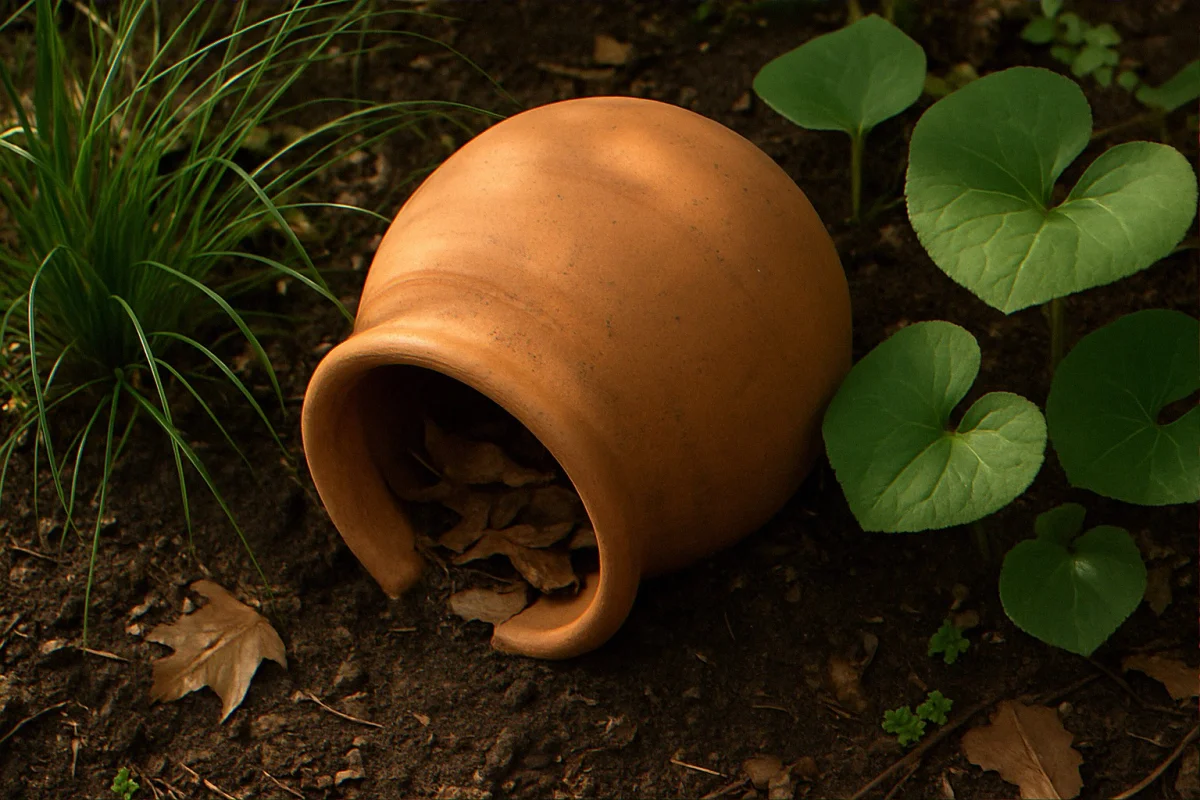
Step 1. Pick a pot. A standard ten-inch terracotta planter, the kind sold at every big-box store for about $7, is the right size. Unglazed terracotta is critical. It stays cool, wicks moisture, and disappears into a planting bed. Plastic gets too hot. Glazed ceramic does not breathe.
Step 2. Notch the doorway. Lay the pot on its side. With a hammer and a small cold chisel, tap a half-moon notch into the rim about two inches wide and one and a half inches tall. Go slow, tap from the inside out, and stop when the opening is just big enough for a fist. Sharp edges from the break are fine. Toads can navigate them. If you split the pot in half, do not throw it out; a half-pot makes an even better entrance and you can skip the notching.
Step 3. Bury the pot to its widest point. Dig a shallow hole in your chosen spot and bury the pot on its side until two thirds is below grade. This is the step most tutorials skip and it is the difference between an occupied house and an empty one. A buried pot stays ten to fifteen degrees cooler than an exposed one through a July afternoon, and it gives the toad the underground feel its instincts are looking for.
Step 4. Floor it with damp leaf litter. Two handfuls of last fall’s oak or maple leaves, lightly damp. Skip pine needles. Too acidic. Skip mulch chips. Too sharp. You want soft, dark, slightly cool.
Step 5. Hide the entrance. Plant a low fern, a low-growing native sedge, or simply tuck a flat rock or branch in front of the doorway so the opening is partly screened. Toads will not enter a hole they can be spotted entering. This is also the step that hides the build from neighbors who would otherwise call it a broken pot.
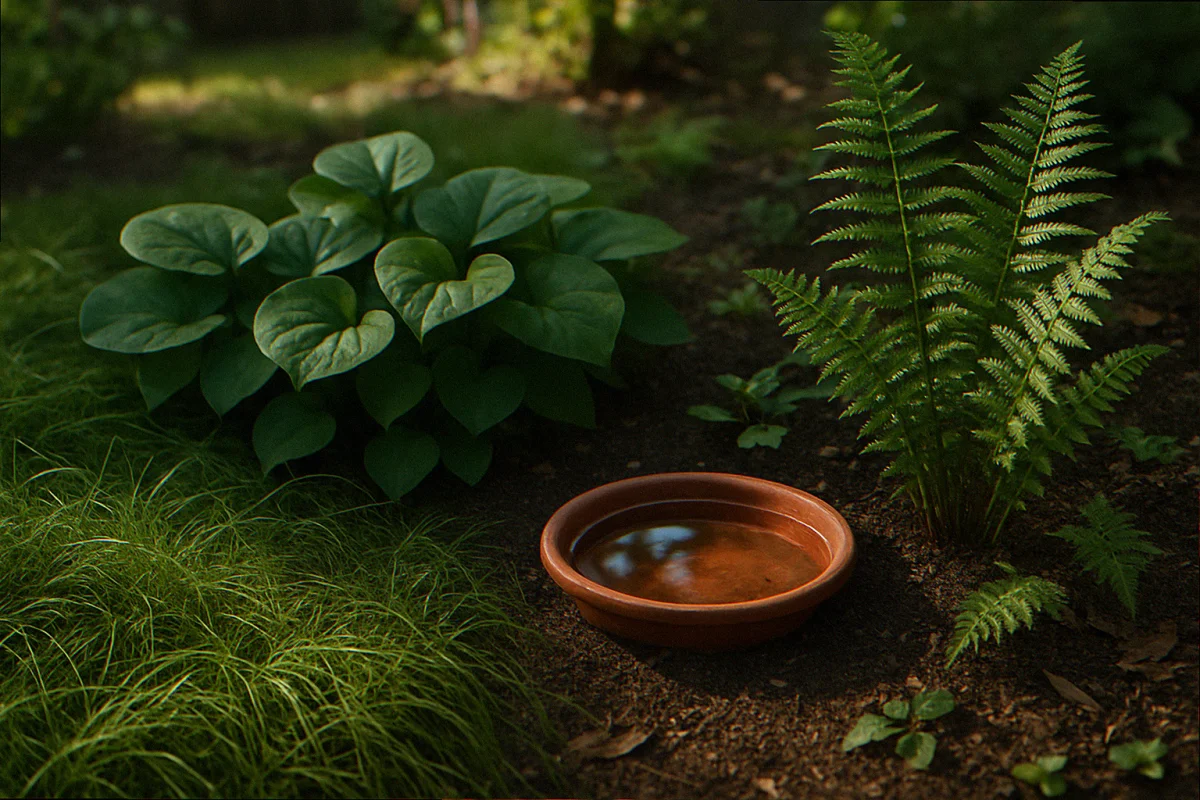
Step 6. Add water within five feet. A shallow terracotta saucer, sunk to ground level, refilled every other day. Half an inch of water is enough. Toads do not swim, they sit and absorb. If you already have a wildlife water source on the property, this guide on backyard water without mosquitoes covers placement details that double for toads.
Materials and cost (all five, for under $15)
| Item | Where | Cost |
|---|---|---|
| 10-inch unglazed terracotta pot | Lowe’s, Home Depot, local nursery | $5–$8 |
| Terracotta saucer (8-inch) | Same | $3–$5 |
| Cold chisel + hammer | Already in your garage | $0 |
| Damp leaf litter | Your own yard, last fall | $0 |
| Screening plant (sedge, fern, or flat rock) | Yard or nursery | $0–$6 |
Total, even on the high end: under $20, and most of us already have the tools and the leaves.
How Do You Know a Toad Has Actually Moved In?
The signs are subtle and worth knowing because the first occupancy is the moment you stop fighting your slug war by yourself.
Check the entrance at 8 p.m. on a humid evening, three to six weeks after install. A resident toad will sit in the doorway at dusk, body half in, eyes scanning the leaf litter. If you do not see the toad itself, look for a small smoothed-out path in the leaf litter just outside the entrance. About an inch wide, leading to the open lawn. That is the foraging trail. You may also find one or two pale half-dollar-sized depressions in the soft soil nearby; toads dig shallow scrapes to rest in.
The clearest sign is droppings. American toad scat is a dark, segmented cylinder about the size of a dry rice grain, often clustered just outside the doorway in the morning. It contains insect chitin and is harmless to handle. The morning you find scat is the morning you can stop buying iron phosphate. A trail camera on a low setting catches all of this without you having to wait around in the dark. The trail camera setup for backyard wildlife we covered earlier works fine for a low-perched toad house.
The Three Plants That Pull Toads In Faster
The build alone gets you maybe a 30 percent chance of occupancy in year one. Pairing it with the right plants pushes that closer to 70 percent because plants change the microclimate around the pot and attract the prey toads hunt.
Pennsylvania sedge (Carex pensylvanica). A short, soft, shade-tolerant native sedge that mats into a cool green carpet. Plant a small clump on the south side of the toad house to shade the entrance from afternoon sun. Available as plugs from most native nurseries for about $4 each.
Wild ginger (Asarum canadense). Wide kidney-shaped leaves at ground level, native to most of the eastern half of the country. The dense low canopy holds humidity, hides the toad’s path, and decomposes into the kind of leaf litter toads forage in. Plant two or three rhizomes in a half-moon around the doorway.
Native ferns. Especially Christmas fern (Polystichum acrostichoides) or lady fern. Ferns hold humidity and create the dim, mossy, “old-growth corner” feel that toads strongly prefer. One fern within two feet of the entrance is enough.
If you are choosing other native ground covers for the same bed, the principles in our native plants for dry shade guide apply directly to the toad-house microhabitat.
What If a Neighbor Calls It a Pile of Junk?
The honest answer is that a properly buried, plant-screened toad house is invisible from the sidewalk. The doorway notch is at ground level, the pot itself is two-thirds buried, and a single sedge or fern hides the entrance. From three feet away it looks like decorative river stone or a patch of ground cover. From the street it is not visible at all.
That said, suburbs are full of neighbors who notice everything and HOAs that mistake function for clutter. Three concrete defenses, in order of how much they cost you:
First, pick the back third of the yard. Toads do not care about the front yard versus the back, and your front-yard HOA risk drops to zero if the house is behind the line of sight.
Second, frame it. A small ring of flat fieldstones or a half-circle of mulched edging around the planted area signals “intentional landscaping” rather than “abandoned debris.” This is the same trick that defuses HOA letters about meadow plantings. Borders read as care.
Third, document the function. If a complaint does land, having a one-paragraph explanation of what the structure is for, paired with an NWF backyard wildlife habitat certification or a printout from your state extension office, shuts down nearly every “rat nest” complaint before it escalates. If you have already had an HOA letter about other native plantings, our HOA letter response plan walks through the exact language to use.
The neighbor argument is real and the social anxiety around it is real. But the toad house, specifically, is the one native habitat element that almost never generates a complaint, because it is the one almost no one can see.
What Changes by Year Two?
The first summer is mostly about whether a toad shows up at all. Year two is when the pattern compounds, and it compounds quickly.
By the second spring, if the toad overwintered nearby (toads dig down about a foot below frost line, often within fifty feet of their summer territory), the same individual usually returns to the same daytime refuge. You will start to recognize the toad. They have surprisingly variable warty patterns. Slug damage on the plants within the toad’s foraging range, roughly a thirty-foot radius, drops noticeably. I stopped buying iron phosphate halfway through my second summer and have not bought it since.
By the third year, with two toads installed in two corners of the yard, the slug damage on hostas, echinacea seedlings, and young milkweed drops to almost nothing. Mosquito pressure at dusk drops too. Toads eat adult mosquitoes off low vegetation. Cucumber beetle and Japanese beetle pressure on the vegetable garden drops, although not as dramatically; toads prefer slower, softer prey. If you have been running a parallel war on Japanese beetles, the pollinator-safe Japanese beetle methods stack well with a toad-led pest control approach.
The other change, the one that is harder to put in a chart, is the one this build is really for. A small ritual settles in: you walk out at 8 p.m. with a glass of water, lift the screening branch, and the toad is sitting in the doorway. You stand there for thirty seconds. You go back inside. That is the entire ritual, and over a summer it becomes the single most reliable nervous-system reset of your day. The garden gives many things back over a year. This one is the quietest, and it costs $15.
FAQ
How long does it take for a toad to move into a new toad house?
If the placement is right. Shaded, damp, near leaf litter, near water. Most American toad houses get a tenant within six to ten weeks during the May-through-July active season. If the spot is right and no one has shown up by August, the placement is the problem. Move the house ten to fifteen feet toward dense ground cover and try again.
Will a toad house attract snakes or other unwanted wildlife?
Garter snakes occasionally investigate toad houses because they eat amphibians, but in a typical suburban yard the presence of a toad house does not measurably raise snake encounters. Toads themselves are harmless. They cannot bite, they do not carry rabies, and the mild skin toxin only affects pets that try to swallow them, not humans handling them briefly.
Can I put a toad house in full sun if I cannot find a shady spot?
No. Toad skin loses water fast and a sun-exposed pot heats up well above the lethal threshold for an American toad. If your yard has no shaded corner at all, plant a native shrub or build a small lattice screen first and let it establish for a season before installing the house. The shade requirement is non-negotiable.
Do I need a water source if my yard already has a birdbath?
A birdbath on a pedestal does not work for toads. They cannot climb in. The water source has to be ground-level and shallow. A terracotta saucer sunk flush with the soil, refilled every two to three days, is enough. If you want something more permanent, a small basin habitat doubles as toad water and bird-drinking station without the mosquito risk discussed in our mosquito control guide.
What should I do if I find toad eggs or tadpoles in my yard?
American toads breed in shallow temporary water. Puddles, ditches, edges of ponds. And the eggs look like long black double strings. If you find them in your yard, leave them alone. Do not move them, do not “rescue” them into a bucket. The female chose the spot for a reason. Toad tadpoles transform in roughly thirty to sixty days and the toadlets disperse on their own.
Want More Wildlife Garden Tips?
Join 5,000+ nature lovers getting our weekly tips on creating wildlife-friendly gardens.
No spam, unsubscribe anytime. Privacy Policy
Emma Harrington
Emma Harrington is a wildlife habitat researcher and content editor with a passion for backyard conservation. She has spent over a decade translating ecological science into practical tips anyone can follow — from selecting native plants to building wildlife-friendly habitats. Her work focuses on helping homeowners transform ordinary yards into thriving ecosystems for bees, butterflies, hummingbirds, and other beneficial wildlife.