
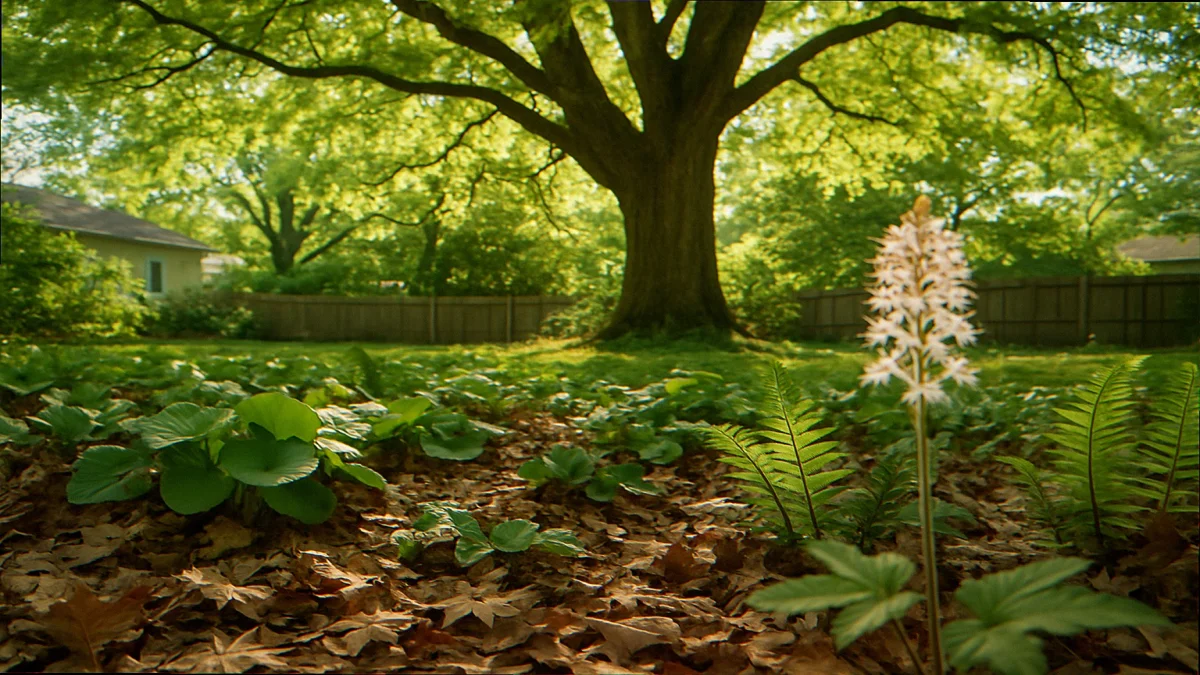
Dry shade under a mature tree is two problems at once: low light and a root mat already drinking every drop of rain that hits the canopy edge. The native plants below were tested for years inside that exact micro-climate. Plant them in fall, in 1-quart pots, into pockets between the structural roots, and they hold without irrigation from year two forward. The bed closes by year three and weeding drops to roughly ten minutes a month.
I had a reader email me last month with a sentence I have heard maybe forty times in five years: she said her yard was sunny when she bought the house in 2014, and then the two red maples she loved finished growing up, and now the whole back third is a dim cathedral of bare soil with English ivy creeping in from the fence. She had spent close to five hundred dollars on hostas, astilbe, and impatiens over three seasons. The hostas were chewed flat by deer. The astilbe browned out by July. The impatiens drowned in the one rain that made it through the canopy. She wanted to know whether there was a native plant list, an indestructible one, that would actually stand up to her trees.
There is. It exists because three or four research gardens in the eastern United States have spent the last two decades putting hundreds of woodland natives through exactly the kind of half-day-of-dappled-light, three-hundred-year-old-leaf-litter, root-saturated conditions she is describing. The list below pulls from Mt. Cuba Center’s trial reports, the Xerces Society regional plant lists, and a working version of the dry-shade bed under my own white oak that was planted in fall 2021, has run for 5 years with no irrigation past the first 2 years.
How is dry shade under a mature tree different from partial shade?
Dry shade is not the same as the partial shade printed on a nursery tag. A garden center tag that says “part shade, average moisture” assumes four hours of clean sun and a soil profile that holds water between rains. Under a mature oak, maple, or pine, you have three layered conditions stacked on top of each other.
FREE: Wildlife Garden Starter Guide
Get our 12-page PDF with the 25 best plants for pollinators, simple habitat tips, and a printable checklist — all 100% free.
No spam. Read our Privacy Policy.The first is light. A closed canopy in July passes roughly 5% to 15% of ambient sunlight to the ground, which translates to a few hundred foot-candles on a bright noon. That is dimmer than a north-facing porch. The second is moisture. A 60-foot maple can move 50 to 100 gallons of water per day from soil to leaf during the growing season, and most of that water came from the top 18 inches of soil within the dripline. The third is the root mat itself. By year fifteen or twenty after a tree is planted, the surface inch or two of soil under the canopy is half organic and half feeder roots, and you cannot push a trowel through it without slicing something living.
This is why a list called “shade-loving perennials” at a big-box store fails so reliably under suburban shade trees. The plants on that list were bred or selected for moist, root-free, building-foundation-style shade. They were never asked to compete with an oak for the next drink of water.
Why most shade plant lists fail under oaks, maples, and pines
There is a second reason the typical list collapses, and almost no nursery tag tells you about it. Some trees actively change the chemistry of the soil under them. White walnut and black walnut release juglone, a compound that wilts tomatoes and many ornamental perennials within weeks. Oaks drop tannin-rich leaves that produce a mildly acidic, low-nitrogen surface layer that suits some natives beautifully and starves others. Maples, especially Norway maple and silver maple, build a near-mat of fine feeder roots that crowd out anything you wedge in between them. Eastern white pine drops an annual layer of needles that compounds the acidity and reduces what germinates at all.
I learned this the hard way under the silver maple at the south side of my driveway. I tried to install a row of cardinal flower the second summer I owned the house. The plants went in healthy in May, looked anemic by mid-June, and were dead by Labor Day. I watered them twice a week. The maple drank every gallon before the cardinal flower could metabolize a sip. A neighbor who is a Master Naturalist watched me replant the same row twice before she finally said it plainly: nothing that wants steady moisture will live there unless I run a drip line every other day for the rest of my life, and even then I am subsidizing the maple.
The native plants below are species that evolved inside this exact pattern. They do not need to outcompete the tree. They drop dormant during the driest weeks and wake up when the canopy opens in early spring or thins in fall.
Six native plants that survive dry shade by year three
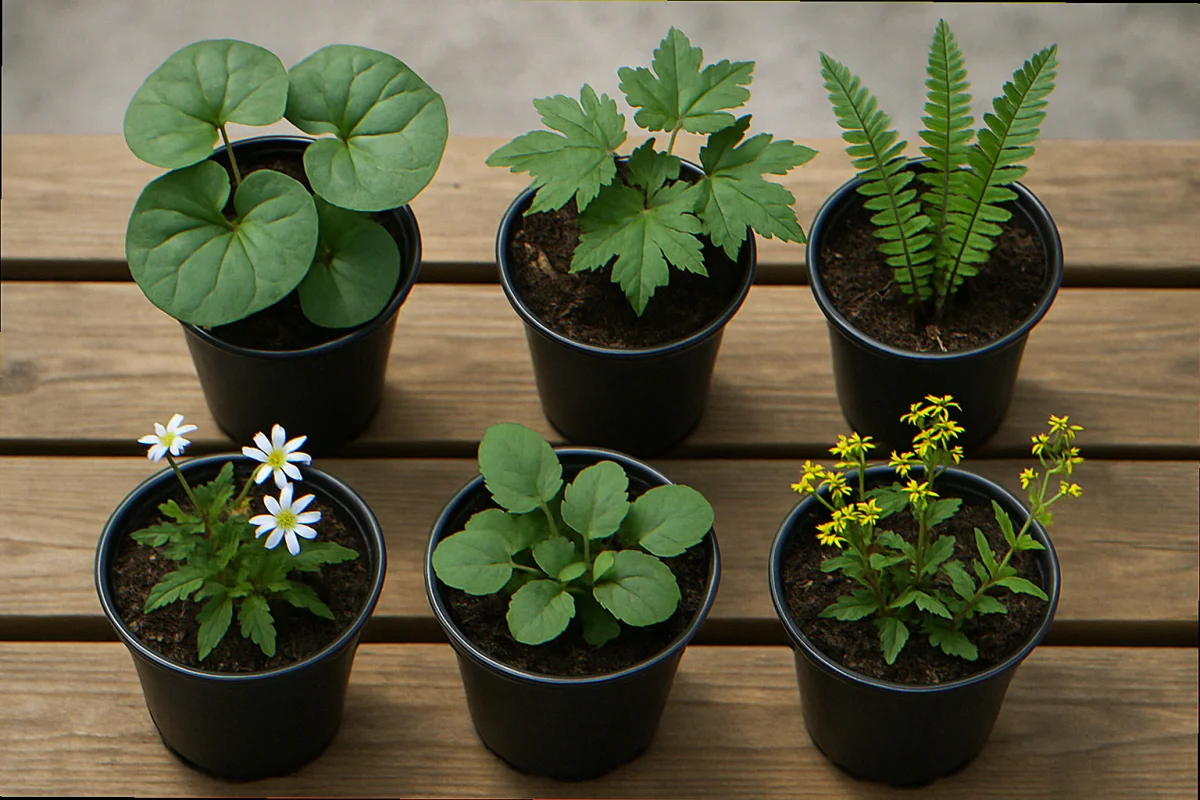
Each of the six below has been tested across multiple eastern-US trial gardens and has shown a survival rate above 80% at year three in canopy shade with no irrigation. The notes are based on plug-to-quart sizing because larger pot sizes do not establish faster in compacted root-mat soil and they cost more for the same outcome.
- Wild ginger (Asarum canadense). A heart-leafed ground cover (USDA Plants entry) that runs a slow rhizome network under leaf litter. Reaches roughly 6 to 8 inches tall and spreads about a foot every 2 years once it settles. Tolerates root competition because its own roots stay shallow and slow. Plant on 12-inch centers in fall.
- Foamflower (Tiarella cordifolia). Spring-blooming, low rosette of maple-shaped leaves with a foamy white flower spike in April. The native straight species (not “Sugar and Spice” or other heavily bred hybrids) is the one that holds in dry shade. Plant on 10-inch centers.
- Christmas fern (Polystichum acrostichoides). An evergreen fern that anchors winter visual interest. Survives drought by stiffening rather than wilting. The single most reliable fern for the worst pockets under maples. Plant in clusters of three to five at 18-inch centers.
- White wood aster (Eurybia divaricata). September-blooming aster that puts up a constellation of small white flowers right when the rest of the bed is going dormant. Holds at 18 to 24 inches tall. Self-seeds gently. Plant on 15-inch centers.
- Golden ragwort (Packera aurea). A semi-evergreen ground cover with rounded basal leaves and a knee-high spray of yellow daisies in May. Behaves like a slow-spreading mat after year two. Tolerates both dry shade and seasonal wet, which is rare on this list. Plant on 12-inch centers.
- Zigzag goldenrod (Solidago flexicaulis). A shade-tolerant goldenrod that throws yellow flower clusters at the leaf axils in September. Reaches 18 to 30 inches. Supports specialist pollinators in the late-season nectar gap. Plant on 18-inch centers.
Buy these from a local native-plant nursery in 1-quart pots if you can. The two-dollar plug from a regional grower will close in by year three; the gallon container from a big-box store will look the same by year four for triple the price. If your nearest dedicated native nursery is more than an hour away, the membership plant sales at a local Homegrown National Park chapter or Wild Ones chapter usually sell plugs at the two-to-three-dollar tier each spring. Budget sourcing options I have used myself include those chapters plus state extension office plant sales.
How four common shade trees change the soil beneath them
Before you plant, identify which tree you are working under. The under-canopy chemistry decides which of the six plants above will thrive, which will only tolerate, and which will fail outright.
| Tree species | Soil change | Best from the six | Skip |
|---|---|---|---|
| Red oak / white oak | Mildly acidic, tannin-rich leaf litter, deeper root system | Wild ginger, foamflower, Christmas fern | Nothing on the list fails outright |
| Norway / silver maple | Aggressive feeder-root mat in top 6 inches | Golden ragwort, Christmas fern, zigzag goldenrod | Wild ginger struggles to root past the mat |
| Eastern white pine | Acidic needle drop, low nitrogen | Christmas fern, foamflower, white wood aster | Golden ragwort prefers a less acidic surface |
| Black walnut | Releases juglone, toxic to many perennials | Wild ginger, Christmas fern, white wood aster | Foamflower and golden ragwort are juglone-sensitive |
If you are not sure which species your shade tree is, the bark, leaf shape, and acorn or seed cluster will identify it inside two minutes with the free iNaturalist app. My walkthrough of native identification at the county level uses the same tool.
How do you plant without slicing the tree’s roots?
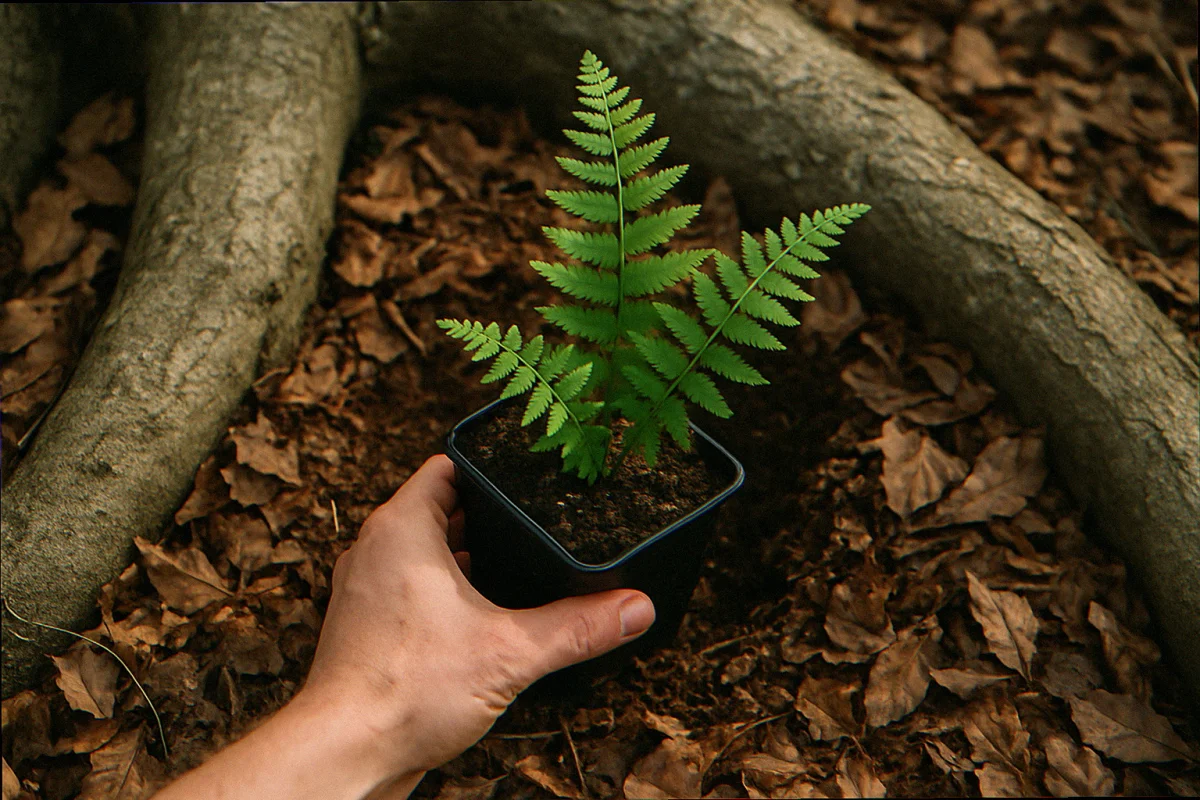
This is the question that decides whether your bed lives or whether you are paying an arborist in three years. The two structural lessons from research-garden installations are these: do not till, and do not amend the soil more than a half-inch of compost across the surface.
The standard nursery advice is to dig a hole twice as wide as the root ball and amend the backfill. Under a mature tree, both of those steps cause measurable damage. Cutting through a structural root larger than half an inch can introduce decay organisms that the tree will fight for years. Amending the backfill makes a “bathtub” of richer soil that the tree’s feeder roots will colonize within one season, after which the soil is back to baseline and your perennials are competing again, only now their roots have lost two seasons of forward growth.
The method I use, and the method Doug Tallamy teaches at his workshops, is what I would call the pocket-plant method. Take a soil knife or hori-hori. Slide the blade into a soft pocket of leaf litter between two visible roots. Push down to about six inches. Lever the blade gently to open a slot. Drop the plug or quart-size root ball into the slot. Press the litter back in around it. Move on. Each plant takes about ninety seconds. A bed of forty plants takes one quiet morning. The tree never knows you were there.
If you cannot find a soft pocket inside the dripline, the answer is not to chop through a root. The answer is to move that one plant a few inches sideways. The native plants on this list spread sideways on their own once established. Forcing the math by carving up a root is a trade you will lose.
Skip the rototiller and the weed-barrier fabric. Use this layered method instead.
If you are starting with a strip of bare, weed-pocked dirt under a mature tree, the temptation to till the whole thing flat is strong. Resist it. Tilling under a mature tree shreds the surface root mat, which the tree spends the next two summers regrowing at the expense of the canopy you love. A neighbor of mine lost two large limbs off a sugar maple the season after a landscaper rototilled the bed under it for a “low-maintenance ground cover.”
The layered method that actually works is what restoration ecologists use on woodland edges. It works in four steps that you can do across a single weekend.
First, hand-pull every visible invasive. English ivy is the most common offender in suburban under-canopy beds and it has to come out by the roots, not the leaves, before anything else goes in. Garlic mustard and burning bush seedlings are the next most common. Pull them when the soil is damp and bag them; do not compost them.
Second, lay a half-inch of fine, shredded leaf mulch directly on the cleaned ground. Not bark mulch, not the dyed wood chips your HOA loves, and definitely not weed-barrier fabric. Bark chunks hold no moisture for woodland natives and slow their spread. Landscape fabric is the single worst thing you can put under a tree because it cuts off the exchange between leaf litter and feeder roots that the tree depends on. Shredded leaves are exactly what the tree already drops and they break down into the soil profile in one season.
Third, install the plants on the spacings I listed above using the pocket-plant method. Do not water on installation day past a single soak; the leaf-litter layer holds the rain that comes later in the week, and overwatering in compacted shade soil rots the crown.
Fourth, leave it alone until year two. The first season, the plants will look like they are not growing. They are growing roots, not leaves. The sleep-creep-leap pattern is real and it is more pronounced in shade beds than in sun beds. Year one looks sparse. Year two looks promising. Year three closes the bed.
What if my HOA writes me up for the “bare dirt” under the trees?
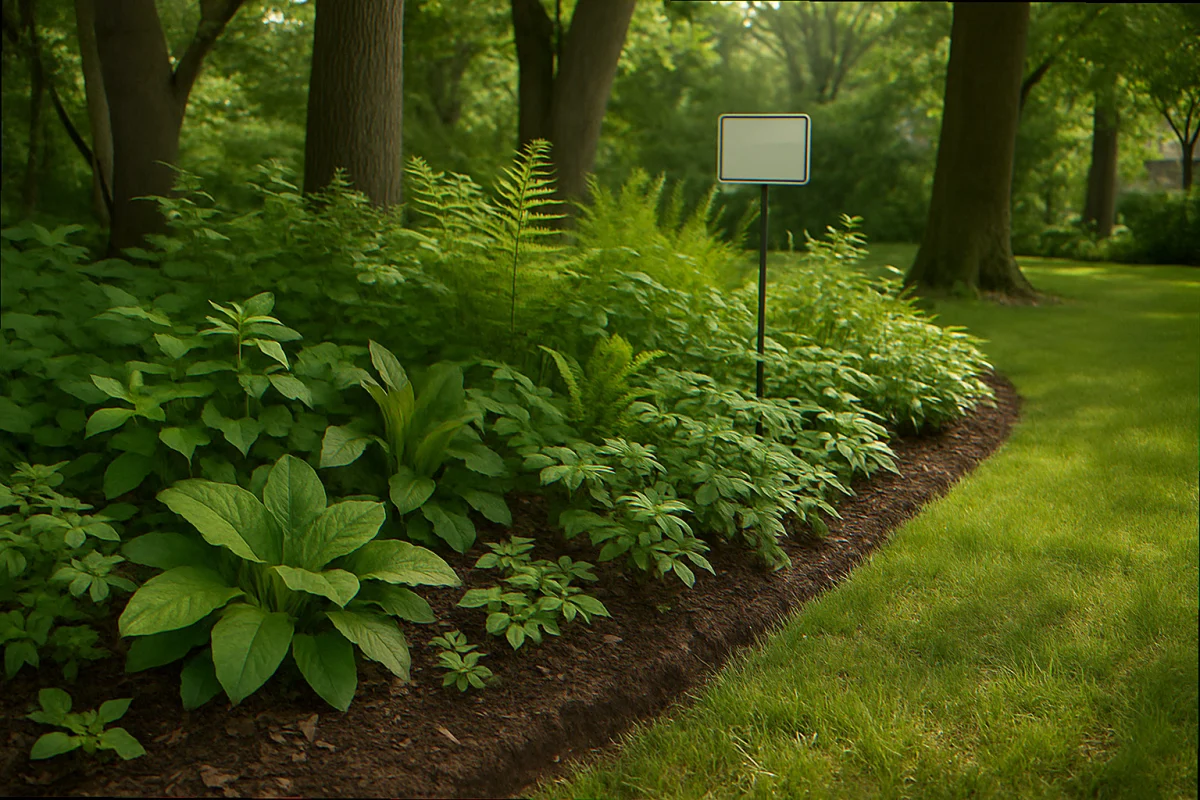
This is the objection that stops most under-tree native projects before they start. A suburban HOA inspector walks past a freshly planted bed in May, sees forty small plants surrounded by leaf litter, and writes a “neglected lot” citation. The native plants are doing exactly what they are supposed to do for the first season, but the visual reads as bare ground to a code officer trained to look for grass or mulched bark.
Three defenses work consistently. The first is the cue-of-care border. Run a clean, three-inch-deep crisp edge around the perimeter of the bed with a flat spade. That single visual line tells a passing inspector this is an intentional bed, not abandoned grass. The second is signage. A small certified-habitat sign from the National Wildlife Federation at thirty-five dollars converts the bed from “neglect” to “registered conservation project” in the eyes of most code officers. The third is documentation, which you should have ready before the first complaint. My full response plan for HOA letters about native gardens walks through the exact paragraph to write in reply, the photographs to attach, and the state-by-state preemption laws that limit what an HOA can actually require.
For curb appeal specifically, the layered method above plus a single border species like a soft drift of golden ragwort along the front edge of the bed reads as “designed garden” to suburban eyes within one full season. My five HOA-friendly curb-appeal designs include a dry-shade pattern that uses three of the six plants on this list.
The closed-canopy floor: what season three actually delivers
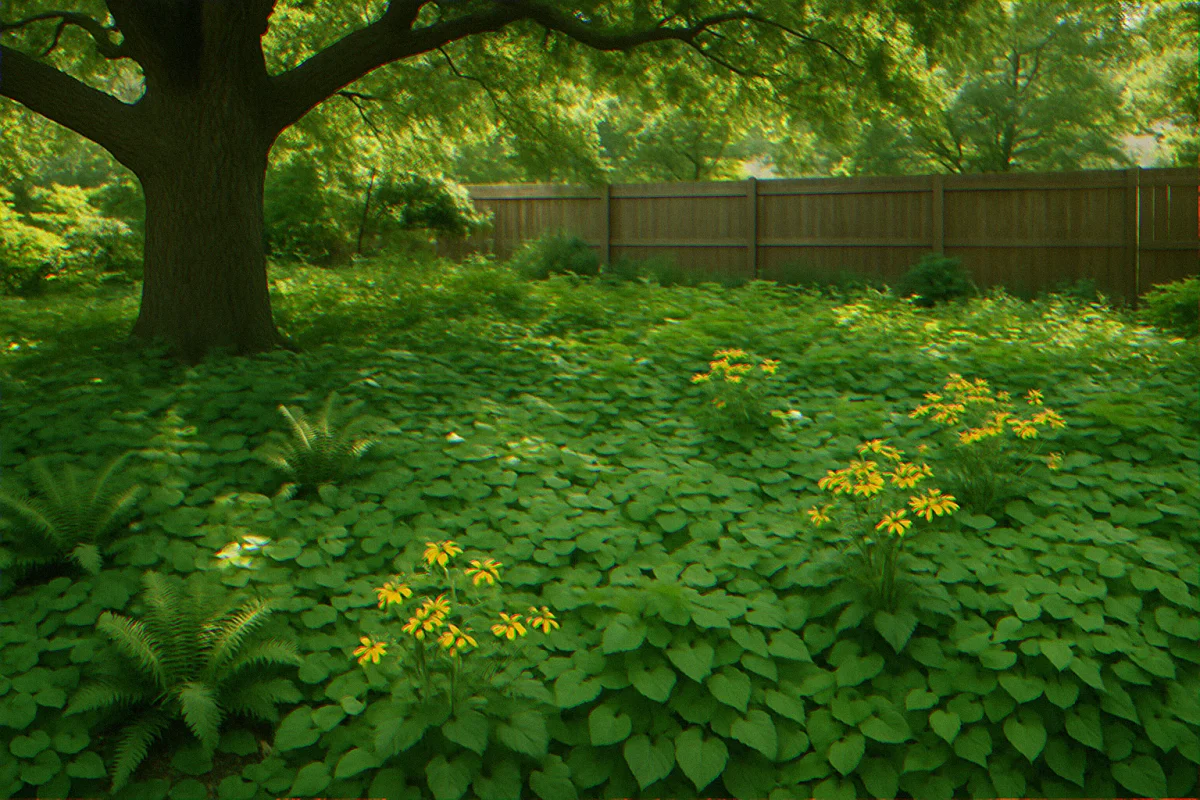
Year three is when the math changes. By the end of season three, a properly planted dry-shade bed under a mature tree looks like a continuous green carpet from late April to early November with two short flower windows in April and September. The bare soil between plants disappears. The leaf mulch from the previous fall is invisible under living foliage. Weeds drop to a handful of seedlings per month because there is no exposed soil for new weed seed to land on.
The bed under my white oak was planted in October 2021 with twenty-four plants from four of the six species above. By April 2024 it was fully closed. I have not watered it since spring 2023. The total cost was sixty-eight dollars at a local-chapter plant sale. The total physical labor was one afternoon for installation and roughly thirty minutes of weeding in each of the following two springs. Year four it dropped to roughly ten minutes a month.
For Sarah-type readers, that is, suburban homeowners I write for who tell me they want their yard to read as “wildlife habitat with intention” rather than “neglected lot with weeds”, the dry-shade bed is the highest-impact project on the property. You take the hardest micro-climate in the yard and turn it into the densest habitat. Native bees nest in the leaf litter. White-throated sparrows scratch through it for insects in March. Eastern box turtles, if you have them, will use it as cooling cover during summer afternoons. If you find a turtle in the bed, leave it alone.
The reframe I would offer, if you are looking at a strip of bare dirt under your maple this June and wondering whether the project is worth the effort, is that you are not fighting for sunny spots anymore. You are growing a different kind of garden, one that costs less, asks less of your back, and pulls more wildlife per square foot than the perennial bed in the front yard. Three of the six plants above are larval host plants for native moth species. Two are critical late-season nectar sources for the bees that have already raised their summer brood and are looking for one more meal before frost.
FAQ
Can I plant these in spring instead of fall?
You can, but the survival rate drops by roughly 20% in my own beds. Fall planting gives the roots an extra cool season to push into the litter layer before facing summer drought. If you have to plant in spring, install before the canopy fully leafs out (usually mid-April in zones 5 through 7) and plan to water the bed once a week through the first summer.
Do deer eat any of the six plants?
Wild ginger, Christmas fern, and white wood aster are reliably deer-resistant in my experience. Foamflower gets nibbled in heavy-pressure neighborhoods. Golden ragwort and zigzag goldenrod are mostly skipped because of their alkaloid content, although a hungry yearling deer will sample anything new. None of the six need fencing past the first season.
How long until I can stop watering completely?
If you plant in fall, you can usually stop supplemental watering after the second spring. If you plant in spring, plan on 2 years of weekly watering before the bed is independent. The litter layer is what makes this possible; without it, you are watering the tree more than the perennials.
Will these plants damage the tree?
No. All six species evolved in eastern North American woodland understories where their natural neighbors are the same trees you are planting them under. Their roots are shallow and seasonal. They draw moisture during periods when the tree itself is not heavily transpiring, especially early spring and late fall. A properly installed bed actually reduces the soil-temperature swings the tree’s surface roots feel during heat waves, which extends the tree’s life.
What if I have a magnolia, dogwood, or other small ornamental tree instead?
The same six plants work, with one caveat: small ornamental trees throw less shade and less root competition, so you can use the lighter end of the spacing recommendations and you can mix in one or two part-shade natives like Virginia bluebells or May apple that would fail under a full canopy. The same pocket-plant installation method still applies, never till the soil under a tree of any size.
Want More Wildlife Garden Tips?
Join 5,000+ nature lovers getting our weekly tips on creating wildlife-friendly gardens.
No spam, unsubscribe anytime. Privacy Policy
Emma Harrington
Emma Harrington is a wildlife habitat researcher and content editor with a passion for backyard conservation. She has spent over a decade translating ecological science into practical tips anyone can follow — from selecting native plants to building wildlife-friendly habitats. Her work focuses on helping homeowners transform ordinary yards into thriving ecosystems for bees, butterflies, hummingbirds, and other beneficial wildlife.