

Last July, I watched a neighbor fog her yard with a hardware-store pyrethroid spray right before a Saturday barbecue. Six mason bees dropped out of the lacewing hedge within the hour. Her kids had no mosquitoes during dinner. Her pollinator garden had no pollinators for three weeks. That single afternoon captures the quiet trade-off most American backyards make every summer: we bomb the insect world indiscriminately because the mosquitoes are unbearable, and we tell ourselves the collateral damage is not that bad. It usually is.
This guide is the one I wish someone had handed me after my own pollinator garden went silent one August. It pulls together what the U.S. Environmental Protection Agency says about mosquito dunks, what a 2023 peer-reviewed meta-analysis in the Journal of Animal Ecology found about dragonflies, what a Clemson University review of 62 studies said about repellent plants, and what actually works in a typical quarter-acre suburban yard. It is written for gardeners who want to sit on the patio without bites and keep the hummingbirds, mason bees, lightning bugs, and lacewings they have spent years cultivating.
You will learn which breeding sites hide in plain sight, how Bti-based mosquito dunks kill larvae without touching bees or fish, which predators are real heroes versus marketing folklore, and a seven-day spring setup plan that crushes mosquito populations before the June peak. No fog trucks required.
FREE: Wildlife Garden Starter Guide
Get our 12-page PDF with the 25 best plants for pollinators, simple habitat tips, and a printable checklist — all 100% free.
No spam. Read our Privacy Policy.Why Backyard Mosquito Sprays Are a Bigger Pollinator Problem Than Most Gardeners Realize
Most yard foggers and hose-end sprays sold at big box stores contain pyrethroids. Synthetic versions of a chrysanthemum compound marketed as “natural-derived.” They are broad-spectrum insecticides. That phrase is doing a lot of work. Broad-spectrum means the chemical does not distinguish between an adult female mosquito and a sweat bee resting on a leaf. It does not distinguish between a mosquito larva in a clogged gutter and a mayfly drifting through the yard from a nearby creek. It kills the insect class it is designed to kill, which is most of them.
That matters for three reasons that rarely make it onto the product label.
First, the timing is wrong. Mosquito sprays are typically applied in the late afternoon or early evening. The exact window when bumble bee workers are finishing their last foraging trips, when honey bees are returning to hives, and when fireflies and moths begin their nightly displays. Residue on leaves and blossoms remains active for days. A single August application in a pollinator garden can eliminate visible bee activity for two to three weeks, according to observations from homeowners enrolled in the National Wildlife Federation’s Garden for Wildlife program.
Second, the population you are spraying against is rebuilt from outside your yard within 72 hours. Mosquitoes in suburban neighborhoods fly in from every direction. Your sprayed yard is an island in an ocean. Your neighbor’s clogged gutter is producing a fresh hatch every seven to ten days. Broadcast spraying is a constant, losing battle for a reason. You cannot spray the entire neighborhood, and the few pollinators that re-colonize your yard die before they can establish.
Third, the pollinators most at risk are the ones you cannot easily replace. Native solitary bees, which make up roughly 70 percent of North American bee species. Mason bees, leafcutter bees, mining bees. Do not travel in colonies. If a single spray event kills the foraging females in your yard, there is no hive sending replacements. The cavity nests in your bee hotel produce nothing the following year. A mature backyard habitat that took you five years to build can lose 60 to 80 percent of its native bee activity in a single season of aggressive spraying, a pattern documented by Penn State Extension researchers studying suburban pollinator declines.
The fix is not to tolerate bites. The fix is to shift from broad-spectrum chemistry aimed at flying adults to targeted larval control plus habitat changes that interrupt the breeding cycle in the first place. That is what the rest of this guide walks through.
The Twelve Hidden Breeding Sites in an Average Suburban Yard
Mosquitoes do not need much. A bottle cap of standing water can produce 300 larvae in seven to ten days. An adult female lays 100 to 300 eggs per batch, and most common backyard species, Aedes albopictus, Culex pipiens, Anopheles quadrimaculatus. Complete the entire larval stage in under two weeks in warm weather. This is why a yard with three unnoticed water sources can feel like it is being invaded from nowhere.
Metropolitan Mosquito Control District field teams inspecting residential properties consistently find the same dozen culprits. Walk your yard with this list and a headlamp one evening in April. You will be surprised.
- Clogged gutters. The single most common breeding site and the one almost no homeowner checks. A pocket of leaves holding a quarter-inch of water along 40 feet of gutter can produce thousands of larvae weekly.
- Corrugated drain pipes. The flexible black tubing used for downspout extensions holds water in every low ribbed segment. Replace with smooth PVC or lay the corrugated pipe on a consistent downward grade.
- Old tires. Even tires used as planters. The rim lip holds water invisibly; bury the rim or drill drainage.
- Birdbaths that go stagnant. A birdbath you refill once a week is a larval nursery. Rinse and refresh every two to three days.
- Plant saucers. The flat dishes under container plants on a patio are classic breeding sites. Dump after every rain.
- Tarps that sag. Grill covers, firewood tarps, pool covers. Tighten or re-pitch so water sheds.
- Kiddie pools and inflatables. If the grandkids come over monthly, drain the pool between visits and store upside down.
- Rain barrels without mesh. A rain barrel is a useful garden tool that becomes a mosquito factory without a fine mesh screen over the intake and overflow.
- Trash can lids and recycling bins. Concave lids pool water for weeks.
- Tree holes and hollow stumps. Especially in older maples and oaks. Fill with sand or expanding foam.
- Wheelbarrows, buckets, and watering cans left outside. Store upside down against a wall.
- Forgotten corners of drainage swales. The spots where your yard slopes to a low area that never quite dries. Regrade or treat as a mini-wetland with Bti.
The five-minute Saturday walk-around, dumping anything with standing water, is the single most effective mosquito control action a homeowner can take. It beats every spray, every plant, every gadget. It is also free.
How Mosquito Dunks and Bti Actually Work (and Why the EPA Calls Them Safe)
For the water you cannot drain. The rain barrel, the pond, the persistent low spot, the storm drain at the curb. The tool you want is a mosquito dunk. The active ingredient is Bacillus thuringiensis israelensis, known as Bti. A single dunk is a dry, donut-shaped tablet that floats on the water surface and slowly releases bacterial spores for roughly 30 days. One dunk treats about 100 square feet of water surface. A ten-dunk package at the hardware store runs $8 to $14 and covers an entire season for most yards.
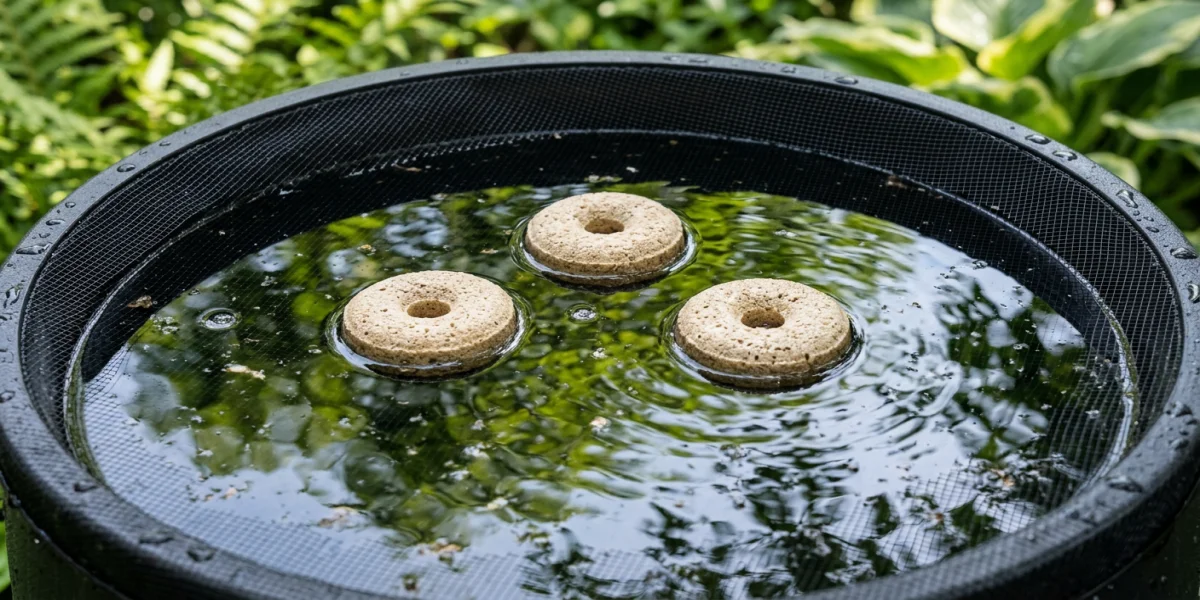
The chemistry is what makes Bti unusual. It is a naturally occurring soil bacterium that produces a crystalline protein, Cry toxin, that is only activated in the specific alkaline conditions found in the gut of mosquito larvae, black fly larvae, and fungus gnat larvae. Every other organism. Humans, pets, honey bees, fish, frogs, birds, dragonfly nymphs, mayflies, crustaceans. Has an acidic or neutral digestive system. The toxin passes through unchanged. The receptor sites the toxin needs to bind to simply do not exist in non-target species.
The EPA fact sheet on Bti is unusually direct for a regulatory document. The agency states that Bti “is not toxic to humans, mammals, fish, or birds” and that studies show “minimal toxicity to honey bees.” Where moderate effects on bees have been recorded in isolated studies, they have been traced to inert formulation ingredients rather than to the active bacterial protein. Even mayflies, stoneflies, and caddisflies. The sensitive stream insects that decades of aquatic biologists have used as indicators of water quality. Are not significantly affected by Bti applications at label rates. This is why Bti has been used in municipal mosquito control in trout streams and salmon habitat for more than 30 years.
A few practical notes that most product labels bury.
Dunks only work on larvae. They do not kill adult mosquitoes flying around your patio. You are attacking the next generation, which is why the payoff feels delayed. Expect two weeks of continued adult activity from larvae already developed, then a dramatic drop as the new hatch fails to emerge. Plan to start treatment in early April in the lower Midwest and Mid-Atlantic, mid-March in the Southeast, and early May in New England and the Upper Midwest.
Crushed Bti granules (sold as “bits” or “pellets”) work faster than dunks because they release spores immediately, but last only one to two weeks. Pellets are the right choice for a kiddie pool you will drain next week. Dunks are the right choice for a rain barrel or garden pond where you want long-term suppression.
Bti does not work in fast-moving water or in bodies with a continuous inflow that flushes the surface film. For a fountain or stream, the better tool is a small recirculating pump that keeps water moving. Mosquitoes cannot lay eggs on moving water surfaces.
Bti is compatible with wildlife ponds. Goldfish and koi do not consume meaningful numbers of mosquito larvae (they prefer pellets), and a stocked ornamental pond often breeds more mosquitoes than it controls because the fish chase away dragonfly nymphs. A wildlife pond with native pondweeds and no fish, treated once a month with a half dunk, produces dragonflies instead of mosquitoes.
Which Mosquito Predators Are Real and Which Are Marketing Myths
Every summer, hardware store end-caps fill with bat houses and purple martin condos sold with the implicit promise that they will solve mosquito problems. The research says both are lovely to have in a yard for reasons that have nothing to do with mosquitoes.
Start with the number you have seen on bat-house packaging: a single bat eats up to 1,000 mosquitoes per hour or 8,000 per night. The figure traces back to a single 1960 laboratory study in which one captive little brown bat caught an average of 9.5 mosquitoes per minute during a 15-minute trial. Researchers noted the rate. Marketers multiplied it by 60 minutes and then by a full night. Field studies of wild bats tell a different story. Insectivorous bats commonly consume 500 to 3,000 insects per night total, and mosquitoes make up a small fraction of that count. Bats are generalists that prefer larger, more calorically valuable prey. Beetles, moths, caddisflies. A bat house is a wonderful addition to a habitat yard for biodiversity reasons. It is not a mosquito solution.
Purple martins get the same treatment. A North American songbird that roosts in colonial housing you can build in your yard. Surely these eat mosquitoes? Gut-content studies from the Purple Martin Conservation Association and several state wildlife agencies have repeatedly found that mosquitoes make up less than three percent of a purple martin’s diet. The timing is wrong: martins feed during bright daylight at heights of 150 feet or more, while mosquitoes stay in the shaded understory and emerge at dusk when martins are roosting. Ironically, martins eat large numbers of dragonflies and damselflies, which are genuine mosquito predators.
So what actually works? Dragonflies work. A 2023 meta-analysis published in the Journal of Animal Ecology reviewed studies across five continents and concluded that dragonflies and damselflies provide effective biological control of mosquitoes at both life stages. Adult dragonflies catch 30 to 100 adult mosquitoes per day. The high end reported from field observations in southern U.S. wetlands. Dragonfly nymphs, which live underwater for one to three years depending on species, eat an average of 40 mosquito larvae per day under typical conditions. A backyard pond with emergent vegetation, a gently sloped edge, and no predatory fish can host a resident population of common green darners, blue dashers, and widow skimmers that keep the yard noticeably clearer for a 30-foot radius.
The other real predators, in rough order of usefulness: frogs and toads (adults eat both mosquitoes and mosquito larvae; a single American toad can consume 1,000 to 10,000 insects in a summer); bats (modest but real contribution, and they eat other pests too); swallows and swifts (they eat airborne mosquitoes where their flight paths cross, mostly near water); spiders (web-building species catch tethered insects including mosquitoes); and mosquitofish (Gambusia) in permanent ornamental water features, with the caveat that they also eat amphibian eggs and should never be released into natural water bodies.
The framing that matters: none of these predators alone will control mosquitoes. They become meaningful only when you also eliminate the breeding sites and treat the standing water you cannot drain. Predators mop up survivors. They do not beat a yard that is actively producing 10,000 larvae a week from a clogged gutter.
What the Clemson Review Revealed About Repellent Plants
The saddest conversation I have had as a garden volunteer involved a woman who had spent $340 on citronella, lavender, lemongrass, rosemary, catmint, and marigold plugs and was frustrated that the mosquitoes on her patio were unchanged. She was not doing anything wrong. The plants were doing what plants do, which is not what the Pinterest boards had promised.
Clemson University’s Department of Entomology reviewed 62 peer-reviewed studies on landscape-planted mosquito repellents. The conclusion was clear and blunt: there is no evidence that planting these species in a garden bed, even in large quantities, produces a measurable reduction in mosquito activity. The volatile oils that repel mosquitoes are locked inside the leaf tissues. They are only released when leaves are crushed, bruised, or distilled into an essential oil and applied topically.

This does not mean the plants are useless. It means the mechanism of action requires human effort. A few applications that do have support.
Crushing fresh lemon balm, lemongrass, or catmint leaves and rubbing them on exposed skin provides roughly 20 to 60 minutes of low-level repellency. Helpful for a short gardening session, not reliable for an evening dinner. A systematic review in Malaria Journal found that citronella oil on skin protects for under two hours when formulated with fixatives, and only about 19 minutes applied neat. Lavender and lemongrass essential oils performed better in lab conditions, reaching around eight hours of complete protection when properly formulated, but these are not the plants in your garden bed. They are industrial extractions.
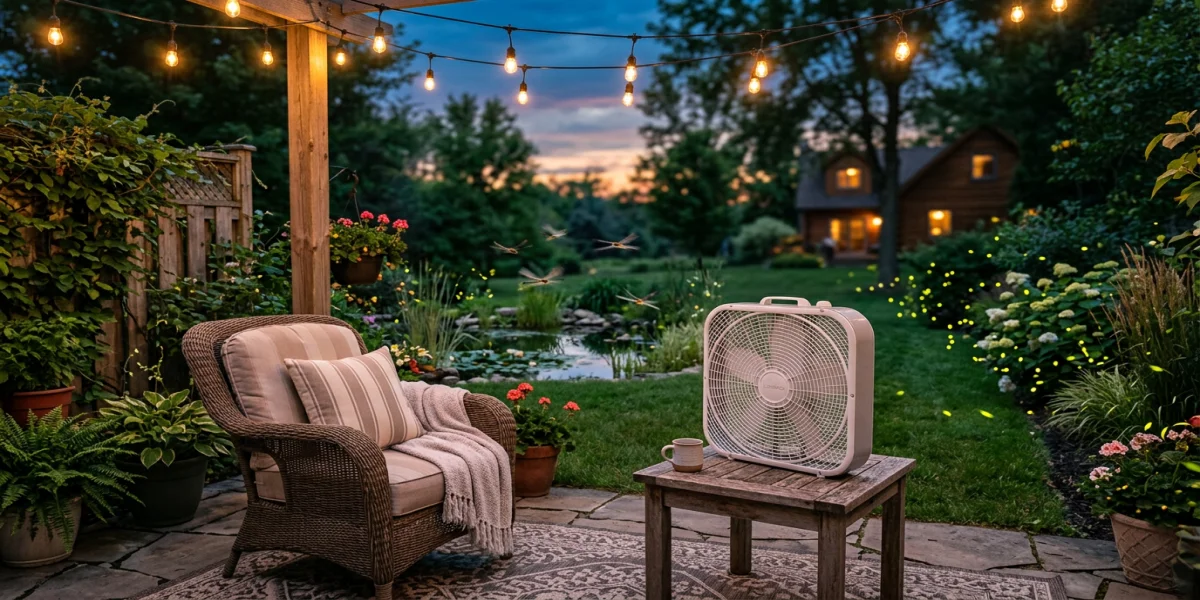
The honest advice: plant these species because they are beautiful, because pollinators love their flowers, because they smell wonderful when you brush past them on the way to the grill. Do not plant them expecting protection. If you want a planting palette built for actual pollinator value rather than mosquito myths, our list of pollinator-friendly plants from the garden center that bees and butterflies actually visit is a better starting point. Allocate your protection budget to draining standing water, Bti dunks, a fan on the patio (mosquitoes are weak fliers. A 20-inch box fan at medium speed creates a mosquito-free zone within six feet), and a DEET or picaridin skin repellent for the handful of evenings per year when you need zero bites.
A Seven Day Pre Summer Setup to Crush Mosquitoes Before June
This is the plan I run in my own yard every April. It takes about six total hours spread over a week. The payoff is a full summer of evenings outside with minimal bites and a yard that still hums with solitary bees and lightning bugs.
Day 1, Saturday morning: the audit walk. Take a notebook and walk every foot of your property. Mark every spot holding water or capable of holding water after rain. Clogged gutters, plant saucers, the forgotten wheelbarrow in the side yard, the tarp draped over the firewood pile, the dog’s outdoor water bowl. Photograph each one. Estimated time: 45 minutes.
Day 2, Sunday morning: gutter and drain clearing. The highest-leverage job of the week. Scoop every gutter. Flush with a hose. Fix any low spots with hanger adjustments. Replace sagging corrugated downspout extensions with smooth PVC sloped toward the street. Two hours for a typical ranch house; longer for a two-story with complex gables.
Day 3, Monday evening: permanent water source setup. Identify every body of standing water that will remain all summer. Rain barrels, garden pond, decorative fountain, any low spots in the yard that do not drain. Drop a mosquito dunk in each. Add a fine mesh screen over rain barrel openings. If a fountain is not running a pump, either install one or treat as a pond. Forty minutes.
Day 4, Tuesday evening: birdbath and feeder water routine. Set a phone reminder for every three days to rinse and refill every birdbath, hummingbird feeder saucer, oriole jelly dish, and water dish. This single habit interrupts the seven-to-ten-day larval cycle of the most common yard mosquito species. Ten minutes per rinse-day.
Day 5, Wednesday morning: eliminate the portable breeders. Bring everything that can hold water under cover or store upside down. Wheelbarrow, buckets, kiddie pool, plant saucers on the patio, any yard toy. Use a large bin or a garage shelf. Thirty minutes.
Day 6, Thursday afternoon: habitat additions for predators. If you do not already have one, install a small wildlife pond or a shallow bog planter to attract dragonflies. A three-by-four-foot pre-formed liner buried in the garden, ringed with native sedges and pickerelweed, produces dragonflies by mid-June. No fish. If you have the right habitat (older trees or proximity to woods), mount a bat house on the south side of a tree or pole, 15 to 20 feet up. Three hours for the pond, 45 minutes for the bat house.
Day 7, Friday evening: patio protection layer. Place a 20-inch box fan on the patio or screened porch. Keep it at medium speed during evening hours when mosquitoes are most active. A fan is cheap, effective, and has zero wildlife impact. Stock a small basket by the door with picaridin lotion (safer around bees than DEET sprays, no odor issue for hummingbird feeders nearby) for the nights you are sitting out beyond the fan’s reach. Fifteen minutes.
Repeat the Day 1 audit walk once a month through September. That is the entire program.
When a Professional Spray Makes Sense and the Four Questions to Ask First
There are three scenarios in which hiring a yard treatment company is defensible. You live in a region with confirmed West Nile or Eastern Equine Encephalitis mosquito activity and have a medically vulnerable household member. You are hosting an outdoor wedding or large event in peak mosquito season. You live adjacent to a wetland, drainage canal, or uncleared lot that produces mosquitoes faster than you can ever drain them.
In all three cases, you still want the smallest spray footprint possible and a company that understands pollinator protection. Most do not. The typical “mosquito service” operator sprays the entire perimeter of every property every 21 days with a synthetic pyrethroid, and the company’s profit model depends on that recurring visit. That is the default offering because it is easy to sell, not because it is what your yard needs.
Four questions to ask before signing any contract.
One: Do you offer a targeted larval-control plan using Bti instead of adulticide spraying? A good company will happily quote a subscription that includes monthly Bti treatment of standing water they identify during a site survey, and no broadcast spraying. If the answer is “we can do that but it costs more,” consider hiring a handyman for the gutter-clearing portion and buying your own dunks.
Two: If we do need a spray, what product do you use, and will you spray only the lower two feet of shrubs and the underside of the deck. Not flowering plants? This is the industry practice called “harborage-targeted spraying.” It hits resting sites where adult mosquitoes actually hide during the day, not the blossoms where pollinators forage. Pyrethrin or pyrethroid applied only to non-flowering resting areas reduces pollinator exposure substantially.
Three: Will you coordinate spray timing to avoid blooming periods and pre-dawn pollinator activity? The best answer is “we spray only after dark, never during bloom, and we notify you 24 hours in advance so you can cover any raised garden beds.” If they shrug, call someone else.
Four: Can I see your pollinator protection policy in writing? Reputable companies that have signed on to initiatives like Pollinator Partnership’s Bee-Safe pledge can produce the document on request. An operator that cannot produce anything in writing is running a standard pyrethroid operation with a pollinator-themed brochure.
If you cannot find a company that meets these criteria in your area, the DIY seven-day plan outlined above genuinely outperforms most commercial services, because it addresses the breeding cycle rather than the symptom.
Mosquito Control Habits That Backfire and Quietly Breed More Bugs
A handful of well-intentioned routines make mosquito problems worse. Recognizing them is often the fastest win a homeowner can get.
Overwatering the lawn and garden. Daily shallow watering keeps the soil surface moist in low spots, and those low spots breed mosquitoes. Switch to deep infrequent watering. Once every five to seven days, 45 minutes per zone. And the soil dries between cycles. Plants are healthier and the neighborhood mosquito count drops.
Using bug zappers. The purple-light electric zappers have been studied repeatedly. Mosquitoes account for less than a percent of the insects killed; the bulk are moths, lacewings, beetles, and other beneficials including nighttime pollinators. The zapper attracts predatory insects that would have eaten mosquitoes had they not been electrocuted. Unplug it.
Stocking the pond with ornamental goldfish for “mosquito control.” Goldfish and koi prefer pellets and readily chase away dragonfly nymphs, which are the genuine mosquito predator. An ornamental fish pond often produces more mosquitoes than an unfished wildlife pond of the same size, especially during summer algal blooms when larvae hide in surface film.
Spraying DEET directly onto hummingbird feeder areas. DEET can damage the feeder port seals and taint nearby nectar. Apply repellent away from feeders, let it dry, and approach the feeder area afterward. Picaridin is a better choice around birds and bees because it has no detectable odor at typical concentrations.
Assuming winter cold kills them. Aedes albopictus eggs survive freezing temperatures in leaf litter and resume activity the first warm week of spring. This is why the April audit walk exists. A pile of leaves left in a rain gutter over winter is already producing larvae the first time the gutter holds 50-degree water.
Installing citronella candles as primary protection. They provide noticeable relief in a still four-foot radius around the flame. They do nothing for a patio-wide zone, and some formulations emit enough smoke that they irritate bees in adjacent beds. Use them as an accent, not as your plan.
Forgetting the front yard. Every strategy in this article tends to get applied to the back yard where people relax. Mosquitoes breeding in the front yard gutter, the driveway swale, and the front birdbath fly to the back yard to bite people. Treat the whole property.
Common questions readers send me
How long does one mosquito dunk last in a rain barrel?
Approximately 30 days of larval suppression per dunk at the labeled coverage of 100 square feet of water surface. A standard 55-gallon rain barrel has roughly 4 square feet of surface area, so a quarter-dunk broken off and dropped in handles the barrel comfortably. Replace monthly from April through October.
Is Bti safe for my dog drinking out of puddles?
Yes. The EPA classifies Bti as non-toxic to mammals. Dogs drinking treated water from ponds or puddles face no meaningful risk. Dunks are not a choking hazard but are still large tablets; store them out of reach if your dog chews.
Will Bti kill tadpoles or salamander larvae in my wildlife pond?
No. Amphibian larvae have digestive systems that do not activate the Bti toxin. Long-term studies of treated vernal pools show no reduction in amphibian recruitment compared to untreated controls.
How often should I rinse my birdbath to prevent mosquito larvae?
Every two to three days. The larval-to-adult cycle in warm weather runs seven to ten days; emptying and refilling every 48 to 72 hours prevents larvae from reaching maturity. A brief rinse with a hose is sufficient. No scrubbing required.
Do ultrasonic mosquito repellers work?
No. A 2010 Cochrane review found no evidence that ultrasonic devices reduce mosquito biting rates. Female mosquitoes do not use ultrasonic hearing for navigation. Save the outlet space.
What is the difference between a mosquito dunk and a mosquito bit?
Dunks are slow-release, donut-shaped tablets that float and release Bti over 30 days. Best for standing water you will leave alone. Bits are granular, sink immediately, and release within 7 to 14 days. Best for temporary water like a kiddie pool you will empty next week, or for spot-treating a larval hatch you just discovered.
Your Yard Can Buzz Without Itching
The gardeners I know who have figured this out share a habit more than a product list. They walk their property for five minutes every Saturday morning with a coffee cup, tipping over anything holding water. They treat their rain barrel and wildlife pond with a single dunk each month through the warm season. They keep a box fan on the patio for evenings. They skip the hardware-store sprayer. And they hear bumble bees in the agastache at ten in the morning and fireflies in the meadow grass at nine at night.
The mosquito fight is not a chemistry problem. It is a water-management problem with a chemistry assist. When you address the breeding cycle, the handful of adults that drift into your yard from elsewhere are a small annoyance rather than an invasion. And you keep every pollinator, bird, and firefly you have spent years attracting. A yard can be mosquito-manageable and wildlife-rich at the same time. It just requires a different plan than the one printed on the back of the fogger can.
For more on building the kind of yard dragonflies and mason bees actually move into, read our guide to how to create a wildlife corridor in your yard, and for the regulatory detail behind Bti safety, the EPA Bti fact sheet is the definitive resource.
Related reading
Want More Wildlife Garden Tips?
Join 5,000+ nature lovers getting our weekly tips on creating wildlife-friendly gardens.
No spam, unsubscribe anytime. Privacy Policy
Emma Harrington
Emma Harrington is a wildlife habitat researcher and content editor with a passion for backyard conservation. She has spent over a decade translating ecological science into practical tips anyone can follow — from selecting native plants to building wildlife-friendly habitats. Her work focuses on helping homeowners transform ordinary yards into thriving ecosystems for bees, butterflies, hummingbirds, and other beneficial wildlife.