
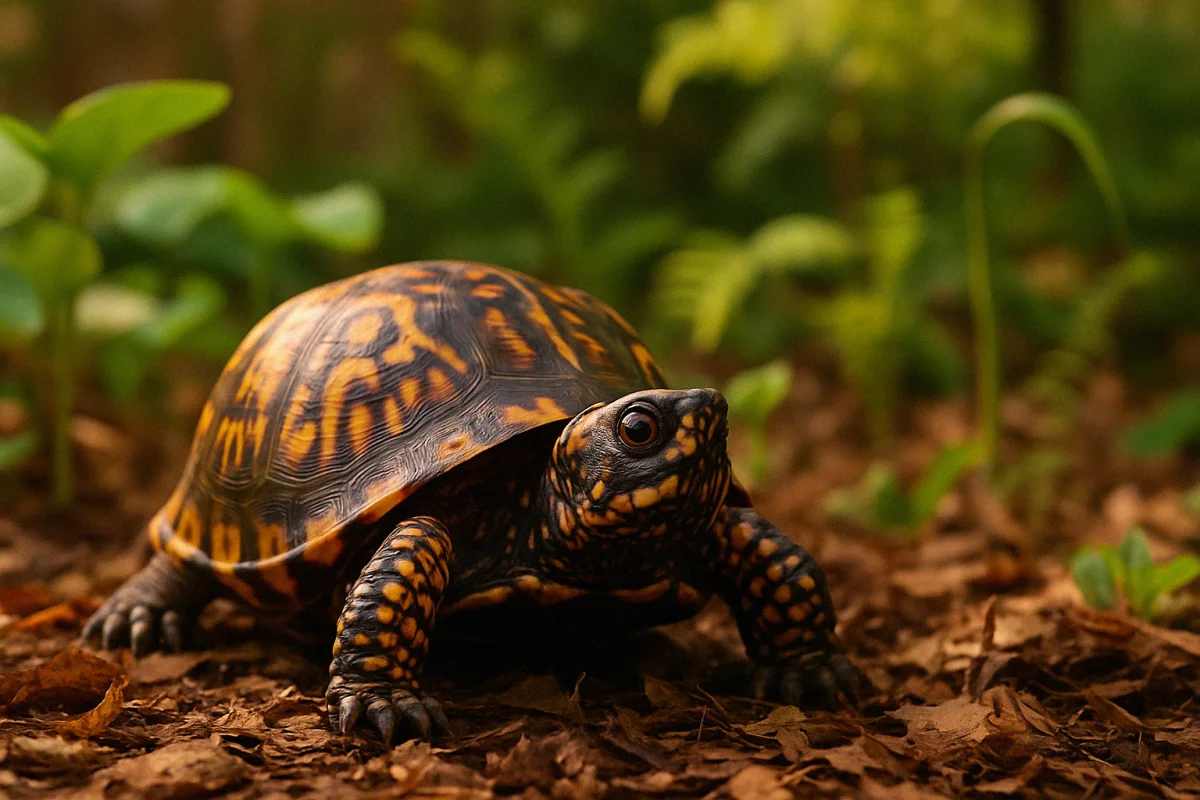
Eastern box turtles spend their entire adult lives inside a home range smaller than two acres, usually within 250 yards of where they hatched. Pick one up, drive it to a state park a few miles down the road, and you have not rescued it. You have stranded it. Most relocated turtles wander for months, lose weight, get hit by cars trying to walk back, and die. The turtle on your mulch path is already home.
There is a particular feeling when you find a turtle frozen on the pine straw, head halfway inside its shell. Half of you wants to scoop it into a tote bag and drive it to the nearest nature preserve where it “belongs.” The other half remembers the deer chewing your coneflowers, the neighbor who runs a string trimmer like he is paid by the calorie, and the worry that suburbia is no place for something this old and slow. A reader emailed me last month to ask whether she should drive a box turtle to a refuge. She had already buckled it into the passenger seat. That well-meaning instinct is the single most common way American gardeners accidentally kill the box turtles they think they are saving.
The 250-yard rule that decides a box turtle’s life
The number that matters here is small and stubborn. A 2008 long-term radio-tracking study from the University of Maryland followed eastern box turtles across a fragmented forest landscape and found average home ranges of 1.3 to 1.9 acres, with most turtles spending their entire lives within 200 to 300 yards of the nest they hatched in. Outside that span, the turtle is, functionally, lost.
That includes the female who emerges in late May or early June to dig a nest. She might walk several hundred yards to find sandy or loose soil. But she walks home afterward, every time, using a mental map biologists still cannot fully explain. Some of it is olfactory. Some of it tracks the angle of polarized light through the canopy. Some of it appears to be magnetic. Move her two miles, and that map points at nothing.
FREE: Wildlife Garden Starter Guide
Get our 12-page PDF with the 25 best plants for pollinators, simple habitat tips, and a printable checklist — all 100% free.
No spam. Read our Privacy Policy.The shell of an adult box turtle is decades old. The animal underneath it is older than your roof, sometimes older than your house. Wild eastern box turtles regularly live 50 to 80 years, with verified records past 100. The turtle in your yard probably remembers when your neighborhood was farmland. That is not a sentimental detail. It is the practical reason home-range fidelity is so unshakable. The turtle survived this long by knowing exactly where every drink of water, every patch of damp leaf litter, and every safe overwintering log sits on a parcel of land roughly the size of a Costco parking lot.
Strip that knowledge away and the animal has nothing left.
Why does moving a box turtle “somewhere safer” usually kill it?
Three things happen the moment you set a relocated box turtle down in a new patch of woods. First, it tries to leave. A 2017 study tracking translocated box turtles in North Carolina found that relocated animals moved an average of 2.4 times farther per day than resident turtles, and their post-release home ranges ballooned to four to seven times the normal size. They are not exploring. They are pacing the edge of a map they cannot read.
Second, they stop eating well. Box turtles are slow, methodical foragers. They know where the wild mayapples ripen in your woodlot, where the slug populations spike after rain, where the partridgeberries are reliable in October. In foreign territory, calorie intake drops sharply. The same North Carolina study recorded a 13% average body-mass loss in relocated turtles over six months, against essentially no loss in resident controls.
Third, they die at a rate that should make any well-intentioned gardener stop and reread the data. Across multiple long-term translocation studies, mortality and disappearance rates in relocated eastern box turtles run between 30% and 60% within the first 18 months. Resident turtle mortality over the same period is closer to 5%. The animal you “saved” is now five to twelve times more likely to be dead within a year and a half than if you had left it alone.
That mortality comes from the obvious things. Road strikes during the long homeward walk, dehydration in unfamiliar terrain, predation when they cannot find cover fast enough. And from the less obvious ones, like failed hibernation. A box turtle that cannot find a deep enough leaf-litter site to overwinter freezes solid in January. The dome shell does not protect against bad geography.
Read the shell before you decide anything
Before you touch the turtle at all, sit on your heels and look at it for a minute. The shell tells you almost everything you need to know.
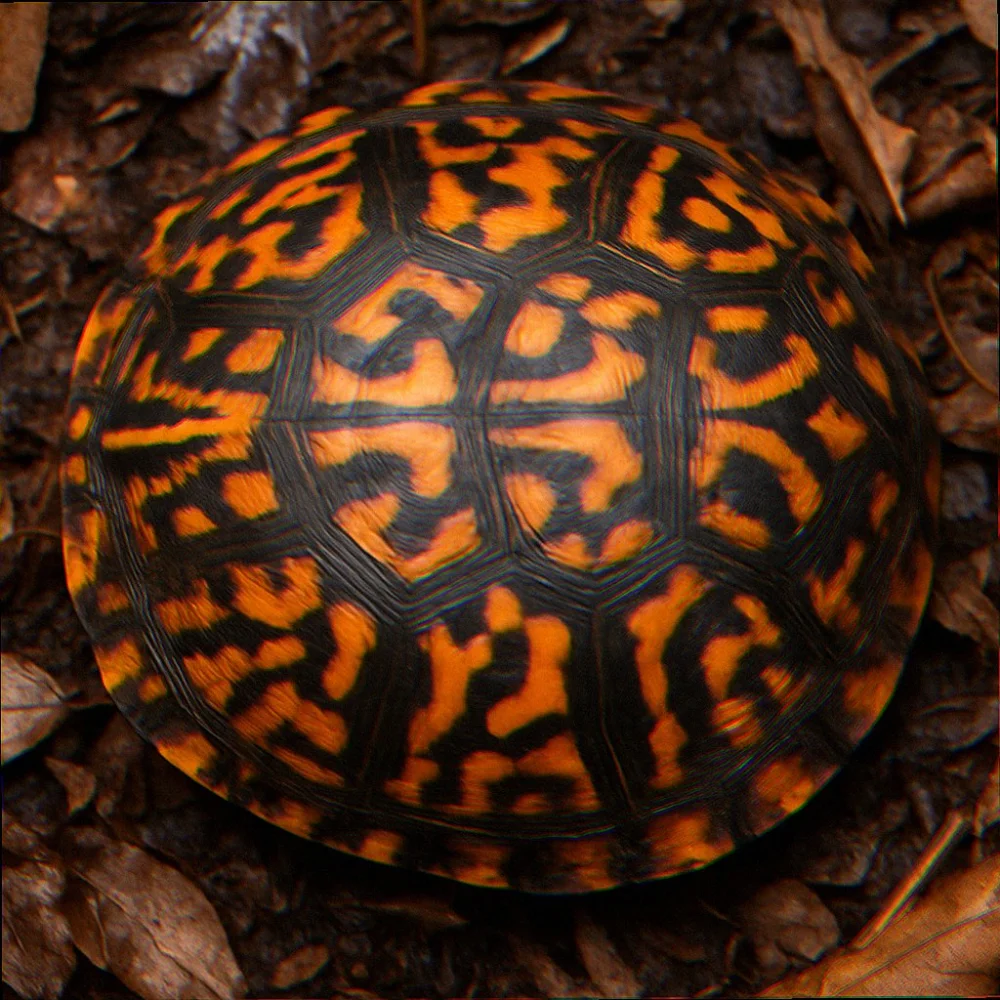
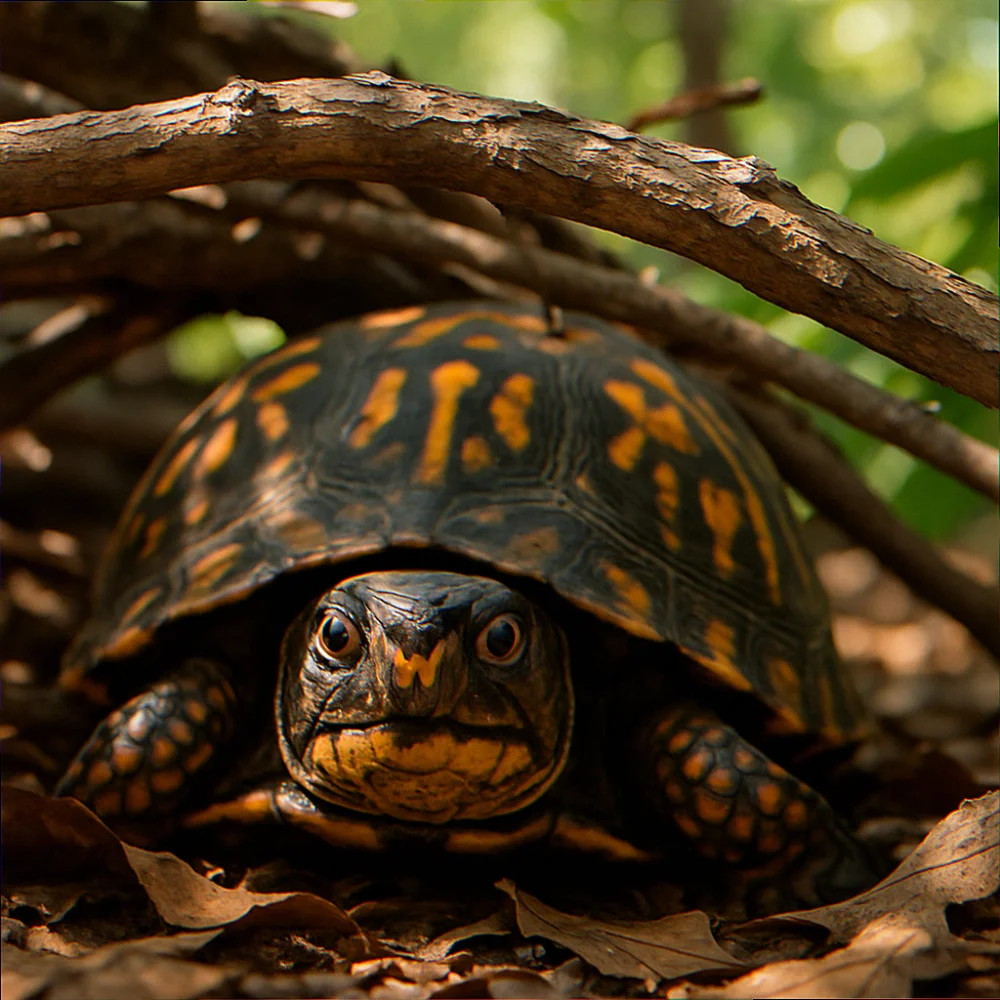
The carapace. The upper shell. Has growth rings on each scute, much like a tree. They are not a clean per-year count after the first decade, but they tell you whether you are looking at a juvenile (small, soft, growth lines clearly spaced) or a mature adult (worn smooth, scutes fused, sometimes mossy around the edges). Color matters too. Bright orange and yellow against deep brown or black is classic Terrapene carolina carolina, the eastern subspecies common from Maine to Georgia. A muted, almost olive shell with thin yellow lines is more likely a three-toed box turtle if you are in the southern Midwest or eastern Texas.
Look at the plastron. The lower shell. If the turtle lets you tilt it gently. Adult males usually have a slight concave dip in the rear plastron and bright red eyes. Adult females have a flat plastron and brown or yellow eyes. This is not idle birdwatcher trivia. A female you see crossing your yard in early June is almost certainly nest-hunting, and disturbing her means she may drop her clutch in the wrong place or reabsorb the eggs entirely.
If the shell shows damage. A cracked scute, a chunk missing, evidence of dog teeth. That is the only condition where a phone call becomes urgent. Note the location precisely, photograph the injury, and call a licensed wildlife rehabilitator in your state. Box turtles heal slowly but reliably with proper care. They do not heal on their own from compound shell fractures, and they cannot survive a dog attack a second time. The Connecticut DEEP fact sheet and the NC Wildlife Resources Commission profile on Eastern box turtles is a good baseline reference for what’s normal versus what needs intervention.
This kind of slow inspection serves the same purpose as the pause we use before “rescuing” a fledgling bird on the ground. The instinct to intervene is almost always wrong; the instinct to gather information first is almost always right.
What if my yard genuinely isn’t safe, dogs, mowers, a busy road?
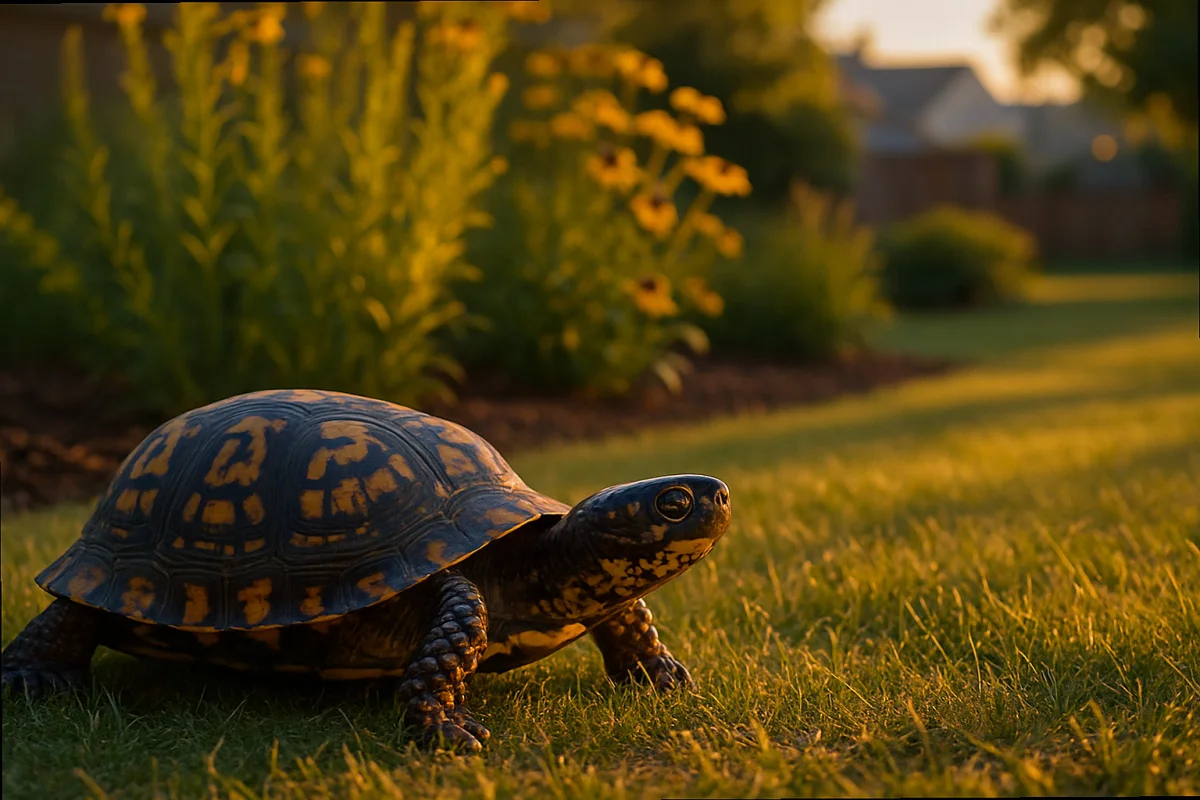
This is the honest objection, and it deserves an honest answer. The risk to a box turtle in suburbia is real. Roughly 60% of all eastern box turtle mortality outside protected forests comes from three sources: lawn mowers, off-leash dogs, and roads. If you live on a quarter-acre lot adjacent to a 40-mph collector road with three German shepherds in a fenceless backyard next door, the turtle’s odds are not great.
But the answer to that risk is not transportation. The answer is environmental modification. Small adjustments to your yard that lower the lethal hazards without uprooting the turtle from its home range.
Mowing is the simplest and biggest lever. Most lethal mower encounters happen because the turtle is sitting still in tall grass and the operator does not see it until the blade does. The fix is a 15-second visual scan before you start any mower, string trimmer, or brush cutter, and a willingness to delay mowing 24 hours after heavy rain. Turtles are most active and most exposed in that window. Many resident gardeners simply stop mowing the back third of the property entirely once they realize a turtle is present. The grass becomes meadow; the turtle gets cover; the lawn-care budget drops.
Dogs are harder. A box turtle pulled into the shell is not safe from a determined dog. The bite force of even a medium-sized dog can crack a shell, and shell injuries are often fatal long after the dog has lost interest. If you have dogs, the working solution is supervised yard time on one side of a clear physical boundary, with the turtle’s preferred zone (usually the wettest, brushiest corner) on the dog-free side. A simple brush pile in that corner buys the turtle a reliable retreat.
Roads are the only situation where short-distance physical relocation is justified. And it has to be the right distance, in the right direction. More on that below.
Five quiet ways to keep a resident box turtle alive in your suburb
The pattern in healthy suburban turtle populations is the same across every state I’ve seen tracking data from: the yards that hold turtles year after year share five small, low-effort features. None of them require buying anything beyond a garden hose.
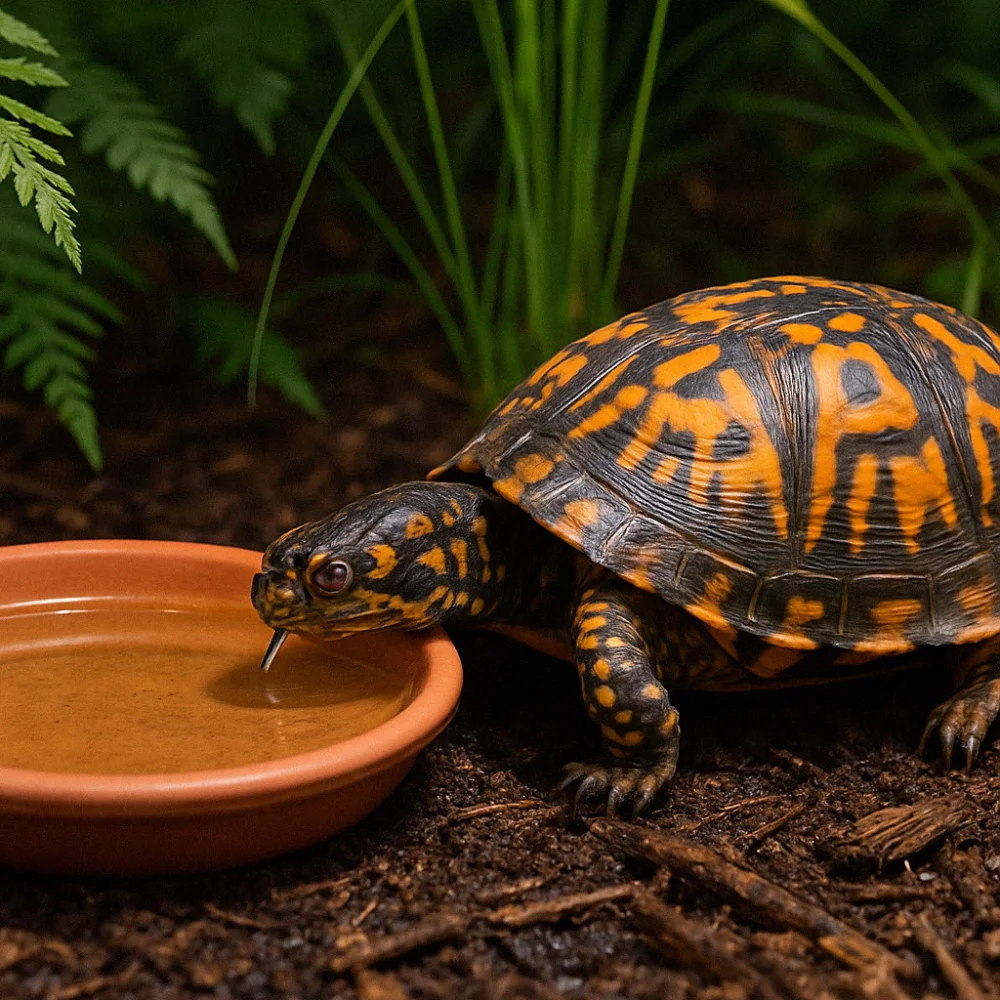
- A consistent, shallow water source set into the ground. Box turtles drink from puddles, not bowls. A plant saucer or terracotta dish sunk into a damp corner of mulch, kept topped off with a slow trickle from the hose every few days, is enough. It needs to be wide and shallow. No more than two inches deep, with a rough surface the turtle can grip while climbing in and out. Add a few smooth river stones for footing. Refresh the water every three to five days to keep it from becoming a mosquito breeding site.
- Damp leaf litter you do not rake up. The single most important resource for a resident box turtle is a permanent zone of undisturbed leaf litter, ideally on the north or east side of the house where it stays cooler and damper. Six inches deep is plenty. This is where the turtle hunts slugs, hides from heat, and ultimately overwinters when temperatures drop in November. If your municipality enforces a “clean yard” rule, fence off the area with a tidy mulch border so it reads as intentional landscaping.
- A pesticide-free buffer zone. Box turtles eat slugs, beetles, earthworms, fungi, and fallen fruit. Anything you spray on your lawn for grubs, ticks, or mosquitoes passes through that food chain and concentrates in the turtle’s liver. If you are not ready to go pesticide-free across the whole yard, draw an honest line around at least the back 25% and stop spraying inside it. Tell the lawn-care company in writing.
- Native fruiting and seed-bearing plants, especially low-growing ones. Wild strawberry, partridgeberry, mayapple, wild ginger, low-bush blueberry, native sedges. These are box turtle groceries. Plant in clusters in the dampest, shadiest part of the yard. As a side benefit, this is also the spine of a working wildlife corridor if any of your neighbors do the same.
- One brush pile or downed log left to rot. A single fallen branch, oak limb, or stack of pruning debris in a back corner gives the turtle predictable cover. The wood eventually softens enough to host the beetles and grubs it will hunt later. If a brush pile reads as too messy for your block, a half-buried hollow log accomplishes the same thing and looks like a deliberate landscape feature.
None of these are exotic. The yards that lose their resident box turtles inside a single season almost always lost the fifth element first. A homeowner cleaned up the brush pile, raked the leaves to the curb, and removed the only cover the turtle had during a hot, dry July.
When is moving a turtle actually the right call?
There are three situations, and only three, where physically moving an eastern box turtle is the correct response.
First, when it is on a road. Stop if safe to do so, pick the turtle up by the sides of the shell (not the tail. That can dislocate vertebrae), and walk it across the road in the direction it was already facing. Set it down 10 to 20 feet beyond the shoulder, in the nearest cover, and walk away. Do not drive it to the next county. The turtle was crossing the road for a reason it understands and you do not. Usually because its home range straddles the road. Take it back and it will simply try the crossing again tomorrow, except this time confused and dehydrated from the trip.
Second, when it has been picked up by someone else and brought to your house. This happens depressingly often. A kid finds a turtle three towns over, the family keeps it in a Rubbermaid bin for a few days, then decides to “release” it in your yard or a nearby park. If you can recover the original location to within a quarter-mile, take it back. If you cannot, the next-best move is the nearest large protected forest in the same county, dropped in the wettest, brushiest part you can find, and reported to your state wildlife agency. That turtle’s odds are bad regardless, but they are worst if you simply add it to your yard population. It will not stay, and it may carry pathogens that affect your resident turtles.
Third, when the turtle is visibly injured. Shell cracks, crushing injuries, eye infections (often signaled by sealed-shut swollen eyelids), or signs of nasal discharge mean a call to a licensed wildlife rehabilitator. Most states maintain a list of permitted rehabbers; the box turtle survey program iNaturalist project for your region is a good starting point for finding one. Transport it in a ventilated container with damp paper towels, no food, no water in the container itself. They can drown in transit.
Everything outside those three scenarios is “leave it.” That includes “my yard is small,” “I have a dog,” “the neighborhood is too built up,” and “I think it would be happier in the woods.” None of those are reasons to relocate. They are reasons to modify your yard.
Don’t tell the HOA, and don’t post the location anywhere online
This is the part nobody likes to say out loud. Box turtles in eastern North America are in long-term decline. The species is listed as Vulnerable on the IUCN Red List and Endangered in several states. And one of the principal drivers is illegal collection for the pet trade. A single charismatic adult turtle, with vivid shell markings, fetches between $80 and $300 on black-market reptile forums. The collectors who run that trade routinely scan local Facebook gardening groups, Nextdoor posts, and geo-tagged Instagram photos for tip-offs.
If you find a turtle in your yard, do not post the address. Do not post the cross street. Do not tag the photo with your neighborhood. If you submit it to iNaturalist (which is genuinely useful for population science), enable the obscured-location setting, which scrambles the coordinates to a 22-kilometer grid square. Researchers can still use the data. Poachers cannot.
The HOA question is the other half of this. If your homeowners’ association has a “clean yard” or “manicured landscape” requirement and you suddenly let the back third go to leaf litter and brush pile, you may attract a complaint. Don’t open that conversation by mentioning the turtle. Mention native pollinator habitat. Mention bird nesting cover. Mention drought tolerance. Show the board a photo of a tidy, intentional native garden with crisp mulched borders and frame your project as that. The turtle benefits silently in the background.
This is the same pragmatic compromise that good native gardeners have always made: real ecology behind a polite border. The HOA gets a yard it can defend in the newsletter. The turtle gets a home range it can use for the next 40 years. Nobody on the board needs to know which is the actual priority.
| 12-month outcome | Resident turtle | Moved < 0.5 mile | Moved > 2 miles |
|---|---|---|---|
| Average home range | 1.5 acres | 3.8 acres | 9.2 acres |
| Daily distance traveled | 22 m | 41 m | 68 m |
| Survival rate at 12 months | 94% | 71% | 38% |
| Average body-mass change | +1.2% | −6.4% | −13.1% |
| Road-strike mortality | 2% | 11% | 27% |
What changes when you decide to share the yard
The first year of living with a resident box turtle is mostly nothing. You might see the animal twice in May, three times in June, maybe once in July when the lawn gets dry enough that it tucks deep into the leaf litter. You may not see it at all in August. Then a rain storm rolls through Labor Day and the turtle is suddenly on the patio, drinking from a flagstone puddle, and you remember why you stopped spraying for mosquitoes.
By year three, if you’ve kept the brush pile, the leaf litter zone, and the unsprayed buffer, you will probably have more than one turtle. Box turtles do not defend territories. Overlapping home ranges are normal. And a yard with reliable food, water, and overwintering cover becomes a small node in the local population. That is the part nobody tells you when you’re standing over the first turtle wondering whether to drive it to the state park.
The other thing that changes is how you read the rest of the yard. You stop seeing fallen logs as cleanup. You stop pulling every last weed out of the perennial bed in October. Those seedheads will hold snow and shelter ground beetles, which the turtle eats next April. The black plastic netting over the strawberry patch comes down because you’ve watched a turtle nose around the base of it and realized the trap risk is not theoretical. The same logic that protects the turtle also protects the cottontail nest you skipped mowing last spring. The yard tightens up around the wildlife rather than around the lawn.
And you get something back that suburbia rarely offers. A relationship with an animal that does not need you. The turtle is not a pet. It does not come when called. It will not be friendlier next year because you put out water. But it will keep being there, season after season, doing the same slow rounds it has done for 40 years, and you will recognize the chip on its third-left scute and know that this is the same individual, and that small recognition turns a yard into a place.
FAQ
How can I tell if a box turtle is wild or someone’s escaped pet?
Wild box turtles have worn, often algae-stained shells with natural pitting and unfaded growth lines. Captive turtles frequently show pyramiding (raised, cone-shaped scutes from improper diet), unnatural smoothness, or shell markings filed down by tank contact. If the turtle walks directly toward you instead of pulling into its shell, it has been hand-fed and is likely an escape. Escaped pets should go to a licensed reptile rescue, not back into the wild. They may carry diseases like ranavirus that devastate wild populations.
Can I move a box turtle to my yard if I think it’ll be safer there?
No. Even if your yard is objectively better habitat. Wetter, brushier, less sprayed. The turtle’s homing instinct will drive it to leave within days. It will spend the rest of its life walking toward its original home range and probably die in transit. The turtles you see in your yard are turtles that already chose your yard. Build habitat for those individuals, not for a turtle you imported.
Do box turtles return to the same spot every year?
Yes, with remarkable precision. Females usually return to within a few feet of previous nest sites in late May and June. Both sexes return to the same overwintering microsite. A particular hollow under a stump, a specific patch of deep leaf litter. For decades. Disturb that microsite by raking it, digging a fence post through it, or paving over it, and the turtle may not find a viable replacement before winter.
What should I feed a box turtle living in my yard?
Nothing. Box turtles eat a wildly varied diet of slugs, earthworms, insects, mushrooms, berries, leaves, and carrion. Far more diversity than any single feeding will provide, and any food you add risks habituating the turtle to humans, which makes it more vulnerable to poaching and roads. The right “feeding” strategy is habitat: leaf litter for invertebrate prey, native fruiting plants for fall calories, and pesticide-free zones so the food chain stays intact.
Is it legal to keep a box turtle I find in my yard?
In most U.S. states, no. Eastern box turtles are protected from collection in nearly every state in their range. Including all New England states, the Mid-Atlantic, much of the Southeast, and the Midwest. Possession laws vary by state, but the practical answer is straightforward: a wild box turtle should stay wild. Even in the small number of jurisdictions where collection is legal with a permit, the ecological argument is the same as the legal one. The turtle is most useful, and most likely to live a long life, exactly where you found it.
Want More Wildlife Garden Tips?
Join 5,000+ nature lovers getting our weekly tips on creating wildlife-friendly gardens.
No spam, unsubscribe anytime. Privacy Policy
Emma Harrington
Emma Harrington is a wildlife habitat researcher and content editor with a passion for backyard conservation. She has spent over a decade translating ecological science into practical tips anyone can follow — from selecting native plants to building wildlife-friendly habitats. Her work focuses on helping homeowners transform ordinary yards into thriving ecosystems for bees, butterflies, hummingbirds, and other beneficial wildlife.