
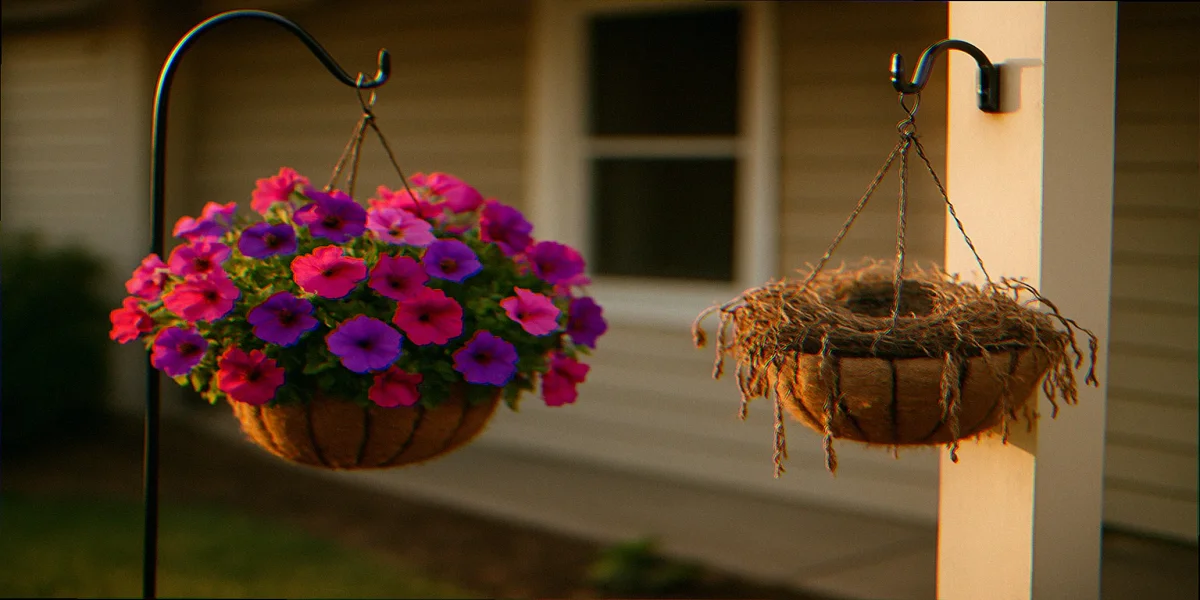
If a bird built a nest in your hanging basket, stop watering the container for the next three to four weeks, leave the basket exactly where it is, and skip any pesticides on nearby plants until the chicks fledge. Most suburban hanging-basket nesters in late May are House Finches, Carolina Wrens, or American Robins, and federal law protects every active native nest on your property.
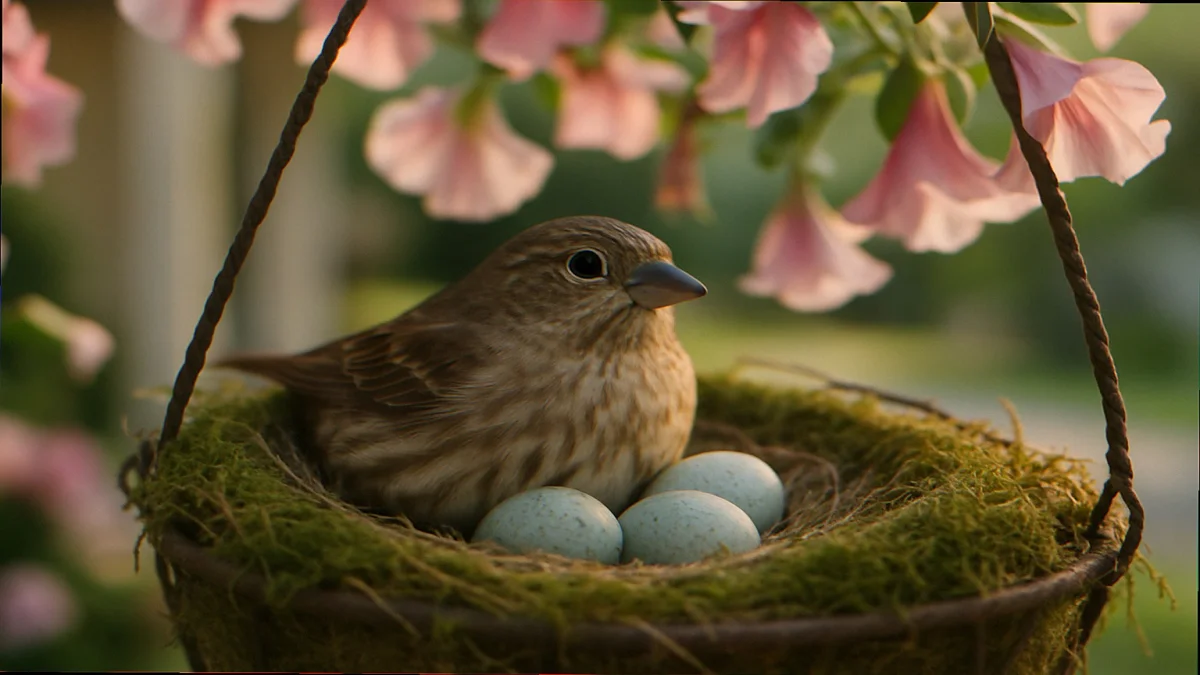
I walked out to dead-head my front-porch petunias last Saturday morning and found three mottled-blue eggs cupped in the moss liner. I had been watering that basket every other day for six weeks, and somewhere between the last watering and that moment a female House Finch decided my $14 Home Depot annual was the safest real estate she could find. The petunias were already starting to look thirsty. The next three to four weeks were going to be a negotiation.
FREE: Wildlife Garden Starter Guide
Get our 12-page PDF with the 25 best plants for pollinators, simple habitat tips, and a printable checklist — all 100% free.
No spam. Read our Privacy Policy.Which birds nest in hanging baskets in late May?
Five species do the overwhelming majority of basket-nesting in suburban North American yards from mid-May through early July. Recognizing which one moved in changes how long you have to wait and how skittish the adults will be when you walk past the porch.
| Species | Egg appearance | Incubation + nestling days | Tolerance of human traffic |
|---|---|---|---|
| House Finch | Pale blue, faint speckles, 4-5 eggs | 13 + 14 = 27 days | High. Used to porches and feeders |
| Carolina Wren | Cream with rusty flecks, 4-6 eggs | 14 + 14 = 28 days | Medium. Flushes if you stare |
| American Robin | Solid sky blue, 3-4 eggs, larger | 13 + 14 = 27 days | Medium-low. Territorial |
| Mourning Dove | Plain white, 2 eggs, flimsy nest | 14 + 13 = 27 days | High. Sits very tight |
| House Sparrow (non-native) | Greenish-white with brown blotches, 4-6 eggs | 11 + 14 = 25 days | Very high. Invasive |
Four of those five are native and federally protected under the Migratory Bird Treaty Act. House Sparrows are the exception. You can legally remove a House Sparrow nest, and many native-bird advocates do so to free habitat for natives, but plenty of suburban gardeners simply leave them be. Identification is the first step, and the easiest tells are egg color and nest construction. Wren nests look like a chaotic ball of twigs with a side entrance. Finch nests are a tidy cup. Robin nests are heavier and built with mud. Dove nests look like a child threw twelve sticks at a planter.
If the eggs are already there when you find the nest, the parent is committed and incubation has begun. If you find an empty cup, the female may still be in the building phase and is more easily disturbed.
The watering trade-off you have to make right now
Here is the hardest part of the deal. Petunias, geraniums, calibrachoa, and most of the standard big-box annual fillers need water every one to two days in late May heat. Nesting birds need that basket dry enough that eggs and nestlings do not chill or drown. You cannot do both well at the same time. Something has to give, and what has to give is the plant.
The math is brutal but worth saying out loud. A $19 hanging basket from Lowe’s or Home Depot represents about 27 days of bird occupancy if eggs are already laid. The plant itself will go dormant or die back, particularly the calibrachoa, which is the least drought-tolerant of the common basket fillers. The good news is that petunias, geraniums, and verbena will usually recover with a hard cutback and renewed watering once the chicks fledge. The bad news is the basket is going to look ratty for the next month, and your neighbor is going to notice.
What you can do without harming the nest:
- Mist the soil edges, never the nest itself, with a fine spray bottle from a step ladder. Two squirts on opposite sides, two times a week. This keeps the roots from collapsing entirely without saturating the cup.
- Move other potted annuals into the shade. They draw less attention away from the conspicuously dying basket if their neighbors look healthy.
- Top-water nearby in-ground plantings normally. The bird does not care about your in-ground beds, only the basket she is sitting in.
Skip the sprinkler. If the basket sits within reach of an overhead irrigation pattern, redirect or pause that zone. The persistent dampness alone can foster mold in the nest material and kill embryos before they hatch.
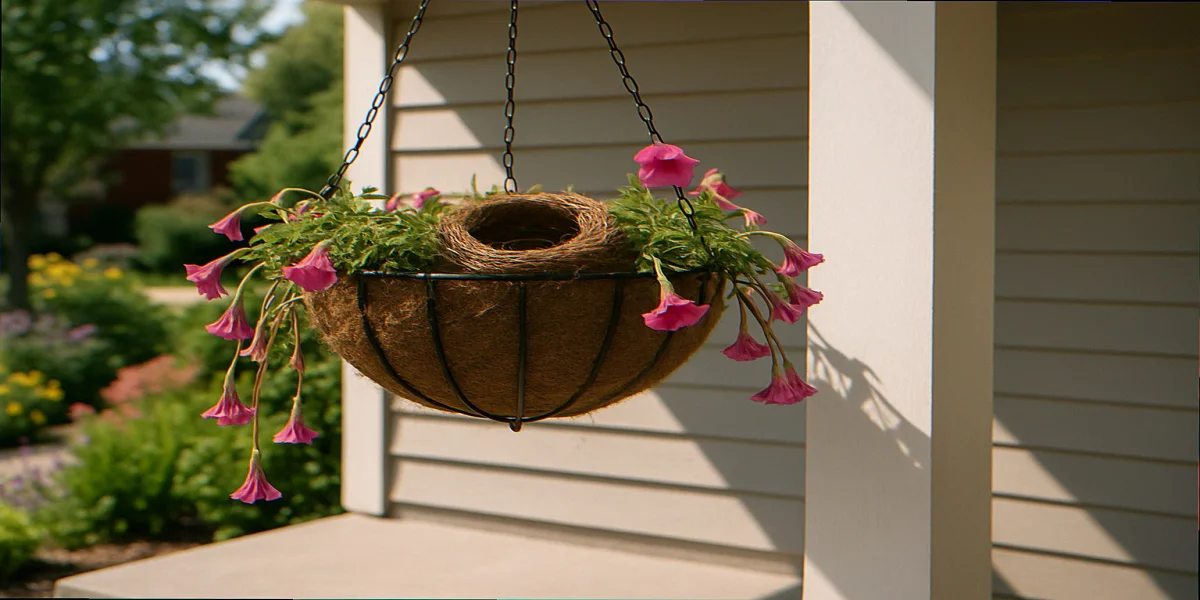
Can I move the basket? What about cleaning up the dead petunias?
The short answer is no, and the slightly longer answer is “probably not, and if you must, six inches at a time over several days.” Parent birds key on the exact GPS coordinates of the nest. If you relocate a basket from a shady west-facing porch column to a sunny south-facing eave even five feet away, there is a real chance the female will not find her way back and will abandon the clutch. Cornell Lab’s nest-watching guidance is explicit on this point and is the source most state wildlife agencies cite when they get the same question every June. Their NestWatch program documentation covers the cautious-move protocol if relocation is truly unavoidable, such as during construction or before a forecasted severe storm.
The same principle covers basket cleanup. Do not deadhead. Do not pull the dead petunias to “tidy” the look. Every time you reach into that basket, you are signaling potential predator presence and burning incubation time off the clock. A female House Finch who is flushed from her nest more than four or five times in a single day can give up entirely. The chicks she leaves behind will not survive without her.
The exception some gardeners ask about is dead plant material that looks like it might rot directly onto the nest. In thirty days of incubation and nestling growth, this almost never happens. Petunias dry into stiff stems. They will not collapse into the cup. Wait it out.
A 3-week timeline from first egg to empty nest
Knowing the calendar makes the wait easier. The full process from the first egg laid to a silent, empty basket runs roughly 25 to 28 days depending on the species. Here is what is happening week by week if you can resist the urge to peek every day.
- Days 1-5 (laying): The female lays one egg per morning until the clutch is complete. She often does not start steady incubation until the second-to-last egg is laid. Eggs can sit cool for a day or two without harm. The basket looks normal during this stretch and you may not even realize the nest is active.
- Days 6-18 (incubation): The female sits on the eggs almost continuously, leaving only briefly to feed. The male of most basket-nesting species brings her food. This is when watering damage matters most. A drenching event during this window can chill eggs below the 95-99°F incubation range and kill the embryos.
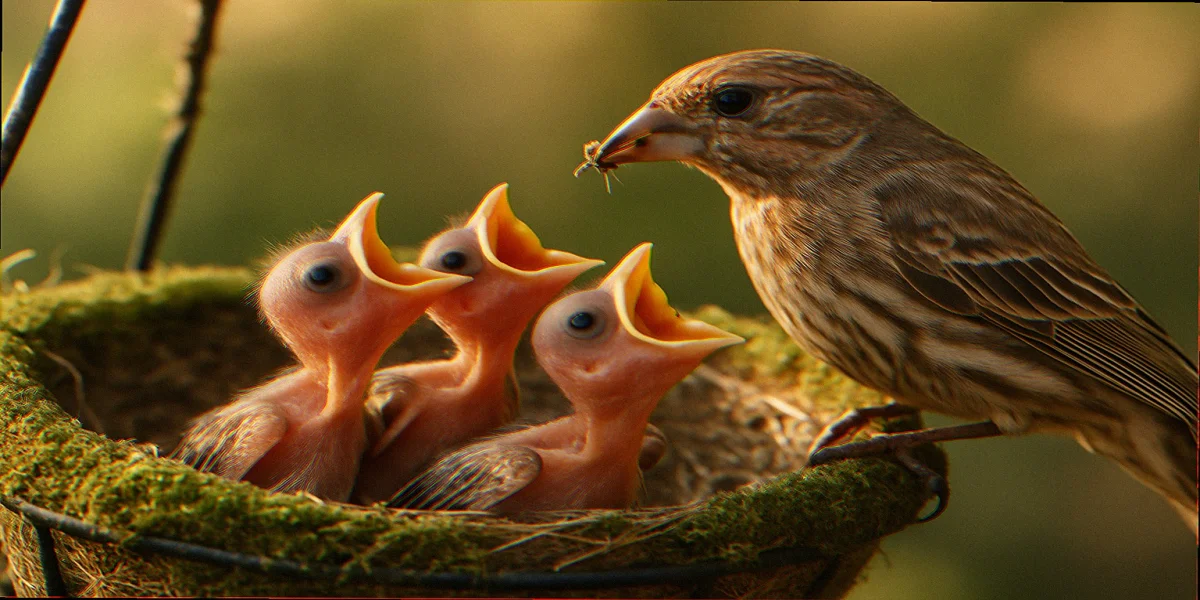
- Days 19-26 (nestling): Eggs hatch over 24 to 36 hours. The chicks are blind, naked, and entirely dependent. Both parents now visit the nest every five to fifteen minutes with insects and seeds. You will see far more activity at the basket. Stand back and enjoy it from a window. This is the “Nature TV” payoff that compensates for the dead plant.
- Days 27-28 (fledge): The chicks crowd the rim and one by one drop or flap to the lawn below. Once they leave the cup they almost never return. Parents continue to feed them on the ground for about two more weeks.
- Day 29 onward: Wait at least 48 hours of total basket silence to be sure the last chick has left and is not just exploring the rim. Then you can resume watering, cut back the plant, and decide whether to replant or let the basket go for the season.
Some species, particularly House Finches and Carolina Wrens, will attempt a second brood in the same nest if you let the basket alone. If you are willing to host a second round, leave the existing structure and simply resume light watering at the soil edges. The second clutch usually arrives within two weeks of the first fledging.
What if my neighbors complain about the dying flowers?
This is the question I get asked most often and it almost never appears in the official wildlife agency literature. Suburban hanging baskets are visible from the street. A drooping, browning, half-dead basket on a front porch reads to the wrong neighbor as neglect, and neighborhoods with active homeowner associations sometimes have unwritten landscaping standards that the porch is supposed to meet.
Three things help, and none of them involve disturbing the nest.
Print a small note. A 4-by-6-inch placard zip-tied near (not on) the basket reading “Active bird nest, please do not disturb. Watering resumes mid-June” turns the eyesore into a small civic-pride moment. People who would otherwise complain about brown flowers are usually delighted to learn there are baby birds on the property. A few will ask to see them. Politely decline the up-close visit and offer to text photos.
Hang a second, identical basket somewhere conspicuous. A fresh, watered, blooming basket on the opposite porch column or hung from a shepherd’s hook on the lawn signals to passersby that you have not abandoned the property and that the dying basket is a known situation. This is the suburban equivalent of putting a “we know” sign on a project. It costs $20 and buys you four weeks of social cover.
If an HOA letter does land in the mailbox, the legal ground is solid. The Migratory Bird Treaty Act is federal law and it prohibits disturbing active nests of native species, full stop. Most HOA boards back off immediately when they realize the federal statute outranks their landscaping rule. For a longer playbook on responding to an HOA letter about an unconventional yard, the post on drafting a measured response to an HOA letter covers the language and tone that tends to work.
Signs the chicks have fledged (and when the basket is yours again)
The transition from full nest to empty nest is fast and easy to miss. You will probably see one of three signs first.
The first is a sudden silence. Two or three days before fledging the chicks are noisy enough to be audible from inside the house. Then one morning the porch is quiet. If the silence holds for 48 hours, the nest is done.
The second sign is fledglings on the lawn or in the foundation shrubs. They look mostly grown but with a stubby tail, soft cheek feathers, and a wide pinkish gape. Do not touch them. The parents are nearby and feeding them. This is the same fledging stage covered in the post on what to do when you find a fledgling bird on the ground. Leashing the dog for a week is the most helpful thing a household can do during this stretch.
The third sign is an empty cup with no warm spots when you finally check, usually in the cool of early morning. Once you see all three signs, you can pull the basket down and reclaim the season.
What to do with the old nest is a matter of personal preference. Federal law does not require you to leave an inactive native nest in place. Most gardeners pull the nest out, compost the plant material, and either replant the basket with a quick-growing annual like calibrachoa (which will bloom by mid-July) or let the basket go for the season and reuse it in late summer for fall mums. The moss liner is worth saving and reusing.
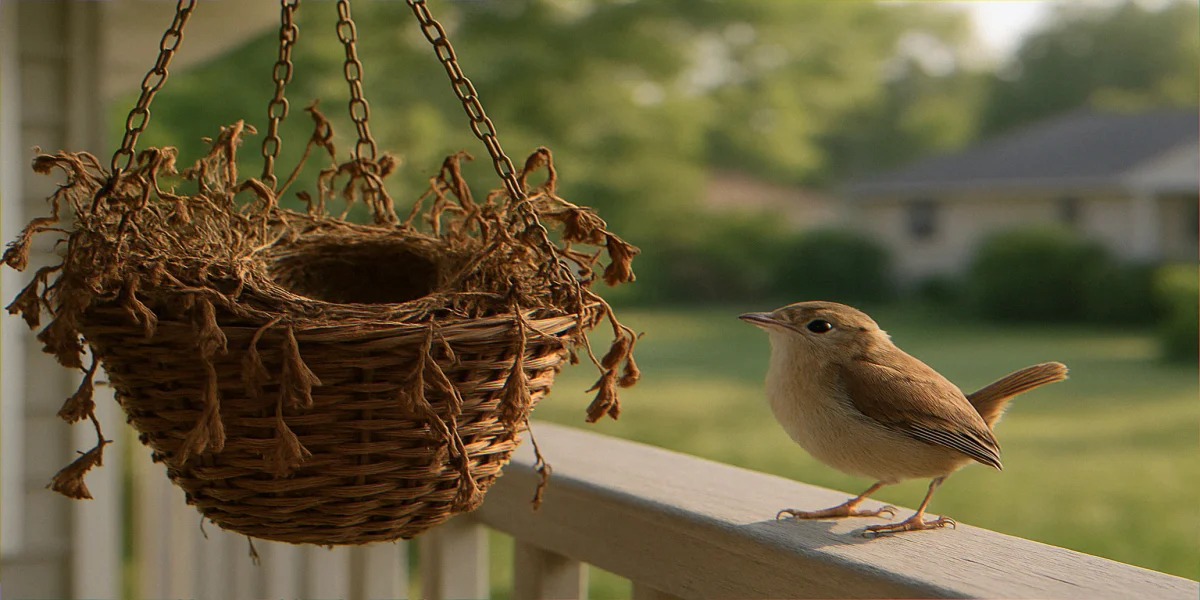
Setting up a backup planter so you do not lose the whole season
The single best thing I did the year I learned this lesson was set up a second hanging basket from the start of the season. The first one was on the front porch in the spot where finches always nest. The second was a backup on a shepherd’s hook on the side patio where bird traffic is lighter. If a nest happens, the front porch goes into hospice mode for a month and the side patio carries the visual load.
The mechanics are not complicated. Buy two baskets in late April. Plant identical or near-identical combinations so they read as a coordinated pair. Hang one in the high-bird-traffic location (the place you have seen finches investigating in previous years) and the other in a quieter spot. If a nest happens, you have an immediate substitute. If it does not, you have two thriving baskets, which is the better outcome anyway.
For the bird-friendly basket, the plant selection matters less than the structural cup. Choose a coir or sphagnum-lined wire basket over a solid plastic pot. Birds prefer the natural fiber and they tuck the nest deeper into a coir liner, which protects against the wind. A dense annual like Calibrachoa or trailing Verbena provides hiding cover above the cup. For the backup basket, prioritize whatever blooms steadily and tolerates inconsistent watering. Calibrachoa is the most photogenic but the thirstiest. Lantana camara is the most forgiving and a moderate pollinator draw, but check whether it is invasive in your state before planting; in much of the southern US it has escaped cultivation.
If you want to extend the wildlife-watching beyond the basket, a small water source at ground level becomes a magnet for fledglings learning to drink. The post on adding a water source for backyard wildlife without breeding mosquitoes covers the dish-and-drip setup that works well in the same suburban porch context.
And if you have a serious case of want-to-see-everything, a porch-corner trail camera trained on the basket from six feet away captures the entire arc. The setup is the same one covered in the guide to running a backyard trail camera at night. You get every visit, every feeding, every fledge attempt, and a small archive worth more than any social media post.
The native-plant angle most basket guides miss
Big-box hanging baskets are mostly non-native annuals because that is what blooms hard and sells through retail. The petunias, calibrachoa, and ivy geraniums in the standard mix are not feeding adult birds or pollinators in any serious way. The reason birds nest in them is structural. A moss liner at the right height with overhead canopy is good real estate regardless of the plant. So while you are stuck waiting out a nest in a basket of bird-irrelevant flowers, take the month to think about whether next year’s basket could pull double duty.
A few native or near-native combinations that hold up in standard suburban basket conditions and feed pollinators while they grow:
- Cardinal flower (Lobelia cardinalis) trained as the centerpiece, with trailing Phlox subulata over the edge. Cardinal flower draws hummingbirds and reaches 18 inches in a basket.
- Wild petunia (Ruellia humilis) for the structural mass, mixed with Calylophus drummondii for trailing yellow. Both tolerate the dry-out-fast condition that a hanging basket inflicts.
- Foxglove beardtongue (Penstemon digitalis) as a tall element with native creeping phlox spilling over the lip. This combination handles late-spring heat well in zones 5 through 8.
None of these are sold at standard big-box garden centers. Local native plant nurseries and the spring plant sales hosted by chapters of Wild Ones are the realistic sources. For verifying that a given plant is actually native to your specific county before you order, the post on running a county-level native check via BONAP walks through the process in under five minutes per plant.
Going native in your baskets does not make the bird nesting any less likely. It just means the same basket is doing meaningful pollinator work when it is not hosting a clutch. That is the version of the suburban yard that feeds the most lives per square foot.
FAQ
Will the parent birds abandon the nest if I water the basket once by accident?
Probably not from one accidental watering. Birds are tougher than the internet makes them sound. A single soaking event during incubation is unlikely to chill the eggs below the lethal threshold unless the water sits in the cup itself. The risk grows with repetition. Stop watering going forward and the clutch usually still hatches on schedule.
How do I know which bird species is using my basket without scaring her off?
Watch from inside a window for ten minutes at dawn or dusk. The female will return to the nest on a predictable rhythm during the laying and incubation phases. Egg color visible from below as she settles, plus the silhouette and any vocalizations from the male nearby, narrow it down. The Cornell Lab’s Merlin Bird ID app identifies the male’s song from a porch recording in under thirty seconds.
Is it legal to remove a House Sparrow nest from my basket?
Yes. House Sparrows are a non-native invasive species in North America and are not protected by the Migratory Bird Treaty Act. You can legally remove their nest. Many backyard bird enthusiasts do so to free habitat for native cavity-nesters. Confirm the identification before acting because young female House Finches can look superficially similar.
Can I keep deadheading the basket if I am very gentle?
No. Even gentle visits force the female to flush from the nest, and repeated flushes during incubation are the most common cause of nest abandonment in suburban hanging baskets. The plant will look worse than you want for three to four weeks. Accept it and step away from the basket entirely.
What if a predator like a snake or a squirrel reaches the nest?
Predation is part of the natural cycle and federal law does not require you to intervene. If you actively want to discourage predators, a baffle on the supporting hook or chain (similar to a squirrel baffle on a bird feeder pole) is a reasonable and legal intervention. Do not put up netting, which traps birds and other wildlife and is covered in detail in the post on wildlife-safe alternatives to garden netting.
Want More Wildlife Garden Tips?
Join 5,000+ nature lovers getting our weekly tips on creating wildlife-friendly gardens.
No spam, unsubscribe anytime. Privacy Policy
Emma Harrington
Emma Harrington is a wildlife habitat researcher and content editor with a passion for backyard conservation. She has spent over a decade translating ecological science into practical tips anyone can follow — from selecting native plants to building wildlife-friendly habitats. Her work focuses on helping homeowners transform ordinary yards into thriving ecosystems for bees, butterflies, hummingbirds, and other beneficial wildlife.