
Quick answer: A wild cottontail nest only stays active for about three weeks. Mark the spot, mow around a 10-foot buffer, and skip the area until the kits leave on their own. The mother visits just twice a day, at dawn and dusk, so an empty-looking nest is usually a healthy nest. Verify she is still nursing with the tic-tac-toe twig test before you assume anything is wrong.
If you mowed your lawn this morning and stopped short over a fist-sized depression of dead grass and rabbit fur, you found an active cottontail nest. The mother is almost certainly not in it. She is intentionally hundreds of feet away, watching from a fence line, and she will only return at dusk to nurse for two or three minutes. That absence is not abandonment. It is a survival strategy that has worked for eastern cottontails for tens of thousands of years, and your job for the next 21 days is to leave it alone.
A reader emailed last spring panicked because she had run the mower over a patch she swore had been empty the week before. Inside what was left of the bowl: four kits, eyes still closed, two of them injured. She asked the same question every May and June email brings: was the mother gone, or did I just kill a healthy litter? The honest answer is that the cottontail family that built a nursery in the middle of suburban turf is not making a mistake. They are doing exactly what wild rabbits in this part of the country have done for generations. The mistake is the mower schedule, and that part is fixable.
What a Cottontail Nest Actually Looks Like in May and June
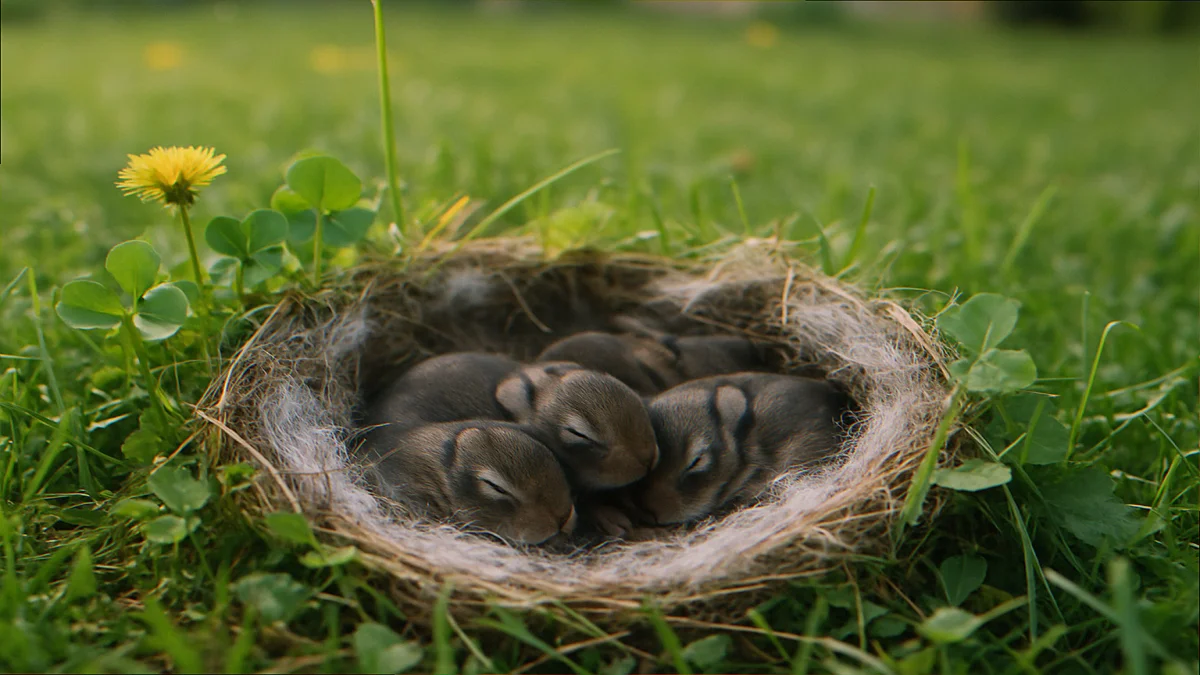
An eastern cottontail nest is the most under-camouflaged thing in the suburban yard and the most overlooked at the same time. The female digs a shallow depression no deeper than four inches and barely wider than a softball. She lines it with dry grass clippings and lays in a tuft of fur she pulls from her own belly. Then she pulls the loose grass back over the top so it looks like a small patch of slightly raised, slightly dead lawn. From standing height, it reads as a thin spot. From the lawn mower deck, it reads as nothing at all.
FREE: Wildlife Garden Starter Guide
Get our 12-page PDF with the 25 best plants for pollinators, simple habitat tips, and a printable checklist — all 100% free.
No spam. Read our Privacy Policy.Cottontail nests get built in open turf because grass-and-fur insulation works better than burrow systems for a litter that will only stay put for three weeks. Wood-edge corners, the base of a deck post, the gap behind the AC condenser, the open middle of the back lawn. None of these are bad picks. They are deliberately spread-out picks that reduce the chance any single predator finds more than one litter per season. A doe will have three to four litters between March and September, and she rarely uses the same spot twice.
The nest you find this week probably has between three and seven kits in it. Newborns are thumb-sized, deaf, and blind, with closed pink eyelids and barely any fur. By day seven their eyes open and the fur starts to color in. By day fourteen they look like miniature versions of the adults, fully furred and capable of short hops if startled. By day twenty-one they leave on their own. And at that point they are independent, eating greens, and using the broader yard as cover.
Why Mother Rabbits Disappear All Day (And Why That Means She Is a Good Mom)
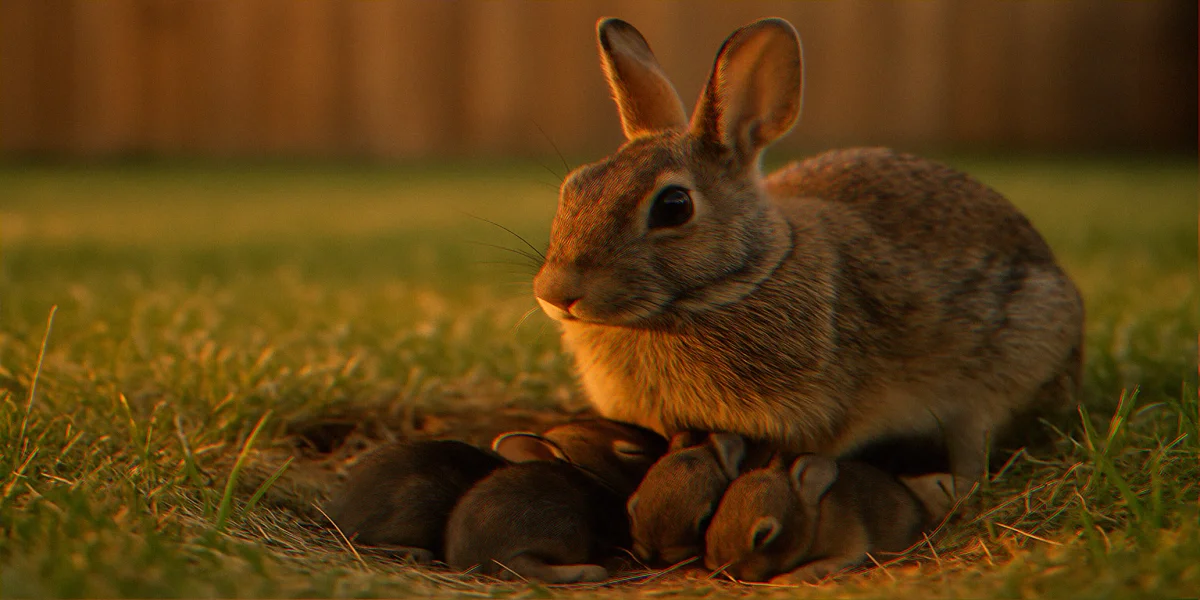
The single most common reason a homeowner moves a cottontail nest is the assumption that the mother is missing. She is not missing. She is deliberately avoiding the nest because her presence draws predators. Adult cottontails carry a strong scent that attracts foxes, coyotes, raccoons, hawks, and free-roaming cats. Kits do not produce that scent until they start eating solid food at around three weeks. The mother’s whole strategy is to break the scent trail by feeding twice a day in 60-second bursts and then leaving immediately.
This is so counter to how mammals are supposed to behave that state wildlife extensions get most of their cottontail intakes from well-meaning people who assumed the litter was orphaned. Most are not. A wildlife biologist at the North Carolina Wildlife Federation put it bluntly in a 2024 spring advisory: wild parents can’t hire a babysitter, so most young animals spend a lot of time on their own well before they can fend for themselves, and when the mother returns, sometimes many hours later, she expects to find her young where she left them.
What this means practically: if you find a nest at 11 a.m. and you check it at 4 p.m. and the kits still appear warm and quiet, the mother is doing her job. If they are cold to the touch, audibly crying, or have visible fly eggs, that is when you call a licensed rehabber. Otherwise, walk away.
How Long Will the Nest Be Active?
From the moment you spot it, count 21 days as the upper bound. Most cottontail kits leave between day 18 and day 24, depending on the litter and the weather. There is no consensus way to age a nest you just found, so the safe assumption is 21 days from today regardless. Below is the rough weekly progression for an average litter:
| Week | Kit appearance | What’s happening in the nest | Mow buffer |
|---|---|---|---|
| 1 (days 1–7) | Pink, deaf, blind, thumb-sized | Mother nurses 1–2x/day, brief visits at dawn/dusk | 10 ft minimum |
| 2 (days 8–14) | Eyes open, fur darkening, ear length doubles | Kits begin to thermoregulate, still nursing | 10 ft minimum |
| 3 (days 15–21) | Fully furred, hopping inside nest, palm-sized | Last nursings, sampling grass at the rim | 5 ft, expect early departures |
| 4 (day 22+) | Out of the nest, scattered in yard cover | Independent, weighing about 4 oz | Resume normal mowing |
The reason the buffer matters so much is that the nest is essentially indistinguishable from the surrounding turf right up until you are standing over it. A push mower deck running at 3 inches will clip the grass roof off entirely. A rotary blade running at 2 inches will hit the kits themselves. Even a string trimmer 18 inches away will throw debris that breaks the camouflage and exposes the litter to crows and jays. The second most common cause of nest loss after mower strikes.
The 21-Day Mow-Free Plan: Week by Week
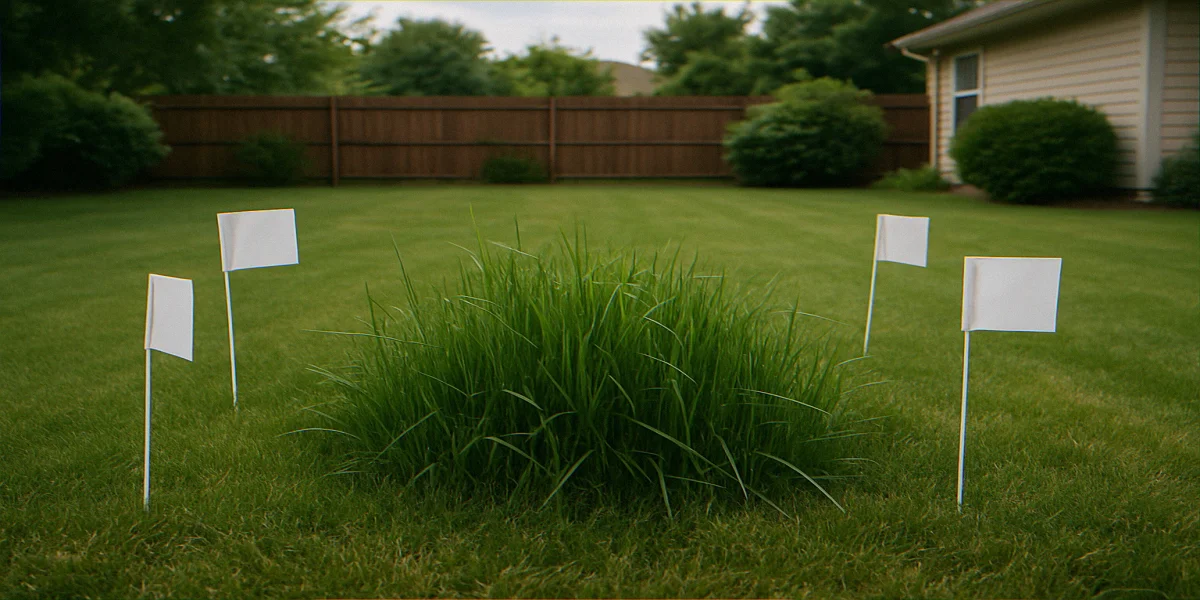
Most homeowners I know who navigate this well do not actually skip mowing the whole lawn. They mow everything except a roughly 12-foot circle around the nest, and they tell the neighbors what they are doing so it reads as intentional rather than neglectful. Here is the rhythm that works:
- Hour 0. Mark the nest perimeter. Place four garden flags or stakes in a square about 6 feet out from the nest center. Step back. Take a phone photo of the entire scene from the spot you usually mow from, so you can find the perimeter again next week when the grass is taller and the visual cues have changed.
- Day 1. Mow the rest of the yard. Cut everything outside the staked area at your normal height. Approach the boundary slowly. When the deck reaches the flags, lift, turn, and continue around. Do not back-cut into the buffer.
- Day 1, evening. Set the tic-tac-toe markers. Use thin twigs, a few strands of dry grass, or dental floss laid in a loose # pattern directly over the fur layer. Do not weight it down. Do not touch the kits.
- Day 2, morning. Check the markers. If the # is broken, scattered, or shifted to one side, the mother visited overnight and the nest is active. Re-set the markers. Repeat every morning for the first week.
- Day 7. Inspect from a distance. Stand 15 feet away and look at the nest with binoculars or a phone zoom. Kits at day 7 should have darkening fur and visible movement. Do not lift the grass cover. If you cannot see movement at all, set the markers tighter and check again in 24 hours.
- Day 14. First close inspection. Now you can briefly lift the cover. Kits should be furred, eyes open, palm-sized. Replace the cover exactly as you found it within 30 seconds.
- Day 18–21. Watch for evacuation. You may see kits hopping at the nest rim at dusk, sampling clover or plantain. The nest is nearly done. Reduce the buffer to about 5 feet to discourage them from settling permanently in the spot.
- Day 22. Resume mowing. If the nest is empty (no kits, no movement, the fur layer flattened or scattered), the litter has dispersed. Mow the buffer at your normal height. You will not see them again at that spot.
This works because cottontail nesting is one of the few wildlife events where the timeline is short, the rules are clear, and the right action is mostly to do nothing. Three weeks of an uncut 12-foot circle is the entire ask, and the lawn recovers in two mows.
The Tic-Tac-Toe Test: How Do I Know the Mother Is Still Coming Back?
The single most useful technique I have seen for verifying an active nest is the tic-tac-toe test, which the House Rabbit Society and most state wildlife agencies now recommend. Cross two thin twigs or two strips of yarn over the nest opening in a # shape, set lightly so any visit will disturb them. Check at sunrise. If the pattern is broken, shifted, or scattered, the doe visited. If it is undisturbed for two mornings in a row, the nest may be abandoned and that is when you call a licensed wildlife rehabilitator.
One caution: dew, wind, and curious dogs can all disturb a twig marker too. That is why two clear mornings are the bar, not one. And the marker itself must be light enough that it actually gets moved by a 2-pound rabbit slipping in and out, so this is not a job for branches. Think pencil-thin sticks or 4-inch lengths of waxed floss.
What the test cannot tell you is the kits’ health. Healthy newborn cottontails are silent, warm, and round-bellied. Cold kits, audibly distressed kits, kits with visible injuries from a mower or pet, or kits with fly eggs around the eyes or mouth need immediate professional help. In every U.S. state, possession of wild rabbits without a permit is illegal, so the right move in those cases is your state’s licensed wildlife rehabilitator, not a home rescue attempt. Cottontail kits have a mortality rate above 90% in well-meaning amateur care, almost all from improper formula, stress, or hypothermia.
What If My HOA Demands the Lawn Be Cut This Weekend?
This is the part of the conversation that gets uncomfortable, because the honest answer is that you may need to push back on a covenant for three weeks, and HOA boards are not famous for nuance about wildlife. The legal reality in most of the United States is that the eastern cottontail is a state-protected game species, and disturbing an active nest can technically violate state wildlife code even when the nest is on private property. Whether that protection rises to the level of overruling your HOA’s mowing schedule depends entirely on your state and your covenant. But it gives you a real, named lever to use in writing.
The script that has worked for the gardeners I know goes like this: a short email to the property manager that includes (a) the date you discovered the nest, (b) a photo of the marked area, (c) a sentence citing the state wildlife agency’s mow-free recommendation, and (d) a specific end date 21 days out when you will resume normal maintenance. Most HOA boards back off when there is an end date and documentation. The ones that do not are usually the same ones who send letters about native plant gardens generally, and a similar communication strategy works.
If you want to soften the optical hit while the buffer sits uncut, you can do what I did one June: drop a single white-painted decorative garden stake at each corner of the 12-foot buffer. From the curb it reads as an intentional design choice, not a missed mow. The same trick that HOA-friendly curb appeal relies on for native beds works just as well for a temporary wildlife buffer.
Cats, Dogs, and Lawn Service Crews: The Three Real Threats
The mower is not the only risk during the 21-day window. The order of practical threats most homeowners face, ranked by likelihood:
- Lawn service crews. If you do not own the mower, the person operating it has not been briefed. Call or text the company the morning before service is scheduled. Tape a printed sign to the gate that reads “Active wildlife nest. Please skip back lawn this visit.” Do not assume verbal instructions get passed to the crew that actually arrives.
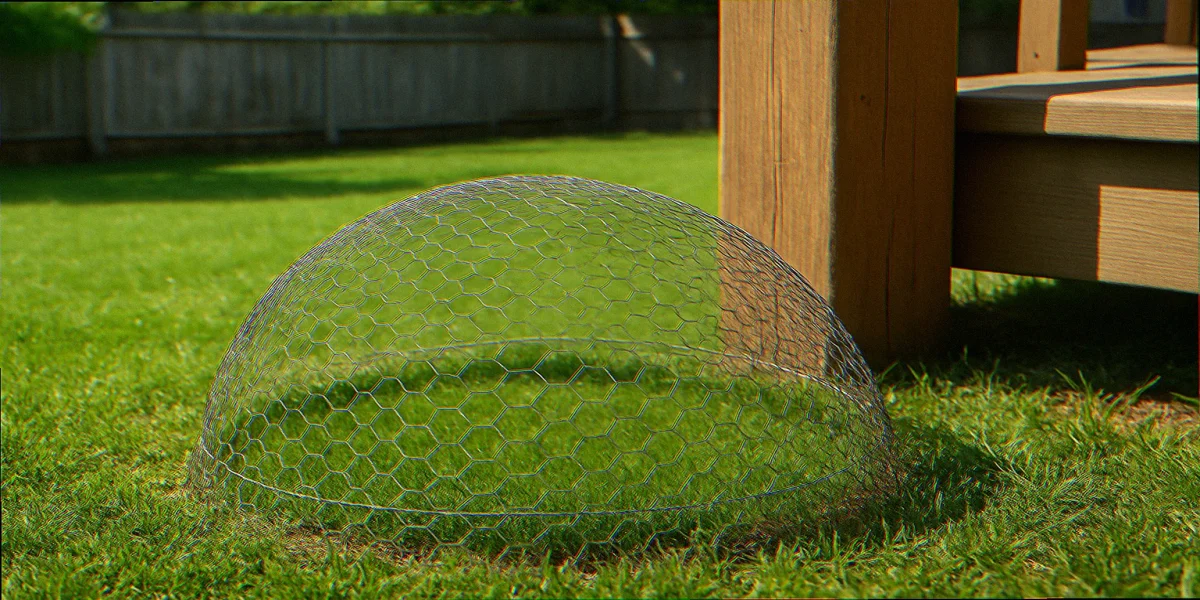
- Outdoor cats. Free-roaming and feral cats are the single largest predator of cottontail kits in suburban yards. A nest in the middle of an open lawn is functionally a feeding station for the neighborhood. The simplest deterrent is a wire mesh dome (chicken wire bent into a 2-foot arch) placed over the nest during the day and removed each evening before dusk. Hardware cloth with 1-inch openings is enough to keep cats out while letting the mother in.
- Family dogs. Even gentle, well-trained dogs follow scent. The cottontail mother’s brief visits leave just enough trail that an off-leash dog can locate a nest in minutes. For three weeks, leash the dog when the yard is the only option, or block the buffer area with portable garden fencing. Inflated curiosity does as much damage as outright predation. Kits chased out of the nest early do not survive.
None of these defenses need to be permanent. A folded laundry basket weighted with a brick works as a daytime cat barrier in a pinch. A 4-foot length of plastic garden border bent into a half-moon discourages dogs without trapping the mother. The whole apparatus comes up on day 22.

When You Can Resume Normal Mowing (Without Hurting the Kits)
The clearest sign the nest is empty: the grass-and-fur cover is flattened, scattered, or gone entirely, and you cannot detect any movement at dawn or dusk for two days. Cottontail kits at three to four weeks leave the nest as a group, usually within the same 24-hour window, and they scatter to nearby cover. A brush pile, the base of a hedge, the gap under a deck. They do not return.
Once you are confident the litter has dispersed, mow the buffer at your normal height. The first cut will look ragged because the grass has had three weeks to grow unchecked, but a second mow at standard schedule restores the look. You can also rake out the fur and dry grass from the nest depression at this point. It will compost into the lawn within a few weeks.
Some homeowners use the moment to expand habitat that will keep the next generation of kits closer to safe cover. A brush pile in the back corner of the yard doubles as a fledgling hideout for cottontails, song sparrows, and toads. So does a section of unmowed wildlife corridor along a fence line. The cottontail you protected this spring is unlikely to nest in the same spot next year, but her offspring may, and a yard with hidden structure gives them better odds.
If you want to take the long view, plant a few low-growing native shrubs at the back of the lot. Gray dogwood, ninebark, fragrant sumac. And accept that the next nest will probably show up there instead of the open lawn. Cottontails are flexible. They use what is available. Give them slightly better cover and they will use it.
The Other Side: When You Actually Want Fewer Rabbits
This is worth saying directly because the same gardener who is protecting a nest in May is often the gardener who lost a row of native asters to rabbits in August. The two truths are not in conflict, but they can feel like it. Protecting a nest is a 21-day commitment to one specific litter. It is not a year-round pledge to feed the population.
If you want to keep rabbits away from vegetable beds and ornamental plants the rest of the season, the strategies that work are fencing, plant choice, and timing. None of which conflict with the nest protocol. You can have a wildlife-friendly back lawn and a fenced front bed in the same yard. You can choose native plants that deer and rabbits skip for the curated beds you actually care about, and let the open turf serve as nursery space for three weeks.
The framing that helps is to think of the yard the way a wildlife biologist thinks of a property. As a mosaic of zones with different rules, not a single rule applied uniformly. Twelve feet of unmowed turf for three weeks is one zone. The fenced raised beds are another. The native shrub border is a third. The cottontails, the pollinators, and the gardener all get what they need without trading off.
What the Mow-Free 21 Days Buys You
The reward for the buffer is not visible right away. You will not see the doe. That is the whole point. What you will see, sometime around day 19 to 22, is a single furred kit hopping along the lawn edge at dusk. Then another. Then for a few weeks afterward, half-grown rabbits will appear at the base of your shrubs at first light, and you will watch them stretch out in patches of clover while the rest of the yard goes about its morning. That is the payoff.
It is also the payoff that a lot of gardeners forget they are working toward when the weekend chore list takes over. The “homegrown national park” idea works when the wildlife is allowed to actually live there. Three weeks of restraint per litter is a small price for that. The lawn will recover. The kits, if you mow over them, will not.
If this is your first nest, take the photo, set the flags, write the email to the HOA, and let the doe do her work. Cottontails have been raising kits in open turf for the entire history of the eastern grasslands. You are not in their way for very long.
FAQ
Should I feed a baby cottontail I find alone in my yard?
No. Wild cottontails are nearly impossible to hand-rear and most attempts kill the kit through aspiration pneumonia, improper formula, or stress. If the kit is fully furred, has open eyes, and is about the size of a tennis ball, it is old enough to be on its own and the mother is no longer attending. Leave it. If it is smaller, cold, or visibly injured, contact a state-licensed wildlife rehabilitator the same day. Do not offer water, cow’s milk, or kitten formula.
How can I tell if a cottontail nest is abandoned?
Place two thin twigs or two pieces of waxed dental floss in a tic-tac-toe pattern directly over the nest in the evening, set lightly so any visit disturbs them. Check at sunrise. If the pattern is broken or shifted, the mother visited. If it is undisturbed two mornings in a row, the nest may be abandoned and that is the threshold for calling a licensed rehabber. Healthy kits are warm, quiet, and round-bellied; cold or audibly distressed kits need help immediately.
Can I move the rabbit nest to a safer spot in my yard?
No, and this is the most common mistake homeowners make. Cottontail mothers locate the nest by scent and memory of the exact spot, and a relocated nest reads as a lost nest. Even moving it three feet can cause her to abandon the litter on her next visit. The correct action is to leave the nest where it is, mark a 10-to-12-foot buffer around it, and adjust your mowing for 21 days. If construction or a hazard makes the original spot truly unsafe, contact your state wildlife agency before touching it.
Why is the mother only visiting the nest at dawn and dusk?
It is a predator avoidance strategy. Adult cottontails carry a strong scent that attracts foxes, raccoons, hawks, and outdoor cats; newborn kits do not. By visiting only twice a day for two to three minutes, the mother breaks the scent trail leading back to the nest. This is the opposite of how cats and dogs raise young, which is why it feels like neglect to most people. It is not. It is what a successful cottontail mother is supposed to do.
How long until I can mow the buffer area normally again?
Plan for 21 days from discovery. Cottontail kits leave the nest at three to four weeks old. The clearest sign the litter has dispersed is a flattened or scattered fur cover with no movement at dawn or dusk for two consecutive days. Once you confirm the nest is empty, you can resume normal mowing height. The grass will look ragged for the first cut but recovers within two mows at your regular schedule.
Want More Wildlife Garden Tips?
Join 5,000+ nature lovers getting our weekly tips on creating wildlife-friendly gardens.
No spam, unsubscribe anytime. Privacy Policy
Emma Harrington
Emma Harrington is a wildlife habitat researcher and content editor with a passion for backyard conservation. She has spent over a decade translating ecological science into practical tips anyone can follow — from selecting native plants to building wildlife-friendly habitats. Her work focuses on helping homeowners transform ordinary yards into thriving ecosystems for bees, butterflies, hummingbirds, and other beneficial wildlife.