
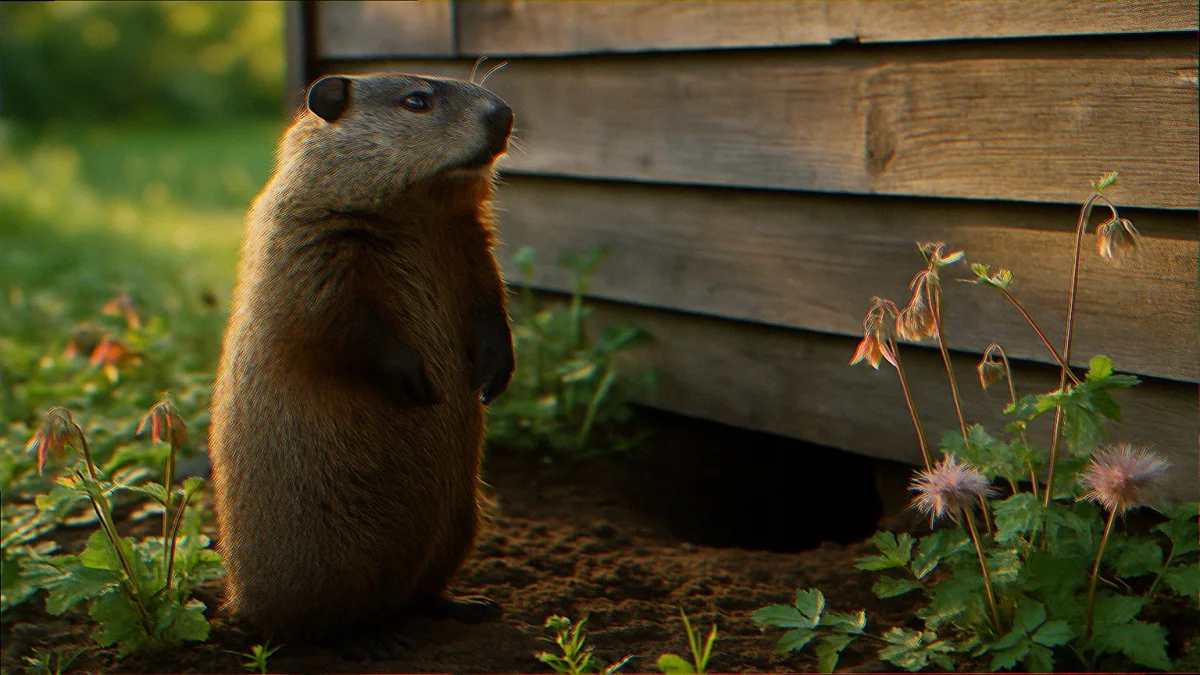
Groundhogs can be kept out of a native garden without trapping by combining a buried-L hardware-cloth fence, a cover audit at burrow entrances, and a rotating scent deterrent within the first three weeks of damage. Most defenses fail because they target jumpers; groundhogs climb and dig instead. Once the fence bends outward underground and arches inward at the top, the same animal that flattened your bed last week walks past.
Quick answer. Build a 36-inch tall, half-inch hardware-cloth fence with the bottom 12 inches bent into an L lying outward under the soil and the top 12 inches angled inward at a 30 degree slope. Audit every brush pile, woodpile, and deck skirt within 50 feet for burrow access and seal the openings with 14-gauge wire mesh. Apply a weekly rotation of capsaicin spray, then predator urine, then garlic to confuse scent imprinting. Three weeks of consistent pressure usually pushes the groundhog to a different yard.
A reader emailed last month after a single overnight visit shaved a six-month-old bed of Aronia melanocarpa, native columbine, and prairie smoke down to nubs. She had inherited the burrow under the porch from the previous owner and had been told groundhogs were harmless field rodents. They are not, and a sub-adult woodchuck in June can clear two pounds of vegetation a day to put on the fat it will live off through hibernation. Native plants in their first year are exactly the soft, nitrogen-rich tissue that groundhogs target before the wild forage hardens off. The damage you found this morning was preventable, and the next round is preventable, but only if the defense matches the actual climbing-and-digging behavior of the animal.
How do I know it was a groundhog and not a rabbit or deer?
Groundhog damage carries a signature that almost nothing else in a backyard produces. The plants are cropped clean to the ground, often within a single one-to-three-foot arc radiating out from a burrow entrance or a fence-line gap. The cut is ragged rather than slicing, because groundhogs use a combination of upper incisors and side molars to tear and crush, not the clean 45 degree razor cut you see from a cottontail. Whole stems vanish along with foliage; rabbits typically leave a one-to-two-inch stub, while a groundhog will eat the stub.
FREE: Wildlife Garden Starter Guide
Get our 12-page PDF with the 25 best plants for pollinators, simple habitat tips, and a printable checklist — all 100% free.
No spam. Read our Privacy Policy.Scat is the other reliable signal. Groundhog droppings are dark brown pellets roughly half an inch long, slightly tapered at one end, often deposited in a latrine spot near the burrow entrance rather than scattered through the foraging area. Rabbit pellets are round, pea-sized, and scattered everywhere a cottontail sits. Deer pellets cluster in groups of fifty or more and have a dimpled end.
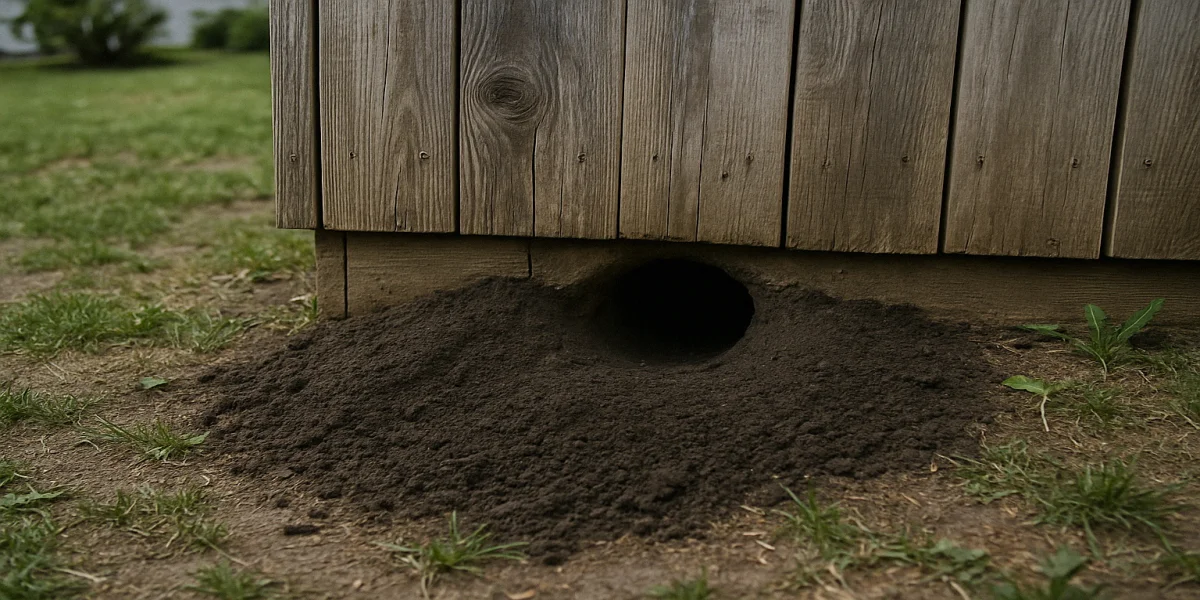
The third tell is the burrow itself. A main entrance is six to twelve inches across, surrounded by a fan of fresh soil, and usually faces south or east on a sloped, well-drained piece of ground. Secondary plunge holes are two to four inches across with no soil fan because the animal dug them from the inside out. If you find a six-inch hole at the corner of your shed and a smaller hole twenty feet away near the woodpile, you are looking at the front and back doors of the same burrow.
Time of damage also matters. Groundhogs are diurnal and feed most heavily between sunrise and 10 a.m., then again from late afternoon until dusk. A bed that looked fine at 8 p.m. and is destroyed by 7 a.m. was visited at dawn. A bed that is shaved between 5 p.m. and dusk was hit on the second feeding window. Rabbits work the same dawn-and-dusk shift but rarely take whole stems; deer hit overnight and leave torn, frayed cuts. The species verification matters because the fencing strategy and scent rotation differ for each. Mix them up and you waste the season.
Why your June bed looks like a buffet to a groundhog
Groundhogs hibernate from about October through late February in most of the temperate United States. They emerge in March at roughly two-thirds of their fall weight, and they have until October to recover that body fat and then add the surplus that gets them through the next winter. June is the peak. Sub-adults are also dispersing from natal burrows during this window and are scouting for territory, which means a yard that did not have a resident groundhog last year can pick one up this year without warning.
What looks to a homeowner like a beautiful new bed of native plugs looks to a groundhog like a buffet of tender, high-protein, low-defense forage in a single concentrated patch. Greenhouse-grown plugs have produced almost none of the bitter alkaloids, terpenes, and tannins that adult native plants rely on for chemical defense. The plants were fertilized to push rapid spring growth, so the foliage is high in nitrogen and water. The root system is shallow, so even if the top is browsed, the regrowth comes in tender again. Adult wild forage in the surrounding meadow or woodland edge has already toughened up by mid-June and is far less appealing. Your bed is the high-value target by simple comparison.
The other variable is cover. Groundhogs forage within roughly fifty yards of a burrow entrance, and they do not like to cross open lawn during full daylight because hawks and coyotes use that sight line. If your bed sits within fifty yards of a burrow and there is a brush pile, a wood stack, a deck skirt, or a dense ornamental shrub bridging the distance, the animal has a covered approach. Remove the cover and the foraging arc shrinks dramatically. This is why the fence alone rarely works; the cover audit is what makes the fence effective.
The buried-L hardware-cloth fence, built right
A standard vertical fence does not stop a groundhog. The animal will either dig under it within two nights or climb over it within thirty seconds. The buried-L pattern addresses both behaviors with a single piece of mesh.
Use half-inch galvanized hardware cloth in 48-inch height. A 25-foot roll runs about $58 at the big-box stores and covers a 22-foot bed perimeter once you account for the bent L at the bottom. Quarter-inch is overkill for groundhogs and far more expensive; chicken wire is too soft and gets bent open in a single night. Stick with the half-inch.
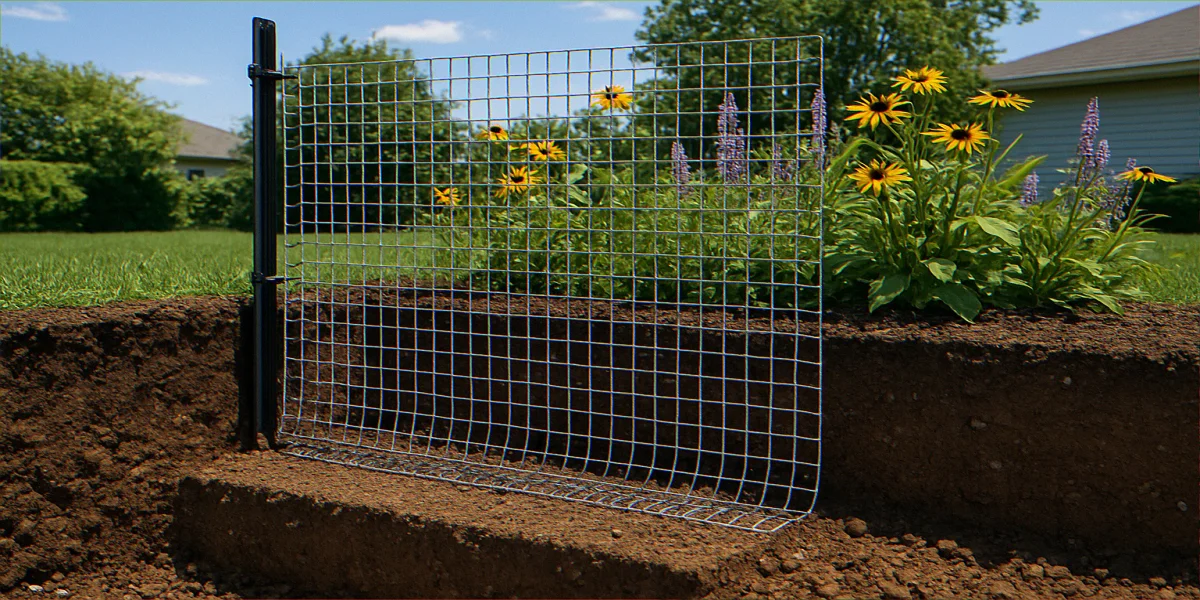
Dig a six-inch deep, twelve-inch wide trench around the perimeter you want to protect. Bend the bottom 12 inches of the mesh into a 90 degree L so that the foot of the L lies flat under the soil pointing outward, away from the bed. This is the dig-stop. When the groundhog noses up to the fence and starts digging, its claws hit the horizontal mesh under the soil before it has tunneled deep enough to come up inside the bed. The animal does not understand fences as engineering; it understands them as obstacles, and a horizontal underground obstacle reads as “this direction does not work” within a few minutes of trying.
The vertical portion of the fence stands 30 inches above grade. The top 12 inches of that vertical run gets bent inward toward the bed at roughly a 30 degree angle. This is the climb-stop. A groundhog climbing a vertical fence reaches the angled overhang, has nothing to grip on the underside, and falls back. The angled top does the work a foot of additional vertical height would not, because the animal can climb 36 vertical inches but cannot navigate the inverted geometry.
Anchor the vertical section with steel T-posts every six feet. Pound the post on the outside of the fence so the groundhog cannot use the post as a climbing aid. Secure the mesh to the post with hog rings or 14-gauge tie wire at the top, middle, and bottom. Avoid plastic zip ties on a permanent fence; they degrade in two seasons under UV and the fence comes loose. The hog ring tool costs $18 once and saves you the rebuild.
For tight beds where a full perimeter fence is overkill, individual plant cages work but must be tall and weighted. Build a 36-inch tall cylinder of half-inch hardware cloth, 18 inches in diameter, with a flat hardware-cloth disk wire-tied across the top. A cylinder without a top gets climbed and the animal sits on the rim chewing down. The pattern is the same one explained in Stop Rabbits From Eating Native Plant Seedlings but scaled up in height and bottom-flared because groundhogs are heavier and rabbits do not climb.
Which scent and motion deterrents actually push groundhogs out?
The country lore on groundhog deterrents is mostly wrong. Mothballs are toxic to wildlife and to soil microbes, and groundhogs ventilate burrows efficiently enough that the naphthalene smell dissipates within hours. Human hair in a stocking is folklore that does not survive a single rainfall. Ammonia-soaked rags work for about three days before the animal habituates. These are not solutions; they are placebos.
The real scent rotation rests on three families of deterrent applied in sequence so the animal cannot habituate to any one of them. Capsaicin sprays burn the soft tissue around the nose and mouth and create a one-week aversive memory. Predator urine, specifically coyote and fox concentrate, triggers an innate fear response in groundhogs that did not grow up around the predator. Garlic-and-egg sprays carry a sulfur signal that groundhogs interpret as decomposing carrion and avoid for about a week before adapting.
Week one, apply a capsaicin-based commercial spray along the fence line and on the lower 12 inches of the bed-edge plants. Reapply after any rainfall over a tenth of an inch. Week two, switch to predator urine concentrate. Apply on the outside perimeter only, never on the plants themselves. The smell up close is unpleasant for humans too, so dose the fence post bases and the brush-cover edges, not the bed. Week three, switch to a garlic-and-egg solid spray. Sold at most garden centers under brand names ending in “-stopper.” Apply on bed-edge plants and on any soil mounds where the groundhog has been digging.
Track the rotation with a wall calendar in the garage, the same way you would track a tomato-blight spray. Miss a week and the animal will probe the perimeter for gaps within 48 hours. Three full rotation cycles is usually enough to push the groundhog to a different yard, because the cumulative signal reads as a dangerous, unpredictable, predator-rich territory.
Motion deterrents add another layer. Solar-powered motion-activated sprinklers cost $35 to $60 and put out a two-second burst of water at any heat-and-motion signature within twenty feet. Aim two of them across the most-used foraging path. The water itself is harmless; the surprise is what registers. Set the sensitivity to medium so squirrels and small birds do not trigger it constantly and run down the battery. Pair the sprinkler with a solar-powered ultrasonic stake that emits 25 to 65 kilohertz pulses on motion trigger. The combination of cold water and unpleasant frequency is something groundhogs do not generalize against, because they have no evolutionary template for either.
Avoid the high-decibel “scarecrow” sirens. They violate noise ordinances in many municipalities, antagonize neighbors, and groundhogs habituate to a repeating sound in three to four days. The principle of effective deterrence is unpredictability, not volume.

Should you live-trap and relocate the groundhog?
The short answer is usually no, and the reasons are legal, ecological, and practical.
Most state wildlife codes restrict relocation of mammals out of concern for disease transmission, range-edge competition, and the survival outcomes of relocated animals. Pennsylvania, Ohio, New York, Michigan, Virginia, and most of New England require either a permit or a specific lethal-control authorization for trapping nuisance groundhogs, and relocation to public land is illegal in most cases. Check your state wildlife agency before you buy a trap. The fines for unpermitted relocation can run several hundred dollars per animal.
The ecological case against relocation is that adult groundhogs released into unfamiliar territory in summer have a mortality rate above 70 percent within six weeks, according to peer-reviewed work summarized by the Penn State Extension woodchuck management guide and broader translocation research on small mammals. Survivors displace resident groundhogs and trigger territorial conflict, which spreads disease and depresses recruitment in both populations. You are not “saving” an animal by relocating it; you are usually killing it slowly through starvation, road strike, or predator pressure.
The practical case is that an empty burrow gets re-occupied. Groundhog dispersal is heavy in June and again in late summer. If you trap and remove the resident, a sub-adult moves in within two to six weeks because the burrow infrastructure is the prize, not the territory. You will spend the rest of the season trapping a series of animals without addressing why the location is attractive. The buried-L fence and cover audit prevent re-occupation. Trapping does not.
The exception is a documented health-and-safety hazard. A burrow under a load-bearing slab, a horse pasture where a foot strike would injure the animal, or a foundation footing showing visible undermining warrants escalating to a licensed nuisance wildlife operator. They will handle the trap, the disposition, and the permit paperwork legally. Expect to pay $200 to $500 per visit and to need a separate exclusion job afterward. The combined cost is usually higher than the buried-L fence and is not a one-time fix.
When the burrow is under a shed, deck, or foundation
A burrow under structure is the most common reason homeowners escalate to a wildlife removal company, and it is also the case where exclusion alone solves the problem, no trapping required, if you do the steps in the right order.
First, confirm the burrow is currently occupied. Loosely stuff each entrance with crumpled newspaper at dusk and check at noon the next day. If the newspaper is pushed out from inside, the burrow is occupied. If it is undisturbed for three consecutive days, the burrow is vacant.
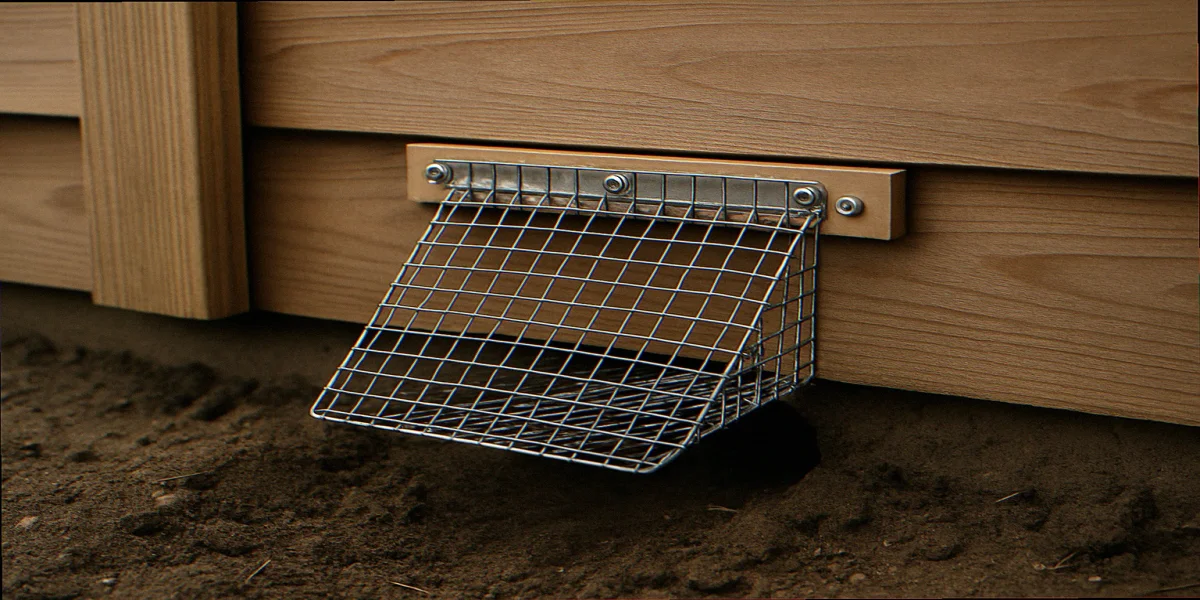
Second, only after confirmed vacancy, install one-way doors over every entrance. A one-way door is a hinged 14-gauge wire flap mounted over the entrance so an animal can push out but cannot push back in. The cheapest option is the “Tomahawk excluder” style at about $42. Mount it with the flap angled slightly downward so the animal’s exit motion forces it open and the flap drops closed behind. Leave the doors in place for seven full days to allow any animal still inside to leave and to prevent re-entry by a different individual.
Third, after seven days, replace the one-way doors with permanent exclusion mesh. Use 14-gauge welded wire panels, buried 12 inches deep around the perimeter of the structure and extending up to the structure skirting. The same buried-L principle applies: the bottom edge of the mesh bends outward under the soil so a new digger hits horizontal obstruction within two inches of starting.
If the structure is a shed or deck with a hollow underside, you can also fill the void after exclusion with two-inch crushed stone to a depth of six inches. The crushed stone removes the void that made the spot attractive in the first place, so even if a future animal breaches the perimeter mesh, there is no longer a hollow to occupy. This is the layered approach that holds up over years and survives owner inattention. The same logic of permanent infrastructure over seasonal vigilance is what makes a properly built brush pile a long-term wildlife asset rather than a maintenance burden.
The mistake people make is filling the burrow with concrete or rocks while the animal is still inside. This is illegal in most states under animal cruelty statutes, traps the groundhog to die slowly, and creates a decomposition smell under your shed for weeks. Do the vacancy check first, every time.
How to defuse the HOA complaint about burrow holes
The same neighbor who tolerates a perfectly manicured pollinator garden will file a complaint within a week of seeing a six-inch hole at the edge of the lawn. Burrow openings read as “abandoned property” to people whose mental model of a yard is mowed turf with hostas, and the HOA letter is real and exhausting. The defense is the same one that works for caging beds and signage on native plantings: make the work look intentional and document it on paper before the neighbor calls.
The first move is to clean up the soil fan immediately. A six-inch burrow ringed by a two-foot half-moon of bare loose dirt reads as a wildlife hazard. Rake the soil flat back into a thin layer, top it with a one-inch ring of dark pine straw, and the eye stops noticing. The burrow is still there, but the visual signal changes from “uncontrolled wildlife” to “garden feature being addressed.” This buys you the time to do the actual exclusion work without a complaint accruing.
The second move is documentation. Print a one-page summary that says “Pollinator habitat: woodchuck exclusion in progress, completion date July 15, 2026” with a small map showing the affected area and the planned fence line. Slip it into your neighbor’s mailbox before they call the HOA. The complaint usually does not happen if the neighbor has been informed in writing in advance, because they have nothing to escalate. The same logic applies in the workflow described in HOA Sent a Letter About Your Native Garden? Do This for the broader case of HOA pushback on native plantings.
The third move is the long game. Cover-up landscaping that screens the burrow exclusion zone from the street works after the fact. A row of native viburnum or chokeberry along the property line breaks the sight line within two seasons. A salvaged stone bench at the bed edge reads as “garden feature” rather than “wildlife control zone.” The combination of exclusion infrastructure plus visual screening is what holds up over years.
If a letter does arrive, respond in writing within 48 hours with the documented exclusion plan, the completion date, and the legal status of the work. HOAs are not allowed to forbid lawful pest exclusion. The letter will end the issue if you treat it as a paperwork transaction rather than a personal conflict. The same principle of curb-appeal management is what the HOA-friendly curb-appeal design playbook applies to general native plantings.

What three weeks of consistent defense actually looks like
Most groundhog defense fails because the homeowner gives up in week two when the damage continues. The animal is testing the perimeter for the first three weeks and will not visibly stop until it has confirmed that every angle of approach has failed.
Week one is the build week. Buried-L fence around the priority bed. Cover audit and removal of brush piles, wood stacks, and dense ornamental shrubs within fifty feet of the bed. First capsaicin spray on day one. Damage will continue, often visibly worse, as the animal probes for fence gaps. This is normal and is not a failure of the strategy.
Week two is the rotation week. Switch to predator urine on the perimeter. Walk the fence line every morning and look for digging marks at the base of the mesh. Any spot showing more than two inches of disturbed soil gets a 12-inch wide horizontal mesh patch wire-tied to the existing fence. Damage to the bed should drop by about half this week if the fence is built correctly. If it is not dropping, the cover audit was incomplete; re-check for unscreened approach paths.
Week three is the consolidation week. Switch the spray to garlic-and-egg. Install one motion sprinkler on the most-used foraging path. Check for new burrow plunge holes within fifty feet of the bed; a sub-adult dispersing through the area will dig new entrances rather than re-occupy the existing burrow. Seal any new holes with 14-gauge mesh after the vacancy check.
By the end of week three, an animal that has hit the fence five or six times, encountered three rotating scents, gotten sprayed by cold water once or twice, and found no cover-screened approach path will typically relocate to a different yard. The remaining work is maintenance: walk the fence monthly, refresh the scent rotation if you see fresh damage, and re-check the cover audit after any new construction or landscaping in the surrounding yards. The same monthly-walk discipline keeps the deterrence from collapsing into the same pattern explained for chronic browse pressure in How to Keep Deer Away From Your Garden.
For a deeper look at why first-year native plantings are the highest-risk window for any browsing mammal, the framework in Sleep, Creep, Leap: Understanding Your Native Plants’ Growth covers the underlying plant biology that makes the defense window finite.
Which native plants will groundhogs leave alone?
Not every plant in a native bed is at equal risk. Groundhog browse preferences track palatability, water content, and accessibility height, and certain species are reliably avoided. Plan the bed with that asymmetry in mind.
| Species | Groundhog risk | Notes |
|---|---|---|
| Asclepias tuberosa (butterfly weed) | High in year one | Latex defense undeveloped in plug; cage for first season |
| Echinacea purpurea (purple coneflower) | High | Tender top growth highly palatable through year two |
| Aronia melanocarpa (chokeberry) | High first year | Foliage browsed; bark intact after year two |
| Monarda fistulosa (wild bergamot) | Low | Aromatic oils deter browse at all life stages |
| Pycnanthemum muticum (mountain mint) | Very low | Menthol scent functions as scent barrier in the bed |
| Allium cernuum (nodding onion) | Very low | Onion volatiles deter browse |
| Solidago speciosa (showy goldenrod) | Moderate | Young shoots browsed; established plants ignored |
| Baptisia australis (blue false indigo) | Low | Alkaloid defense develops quickly |
| Eupatorium fistulosum (joe pye weed) | Moderate | Tall stems usually above feeding height by midsummer |
| Geranium maculatum (wild geranium) | Low | Tannins make it unpalatable |
A practical design move is to ring the priority pollinator species with a perimeter of mountain mint and nodding onion. The scent compounds from the perimeter species function as a passive scent barrier and reduce the rate at which groundhogs investigate the interior of the bed in the first place. This is documented in pollinator-garden trial work at university extensions and is also how Indigenous companion-planting traditions handled herbivory pressure for centuries. The same perimeter-defense logic is applied in the bed-edge design choices covered in 15 Deer-Resistant Native Pollinator Plants, which translates well to groundhog defense because the underlying chemistry deters both browsers.
Authoritative reference for plant palatability rankings, dispersal behavior, and exclusion best practices: the USDA APHIS Wildlife Damage Management program. State extension publications, especially those from Penn State, Cornell, and the University of Maryland, carry the most current peer-reviewed work on regional groundhog management and are the second-best resource if you need a specific local recommendation.
FAQ
How long does the buried-L fence last before it needs replacement?
A properly installed 48-inch half-inch galvanized hardware-cloth fence holds up for 8 to 12 years before the galvanized coating breaks down enough to allow rust through the wire. The first failure point is usually the soil-line junction where moisture is highest. Inspect that strip annually each spring and patch with a 12-inch tall strip of new mesh wire-tied over the corroded section. Vertical sections above grade typically last the full lifetime without intervention.
Do groundhogs come back to the same yard year after year?
The burrow infrastructure is the prize. A successfully excluded burrow does not draw the same animal back, but a vacant burrow within a hundred yards of yours will be re-occupied each spring by a dispersing sub-adult, and that new resident will probe your yard within its first month. The buried-L fence is what prevents re-occupation of the foraging area, not removal of the original animal. Plan the defense as permanent infrastructure rather than as a seasonal task.
Will fencing also stop rabbits and voles?
A half-inch buried-L hardware-cloth fence stops cottontail rabbits at the same time it stops groundhogs, because the mesh size is too small for kits to slip through and the buried L stops digging at the base. It does not reliably stop voles, which travel in surface runways under thatch and snow. For vole pressure, the cardboard-and-plug-spacing approach in Native Plant Seedlings vs Weeds: How to Tell Them Apart Before You Pull overlaps with vole runway disruption, and a tighter quarter-inch mesh at the soil line adds vole protection if your area has heavy vole activity.
What if I rent and cannot build a permanent fence?
The individual plant cage version of the buried-L is the workaround. A 36-inch tall, 18-inch diameter half-inch hardware-cloth cylinder with a flared 12-inch base sitting flat on the soil under one inch of mulch functions the same way as a buried fence on the perimeter scale. The bottom flare prevents digging; the height plus the wire-mesh top prevents climbing. The cylinder lifts out when you move and goes back together in five minutes. The cost is about three dollars in mesh per cylinder if you cut your own, which works out to roughly the price of one plug for the cage protecting it.
Is it safe to use cayenne pepper directly on the plants instead of buying capsaicin spray?
Yes for the plant. Maybe not for the pollinators. Cayenne dust burns pollinator feet, and bumble bees with capsaicin contamination on their leg hairs show measurable foraging-time reduction in trial work. The pre-mixed commercial capsaicin sprays use a much lower concentration with a sticker-spreader that adheres to the foliage and washes off the soil and the pollinator landing pads more cleanly. Stick with the labeled commercial spray during the pollinator-active months. If you really want a homemade version, brew cayenne tea, strain it twice through a coffee filter, and dilute to one teaspoon of strained liquid per quart of water, then apply only to bed edges and never on open flowers.
Want More Wildlife Garden Tips?
Join 5,000+ nature lovers getting our weekly tips on creating wildlife-friendly gardens.
No spam, unsubscribe anytime. Privacy Policy
Emma Harrington
Emma Harrington is a wildlife habitat researcher and content editor with a passion for backyard conservation. She has spent over a decade translating ecological science into practical tips anyone can follow — from selecting native plants to building wildlife-friendly habitats. Her work focuses on helping homeowners transform ordinary yards into thriving ecosystems for bees, butterflies, hummingbirds, and other beneficial wildlife.