
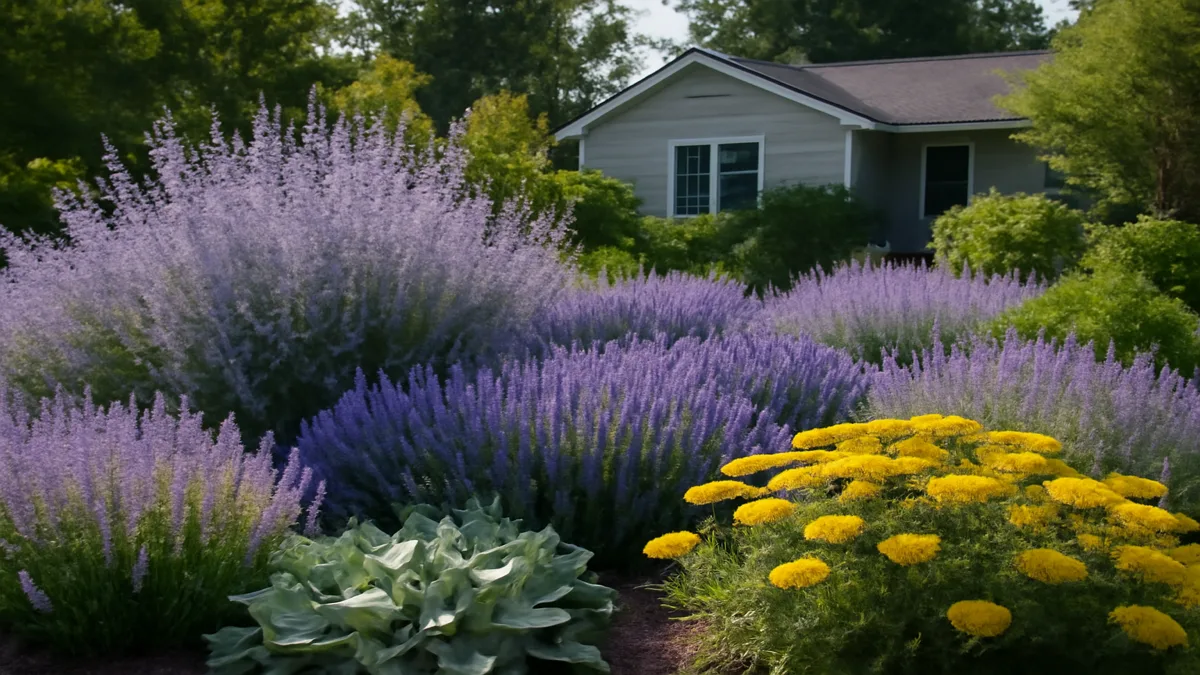
If you’ve been wondering how to keep deer away from your garden without resorting to a medieval-style moat or a shotgun strapped to a rocking chair, you’re in excellent company. Across the country, gardeners who spent years nurturing tomato plants, hostas, hydrangeas, and tulips are waking up to find their hard work reduced to chewed-off stubs overnight. Deer are beautiful animals. Nobody disputes that. But when a doe and her twins treat your vegetable patch like an open-air buffet, the romance wears thin pretty fast.
The frustrating truth is that deer are creatures of habit and remarkable adaptability. A single repellent, one tall fence panel, or a plastic owl propped on a fencepost might work for a week or two before the local herd figures out the trick. That’s why wildlife biologists and experienced gardeners swear by something called Integrated Pest Management. A fancy term that basically means layering multiple methods and rotating them so the deer never quite settle into a routine on your property.
In this guide, we’ll walk through eight proven strategies, from the bulletproof (literal 8-foot fencing) to the surprisingly clever (fishing line tricks that exploit deer’s poor depth perception). We’ll also cover deer-resistant plants that do half the work for you, commercial repellents worth their price tag, and a few well-meaning mistakes to avoid. Grab a cup of coffee. By the end of this, you’ll have a real plan your garden can actually live with.
FREE: Wildlife Garden Starter Guide
Get our 12-page PDF with the 25 best plants for pollinators, simple habitat tips, and a printable checklist — all 100% free.
No spam. Read our Privacy Policy.Why Deer Keep Coming Back (And Why One Trick Never Works)
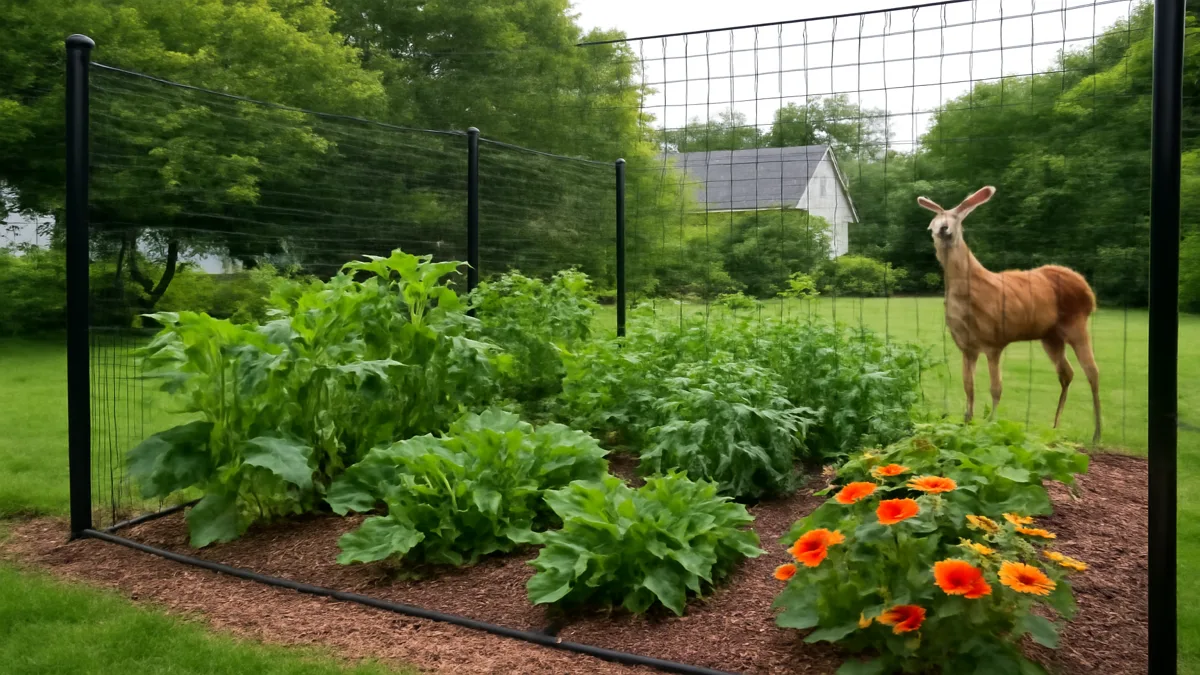
Before we dive into methods, it helps to understand your opponent. White-tailed deer and mule deer are intelligent, cautious, and they learn faster than most people give them credit for. Once a doe figures out that the rustling plastic bag tied to your fence isn’t actually a threat, she’ll bring her fawns back night after night and teach them to ignore it too.
This is the single biggest reason homeowners fail at deer control. They buy one product, install it, watch it work for ten days, and then get blindsided when the deer return with reinforcements. The United States Department of Agriculture’s wildlife services division has documented this habituation pattern for decades. Deer adapt to almost any stationary, predictable deterrent within two to four weeks.
“The most effective deer management strategy isn’t finding the perfect product. It’s rotating two or three good methods often enough that the deer never stop viewing your yard as unpredictable and potentially dangerous. A landscape of fear beats a landscape of fences, every time.”
Keep that idea in your back pocket as we go through these eight methods. None of them is a silver bullet on its own. But stack two or three together, rotate them every few weeks, and suddenly your garden becomes the one yard on the block the deer decide isn’t worth the trouble.
Method 1: Build a Fence That Actually Works
Let’s get the big one out of the way first. If you’ve got the budget and the space, a proper fence is the single most reliable way to keep deer away from your garden. But “proper” is doing a lot of heavy lifting in that sentence.
A vertical fence needs to be a full 8 feet tall to reliably keep deer out on flat ground. On sloped property, bump that up to 10 or 11 feet, because deer can use elevation to their advantage and clear lower fences like they’re hopping a garden hose. The bottom of the fence also has to be secured within 6 inches of the ground. Deer are surprisingly willing to crawl under a gap if jumping over isn’t an option.
Here are the fencing options worth considering, roughly in order from cheapest-but-trickiest to most expensive-but-most-effective:
- Invisible fishing line fence: Run 15-30 lb monofilament at 1.5 ft and 3 ft heights. Deer brush against it, can’t see what hit them, and spook. Cheap, nearly invisible, surprisingly effective for small gardens.
- Solid 6-foot privacy fence: Because deer won’t jump what they can’t see over (they fear blind landings), a solid wood or vinyl privacy fence can work at a shorter height than open wire mesh.
- 3D double fence: Two parallel 4-5 ft fences spaced 3-5 ft apart. Deer have poor depth perception and refuse to jump into the “trap” of the inner fence. Ingenious and affordable.
- Woven wire deer fence (8 ft): The gold standard. Polypropylene or metal mesh, professionally installed, lasts 15-20 years.
- Electric fence: 5-7 strands, 4,000-5,000 volts. Train deer by smearing peanut butter on small aluminum foil flags attached to the wire. One zap on the tongue teaches a lasting lesson.
Method 2: Motion-Activated Sprinklers and Sound Devices
If fencing isn’t in the cards, motion-activated deterrents are the next best thing. And arguably more fun. Products like the Orbit Yard Enforcer (sometimes sold as “Scarecrow”) and Havahart’s Critter Ridder sprinkler detect movement and fire a sudden burst of water plus a hissing sound. Deer hate it. They really, really hate it.
What makes these devices work is the element of surprise. Unlike a stationary scarecrow, a sprinkler doesn’t go off until a deer is already within range, and the unpredictability is what triggers their flight response. Biologists call this “aversive conditioning,” and it’s the same principle used to keep bears out of campgrounds.
Strobe lights and bioacoustic devices. Speakers that broadcast recorded deer distress calls at intervals. Work on a similar principle. The critical rule: move these devices every 10 to 14 days. If you leave a sprinkler in the same spot all summer, the deer will map out exactly where the trigger zone is and simply walk around it. Rotate, relocate, and keep them guessing.
Method 3: Plant Things Deer Hate
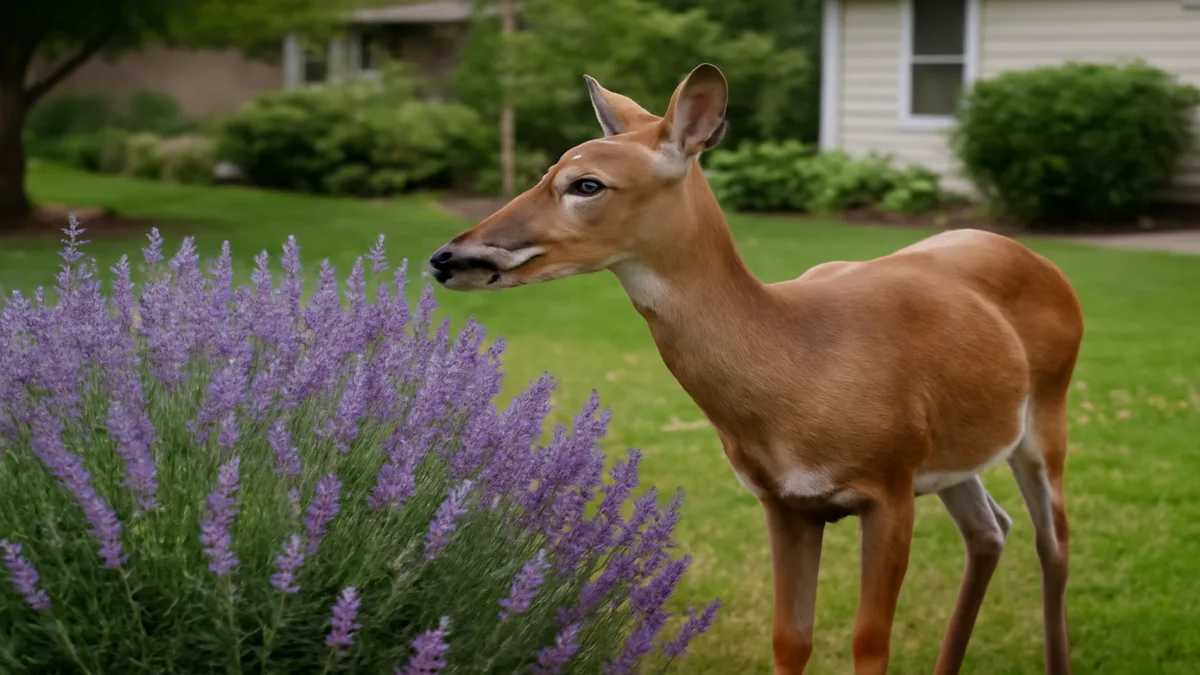
Here’s a beautiful truth that many new gardeners miss: you can shift the odds in your favor just by choosing the right plants. Deer have favorites (hostas, tulips, daylilies, roses, arborvitae) and foods they actively dislike. Build your garden’s perimeter and decorative borders with deer-resistant species and you’ve essentially created a culinary force field.
Deer avoid three main categories of plants: strongly aromatic (too pungent), physically uncomfortable (fuzzy, prickly, or leathery leaves), and outright toxic. Some of the best picks for each category:
- Aromatic: Russian Sage, Lavender, Catmint, Bee Balm, Anise Hyssop, Ornamental Onions (Allium)
- Fuzzy, prickly, or leathery: Lamb’s Ear, Heartleaf Brunnera, Yarrow, Barberry, Oregon Grape
- Toxic (use with care around pets and kids): Foxglove, Bleeding Heart, Monkshood, Oleander
A bonus: many deer-resistant aromatics double as excellent pollinator plants. If you’re already thinking about building a pollinator garden, lavender, bee balm, and catmint pull double duty. Feeding bees and butterflies while repelling deer. That’s the kind of layered design that makes a yard bulletproof.
Method 4: Commercial Repellents, What’s Actually Worth Buying
The repellent aisle at your local garden center is a jungle, and most of what’s on the shelf is either overpriced, underpowered, or both. To save you some trial and error, here’s a comparison of the commercial deer repellents that independent university extension studies consistently rank highest.
| Product | Active Ingredient | Effectiveness | Duration | Approx. Price |
|---|---|---|---|---|
| Deer Away / Big Game Repellent | 37% putrescent egg solids | Over 85% | About 5 weeks | $26 / gallon |
| Deer-Off | Egg solids + capsaicin + garlic | High | 3-4 weeks | $28 / pint (makes 1 gal) |
| Hinder | Ammonium soaps (safe on edibles) | Moderate-High | 2-3 weeks | $40 / gallon |
| Tree Guard | Denatonium benzoate (extreme bitterness) | High on woody plants | 3-4 months | $40 / gallon |
| Nott’s Chew-Not | 20% thiram fungicide (dormant trees only) | High | Whole dormant season | $50 / 2 gallons |
| Miller’s Hot Sauce | Capsaicin | Moderate | 2-3 weeks | $80 / gallon |
A quick word on choosing: if you’re spraying ornamentals, Deer Away and Tree Guard are hard to beat. For vegetable gardens where food safety matters, Hinder is the go-to because its ammonium soap chemistry is approved for edible crops. For winter protection on young fruit trees or shrubs, Chew-Not’s thiram formulation will cover you through the whole dormant season in a single application.
Method 5: Homemade Scent Deterrents
If you’d rather not spend $40 on a gallon of anything, the good news is that scent-based deterrents often work nearly as well as commercial products. And many gardeners find they work better because they can be swapped out frequently. Remember, deer fear unpredictability. A new smell every two weeks keeps them off-balance.
The science behind this is something called a “landscape of fear.” Deer rely heavily on their sense of smell to detect predators, and strong or unfamiliar odors trigger caution. Scent repellents tend to outperform taste repellents because deer bail before they even take a bite.
Here are five homemade scent deterrents worth rotating:
- Predator urine (coyote or fox). Available at hunting supply stores. Apply to cotton balls and hang in mesh bags around the perimeter.
- Human hair from a barber shop. Stuff into mesh bags or old pantyhose and hang on stakes every 10 feet.
- Irish Spring soap. Shave into chunks, place in mesh bags, and rehang every 4-6 weeks.
- Fabric softener sheets. The cheap, strongly scented kind. Staple to stakes along paths deer typically use.
- Garlic-and-egg spray. Blend 4 cloves garlic, 2 raw eggs, and 1 tablespoon cayenne into a gallon of water. Strain, spray foliage weekly.
Method 6: Rotate, Combine, and Outsmart
We keep coming back to this because it matters more than any single product: rotation is the secret sauce. The best deer-proof gardens in the country aren’t the ones with the tallest fences or the most expensive repellents. They’re the ones run by gardeners who treat deer deterrence like a seasonal chore.
A practical rotation might look like this: motion sprinklers in April and May while plants are tender, commercial repellent spray June through August, scent bags and fishing line fence as a continuous background layer, and a dormant-season thiram application on young trees in November. Mix, match, and pay attention to what’s working.
The same principle applies to any garden pest. Whether you’re trying to keep rabbits out of your garden or keep squirrels out of your garden, layered, rotating defenses always beat single-solution thinking. Pests are smart. Your defense needs to be smarter.
Method 7: Remove What’s Attracting Them
Here’s an uncomfortable question: is something on your property actively inviting deer in? Bird feeders that spill corn and seed, fallen apples rotting under a fruit tree, salt licks left over from a previous owner, even a too-lush lawn fertilized to golf-course perfection. All of these can turn your yard into a deer destination.
Audit your property honestly. Rake up fallen fruit weekly in autumn. Switch to bird feeders with catch trays, or pull them down entirely during peak deer season. Fence off the compost pile if it contains vegetable scraps. And whatever you do, never intentionally feed deer, even in winter. It creates dependency, concentrates the local population, and guarantees a population explosion that will haunt your garden for years.
Method 8: Know When to Call in the Professionals
Sometimes the problem is just bigger than you. If you live in an area with chronic deer overpopulation. Suburban sprawl meeting former forest is the classic recipe. No homeowner-level intervention is going to hold the line forever. That’s when it’s worth contacting your state’s wildlife agency or a licensed nuisance wildlife operator.
Your local university extension service is also an underused resource. They’ll often do free or low-cost site visits, identify the specific species eating your plants, and recommend solutions tailored to your region. Check with the USDA APHIS Wildlife Damage program or your state’s cooperative extension (most run excellent deer-management guides; the Penn State Extension publishes a particularly thorough one).
What NOT to Do: Five Common Mistakes
Before we wrap up, a quick list of well-meaning ideas that waste time and money:
- Relying on a single method indefinitely. Deer habituate. Always rotate.
- Plastic owls, rubber snakes, and scarecrows. Deer ignore stationary props within days.
- Any fence under 8 feet tall. Deer can clear a 7-foot fence from a standing start. It’s not worth the lumber.
- Hunting or trapping outside legal seasons. Illegal in every state, and completely unnecessary with proper deterrence.
- Feeding deer anywhere near your property. You’re not helping them. You’re creating tomorrow’s problem.
Bringing It All Together
Keeping deer out of your garden isn’t about winning a one-time battle. It’s about building a garden environment that deer quietly decide isn’t worth their time. Fence what you can, spray what you can’t, rotate your tricks, plant the right things, and remove the temptations. Do that consistently, and within a season or two the local herd will rewrite their mental map of your neighborhood and skip your yard entirely.
Gardening in deer country is a long game, but it’s a winnable one. Don’t let a few bad mornings discourage you. Your tomatoes, tulips, and hostas are absolutely worth defending.
Did this guide help you plan your deer defense? Share it with a fellow gardener who’s been losing sleep over midnight visitors. Every gardener deserves to enjoy the flowers they worked so hard to grow.
Frequently Asked Questions
What is the single most effective way to keep deer away from my garden?
A properly installed 8-foot fence is the most reliable single method, but wildlife biologists agree that layered defenses work better long-term. Combine a physical barrier with motion-activated sprinklers and a rotating commercial repellent, and you’ll outperform any single solution. Deer habituate quickly to predictable deterrents, so variety genuinely matters more than any one product.
Do deer-repellent plants really work, or is that just marketing?
They genuinely work, though “deer-resistant” is more accurate than “deer-proof.” Aromatic herbs like lavender and catmint, fuzzy-leafed plants like lamb’s ear, and toxic species like foxglove are reliably unappealing to deer. During severe winters or droughts, hungry deer may sample almost anything, but in normal conditions these plants are passed over in favor of tastier options elsewhere.
How often should I reapply commercial deer repellents?
Most liquid repellents last three to five weeks under normal conditions, but heavy rain, irrigation, and new plant growth all shorten that window considerably. As a rule of thumb, reapply every two to three weeks during active growing season, after any significant rainfall, and whenever you notice tender new shoots that weren’t coated in the previous application. Consistency is everything.
Are home remedies like Irish Spring soap and human hair actually effective?
Yes, surprisingly well, though they work best as part of a rotation rather than a standalone defense. Strong, unfamiliar scents trigger deer’s caution instincts, and cheap household items take advantage of that. Swap them out every four to six weeks so deer don’t acclimate, and combine with at least one other method. Scent alone rarely holds up against a determined, hungry herd.
Will feeding deer on one side of my property keep them away from my garden?
Absolutely not. This is one of the most damaging myths in backyard wildlife management. Feeding deer increases the local population, creates dependency, and concentrates animals in a small area. You’ll end up with more deer visiting more often, and once your feeding station is empty they’ll head straight for your vegetables. Never intentionally feed deer, period.
Want More Wildlife Garden Tips?
Join 5,000+ nature lovers getting our weekly tips on creating wildlife-friendly gardens.
No spam, unsubscribe anytime. Privacy Policy
Emma Harrington
Emma Harrington is a wildlife habitat researcher and content editor with a passion for backyard conservation. She has spent over a decade translating ecological science into practical tips anyone can follow — from selecting native plants to building wildlife-friendly habitats. Her work focuses on helping homeowners transform ordinary yards into thriving ecosystems for bees, butterflies, hummingbirds, and other beneficial wildlife.