
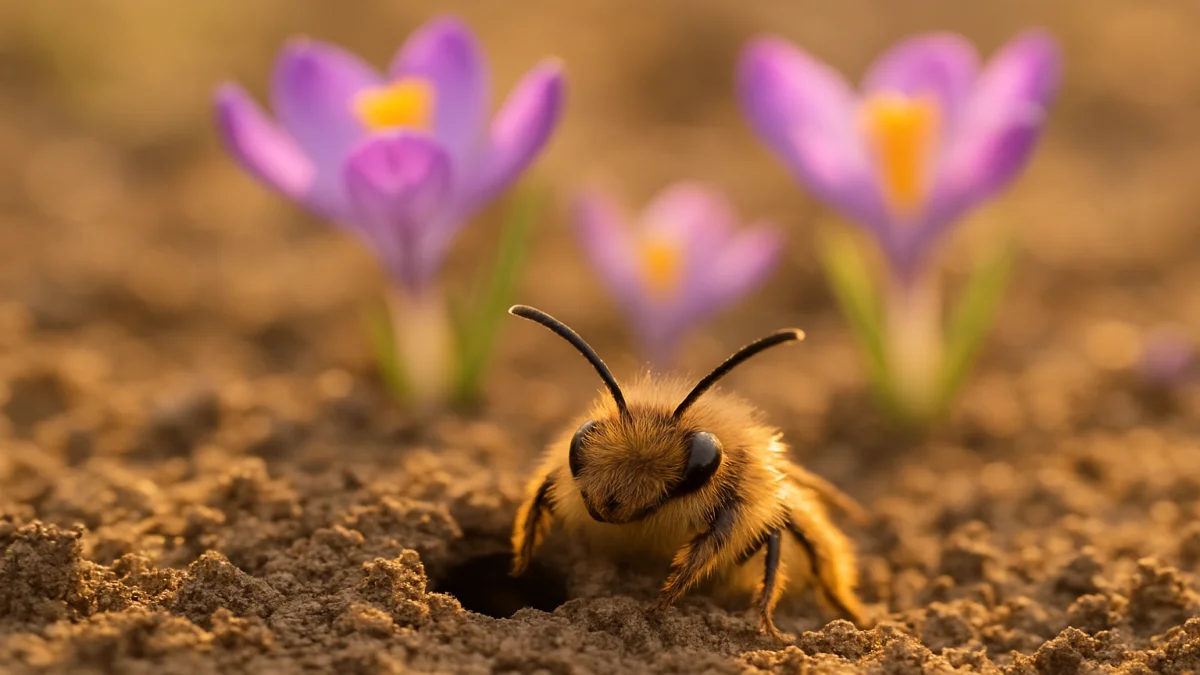
That small mound of dirt near your garden bed isn’t an ant hill. Those tiny holes dotting bare patches of your lawn aren’t random erosion. Chances are, you’re looking at the front door of one of nature’s most overlooked workers. A ground nesting bee.
Most people picture beehives hanging from trees or tucked inside wooden boxes. However, the reality is far more interesting. A full 70 percent of native bees in North America nest in the ground, according to the Xerces Society. They dig tunnels in bare soil, raise their young underground, and quietly pollinate the flowers and crops you depend on every season.
These ground nesting bees deserve your attention. More importantly, they deserve your protection. In this guide, you’ll learn exactly how to identify them, tell them apart from stinging pests, and make your yard a safe haven for these essential pollinators.
FREE: Wildlife Garden Starter Guide
Get our 12-page PDF with the 25 best plants for pollinators, simple habitat tips, and a printable checklist — all 100% free.
No spam. Read our Privacy Policy.What Are Ground Nesting Bees and Why 70 Percent of Native Bees Live Underground
The United States is home to more than 3,600 wild bee species, a number tracked through pollinator inventories at USDA and partner programs. That number surprises most gardeners. In fact, only about 20 percent of these species have a known conservation status, meaning scientists are still learning about the vast majority of them.
Among those thousands of species, roughly 70 percent are ground nesters. They don’t build wax combs. They don’t live in colonies of thousands. Instead, each female digs her own individual tunnel into the earth, creates small chambers, and provisions each one with a mixture of pollen and nectar before laying a single egg. A single female may visit 30 to 50 flowers per provisioning trip, gathering enough pollen to feed one larva for roughly 10 months underground.
So why do so many bees choose to nest underground? There are several good reasons:
- Soil provides excellent insulation against temperature swings during spring and fall
- Underground tunnels protect developing larvae from wind, rain, and surface predators
- Bare ground is abundant in natural landscapes, making it an accessible nesting resource
- The earth retains moisture, which helps preserve the pollen provisions that feed larvae
- Underground nests are less visible to parasitic flies and wasps that target exposed nests
- Soil drainage prevents waterlogging in well-chosen nest sites
These bees are solitary, meaning each female works alone. There is no queen. There is no hive hierarchy. Each mother bee is responsible for her own offspring from start to finish. She selects the nest site, excavates the tunnel, gathers the provisions, and seals the chamber. All without help from any other bee.
This is fundamentally different from honeybees, where thousands of workers share responsibilities inside a single hive. For ground nesting bees, independence is the entire strategy. And it works remarkably well.
Despite being solitary, many ground nesting bee species are gregarious. That means hundreds or even thousands of individual females may choose to nest in the same patch of suitable soil. These gatherings are called aggregations, and they can look dramatic. But they are completely harmless.
Five Common Ground Nesting Bee Species You Will Find in North American Yards
Knowing which bees are nesting in your soil helps you understand their role in your garden. Here are five genera that commonly form aggregations in yards across the United States.
Andrena (Mining Bees)
Mining bees are the most species-rich group of ground nesters in North America. They peak in activity from March through May, making them among the earliest pollinators each spring. Andrena bees often form very large aggregations in lawns, garden borders, and along sidewalks. They are small to medium-sized, usually dark-colored, and covered in fine hair.
Lasioglossum (Sweat Bees)
Sweat bees are tiny. Some are barely larger than a grain of rice. They earned their common name because a few species are attracted to human perspiration. Besides their small size, they’re recognized by their metallic green or dark coloring. They nest in bare soil and are active throughout the growing season.
Colletes (Cellophane Bees)
Cellophane bees get their name from the transparent, cellophane-like lining they secrete inside their nest tunnels. This waterproof coating protects the pollen provisions from moisture and fungal growth. They prefer sandy, well-drained soils and are common in the eastern United States.
Anthophora (Digger Bees)
Digger bees are sturdy, fast-flying bees that resemble small bumblebees. They are excellent pollinators of spring-blooming flowers and fruit trees. Their nests often appear in south-facing soil banks, clay walls, and compacted garden paths. For example, you might notice their distinctive turret-shaped nest entrances near your raised beds.
Habropoda laboriosa (Southeastern Blueberry Bee)
This specialist pollinator is economically important because it is one of the most effective pollinators of blueberry flowers. The southeastern blueberry bee nests in sandy soil near blueberry patches. Its buzz pollination technique. Vibrating its flight muscles to shake pollen loose from flowers. Makes it far more efficient than honeybees on blueberry crops.
NC State Extension identified 212 species within just these five common genera in North Carolina alone. Your yard likely hosts more ground nesting bee diversity than you ever imagined. If you’re unsure about a species you’ve spotted, upload a clear photo to iNaturalist for research-grade community confirmation.
Ground Nesting Bees vs Yellowjackets: How to Tell Them Apart in Seconds
This is the section that matters most for your peace of mind. Many gardeners spot insects flying near the ground and immediately assume the worst. However, telling ground nesting bees apart from yellowjackets takes only a few seconds once you know what to look for.
| Feature | Ground Nesting Bees | Yellowjackets |
|---|---|---|
| Body texture | Fuzzy, covered in fine hair | Smooth, shiny, waxy appearance |
| Body shape | Rounded, sturdy | Narrow waist, angular |
| Color | Dark brown, black, or metallic green | Bright yellow and black stripes |
| Nest type | Individual holes, each female has own entrance | Single hole shared by hundreds |
| Behavior | Non-aggressive, ignore people | Aggressive, especially near food |
| Diet | Nectar and pollen only | Meat, sugary drinks, garbage |
| Sting risk | Males cannot sting; females rarely sting unless handled directly | Sting repeatedly without provocation |
| Season | Most active in early spring | Peak aggression in late summer and fall |
The easiest tell is the nest entrance itself. Solitary ground bees each have their own tiny opening, usually surrounded by a small mound of excavated soil. On the other hand, a yellowjacket colony uses a single larger hole where you’ll see dozens of wasps entering and exiting in rapid succession.
Another quick test: stand three feet away and watch for 30 seconds. Ground nesting bees will fly past you without interest. Yellowjackets will investigate you, circle your head, and may become defensive if you stay near their nest.
Body hair is another reliable clue. Ground nesting bees have fuzzy, pollen-collecting hair covering their bodies and legs. Yellowjackets, by comparison, appear smooth and almost plastic-like. You can often spot this difference even from several feet away on a sunny day.
Finally, consider the time of year. If you’re seeing ground-level insect activity in March or April, you’re almost certainly dealing with native ground nesting bees. Yellowjacket colonies don’t reach nuisance-level populations until mid-summer, and their aggression peaks in August and September when food becomes scarce.
Why Ground Nesting Bees Are Disappearing From Suburban Yards
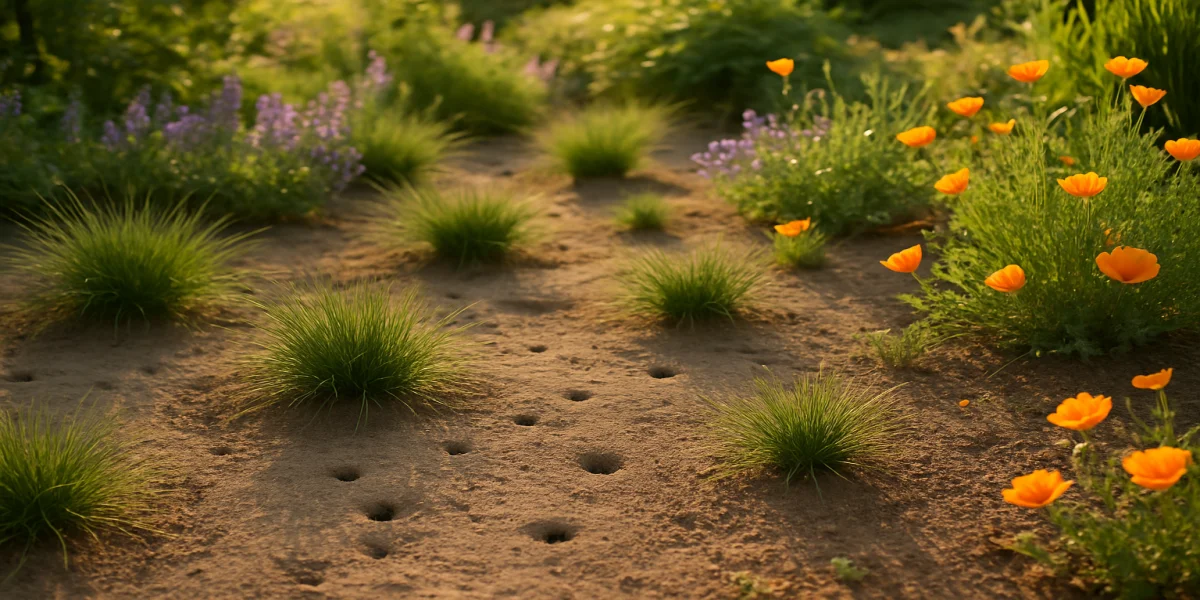
Suburban landscaping practices are systematically eliminating the habitat that ground nesting bees need. These essential pollinators are vanishing from the very yards where they’re needed most.
Here are the primary threats:
Thick mulch layers. A two- to four-inch blanket of hardwood mulch creates an impenetrable barrier. Bees cannot dig through it to reach the soil beneath. Every mulched bed is a lost nesting opportunity.
Landscape fabric. Weed barrier fabric blocks ground nesting bees completely. Even when covered with mulch or gravel, the fabric underneath prevents any access to the soil surface. This is one of the most destructive products for ground nesting habitat.
Pesticide-treated soil. Systemic insecticides applied to lawns and garden beds persist in the soil for 60 to 180 days. Ground nesting bees absorb these chemicals through direct contact as they dig their tunnels. The larvae developing underground are especially vulnerable.
Compacted soil from foot traffic and machinery. Bees need loose, workable soil to excavate their tunnels. Heavily compacted clay or soil compressed by lawn equipment and foot traffic becomes too hard for small bees to penetrate.
Loss of bare ground. Modern yards aim for 100 percent coverage. Every square inch filled with grass, mulch, groundcover, or hardscape. But ground nesting bees specifically require patches of bare, sun-exposed soil. No bare ground means no nesting sites.
Besides habitat loss, the timing of spring lawn maintenance also matters. Many homeowners apply their first round of fertilizer, pre-emergent herbicide, and insecticide in March and April. Precisely when Andrena mining bees and other early-season species are emerging from their underground nests and beginning to forage.
How to Create and Protect Ground Nesting Habitat in Your Garden
The good news is that creating habitat for ground nesting bees is surprisingly simple. You don’t need to buy special equipment or redesign your entire landscape. Small, intentional changes make a real difference.
Leave Bare Soil Patches
Designate a few areas in your yard where the soil stays exposed. South-facing slopes and well-drained spots near garden edges work best. Ground nesting bees prefer loose, undisturbed soil with good drainage and sun exposure. A patch as small as two feet by two feet can support several nesting females.
Switch to Compost Mulch
If you need to mulch, compost mulch is a much better alternative to hardwood chips. Compost mulch breaks down faster, integrates into the soil surface, and still allows bees to access the ground beneath. Apply it in thinner layers. One inch or less. Around plantings where bees are active.
Remove Landscape Fabric
Wherever possible, pull up existing landscape fabric. Our step-by-step guide to removing landscape fabric without wrecking your soil walks through the process bed by bed. Replace it with a thin layer of compost or simply allow natural leaf litter to serve as weed suppression. Your soil biology. And your ground nesting bees. Will thank you.
Plant Native Bunchgrasses and Clump-Forming Sedges
Native bunchgrasses and clump-forming sedges are ideal companions for ground nesting bees. Unlike turf grass, which forms a dense mat, these plants grow in distinct clumps with bare soil visible between them. This open structure gives bees direct access to the ground for nesting.
Provide Early-Season Flowers
Spring emergence is critical for ground nesting bees, with most species breaking dormancy when soil temperatures reach 55°F (13°C). They are among the earliest pollinators for fruit trees, berry bushes, and spring wildflowers. Plant early-blooming natives like willows, redbuds, and spring ephemerals to provide food when these bees first emerge. You can find more options in our guide to 8 pollinator-friendly plants from garden centers.
Pro Tip: The single most effective thing you can do for ground nesting bees is to leave one undisturbed, sun-exposed patch of bare soil in your garden year-round. No mulch, no fabric, no foot traffic. Just bare earth and sunshine. This simple act provides habitat that is disappearing across suburban America.
For more ways to support native pollinators in your yard, see our complete safe pollinator garden guide.
Lawn Care Practices That Help and Hurt Ground Nesting Bees
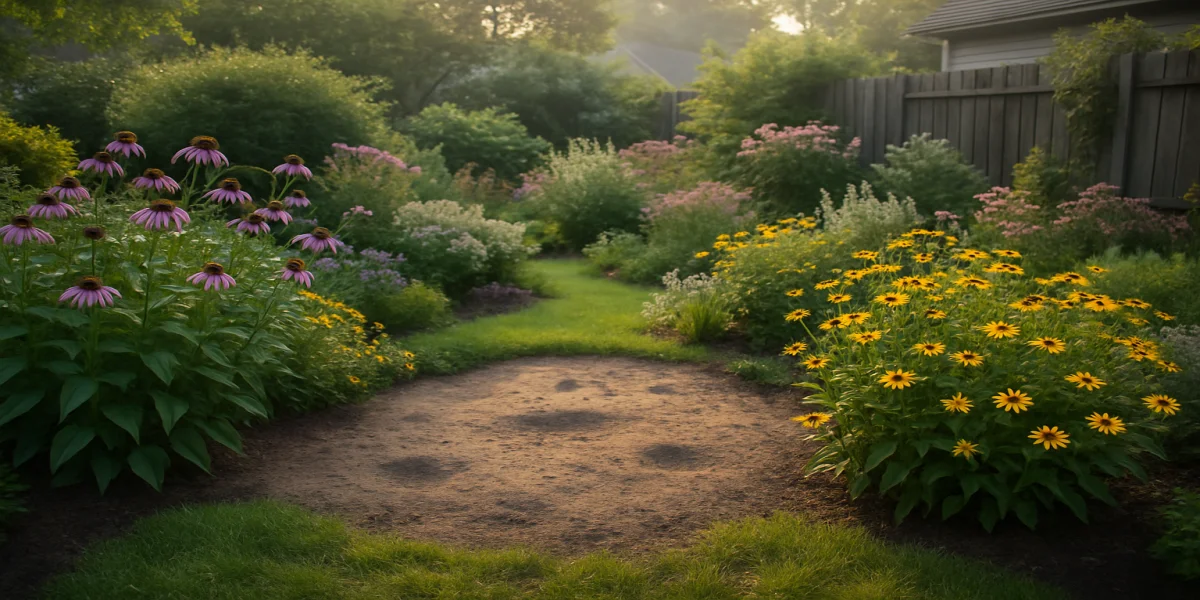
Your mowing, watering, and soil management habits directly affect whether ground nesting bees can survive in your yard. Here’s what helps and what harms them.
Mowing Height and Frequency
Mow higher and less frequently to protect nests. A lawn mowed at three to four inches provides better cover for nest entrances than a lawn scalped to two inches. Reducing mowing frequency during March through May. The peak nesting season. Gives bees time to establish without disturbance.
The No Mow May movement supports this approach. By skipping or reducing mowing during May, you allow spring wildflowers like clover and dandelions to bloom. These provide critical early-season food for ground nesting bees and other native pollinators.
Tilling
Tilling kills ground nesting bees. It destroys active nests, crushes developing larvae, and obliterates the carefully constructed tunnel architecture that females spend days building. If you garden in beds near known nesting areas, reduce or eliminate tilling entirely. Use no-till methods, or time your tilling for late fall after bees have completed their nesting cycle.
Watering
Excessive irrigation can flood underground nests. Ground nesting bees choose sites with good drainage for a reason. If you have an in-ground sprinkler system, consider leaving dry zones where bees are nesting. Overwatering compacts soil and fills tunnels with water, drowning developing larvae.
Fertilizer and Herbicide Application
Synthetic lawn fertilizers and pre-emergent herbicides change soil chemistry. Avoid applying them near known nesting areas, especially during the spring emergence period. Organic lawn care approaches are more compatible with ground nesting bee habitat.
Leaf Blowing
Aggressive leaf blowing, particularly with commercial-grade equipment, can disturb nest entrances and disorient returning females. During spring nesting season, consider raking instead of blowing in areas where you’ve seen ground bee activity.
The best lawn for ground nesting bees is one that’s slightly imperfect. A few bare patches, some clover in the turf, higher mowing height, and reduced chemical inputs create conditions where both your grass and your native bees can thrive.
What to Do When You Discover a Ground Bee Aggregation
You walk outside on a warm April morning and discover dozens. Maybe hundreds. Of small bees hovering just above the ground in your yard. Your first instinct might be alarm. That’s completely understandable.
Here’s what you need to know: ground bee aggregations look intimidating but are completely safe. The bees buzzing low over the soil are almost certainly males. Males don’t have stingers. They’re simply patrolling the area, waiting for females to emerge so they can mate.
The females are busy below ground, excavating tunnels and provisioning nest cells. They are focused entirely on their work. Females can sting but rarely do so unless you pick one up and squeeze it.
Here’s a step-by-step guide for what to do:
- Stop and observe. Watch the bees for a few minutes from a comfortable distance. Note their behavior. Are they hovering calmly near the ground? That confirms they’re ground nesting bees, not yellowjackets.
- Mark the area. Place a few garden stakes or flags around the aggregation so family members and visitors know to walk around it.
- Avoid the area temporarily. Most ground bee aggregations are active for four to six weeks in spring. After that, the adult bees die off and the area returns to normal.
- Skip lawn treatments nearby. Don’t apply pesticides, herbicides, or fertilizers within 10 feet of the nesting area during the active period.
- Delay mowing that section. If the bees are nesting in your lawn, simply mow around that patch until the activity subsides.
- Educate your neighbors. If the aggregation is near a property line, let your neighbors know these are harmless native bees. A brief conversation can prevent an unnecessary exterminator call.
Resist the urge to spray or pour water on the nests. These bees are temporary guests that provide enormous ecological value. A single aggregation of Andrena mining bees can pollinate thousands of flowers during their short adult lives.
If you’re interested in supporting other solitary bee species alongside your ground nesters, consider adding above-ground nesting habitat with our guide to cleanable mason bee houses.
Common Questions About Ground Nesting Bees
Will Ground Nesting Bees Damage My Lawn or Garden?
No. Ground nesting bees cause no structural damage. Their tunnels are narrow. Roughly 7 to 10 millimeters across, the diameter of a pencil. And shallow, usually only four to eight inches deep. The small mounds of excavated soil at nest entrances are temporary and disappear with the next rain or mowing. Meanwhile, the pollination services these bees provide actually benefit your garden plants and increase fruit yields.
Are Ground Nesting Bees Dangerous to Children or Pets?
Ground nesting bees pose virtually no sting risk during normal yard activities. Male bees, which are the ones you’ll see flying around most actively, cannot sting at all. Female bees have stingers but are extremely reluctant to use them. You would need to physically grab and squeeze a female bee to provoke a sting. Children and pets can walk near aggregations safely. Simply teach children not to swat at the bees or step directly on nest holes.
How Long Do Ground Nesting Bees Stay Active in My Yard?
Most ground nesting bee species are active for four to six weeks in spring, typically from mid-March through early May depending on your region. After this period, the adult bees die. The next generation develops underground throughout summer and fall, emerging the following spring. Any inconvenience from an aggregation is truly temporary.
Can I Relocate Ground Nesting Bees to a Different Part of My Yard?
Unfortunately, relocating ground nesting bees isn’t practical. Each female has selected her specific nest site based on soil conditions, sun exposure, and drainage. Moving the bees would destroy their carefully provisioned nests and kill the developing larvae. The best approach is to coexist for the few weeks they’re active. If you want bees to nest in a different location next year, create attractive bare soil habitat where you’d prefer them and allow the old area to become overgrown.
Should I Call an Exterminator for Ground Nesting Bees?
No. Calling an exterminator for ground nesting bees is unnecessary and ecologically harmful. These bees are beneficial pollinators that pose no threat. Pesticide treatment of a ground bee aggregation kills hundreds or thousands of native bees, contaminates the soil, and removes pollinators that your garden, your neighbors’ gardens, and nearby wild plants depend on. If you’re unsure whether you have ground nesting bees or yellowjackets, use the comparison table above to confirm identification before taking any action.
For more detailed information on protecting all types of native bee nesting habitat, visit the Xerces Society nesting resources page.
Your Yard Can Be Part of the Solution
Ground nesting bees are quiet, hard-working, and essential. They pollinate your tomatoes, your blueberry bushes, your apple trees, and the wildflowers along your fence line. They ask for nothing more than a small patch of bare, undisturbed soil and a few early-blooming flowers.
The choices you make in your yard. How you mulch, when you mow, whether you leave bare ground or cover every inch. Directly determine whether these native bees can survive in your neighborhood.
Every gardener has the power to make a meaningful difference. Leave a bare patch. Mow a little higher. Skip the landscape fabric. Choose compost over hardwood mulch. These small adjustments cost nothing and create habitat that is vanishing from suburban landscapes across the country. Pair them with a backyard wildlife corridor and your yard becomes a working stop on a much bigger pollinator route.
With more than 3,600 wild bee species in the United States and 70 percent of them nesting underground, the ground beneath your feet is one of the most important pollinator habitats in North America. Protecting it starts in your own backyard.
Related reading
Want More Wildlife Garden Tips?
Join 5,000+ nature lovers getting our weekly tips on creating wildlife-friendly gardens.
No spam, unsubscribe anytime. Privacy Policy
Emma Harrington
Emma Harrington is a wildlife habitat researcher and content editor with a passion for backyard conservation. She has spent over a decade translating ecological science into practical tips anyone can follow — from selecting native plants to building wildlife-friendly habitats. Her work focuses on helping homeowners transform ordinary yards into thriving ecosystems for bees, butterflies, hummingbirds, and other beneficial wildlife.