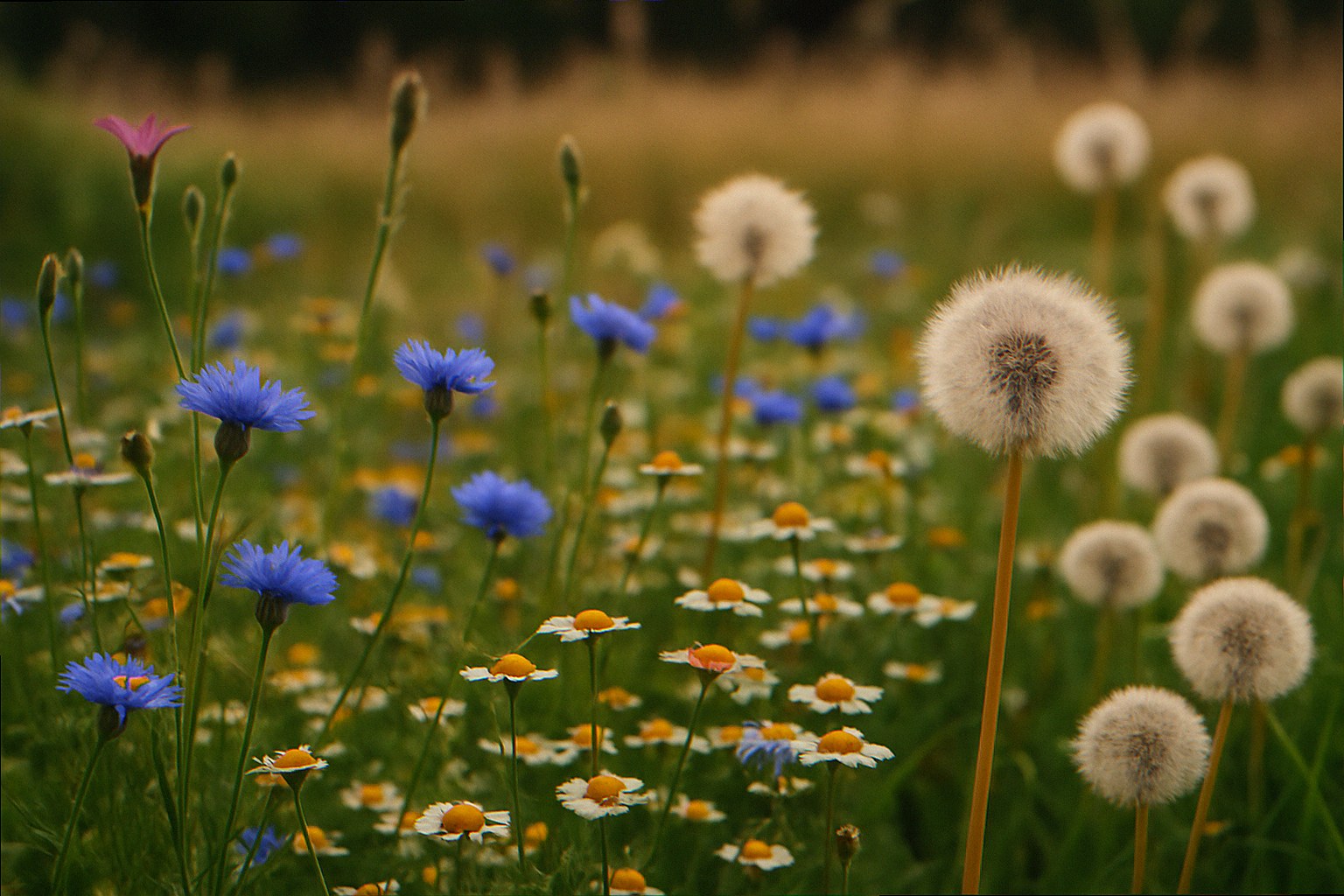
The shiny tin of “American Wildflower Mix” sitting on the box-store endcap is one of the most expensive mistakes I have ever made in my own yard. I scattered three tins of it across a freshly cardboarded patch the spring I bought my house, watered it like a religion, and waited for the meadow that the front-of-can photograph had promised me. What came up was a thicket of oxeye daisy, bachelor’s button, and a single, lonely black-eyed Susan that I am pretty sure hitched in from a neighbor’s yard. Two of those three species are listed as noxious weeds in at least one US state. I had paid $36 to plant invasives on top of cardboard I had spent six weekends laying down.
I’ve heard from someone in my neighborhood who summed up the frustration of finding misleading wildflower mixes perfectly. They pointed out that unscrupulous sellers like American Meadows often include nonnative and even invasive species in their so-called ‘native wildflower’ packets. This is a common issue, and it highlights a gap in knowledge: no one at the store teaches you how to interpret the information on the back of the package. By the end of today’s post, you’ll know how to quickly assess any wildflower can, determining in just 90 seconds if it should go in your cart or back on the shelf.
Why “Wildflower” on the Front of the Can Means Almost Nothing
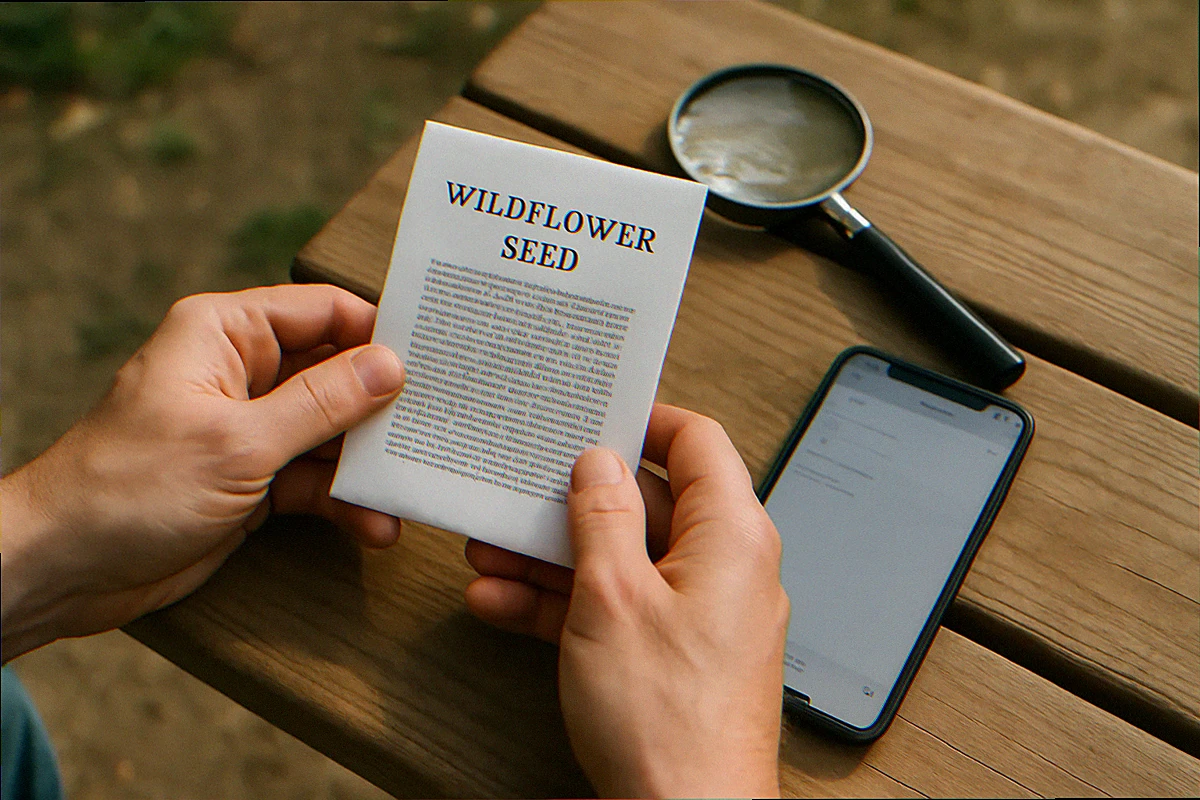
“Wildflower” is not a regulated word on a seed label. Unlike “USDA Organic” or “Non-GMO Project Verified,” nobody in Washington is auditing what counts as a wildflower. A seed company can legally print “American Wildflower Mix” on a tin filled with European poppies, Asian forget-me-nots, and a sprinkling of true natives, and the label is not lying because the term itself has no legal teeth.
FREE: Wildlife Garden Starter Guide
Get our 12-page PDF with the 25 best plants for pollinators, simple habitat tips, and a printable checklist — all 100% free.
No spam. Read our Privacy Policy.The University of Washington put numbers on this. Researcher Sarah Reichard purchased 19 packets of generic wildflower mix from box stores and garden centers, ran the seeds through a stereoscope, and counted what was actually inside. Roughly half the seeds were not native to North America at all. Eight of the 19 packets contained plants listed as noxious weeds in at least one US state or Canadian province. The worst packet she tested held 13 different invasive species in a single can. That is not a typo. Thirteen.
One in three packets listed no contents on the back. Another third listed contents that did not match what was actually in the seed mix when she counted. Only five of the 19 packets accurately told the buyer what was inside. If you have ever stood in front of a wall of bright red and yellow tins and felt confused, the confusion is the product. Vague labeling lets the company ship the same Eastern European seed batch to Vermont, Texas, and Oregon and call it regional. It also lets them dump cheap filler seed (looking at you, oxeye daisy) into the bag to keep the price under $10.
The Penn State Extension office puts it more politely: a mix without zone-specific labels and Latin names “may contain non-native species that fail to persist or become locally weedy.” Translated from extension-speak, that means the seed company gets your money this year, the plants either die or take over your yard, and you get to fight them with a shovel for the next decade. I would rather skip that arrangement.
The Five Filler Species That Show Up in Almost Every Cheap Mix
Before I tell you what to look for on a good label, you need to recognize the names of the bad actors so they jump off the page when you read the back of a can. After three seasons of opening other people’s seed tins (friends ask me to look) I see the same five species over and over. Memorize the Latin names. Common names are slippery on purpose.
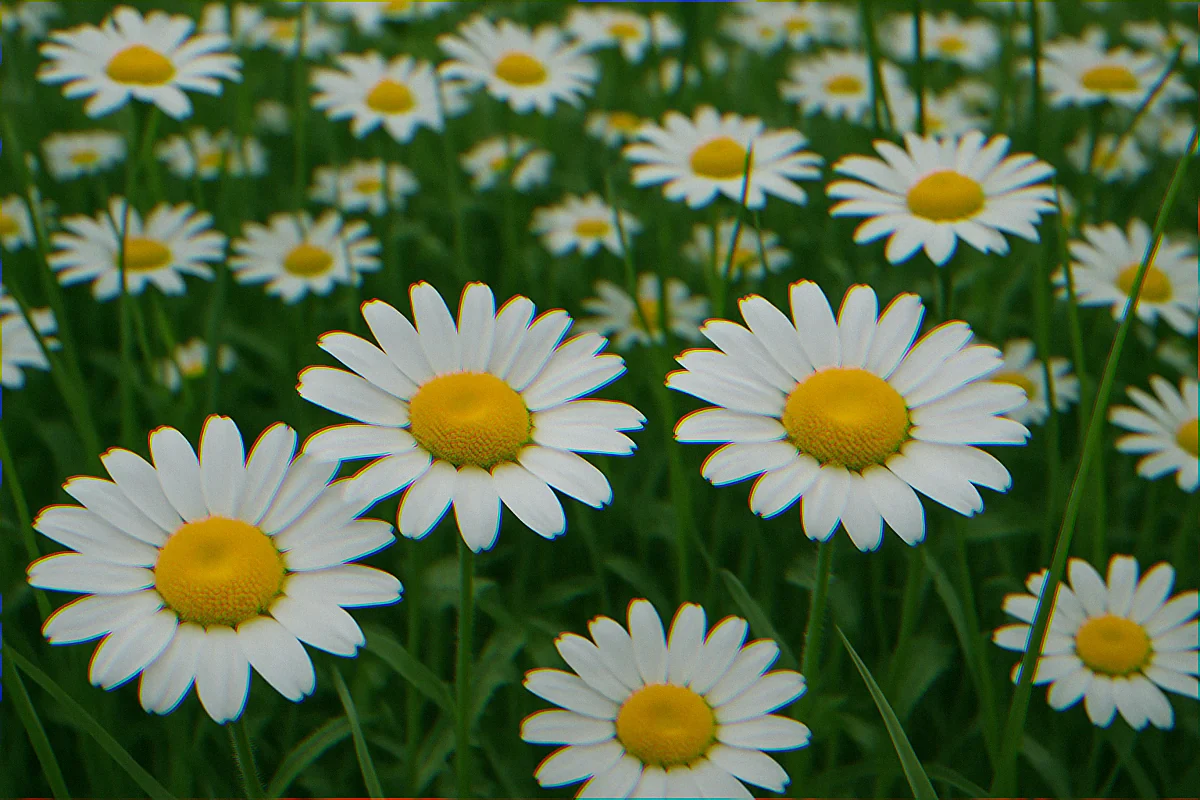
1. Oxeye daisy (Leucanthemum vulgare). The classic white-petal, yellow-center “daisy” of European meadows. Pretty in a photo, banned outright in Washington State seed mixes, listed as a Class B or C noxious weed in Colorado, Montana, Wyoming, New Mexico, and a dozen other states. It outcompetes native bunchgrasses and is on the official prohibited list for the Washington State Noxious Weed Control Board. If a label says “oxeye daisy” or “Leucanthemum vulgare” anywhere in the ingredient list, put the can back. The native lookalike that mixes confuse it with is Shasta daisy, but Shasta is a garden hybrid (not native either) so do not let a substitution fool you.
2. Dame’s rocket (Hesperis matronalis). Tall purple-and-white four-petal flower that gets sold under the romantic name “wild phlox.” It is not phlox. Real phlox has five petals. Dame’s rocket has four. The plant escapes gardens, blankets forest edges, and crowds out native spring ephemerals like trillium and bloodroot. Listed as a regulated invasive in Wisconsin, Connecticut, Massachusetts, Tennessee, and others.
3. Bachelor’s button (Centaurea cyanus). The blue, fringy-looking cornflower that bees do visit, which is what the seed companies use to justify keeping it in the mix. The problem is the rest of the Centaurea genus. Spotted knapweed (C. stoebe) and diffuse knapweed (C. diffusa) are catastrophic invasives that have destroyed millions of acres of rangeland in Montana and Idaho. If a cheap mix is sloppy enough to label bachelor’s button as “knapweed,” you are gambling on which species is actually in there. The Penn State Extension’s wildflower mix primer calls out the Centaurea group specifically.
4. Crown vetch (Securigera varia or Coronilla varia). Pink and white pea-family ground cover originally planted on US highway embankments in the 1950s for erosion control. It does control erosion. It also smothers every native it touches. Most state DOTs have stopped using it; some box-store seed mixes have not.
5. Sweet alyssum (Lobularia maritima) and forget-me-not (Myosotis spp.). Both Mediterranean. Both common bag-stretchers. Both have escaped in the Pacific Northwest, the Upper Midwest, and parts of the Northeast. Not as catastrophic as the first three but still not what you signed up for when you bought a “native” mix.
That is your blocklist. Five names, five Latin tags. If you see any of them in the ingredient list, walk away.
What a Trustworthy Wildflower Label Actually Lists
A label you can trust has four things on the back. Most cheap mixes are missing at least two of them. Run this checklist physically with the can in your hand at the nursery and you will not need to remember any of it once it becomes muscle memory.
Item 1: Every species spelled out in Latin (binomial nomenclature). Not “daisy” or “coneflower.” Rudbeckia hirta and Echinacea purpurea. Latin names are non-negotiable because common names overlap between native and non-native species. There are at least four plants called “wild bergamot” in seed catalogs and only one of them (Monarda fistulosa) is the native that pollinators actually evolved with. If the back of the can shows only common names, the company is hiding what is inside.
Item 2: Percentage by weight for each species. A reputable mix lists “Rudbeckia hirta 18%, Echinacea purpurea 12%, Asclepias tuberosa 8%…” down the list. Why weight? Seed sizes vary wildly. Black-eyed Susan seeds are tiny; lupine seeds are huge. Listing by weight tells you the company actually formulated the blend rather than dumping leftover batches into a shaker. If the label says “contains a mix of wildflowers” with no percentages, you are buying a lottery ticket.
Item 3: Origin of seed (state or ecoregion). A native species grown from Texas seed is genetically different from the same species grown from Wisconsin seed. They flower at different times, tolerate different cold, and feed different pollinator populations. Top-tier suppliers list the seed source state on every line. Acceptable suppliers list “regionally collected” or “EPA ecoregion 8.” Mixes that say nothing about origin are pulling seed from whatever wholesale lot was cheapest that month, often imported.
Item 4: A lot number and a germination test date. Federal Seed Act and most state seed laws require a lot number and a germination percentage tested within the last nine months. A 2024 germ test for seed you are buying in May 2026 is fine. A 2022 test means the seed has been sitting in a warehouse and you can expect maybe 40% of the labeled germination rate.
That is it. Latin names, weight percentages, regional origin, fresh germination test. Anything short of all four is a marketing tin, not a planting tool. I keep a phone photo of this checklist in my notes app and pull it out at the garden center before I commit.
Cross-Check Every Latin Name in 90 Seconds
Once you have a label that lists species in Latin, you still have to verify they are native to your specific county. “Native to North America” is too broad. Indigo bush (Amorpha fruticosa) is native to the central US and a problematic invader in the Pacific Northwest. Native is local, not continental.
The 90-second routine I run at the nursery, on my phone, in the parking lot before I drive home:
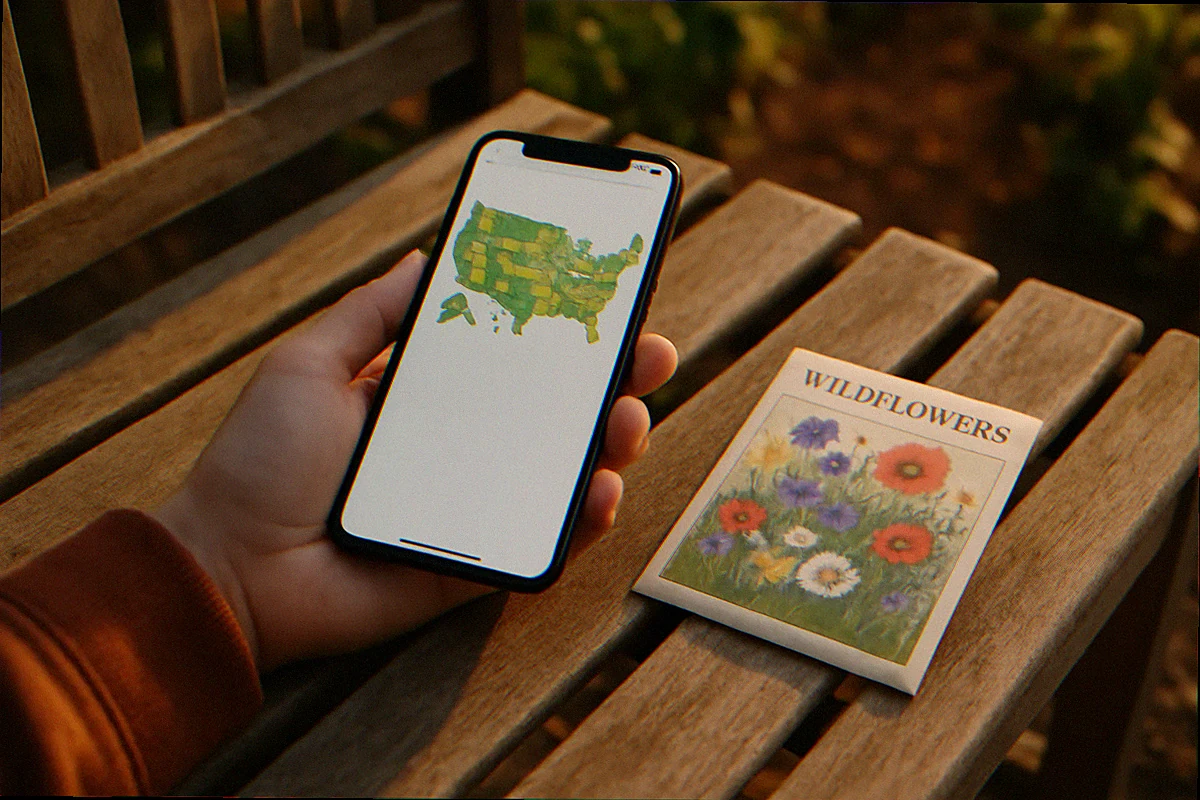
Step 1 (30 seconds): BONAP. Open the Biota of North America Program county map. Type the Latin name into the genus and species lookup. You will get a US map color-coded by county. Green means native to that county. Yellow means present but introduced. White means absent. If your home county is green for every species in the mix, you are clean. If even one species shows yellow or red in your county, that species is the filler.
Step 2 (30 seconds): State noxious weed list. Google “[your state] noxious weed list site:.gov” and ctrl-F for the Latin names, or check the Washington State Noxious Weed Control Board as a benchmark for what aggressive states are actively banning. A direct hit means the plant is illegal to sell as seed in your state and the can in your hand should not exist. Take a photo of the label and report the SKU to your state Department of Agriculture; they care, and box stores will pull the product. I have done this three times in two years.
Step 3 (30 seconds): iNaturalist research-grade observations. Open the iNaturalist app and search the Latin name. Switch the map to your county. If hundreds of research-grade observations cluster in your area, the species is a real local native. If observations cluster only in California or Texas while you live in Pennsylvania, the seed origin is wrong even if the species technically exists in your state.
Ninety seconds. Three tabs. I do this with cold fingers in early-spring parking lots and it has saved me roughly $400 in bad seed since the 2024 season. For deeper county-level verification on plants you find in your own yard, I also wrote a longer walk-through on how to verify a plant is truly native to your county that covers the same tools in more detail.
Where to Buy Mixes That Pass All Four Checks
Here is the part where ecology purists and the pragmatist in me disagree, and I am going to lay out both sides honestly because Sarah is reading this on her phone in a Lowe’s parking lot and she needs real options.
The gold standard: regional native-only growers. Companies like Prairie Moon Nursery, Roundstone Native Seed, Ernst Conservation Seeds, Pinelands Nursery, and Northwest Meadowscapes sell mixes formulated by ecoregion. Every species is local. Every label has Latin names, percentages, and origin. Pricing is higher per ounce, but the germination rates are honest and you are not paying for filler. For a 200-square-foot bed I typically spend $25 to $40 here.
The decent middle: state native plant society seed sales. Almost every state has a native plant society that runs annual seed swaps and sales. Wisconsin’s, Minnesota’s, Ohio’s, and Pennsylvania’s are particularly good. Seeds are usually locally collected, often by volunteers, and labeled by collection county. Pricing is volunteer-cheap. The trade-off is limited selection and ship windows; you have to mark your calendar.
The pragmatic fallback: state DOT pollinator program seed. Most state transportation departments sell native seed for roadside meadow restoration in 5-pound and 25-pound bags. The species lists are public and audited. The bags are large for a backyard but you can split with a neighbor, and the per-square-foot cost is the cheapest legitimate native option there is. Iowa, Illinois, Minnesota, and Pennsylvania DOTs all run public programs.
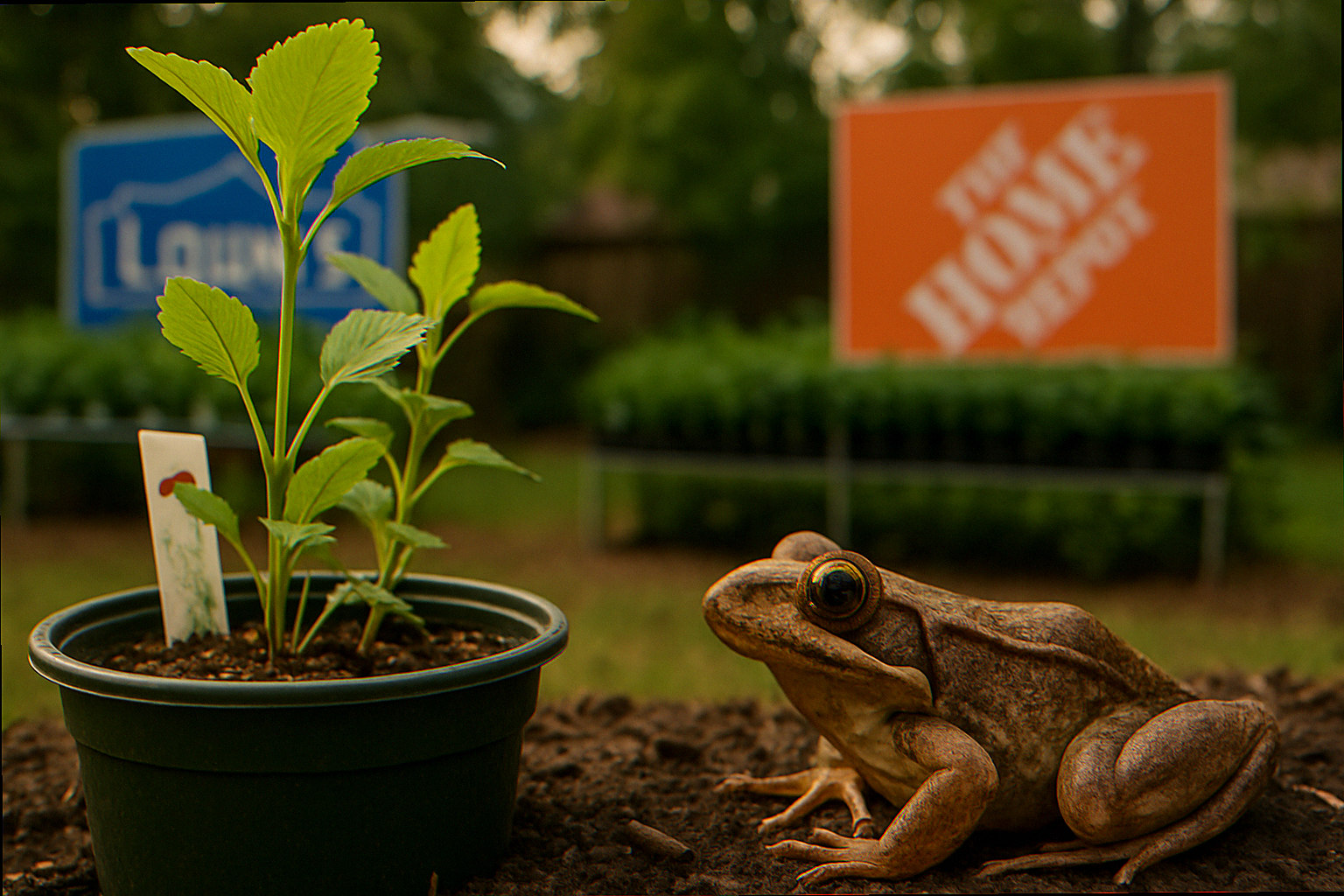
The big-box reality: Lowe’s, Home Depot, and Walmart do carry one or two genuinely native single-species packets, usually black-eyed Susan, butterfly weed, and purple coneflower. Those are fine. What you want to avoid in those stores is the generic “wildflower” tins with the meadow photo on the front. If you cannot leave a box store without a wildflower mix in your hand, look for tins that say specifically “regional native mix” with a state map and Latin names; American Meadows does sell those as a separate product line from their generic mixes. Read the back of every can, every time.
If you are converting a lawn for the first time and budget is tight, I wrote a separate piece on how to build a native plant garden on a budget with bulk plug sources, free seed swaps, and DOT bag-splitting strategies. That guide pairs naturally with this label-reading skill.
“I Already Planted a Box-Store Mix”, What to Do Now
This is the email I get most often, and the answer depends on how long ago you planted and what is coming up. The good news: most invasive fillers identify themselves within the first season because they are aggressive growers. The bad news: if you let them set seed even once, you will be fighting them for years.
If you planted this spring and nothing is up yet, you have time to course-correct. Wait until the seedlings get their second true leaves (usually three weeks after germination). At that point you can identify what you have. Use the iNaturalist “Seek” mode on your phone, snap photos of every seedling cluster, and start a list. Mark the natives with garden flags so you remember which is which. Pull every confirmed invasive seedling by hand before it puts down a taproot. This is the cheapest moment to fix the problem and the only moment you will ever be ahead.
If you planted last year and the bed is established, prioritize the worst offenders. Oxeye daisy and dame’s rocket are flagged first because they set the most seed per plant. Cut the flowering stalks before they go to seed even if you cannot dig the roots yet. That single step prevents the seedbank from growing for another year while you plan a full reset. The University of Washington’s 2002 study on weed-filled wildflower mixes still tracks population spread from that single decade and the numbers are not encouraging.
If the bed is fully overrun (more invasives than natives), the honest answer is to start over. Smother the whole area with cardboard and mulch for one full season, then replant with seed you have actually verified. I cover the smother protocol in detail in my walk-through on killing lawn with cardboard and replanting with native prairie plugs, and the same timeline works for resetting a compromised meadow.
The HOA dimension matters here. If your neighbors saw the meadow photo on the tin and have been quietly hoping your yard looks like that, an honest seed-mix reset means a year of cardboard and mulch in the front yard. That can trigger code violations in HOA-managed neighborhoods. Before you smother, take photos of the existing weed problem, document the invasive species list, and email your HOA board explaining that you are removing prohibited species under guidance from your state extension office. Most boards will not push back on weed control documentation. For neighborhoods where the optics matter, my piece on HOA-safe curb appeal for native gardens covers framing the project so it reads as intentional restoration rather than neglect.
The Five-Minute Routine That Saved My Backyard Meadow
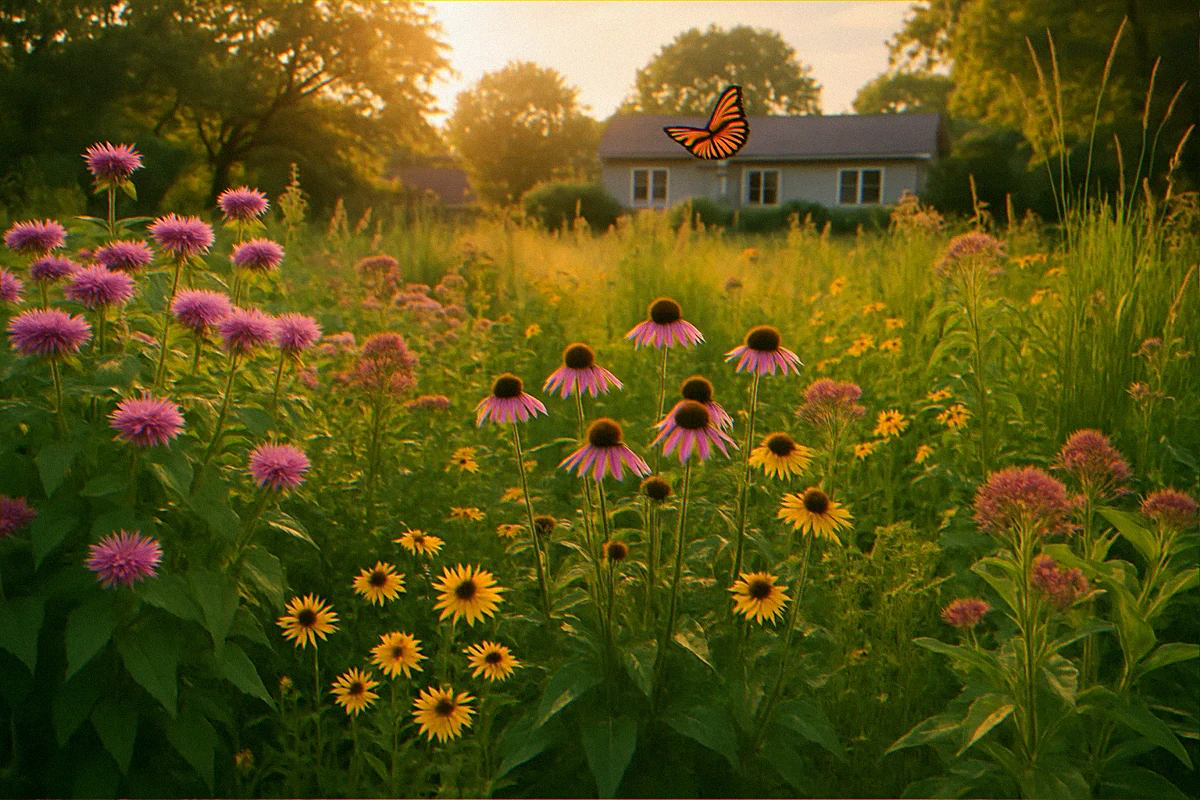
Two years after the disaster tin I told you about at the top of this article, my front-yard bed is mostly thriving. The bed is not perfect (I am still pulling oxeye daisy seedlings every June, which is the price of one bad spring) but the natives are now dominant and the meadow looks like the photo I had originally wanted.
The routine that got me there is built around the four-item label check and the 90-second cross-reference. I do not buy any seed mix without running both. I keep a running list in my phone of which suppliers passed the check (Prairie Moon, Roundstone, Wisconsin Native Plant Society) and which failed (three different store brands by name; I will not list them here because the formulations change). The list took me about six purchase cycles to build. Yours will probably take three or four if you start with this guide.
Specific numbers from my own yard, in case you want benchmarks. In 2024 I planted a 180-square-foot test patch using a verified mix from Prairie Moon (cost: $32, 17 species, all native to my Wisconsin county). Germination by end of season was about 75% of labeled species, which is excellent for a meadow planting. By summer 2025, year two, I counted 14 of the 17 species blooming. Native bee visits (counted on a single 15-minute sit on a sunny July afternoon) jumped from 3 species pre-conversion to 11 species. Monarchs found the butterfly weed within six weeks of bloom. The whole bed cost me less than one of those box-store tins after returns.
This is what a working native meadow looks like when the seed was right from the start. It is also why I get angry about the cheap tins. They cost people years of weeding to undo and they wreck the trust that gardeners place in the word “native.” Read the back of every can. Cross-check every Latin name. Walk away from anything that fails the four-item check. That is the whole game.
If you want to take this further, my deeper walk-through on native pollinator plants by US region lists verified species by zone, and the rain-garden three-zone recipe walks through species selection for the specific case of wet ground. For zone-specific full-yard planning, see the foolproof native plant garden recipe by USDA zone. And for cold-stratifying the seed once you have it home, my stratification protocol walks through the moist-paper-towel method that has given me the best germination rates.
Questions from the comments
Is American Meadows safe to buy from?
It depends entirely on which product line. Their generic “wildflower” mixes have historically contained non-native filler species; their separately-labeled “Native Regional Mixes” are formulated by ecoregion and include Latin names. Always read the back of the specific can you are holding. The same brand can ship safe products and risky products on adjacent shelves.
Are all non-native plants invasive?
No. Most non-native ornamentals are well-behaved and stay where you plant them. The problem with cheap wildflower mixes is that the specific non-native filler species (oxeye daisy, dame’s rocket, crown vetch, knapweed cousins) are documented invaders, not garden-tame ornamentals. The label issue is honesty, not blanket nativism.
Does it matter for pollinators whether the plant is native?
For honeybees, less so. Honeybees are themselves European and visit most flowers. For native solitary bees, butterflies, and specialist pollinators (the species that are actually declining), it matters a lot. Roughly 25% of native bees in North America are specialist feeders that depend on one specific plant family. A meadow of European bachelor’s button will not feed them.
How do I know if my state regulates wildflower mix sales?
The Federal Seed Act requires Latin names on the label, but enforcement is patchy. State-level noxious weed laws are the actual teeth: Washington and Colorado actively prohibit specific species in seed mixes; Oregon, Idaho, and Montana regulate the major rangeland invaders. Search “[your state] noxious weed seed mix” on the .gov domain for your state’s specifics.
What is the best wildflower mix for beginners?
For most US ecoregions, a single-species packet of Rudbeckia hirta (black-eyed Susan) is the lowest-risk first purchase. It is widely native, easy to verify, blooms reliably in year one, and reseeds without becoming weedy. Once you have grown one species successfully, expand to a verified regional mix from Prairie Moon, Roundstone, or your state native plant society.
The Bottom Line
The seed industry sells “wildflowers” the way the supplement industry sells “natural”. The word is decorative, not regulated. The fix is not to give up on planted meadows; it is to learn to read the back of the can in 90 seconds. Four items on the label, three tabs on your phone, five species to walk away from. The rest is just time and water. The meadow you actually wanted is on the other side of that habit.
Want More Wildlife Garden Tips?
Join 5,000+ nature lovers getting our weekly tips on creating wildlife-friendly gardens.
No spam, unsubscribe anytime. Privacy Policy
Emma Harrington
Emma Harrington is a wildlife habitat researcher and content editor with a passion for backyard conservation. She has spent over a decade translating ecological science into practical tips anyone can follow — from selecting native plants to building wildlife-friendly habitats. Her work focuses on helping homeowners transform ordinary yards into thriving ecosystems for bees, butterflies, hummingbirds, and other beneficial wildlife.