
Learning how to keep birds from eating plants is one of those gardening puzzles that sounds simple until you walk outside and find your strawberry patch stripped bare by 7 a.m. One morning you’re admiring ripening tomatoes and tender seedlings; the next, sparrows have pecked holes in every red fruit and starlings have shredded your lettuce like confetti. If you’ve been there, you know the frustration. And the guilt that comes with wanting to protect your harvest without harming the wildlife you actually love watching.
The good news is that you don’t have to choose between a productive garden and a bird-friendly backyard. Over the past few decades, gardeners, wildlife biologists, and extension researchers have refined a whole toolkit of humane, effective methods that shield your plants while keeping birds safe. Some cost almost nothing. Others require a weekend of setup but pay you back for years. None of them involve poison, sticky traps, or anything that would make you wince.
In this guide, I’ll walk you through eight proven techniques. From choosing the right netting mesh size (it matters more than you think) to rotating scare devices so birds don’t shrug them off after a week. You’ll also find a handy reference table, a few strong opinions about what not to do, and answers to the questions readers ask me most. Grab a cup of coffee, and let’s get your garden back.
FREE: Wildlife Garden Starter Guide
Get our 12-page PDF with the 25 best plants for pollinators, simple habitat tips, and a printable checklist — all 100% free.
No spam. Read our Privacy Policy.Why Birds Target Gardens in the First Place
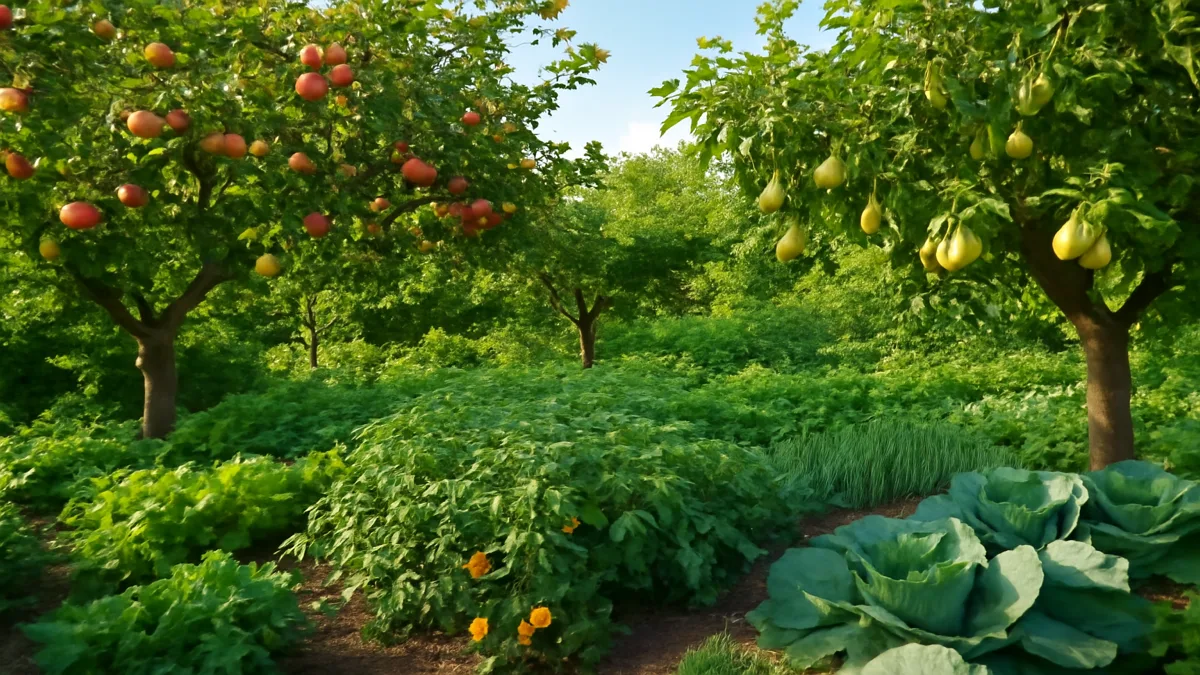
Before we talk solutions, it helps to understand the problem. Birds don’t raid your garden out of spite. They’re opportunists following three basic drives: food, water, and safety. A well-tended vegetable patch offers all three. Ripe berries are high-calorie fuel during nesting season, moist soil provides easy-to-extract worms and grubs, and dense foliage gives cover from hawks and cats.
Different species cause different kinds of damage, too. Sparrows and finches love seedlings and peck at soft leaves. Starlings and blackbirds travel in flocks and can strip a cherry tree in an afternoon. Crows go after corn and freshly planted seeds. Pigeons flatten brassicas. Knowing who’s visiting helps you pick the right defense. There’s no point stringing up hawk decoys if your real problem is sparrows sneaking under the bean trellis.
It’s also worth remembering that most backyard birds are legally protected in the United States under the Migratory Bird Treaty Act. That means lethal control is off the table. Not just ethically, but legally. Fortunately, the humane methods below work better anyway.
Method 1: Bird Netting Done Right
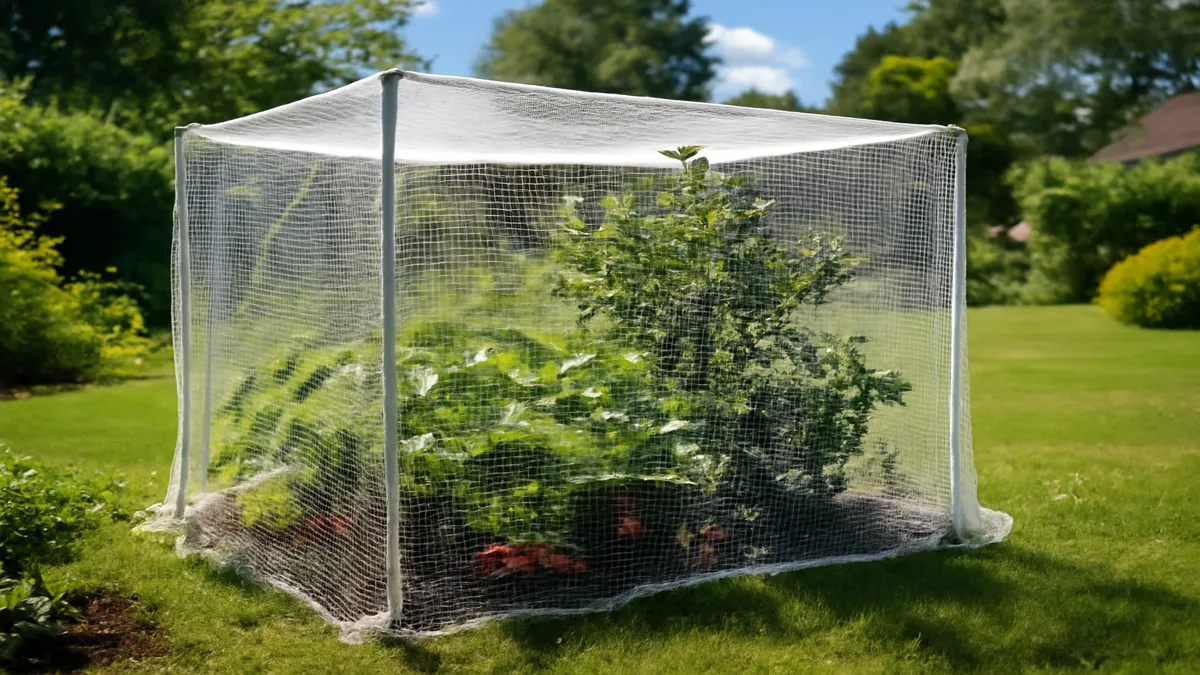
Netting is the single most effective barrier you can install, but only if you choose the right kind. The gardening aisle is full of cheap, large-mesh plastic nets that look harmless. And turn into wildlife traps the moment a songbird, snake, or bat gets tangled. A good rule of thumb is the “finger test”: if you can poke your finger through the mesh, it’s too big. Wildlife-friendly netting has holes smaller than 5mm.
Look for UV-stabilized HDPE (high-density polyethylene) netting in white. White is more visible to birds and bats, especially at dusk and dawn when most entanglements happen. Professional-grade netting runs about $0.50 per square meter and lasts five to ten years if you store it indoors over winter. Brand names like Fruit Saver, Hail Guard, and Vege Net are widely trusted by orchardists.
“The best bird netting is the one a bird never touches. Keep it taut, keep it off the foliage, and keep the mesh small enough that wings and beaks can’t get through.”. Paraphrased from a Penn State Extension bird management bulletin
Here’s the mesh-size cheat sheet I wish someone had handed me when I started:
Netting Mesh Sizes by Target Pest
| Mesh Size | Target Birds | Best Use | Notes |
|---|---|---|---|
| Under 5mm | All songbirds (wildlife-safe) | Berry cages, vegetable covers | The gold standard. Passes the finger test |
| 1/2 to 3/4 inch (15mm) | Sparrows, finches, small birds | Seedling beds, lettuce, greens | Use only on tight frames, never loose |
| 1 to 1.25 inch (22-28mm) | Starlings, pigeons, robins | Fruit trees, grape vines | Risk of entanglement. Supervise daily |
| 2 to 3 inch (50-75mm) | Crows, seagulls, ravens | Corn, large row crops | Not recommended in songbird areas |
Whatever size you choose, stretch the netting over a frame rather than draping it directly on plants. Loose netting is where birds get tangled. A simple PVC hoop or wooden cage keeps the mesh suspended and lets you lift it for weeding and harvest.
Method 2: Physical Covers and Cages
Not every crop needs full netting. For smaller or lower-profile plantings, physical covers do the job with less fuss. I use four kinds depending on the season:
- Floating row covers. Lightweight spun fabric laid over hoops. Excellent for lettuce, brassicas, and young transplants. Lets in light and rain, keeps birds out.
- Frame-mounted berry cages. Permanent wooden or metal frames wrapped in fine mesh. Perfect for blueberries, raspberries, and strawberries.
- Cloches. Individual domes (glass, plastic, or wire mesh) over single seedlings. Handy when you’ve just planted and need two weeks of protection.
- Cherry tree net covers. Giant sock-like nets designed to drop over a whole small tree. Install before fruit colors up, remove after harvest.
The advantage of physical covers is that they’re reusable, visible, and don’t rely on fooling birds psychologically. The disadvantage is storage. You’ll need a shed or garage corner to stash them during the off-season.
Method 3: Visual Scare Devices (and Why You Must Rotate Them)
Scare devices work on a simple principle: birds are wary of anything new, unpredictable, or predator-shaped. The catch is that birds also habituate fast. An owl decoy that terrifies starlings on Monday is a convenient perch by Friday. The fix isn’t fancier decoys. It’s movement and rotation.
Here’s the order I recommend for setting up a scare system:
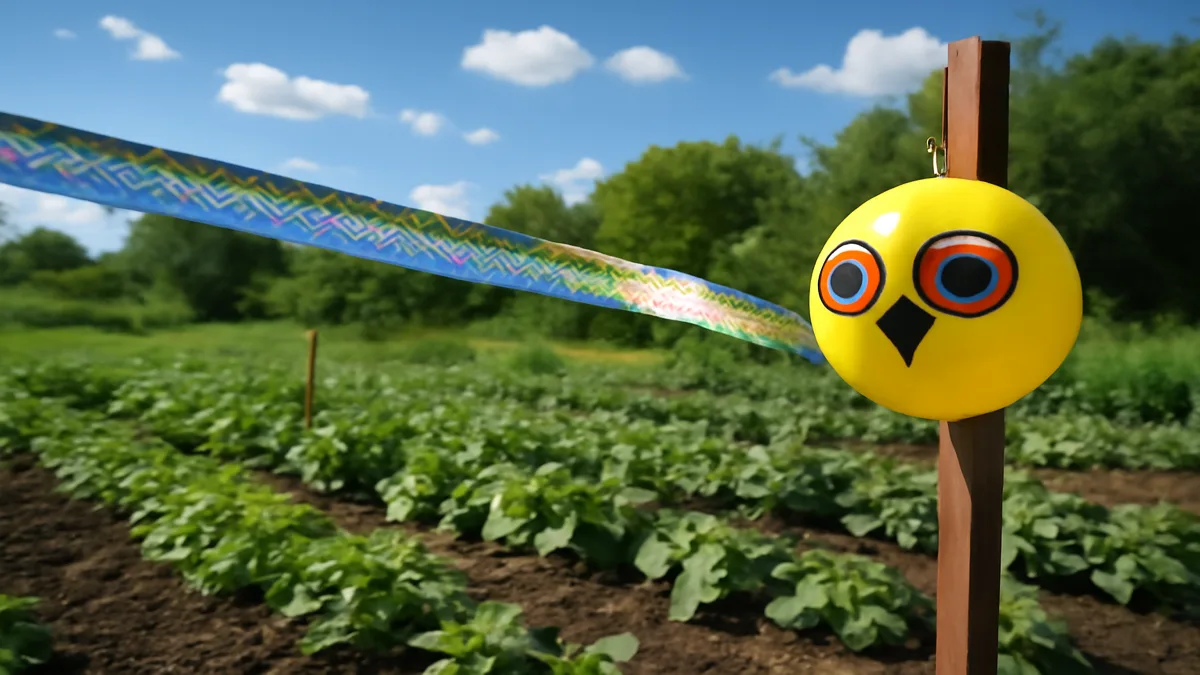
- Start with reflective tape. Bird-X Irri-Tape and similar products flash in sunlight and crackle in the breeze. Hang strips every 3 to 5 feet around the perimeter.
- Add scare-eye balloons. The oversized eyespots mimic the face of a predator. Hang them at bird-eye level, not overhead.
- Introduce owl or hawk decoys. But move them every 3 to 4 days. A stationary decoy is useless within a week. Rotate positions, change the pose, and take them down for a few days every month.
- Layer in motion-activated sprinklers. A sudden burst of water is startling, random, and harmless. Popular brands like the Orbit Yard Enforcer run on battery power.
- Finish with solar-powered predator calls. These broadcast random hawk or distress calls at irregular intervals. Because the timing is unpredictable, birds don’t learn to ignore them.
The key word in all of this is rotate. Change something every few days. A new decoy location, a fresh reflective strip, a different call pattern. Birds are smart. Your job is to stay one step ahead.
Method 4: Choose Plants Birds Don’t Love
If you’re redesigning a bed or planning a new border, consider leaning on plants that birds simply aren’t interested in. You won’t eliminate visits, but you can dramatically reduce pressure on the plants you care about.
Three categories work especially well:
- Prickly or thorny plants: barberry, roses, holly, and hawthorn. Birds avoid the foliage and the fruit is often too tough for small species.
- Aromatic herbs: lavender, rosemary, sage, and thyme. Strong volatile oils mask the scent of nearby edibles and most birds dislike the texture.
- Sharp-leaved architectural plants: yucca, agave, and ornamental grasses. They add structure without offering a buffet.
I like to interplant aromatic herbs among vegetables as a living repellent. A border of rosemary around a lettuce bed won’t stop a determined starling, but it reduces casual browsing and smells wonderful when you brush past it.
Method 5: Time Your Planting and Harvest
Timing is an underrated weapon. Birds pressure gardens hardest during nesting season (spring) and fledging season (early summer), when parents need to shovel protein into growing chicks. If you can stagger your plantings so the most vulnerable stages. Germinating seeds, young seedlings, ripening fruit. Fall outside those peak windows, you cut losses without lifting a finger.
Harvesting early is another trick. Strawberries and cherries don’t need to be dead ripe on the vine. Pick them at the “blush” stage and let them finish indoors on a windowsill. You’ll beat the birds by 24 to 48 hours and the flavor is nearly identical. For corn, harvest as soon as silks turn brown rather than waiting the extra few days that tempt crows.
Method 6: Decoy Feeders and Sacrificial Plants
This one sounds counterintuitive: feed the birds on purpose. But a well-placed feeder or sacrificial mulberry tree pulls hungry birds away from your vegetable beds and toward food you’re happy to share. It works best for species that prefer seeds or wild fruit over garden produce. Sparrows, finches, and cedar waxwings respond especially well.
Place the decoy feeder at least 30 feet from the garden, in an area with good cover. Fill it with sunflower or millet seed, whichever is cheapest locally. If you’re worried about attracting too many birds, think of it like this: a small flock at a feeder is a small flock not in your lettuce. For more on feeding stations that work with. Not against. Your garden, see our guide to building a pollinator garden.
Method 7: Garden Hygiene and Structural Choices
Sometimes the best defense is making your garden less attractive in subtle ways. Dense hedges and overgrown corners give birds the cover they need to stage raids. Opening up sight lines. Pruning shrubs, removing low branches, clearing brush piles near beds. Makes birds feel exposed and they’ll spend less time foraging there.
A few structural tweaks that help:
- Keep a clear zone of 10 to 15 feet between bird cover (hedges, trees) and vulnerable crops.
- Mulch with reflective materials like aluminum foil strips around high-value plants during peak pressure weeks.
- Install perch deterrents (spikes or wires) on fence posts and trellises overlooking beds.
- Clean up fallen fruit daily. Rotting windfalls are a bird magnet and invite repeat visits.
These are small habits, but they compound. A garden that’s slightly harder to work gets skipped in favor of easier targets down the block.
Method 8: Integrate With Your Other Pest Defenses
Birds rarely travel alone on the pest list. If you’re already battling squirrels, rabbits, or deer, the smart move is to design one integrated defense rather than stacking single-pest solutions. Wildlife-safe netting often handles birds and small mammals at once, and sturdy fencing designed for deer can include bird-deterrent elements at the top.
We have full guides on the two mammals that cause most gardeners the biggest headaches: check our walkthrough on how to keep squirrels out of the garden and our larger-scale playbook on how to keep deer away from the garden. Many of the techniques. Motion-activated sprinklers, strategic plant choice, physical barriers. Overlap beautifully with bird management.
What NOT to Do: Common Mistakes That Hurt Birds
Before we wrap up, a quick warning. A few popular “bird control” products and folk remedies are genuinely harmful. Avoid these, both for the birds’ sake and, in some cases, for your own legal protection:
- Large-mesh netting (over 5mm). It entangles and kills songbirds, snakes, hedgehogs, and bats. Illegal in some jurisdictions.
- Kite string “bird scare” lines. Thin monofilament wraps around wings and legs. Never use it.
- Broken mirrors or shiny shards. Reflective surfaces can cause fatal window-style collisions.
- Sticky traps. Inhumane, indiscriminate, and they kill non-target species including pollinators.
- Poison or poisoned bait. Illegal for birds in the U.S. under the Migratory Bird Treaty Act and a disaster for the food chain.
The humane methods in this article work better anyway. There’s no shortcut worth the cost of a songbird’s life or an unexpected visit from a wildlife officer.
Putting It All Together: A Simple Seasonal Plan
If you’re new to this, don’t try to install everything at once. Here’s the approach I’d recommend for most home gardens:
Early spring: Install reflective tape and hang one scare-eye balloon over the most vulnerable beds. Plant a border of aromatic herbs.
Late spring: Cover seedlings with floating row covers. Set up berry cages before fruit begins to color. Move decoys weekly.
Summer: Add motion-activated sprinklers near ripening fruit. Harvest early and often. Clean up windfalls daily.
Fall: Remove and store covers. Prune back cover that gave birds staging areas. Plan next year’s rotation.
Within one full season, you’ll know which methods your local bird population responds to most and which you can skip. Every garden is a little different.
Final Thoughts and a Quick Ask
Protecting your garden from birds doesn’t have to mean declaring war. With the right netting, smart scare rotation, thoughtful plant choices, and a few structural tweaks, you can harvest your strawberries and still enjoy a thriving backyard ecosystem. The goal is coexistence. A garden that feeds you and a yard that still welcomes the songbirds you love hearing at dawn.
If this guide helped you think through your own bird problem, please share it with a gardening friend or neighbor. The more of us who use humane, wildlife-safe methods, the healthier our local bird populations stay. And the better our gardens grow. You can share it on Facebook, Pinterest, or just forward the link to someone who’s been complaining about their tomatoes. I’d really appreciate it.
Common questions readers send me
What is the cheapest way to keep birds from eating plants?
Reflective tape is hands-down the cheapest effective option. A 100-foot roll runs under $10 and protects a small garden for a full season. Cut strips about 18 inches long and tie them to stakes every 3 to 5 feet around vulnerable beds. Replace or reposition every few weeks to prevent birds from habituating.
Does fake owl really work on birds?
Only if you move it. A stationary plastic owl fools birds for about three to five days before they recognize it as harmless and start perching on it. Relocate the decoy every 3 to 4 days, change the direction it’s facing, and take it down entirely for a week each month. Rotation is what keeps the illusion alive.
What mesh size netting is safe for songbirds?
Use netting with a mesh smaller than 5mm. Small enough that you cannot poke your finger through. White, UV-stabilized HDPE is the standard. Always mount the netting on a frame rather than draping it loosely over plants. Loose, large-mesh netting is the leading cause of bird entanglement in home gardens.
Will a bird feeder distract birds from my vegetables?
Often, yes. Especially for seed-eating species like sparrows and finches. Place the feeder at least 30 feet from your garden beds, in an area with natural cover, and keep it stocked with affordable sunflower or millet seed. It won’t deter fruit-loving starlings as effectively, but it reduces overall pressure.
Are there plants that naturally repel birds?
No plant truly repels birds the way some herbs repel insects, but several categories are unappealing. Prickly plants like barberry and holly, aromatic herbs like lavender and rosemary, and sharp-leaved species like yucca all see minimal bird activity. Interplanting them among vulnerable vegetables reduces casual browsing without harming local wildlife.
Related reading
Want More Wildlife Garden Tips?
Join 5,000+ nature lovers getting our weekly tips on creating wildlife-friendly gardens.
No spam, unsubscribe anytime. Privacy Policy
Emma Harrington
Emma Harrington is a wildlife habitat researcher and content editor with a passion for backyard conservation. She has spent over a decade translating ecological science into practical tips anyone can follow — from selecting native plants to building wildlife-friendly habitats. Her work focuses on helping homeowners transform ordinary yards into thriving ecosystems for bees, butterflies, hummingbirds, and other beneficial wildlife.