
If you have spent any time gardening for butterflies, you already know the drill. You plant the milkweed, you fill the beds with coneflower and zinnia, you hang a little banner that says something cheerful about pollinators, and you wait. The swallowtails drift in, the monarchs float through in late summer, and everything looks the way the seed catalog promised. But here is something that surprises most gardeners when they learn it: nectar alone is not enough. Butterflies need something else, something almost nobody talks about, and it is one of the cheapest and easiest features you can add to your yard.
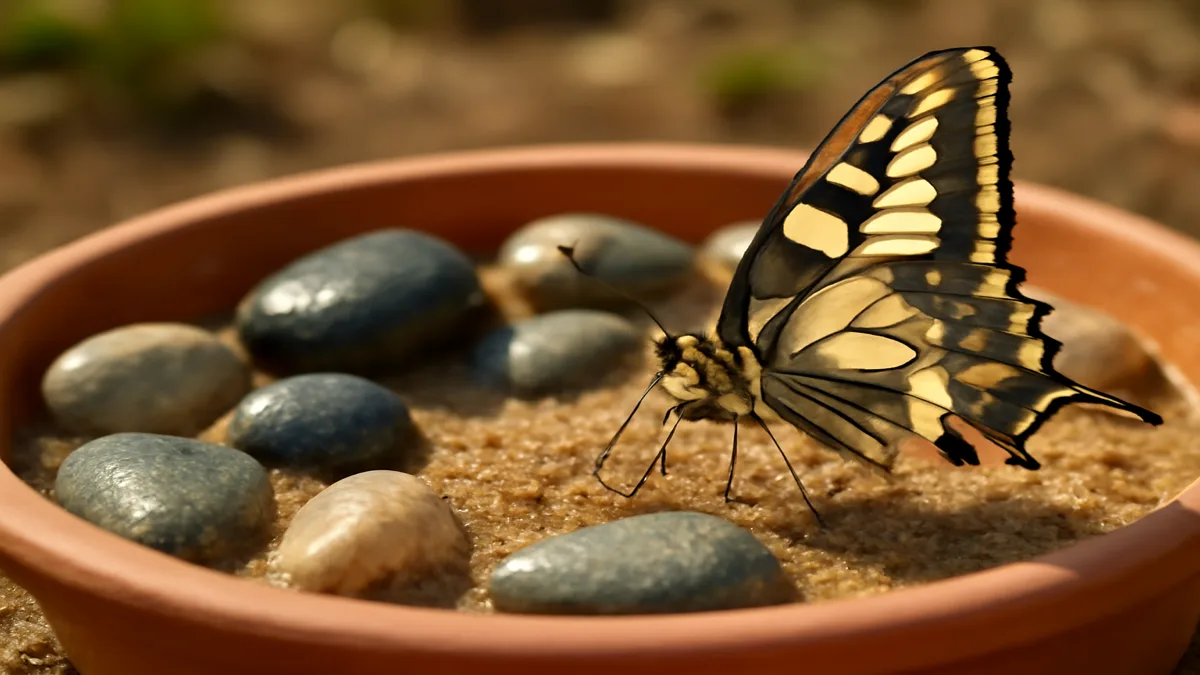
That feature is a puddling station. It is, in plain terms, a shallow dish of damp sand and soil seasoned with a few pinches of salt and mineral. It looks like nothing. It costs between $5 and $15 to build. And yet it solves a problem that every serious butterfly gardener eventually runs into, which is that adult butterflies, especially the males, desperately need sodium and amino acids that they cannot get from flowers. Without a source of dissolved minerals, your garden can look like a butterfly paradise and still be missing a critical piece of the puzzle.
This guide will walk you through exactly how to build one. We will cover the biology behind why butterflies puddle, the simple weekend version that a beginner can put together in 15 minutes, an upgraded version for gardeners who want something permanent and beautiful, the placement rules that determine whether butterflies actually use it, and the small mistakes that keep most homemade puddling stations empty. If you are over 40 and you have watched the number of butterflies in your yard quietly shrink over the last couple of decades, this is one of the most direct things you can do to reverse that trend on your own property.
FREE: Wildlife Garden Starter Guide
Get our 12-page PDF with the 25 best plants for pollinators, simple habitat tips, and a printable checklist — all 100% free.
No spam. Read our Privacy Policy.Why Butterflies Puddle in the First Place
When you watch a butterfly on a flower, it is drinking nectar, which is basically sugar water with trace compounds. Nectar gives a butterfly the calories it needs to fly, court, and lay eggs. What nectar does not give it, in any meaningful amount, is sodium. And sodium matters enormously for insect biology. It powers nerve function, muscle contraction, and, most importantly for butterflies, reproduction. Conservation groups like the National Audubon Society have documented how mineral availability shapes pollinator success across whole regions.
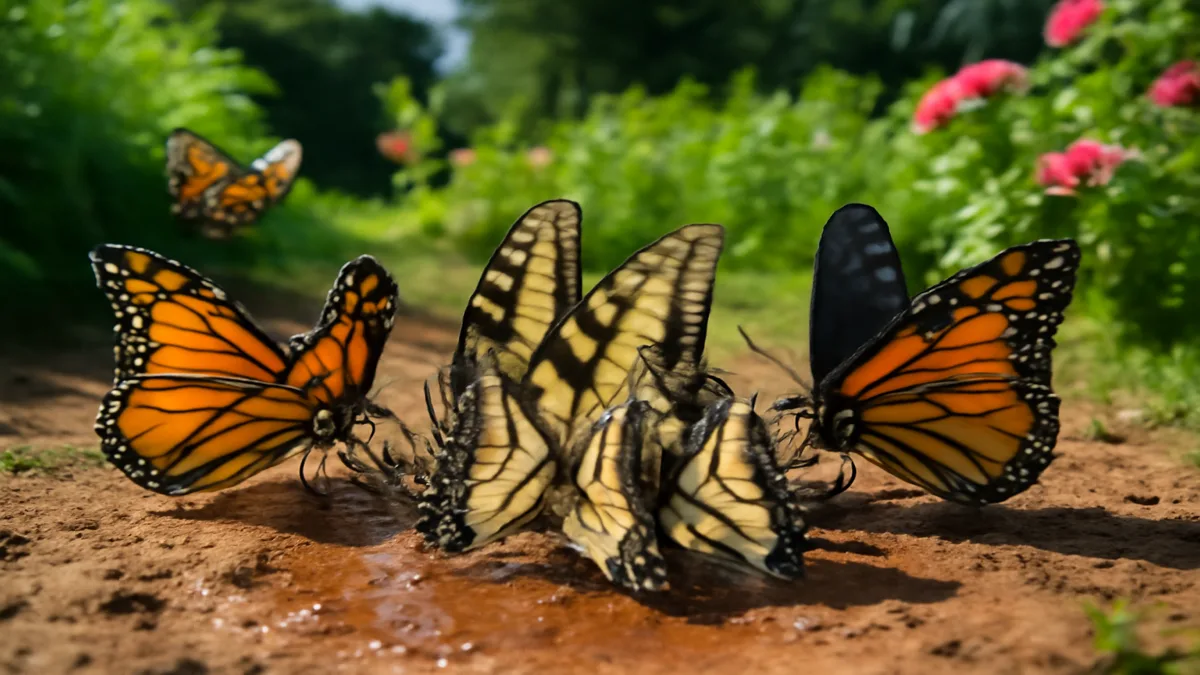
Butterflies cannot scoop water from a birdbath or a pond the way songbirds can. Their mouthparts are a coiled straw called a proboscis, and that straw is designed to probe into flowers or sip from thin films of moisture. A birdbath is a drowning hazard. A garden pond is decorative scenery. What a butterfly actually needs is a wet surface that it can stand on while it extends that straw into the mud and draws up dissolved minerals. Biologists call this behavior puddling, and if you have ever seen a cluster of yellow sulphurs or tiger swallowtails gathered on a damp dirt road on a summer morning, you have seen it in action.
Here is the part that usually surprises people. The butterflies doing almost all the puddling are male — often more than 90% of the visitors at a single station. Females do it occasionally, but the overwhelming majority of puddlers are males collecting sodium that they do not need for themselves. What they do with it is striking. During mating, a male butterfly transfers a packet called a spermatophore to the female, and that spermatophore is loaded with sodium and amino acids that he has carefully accumulated from puddling. Biologists call this a nuptial gift. The female uses those minerals to produce eggs, and the more sodium she receives, the more eggs she can lay and the stronger those eggs tend to be.
A butterfly garden without a puddling station is like a restaurant that serves only dessert. The nectar flowers get all the attention, but the minerals dissolved in a single teaspoon of damp, salted sand may do more for the next generation of butterflies than an entire bed of flowers.
So when you build a puddling station, you are not just adding a cute garden feature. You are directly supporting butterfly reproduction in a way that almost no other single action in your yard can match. And yet, walk through almost any ornamental butterfly garden in the country and you will not find one. The gap between what butterflies need and what gardeners typically provide is, frankly, embarrassing, and it is an easy gap to close. If you want the broader picture of what a butterfly-friendly landscape looks like, our guide on how to attract butterflies covers the full habitat approach, and puddling stations are one of its most underrated pieces.
The Simple DIY Version: Five to Fifteen Dollars
You do not need to order anything online to build a working puddling station. Almost everything can come from a hardware store, a garden center, or your own backyard. The entire project fits in a single afternoon, and if you already have a terracotta saucer sitting under a neglected houseplant, it can cost you essentially nothing.
The core idea is this. You want a shallow, flat vessel that holds a mixture of sand and soil, seasoned with a tiny amount of sea salt and topped with flat stones that butterflies can land on. You want it damp, not flooded. You want it in full sun. And you want it near enough to your nectar plants that a butterfly flitting between blossoms will notice it.
Materials You Will Need
| Item | Quantity | Approximate Cost | Notes |
|---|---|---|---|
| Shallow dish (8 to 12 inches wide) | 1 | $3 to $8 | Terracotta saucer or plastic plant tray works well |
| Coarse sand or fine gravel | 2 cups | $2 to $4 | Avoid play sand, which contains additives |
| Garden soil | 1 handful | Free | Use untreated soil from your own yard |
| Small flat river stones | 6 to 10 | $2 to $4 | Creates landing platforms above the mud |
| Sea salt (non-iodized) | 1 teaspoon | Pennies | Never substitute iodized table salt |
| Wood ash (optional) | Small pinch | Free | From untreated firewood only |
| Water | As needed | Free | Rainwater is ideal |
A quick note on the sand. Play sand sold for sandboxes is often treated with silica coatings or other additives that you do not want leaching into the mud your butterflies will drink from. Look for horticultural sand, masonry sand, or the coarse sand sold for aquariums and ponds. Similarly, the salt should be plain, uniodized sea salt. Iodized table salt contains iodine compounds and anti-caking agents that are not friendly to insect physiology, and table salt at high doses can actually harm butterflies rather than help them.
Step-by-Step Construction
Once you have your materials gathered, the build itself is very simple. If you can pot a houseplant, you can build a puddling station. Here is the sequence that works reliably, developed from years of trial and error by backyard butterfly enthusiasts and refined by groups like the North American Butterfly Association.
- Choose your dish. Depth matters more than diameter. You want something no deeper than one to two inches at most. A butterfly that steps into deep water will get its wings wet and may not recover. A wide, shallow terracotta saucer meant for a large flowerpot is close to perfect.
- Mix your base. Combine roughly equal parts coarse sand and garden soil in a bucket. You are aiming for a texture that holds moisture without turning into sticky clay. The soil contributes organic matter and trace minerals, and the sand keeps the mixture loose enough to stay damp rather than waterlogged.
- Fill the dish. Pour your sand and soil mixture into the dish until it sits just below the rim. Smooth the top so it is reasonably level, but do not pack it down hard. Butterflies want a surface they can probe, not a compressed brick.
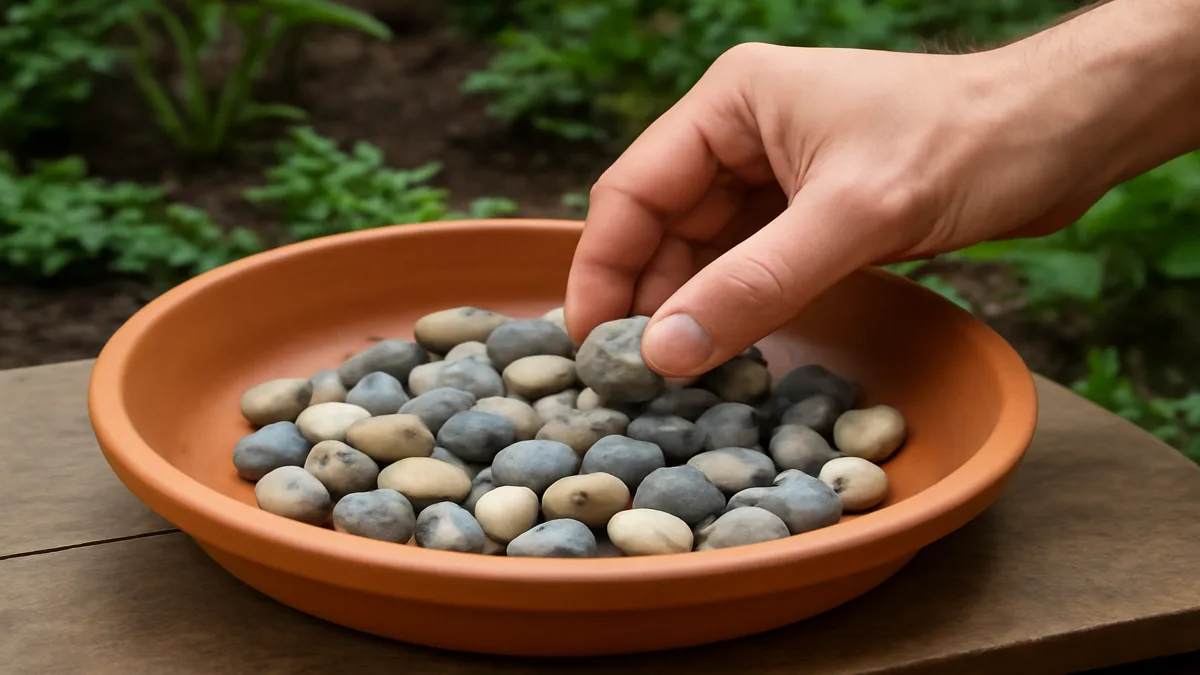
- Add the landing stones. Place 6 to 10 small flat stones on top of the mixture, pressing each one gently so its top surface is dry and its base is in contact with the damp soil below. Butterflies prefer to land on dry stones and then reach down into the mud with their proboscis rather than stand directly in the wet mix.
- Season the mix. Sprinkle one teaspoon of non-iodized sea salt evenly across the surface. If you have a wood stove or fire pit that burns clean, untreated wood, add a small pinch of cold, dry wood ash as well. The ash contributes potassium and other minerals that amplify the appeal for puddling butterflies.
- Water to saturate. Slowly pour water over the mix until it is thoroughly damp but not flooded. You are looking for the texture of a wrung-out sponge. If water is pooling on the surface, you have gone too far, so let it drain or sit in the sun for a few hours before you evaluate.
- Place in full sun. Position the finished station in a spot that gets at least 6 hours of direct sun per day, ideally in the morning and midday hours when butterflies are most active. Nestle it at ground level or raise it a few inches on a flat stone.
- Maintain moisture. Check the dish every two or three days. In hot, dry weather you may need to add water daily. In cooler or rainy stretches, leave it alone. The single most common reason a puddling station fails is that the owner lets it dry out completely and the butterflies stop visiting.
That is the entire build. 15 minutes of hands-on work, a few dollars of materials, and you have given your garden something that roughly 99% of suburban yards lack. Pairing the station with a bed of pollinator-friendly plants from your garden center doubles the impact, since the visitors you draw to nectar will also discover the minerals.
The Advanced Version: Thirty to Sixty Dollars
If the simple version has been running successfully for a season or two and you find yourself wanting something more permanent, there are several upgrades worth considering. None of them are strictly necessary, but each addresses a limitation of the basic build that you will start to notice after a year of use.
The first upgrade is the vessel itself. A terracotta saucer is cheap and effective, but it is also fragile, porous, and prone to cracking over a freeze-thaw winter. A glazed ceramic dish or a shallow concrete basin lasts for years, holds moisture more evenly, and can be incorporated into a more formal garden design. Concrete pedestal birdbaths with shallow tops can be retrofitted as puddling stations by filling the basin with sand and soil rather than water, although you should plug any drain holes first.
The second upgrade is zoning. Instead of a single uniform mixture, create two or three distinct zones within a larger dish. One zone gets the standard sand and soil mix with sea salt. Another zone gets a small amount of composted manure worked in, which adds amino acids and nitrogen compounds that some species actively seek out. A third zone can be almost pure sand with just a whisper of salt, which some smaller species prefer. Butterflies are surprisingly picky, and multiple mineral profiles in a single station attract a wider range of visitors.
The third upgrade is automation. If you travel, or if your garden is in a hot climate where a shallow dish can dry out in a single afternoon, running a small drip irrigation line to the station solves the moisture problem permanently. A low-flow drip emitter set to release a few drops per minute during the hottest part of the day will keep the surface consistently damp without ever flooding it. The Xerces Society, which has published extensively on invertebrate conservation, has some useful habitat guidelines that touch on water management for pollinator gardens and are worth reading if you want to take the long view.
The fourth upgrade is composted manure. This is optional, and honestly a little unpleasant to work with, but experienced butterfly gardeners will tell you that adding a small amount of well-composted cow or horse manure transforms the number of visitors a puddling station attracts. The manure contributes amino acids and additional sodium that sand and soil cannot provide on their own. If you go this route, use only thoroughly composted material, never fresh, and keep the quantity small, perhaps a tablespoon worked into the base of a large station.
Placement: Where You Put It Matters More Than How You Build It
You can build the most beautiful puddling station in the neighborhood and have it sit empty for an entire summer if you put it in the wrong spot. Placement is the single variable that most often separates a station that hosts daily clusters of swallowtails from one that only the ants discover. Fortunately, the rules for placement are straightforward.
- Full sun is non-negotiable. Butterflies are cold-blooded and need an ambient temperature above roughly 55 degrees Fahrenheit to fly actively. A shaded puddling station is a cold puddling station, and cold puddling stations do not attract butterflies no matter how well mineralized they are.
- Proximity to nectar plants matters. A butterfly feeding on lantana or milkweed is unlikely to fly 50 yards across an open lawn to find a mineral source. Place your station within about 10 feet of an established nectar bed so that the station feels like a natural extension of the feeding area.
- Shelter from wind. A light breeze is fine, but a station exposed to strong, steady wind dries out fast and is physically uncomfortable for butterflies to land on. Tuck it against a hedge, a fence line, or a cluster of taller perennials that break the wind without blocking the sun.
- Distance from bird feeders. This one catches many gardeners by surprise. Songbird feeders attract hawks and other predators, and a puddling station directly under a feeder is essentially a trap. Keep the two at least 20 feet apart.
- Ground level or slightly raised. Butterflies naturally puddle on wet ground, dirt roads, and mud along stream banks. A station that sits at ground level feels natural to them. If you must elevate it for aesthetic reasons, raise it only a few inches on a flat stone rather than putting it on a waist-high pedestal.
- Multiple stations reduce competition. Male butterflies can be surprisingly territorial about puddling sites, and in a small yard with only one station you may see fights break out. Two or three stations spread around the garden, each a few yards apart, let more males puddle simultaneously and can dramatically increase the total number of butterflies your property supports.
If you already have a water feature like a wildlife pond on your property, place the puddling station on the sunny side of it rather than opposite. The humidity around a pond edge keeps the station from drying out as quickly, and butterflies often cruise the margins of open water looking for warm landing spots anyway.
Maintenance Through the Seasons
A puddling station is not a fire-and-forget garden feature. It is, however, one of the lowest-maintenance wildlife installations you can own, and the rhythm of care becomes second nature after a few weeks.
During the active season, which runs roughly from late spring through early fall in most of North America, the main job is keeping the surface damp. Check every two to three days by pressing a finger into the sand. If it comes up clean and dry, add water. If it comes up muddy, leave it alone. In a hot, dry July, you may be topping it up daily. In a cool, rainy May, it may need no attention for a week.
Every four to six months, empty the station completely and rebuild the mix. Organic matter in the soil begins to break down over time, bacterial films develop on the sand and stones, and the salt concentration drifts as water evaporates and redeposits minerals unevenly. A complete refresh with new sand, new soil, a fresh teaspoon of sea salt, and a rinse of the stones keeps the station healthy and appealing.
When you scrub the dish and stones, use white vinegar diluted about one part vinegar to three parts water. Never use bleach, ammonia, or commercial disinfectants. Residues from these cleaners can linger in the porous surfaces of terracotta and stone and harm the very insects you are trying to attract. Vinegar kills most problem bacteria and algae, rinses cleanly with water, and leaves no residue that matters.
Winterization depends on your climate. In zones where temperatures stay above freezing, you can leave the station in place and continue light maintenance through the off-season. In zones that freeze hard, empty the dish completely, store any ceramic or terracotta indoors or under cover to prevent freeze cracking, and plan to rebuild the whole station fresh in early spring when the first warm days bring out overwintering butterflies hunting for minerals. The early spring rebuild is, in fact, one of the best moments to have a working station, because puddling activity spikes dramatically in the first 14 days of warm weather.
Common Mistakes That Keep Puddling Stations Empty
If you have built a station following the guide above and you still are not seeing butterflies after a few weeks, one of a handful of common errors is almost certainly the cause. None of them are difficult to fix, but all of them are easy to make, and most gardeners who give up on puddling stations do so because they stumbled into one or more of these traps.
The first mistake is water that is too deep. Anything beyond an inch of standing water is a hazard, and butterflies will avoid a dish they sense as risky. The whole point of the stones is to give them a dry perch above a damp substrate, and if the stones are submerged, the station reads as a birdbath, which butterflies cannot use.
The second mistake is pure water with no mineral content. A dish of wet sand with nothing else in it is not a puddling station. It is just wet sand. The salt, the soil, and the optional wood ash or manure are what make the station useful, and leaving any of them out dramatically reduces the number of visitors.
The third mistake is using iodized table salt. This one is everywhere online because people reasonably assume that salt is salt, but iodized table salt contains potassium iodide, an anti-caking agent, and sometimes dextrose. None of these belong in a butterfly habitat. Stick with plain sea salt, kosher salt without additives, or mineral salt sold for livestock.
The fourth mistake is using pesticide-contaminated soil. If you have treated your lawn with systemic insecticides, do not use soil from that lawn in your station. The same compounds that control grubs in turf can kill butterflies sipping minerals from your dish. Use soil from an untreated vegetable garden, a wild corner of your yard, or bagged organic garden soil.
The fifth mistake is placing the station too far from nectar plants. Butterflies are busy creatures, and they will not make exploratory flights across open lawn to find a mineral source. Put the station in or immediately adjacent to a bed of flowers for butterflies, not in a sunny corner of the yard that happens to be convenient for you.
The sixth and most common mistake is letting the station dry out completely. Once a butterfly finds a station and starts using it, it will return day after day as long as the station remains productive. A station that dries out between visits effectively resets the training, and the butterflies may not come back even after you rewet it. Consistency matters more than perfection.
Who Else Shows Up Besides Butterflies
One of the quiet pleasures of running a puddling station is that butterflies are not the only visitors. Sodium and amino acids are useful to a wide range of insects and small animals, and a well-placed station functions as a miniature mineral lick for an entire slice of garden wildlife.
Male bees, particularly native solitary species — which make up roughly 70% of North American bees — visit puddling stations for the same reasons butterflies do. They collect sodium for use in reproduction and mating displays. Unlike honeybees, which get most of their mineral needs from inside the hive, solitary bees depend on external mineral sources and will return to a reliable station regularly. Moths, which most people never see because they fly at night, often visit puddling stations at dawn and dusk. If you look at your station just before sunrise on a summer morning, you may see hawkmoths, underwings, and other large-bodied species that you would otherwise never know shared your yard.
Damselflies and small dragonflies sometimes perch on the landing stones, using them as sunning spots rather than mineral sources. Small wasps, including paper wasps and mud daubers, drink from the damp surface, and while some gardeners are uneasy about wasps, they are valuable predators of garden pests and their presence is usually a good sign. Songbirds, especially goldfinches and sparrows, will sometimes drink from water that pools on the stones, and chipmunks and squirrels have been known to investigate, though they rarely linger.
The broader point is that a puddling station is not a single-purpose feature. It is a small node of biological richness in your landscape, and over the course of a season you will see more diversity gather around it than you expected when you first mixed sand and salt in a terracotta saucer. A station like this also pairs naturally with a larger plan to create a wildlife corridor in your yard, since minerals, nectar, and shelter together pull in species that any one feature alone would miss. Organizations like the North American Butterfly Association have long recognized the value of these small, overlooked habitat features, and puddling stations consistently show up in their recommended practices for serious butterfly gardeners.
Quick answers to the usual questions
How long does it take for butterflies to find a new puddling station?
Usually between a few days and two or three weeks, depending on how many butterflies are in your area and how close the station is to existing nectar plants. If you build it during peak butterfly season in June or July and place it near blooming flowers, expect visitors within the first week. If you build it in early spring before many butterflies are active, it may take longer, but the station will be ready when they emerge.
Can I use a bird bath as a puddling station?
Not directly, because bird baths are too deep and have smooth, slippery basins that butterflies cannot grip. However, you can convert a shallow bird bath by filling the basin with sand and soil, adding flat stones, and treating it exactly like a ground-level station. The pedestal height is not a problem for butterflies as long as the surface itself is suitable.
Do I need to add salt every time I refill the water?
No. The salt dissolves into the sand and soil and stays there for weeks. Simply topping up the water does not require adding more salt. You only need to add a fresh teaspoon of sea salt when you do a full rebuild of the station every four to six months, or if heavy rain has flushed the dish repeatedly and you suspect the minerals have washed away.
Will a puddling station attract pests to my yard?
In almost all cases, no. The insects that visit puddling stations, including bees, moths, and occasional wasps, are the same insects that already live in a healthy garden ecosystem. A puddling station does not create pest populations, it simply makes your yard slightly more attractive to beneficial insects that are already passing through. The stations are too small and too seasonal to draw in significant numbers of nuisance species.
Can I build a puddling station on a balcony or patio?
Yes, and many apartment gardeners do exactly this. The same principles apply. Choose a shallow dish, use the sand and soil mix with sea salt, add landing stones, keep it damp, and place it in full sun near any potted nectar plants you are growing. Urban butterflies, especially cabbage whites, swallowtails, and skippers, will find container puddling stations on upper floors as readily as ground-level ones, provided the station is in direct sunlight for several hours each day.
Related reading
Want More Wildlife Garden Tips?
Join 5,000+ nature lovers getting our weekly tips on creating wildlife-friendly gardens.
No spam, unsubscribe anytime. Privacy Policy
Emma Harrington
Emma Harrington is a wildlife habitat researcher and content editor with a passion for backyard conservation. She has spent over a decade translating ecological science into practical tips anyone can follow — from selecting native plants to building wildlife-friendly habitats. Her work focuses on helping homeowners transform ordinary yards into thriving ecosystems for bees, butterflies, hummingbirds, and other beneficial wildlife.