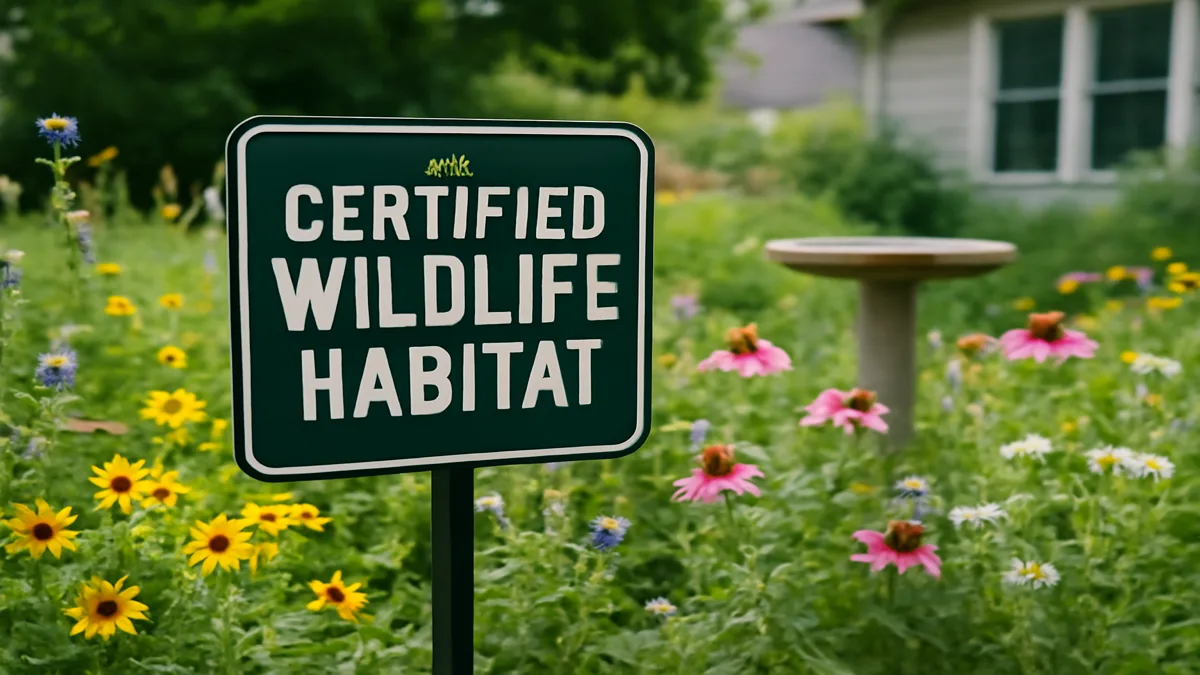
Somewhere between the third cup of coffee and the second look out the kitchen window, a lot of us have had the same thought: what if this backyard actually did something? Not just looked nice from the patio, not just gave the grandkids a place to run around during summer visits, but truly pulled its weight for the birds, bees, butterflies, and other creatures whose world keeps shrinking year after year. If you’ve ever stood at that window watching a lone goldfinch pick at a dandelion and wondered whether your half-acre could be part of the solution, the answer is yes, and there’s a formal program that proves it.
Getting your yard recognized as a certified wildlife habitat through the National Wildlife Federation (NWF) is one of the most satisfying projects a homeowner over 40 can take on. It’s not expensive, it doesn’t require a landscape architect, and you probably already have half of what you need. The program has been running since 1973, and more than 300,000 properties across the country. From tiny balcony gardens in Chicago condos to sprawling Texas ranches. Carry the NWF plaque by the front door. This guide walks you through exactly what the certification requires, how the application works, what the common gaps look like, and how to close them without blowing your retirement budget.
We’ll cover the five core elements NWF looks for, the step-by-step application (it takes about twenty minutes), the $20 fee and what it actually gets you, and the small tweaks that turn an ordinary suburban lot into a place where chickadees raise families and monarch caterpillars find the milkweed they desperately need. By the end, you’ll have a clear action plan. And probably a new reason to stop apologizing for that slightly wild corner behind the shed.
FREE: Wildlife Garden Starter Guide
Get our 12-page PDF with the 25 best plants for pollinators, simple habitat tips, and a printable checklist — all 100% free.
No spam. Read our Privacy Policy.What Is a Certified Wildlife Habitat, Really?
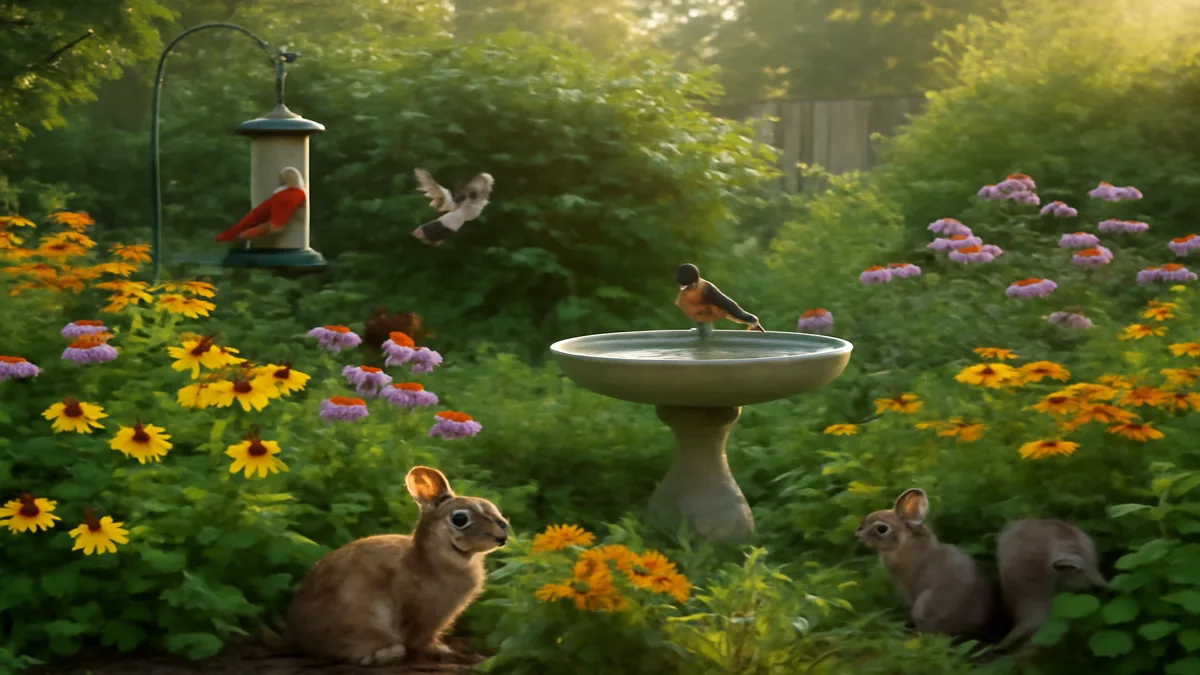
The National Wildlife Federation’s Certified Wildlife Habitat program is essentially a promise between you and the wildlife in your area. You agree to provide the basic building blocks that creatures need to survive and thrive. Food, water, shelter, a safe place to raise their young, and sustainable land-care practices. And in return, NWF officially recognizes your yard as part of a continent-wide network of backyard sanctuaries. There’s no inspection, no bureaucrat with a clipboard, no ongoing audit. The program runs on the honor system, and most people find that motivating rather than loose: once you commit on paper, you actually do the work.
The certification is a lifetime recognition, which surprises a lot of people. You pay the $20 application fee once, and your property stays on the NWF map forever. Even if you move, though the new owners would need to recertify if they want the plaque. It’s worth emphasizing that this is not a government program, not a permit, and not a restriction on what you can do with your property. You won’t get a tax break (in most places) and nobody is going to tell you that you can’t mow your lawn. It’s simply a framework and a public acknowledgment that your little patch of earth is doing its part.
For homeowners in the 40-plus bracket, the program hits a particular sweet spot. You’ve probably got a yard that’s matured. Trees with some age on them, shrubs that have filled in, maybe a tired flower bed or two. Instead of ripping everything out for a fresh start, certification nudges you toward working with what you already have, filling in strategic gaps, and leaning into the natural character of the place. It’s gardening for people who’d rather watch wildlife than wrestle with a leaf blower.
The Five Core Elements NWF Requires
Every certified habitat, whether it’s a quarter-acre lot in Ohio or a rooftop garden in Brooklyn, has to demonstrate all five elements. The good news is that the requirements are flexible. You pick from menus of options in each category, and most established yards already satisfy two or three elements without any changes. Here’s exactly what you need, with the minimum thresholds spelled out.
1. Food. At Least Three Sources
NWF requires three distinct food sources from the following menu: seeds from native plants, berries or fruit (serviceberry, dogwood, and elderberry are classic choices), nectar from tubular flowers, foliage or twigs that deer and rabbits browse, pollen for bees and beetles, and supplemental feeders. Most yards already have one or two native seed producers. A coneflower patch, a sunflower left standing through fall. And adding a berry shrub plus a hummingbird feeder gets you to three without much fuss. If you’re starting from a lawn-only property, focus on berry-producing shrubs first because they feed dozens of bird species across multiple seasons.
2. Water. At Least One Source
One reliable water source is enough to check this box. A simple birdbath counts, but so does a backyard wildlife pond, a rain garden that collects runoff from the downspout, a stream, or a puddling station for butterflies (basically a shallow dish of wet sand with a few flat rocks). The critical word here is reliable. A birdbath that goes dry for a week in July or freezes solid in January isn’t doing its job. If you live in the North, plan to add a heated birdbath or a de-icer for winter use. More on that in the gap-closing section below.
3. Cover. At Least Two Types
Animals need places to hide from predators, escape bad weather, and rest between feeding runs. NWF asks for two distinct types of cover from this list: a wooded area, a bramble patch, dense ground cover, thick shrubs, a rock pile, evergreens for winter protection, and roosting boxes. The rock pile is my favorite because it costs nothing. Just stack leftover stones in a sunny back corner, and you’ll host chipmunks, skinks, toads, and overwintering queen bumblebees within a season. Evergreens are the other workhorse; a single mature holly or a pair of arborvitae can shelter an entire songbird population through a February ice storm.
4. Places to Raise Young. At Least Two
This is where many yards quietly exceed the requirement without the owner realizing it. Qualifying features include mature trees (where most songbirds nest), dead trees or snags, dense shrubs, nest boxes, host plants for caterpillars (milkweed for monarchs, parsley and dill for swallowtails), wetlands, and caves or burrows. If you have one mature tree and a dense shrub border, you’re already there. The one place people resist is the dead tree. There’s a cultural instinct to remove snags for tidiness, but if a dead tree isn’t threatening a structure, leaving it standing is the single best thing you can do for woodpeckers, owls, and cavity-nesting bluebirds.
5. Sustainable Practices. At Least Two from Each Category
The last element has three subcategories, and you need at least two practices from each. Under soil and water conservation, options include a rain garden, heavy mulching, drip irrigation, and xeriscaping. For controlling invasive species, you need to actively remove invasives (English ivy, Japanese honeysuckle, burning bush) and plant natives in their place. For organic practices, you commit to no pesticides, composting, and natural fertilizers. This is the category that trips people up most often, but it’s also the category that delivers the biggest long-term benefits. Healthier soil, lower water bills, fewer pest problems year over year.
The Complete Certification Checklist
Before you submit your application, walk your yard with this table in hand. Check off what you have, circle what you’re missing, and you’ll know exactly where to focus your effort.
| Element | Minimum Required | Easiest Options | Typical Cost to Add |
|---|---|---|---|
| Food | 3 sources | Berry shrub, native seeds, feeder | $40–$120 |
| Water | 1 source | Birdbath or rain garden | $30–$90 |
| Cover | 2 types | Rock pile + dense shrubs | $0–$60 |
| Places to Raise Young | 2 types | Mature tree + host plants | $0–$50 |
| Sustainable Practices | 2 per subcategory | Mulch, compost, no pesticides | $0–$40 |
| Application Fee | One-time | Online submission | $20 |
Most yards land somewhere between $100 and $250 in total startup cost, including the application fee and a few strategic native plants. If you already garden, you’re probably closer to $50.
How Much It Costs and What You Get
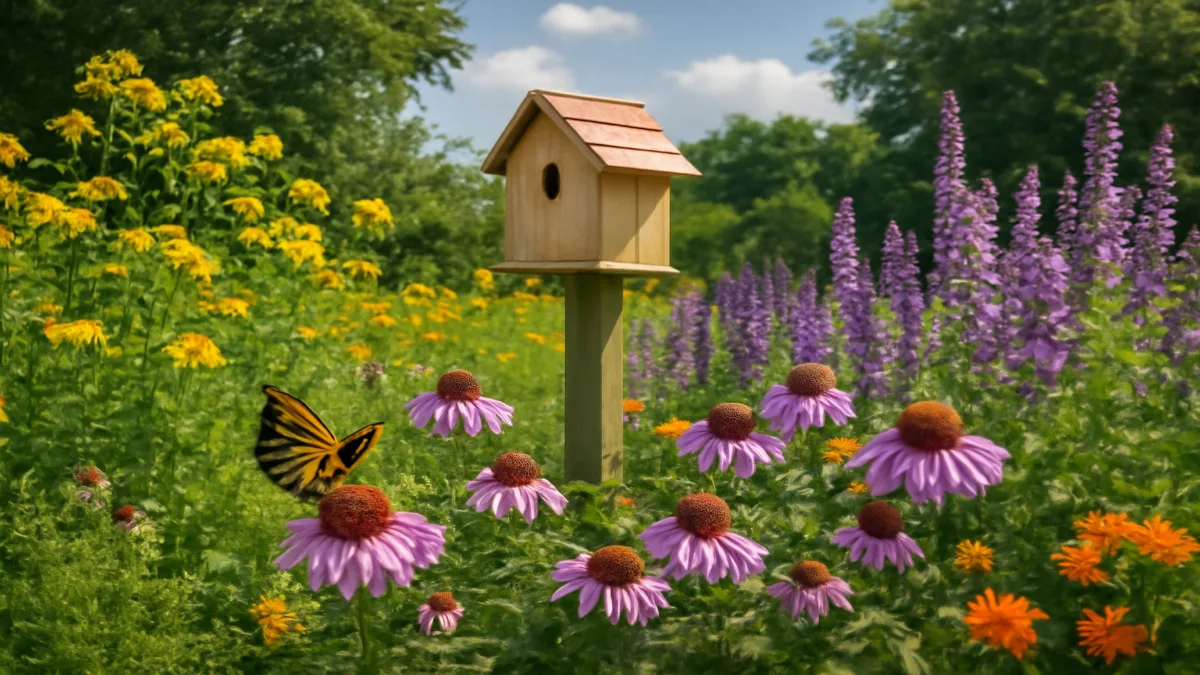
The application fee is a flat $20, and it’s a lifetime certification. No renewals, no annual dues. For that twenty bucks, you get a personalized certificate suitable for framing, a listing in the NWF’s public database of certified habitats (which matters more than you’d think; neighbors find you, and local news sometimes picks up clusters of certified yards), and the right to purchase the official metal yard sign or plaque. The sign is sold separately and runs $30 to $40 depending on the style you choose. There’s a standard green-and-gold version, a premium engraved one, and seasonal variants.
The sign is, in my experience, the single most effective tool in the whole program. It does three jobs at once: it announces your commitment to anyone walking by, it gently pressures you to keep up the practices (nobody wants to post a sign and then spray Roundup), and. This is the real payoff. It inspires neighbors to ask questions. In my own cul-de-sac, two additional households certified within eighteen months of my sign going up. Multiply that pattern across 300,000 properties and you start to see why NWF considers the program their most scalable conservation initiative.
“Your garden can be a powerful statement. A living declaration that you believe in a future where wildlife and people thrive together. One certified yard is a gesture. A neighborhood of them is a movement.”, National Wildlife Federation
Step-by-Step Application Process
The actual application takes about twenty minutes online. There’s no test, no photo requirement (though photos are encouraged), and no waiting list. Here’s the exact sequence I recommend, from first walk-through to certificate in hand.
- Assess your current yard using the printable NWF checklist. Download it from the NWF site, walk the property with a clipboard, and honestly mark what you already have. Most people discover they’re two or three items short. Not starting from zero.
- Fill the gaps strategically. Tackle the cheapest and fastest wins first. A birdbath and a rock pile can go in the same afternoon and often cover two missing elements. Save bigger projects. Planting a pollinator garden or installing a small pond. For the following weekend or season.
- Document with photos (optional but highly recommended). Snap a few shots of each of the five elements. You won’t need to submit them for basic certification, but they’re invaluable if you ever apply for the premium “Community Wildlife Habitat” tier, and they make a great scrapbook of the before-and-after.
- Submit online at nwf.org/garden-for-wildlife/certify. The form asks you to confirm each element with a simple checkbox and describe what you’re providing (e.g., “serviceberry, black-eyed Susan, tube feeder” for food). Be specific. It helps the NWF understand regional trends.
- Pay the $20 fee. Credit card, PayPal, or check. The fee is tax-deductible as a charitable contribution in most cases; save the receipt.
- Receive your certificate in 2 to 4 weeks. It arrives as a mailed certificate plus an emailed digital version. Order the yard sign separately through the NWF shop once your certificate number is issued.
That’s it. No follow-up visits, no paperwork renewal, no annual recertification. You maintain the habitat because you want to, not because the program forces you to.
Common Gaps and How to Close Them
After helping dozens of friends and neighbors through this process, I’ve noticed the same five gaps come up almost every time. If your yard is missing something, it’s almost certainly one of these. Here’s how to close each one without overcomplicating things.
- No reliable water source. This is the single most common gap. Solution: a pedestal birdbath ($30 at any garden center) for three seasons, plus a heated birdbath or plug-in de-icer ($60) for winter. Total investment: under $100, and you’ll immediately see more bird activity.
- Only one food source (usually a single bird feeder). Fix this by adding a berry-producing native shrub. Serviceberry, winterberry, or elderberry. And a small patch of native pollinator plants like bee balm or purple coneflower. The shrub feeds birds, the flowers feed pollinators, and the existing feeder rounds out the trio.
- A too-perfectly-manicured yard. Wildlife needs some mess. Solution: designate one corner. Ideally behind a shed, along a fence line, or in a back property edge. As a “wild zone.” Stop mowing it, let leaves accumulate, stack a brush pile. This one move often satisfies both the cover and the raising-young requirements simultaneously.
- Pesticide use, even occasional. Commit to going organic. This is a mindset shift more than a cost. Swap your weed-and-feed for compost-based fertilizer, tolerate a few dandelions, and handle pest outbreaks with targeted, least-toxic methods (insecticidal soap, hand-picking, beneficial insects). Your pollinators will reward you within one growing season.
- Non-native lawn dominating the property. You don’t need to eliminate the lawn, NWF certifies plenty of yards that still have one. But you do need to shrink it. Expand your existing plant beds by two or three feet into the lawn, replace turf along fence lines with native groundcover, and convert sunny corners into pollinator patches. Every square foot of lawn replaced is a square foot returned to wildlife.
Why This Matters More Than You Think
Here’s the part that makes the $20 feel embarrassingly small. In the last fifty years, North America has lost roughly three billion birds. Insect populations have collapsed by 45 percent in monitored ecosystems. Monarch butterfly numbers are down more than 80 percent from historical highs. The drivers are complicated. Pesticides, habitat loss, climate shifts. But one stubborn fact cuts through: suburban and residential yards cover more acreage in the United States than all the national parks combined. What happens on private land is not a side issue. It is the issue.
When you certify your yard, you’re not just getting a plaque. You’re contributing a measurable patch of functional habitat to a continental mosaic. Researchers at the Cornell Lab of Ornithology and the National Audubon Society have documented that clusters of certified wildlife-friendly yards measurably increase songbird nesting success compared to surrounding neighborhoods. One yard is a gesture. A street full of them is a corridor. A neighborhood full of them is a functioning ecosystem.
For readers in their forties, fifties, and sixties, this framing matters in another way: certification is one of those projects where the payoff compounds over time. The sugar maple you plant this spring will be shading nesting robins in 2036. The pollinator bed you expand this fall will be feeding monarchs the grandkids will see. Unlike most home improvements, a wildlife habitat gets better every year you leave it alone.
Common questions readers send me
Do I need a big yard to qualify for NWF certification?
No. NWF certifies balconies, rooftop gardens, apartment patios, and even windowsill container gardens as long as they provide the five elements at an appropriate scale. A certified balcony might include a few native potted plants (food and host plants), a shallow water dish, a small brush bundle for cover, and a commitment to organic care. The program is explicitly designed to be accessible regardless of property size.
Will certification affect my property taxes or HOA standing?
Certification has no direct effect on property taxes in most jurisdictions, though a few states and municipalities offer small tax incentives for certified wildlife habitats or rain gardens. Check with your local extension office. Regarding HOAs, the certification itself is recognized by a growing number of associations as legitimate grounds to maintain naturalized areas, but it does not automatically override local rules. If your HOA is strict, use the NWF certificate as leverage in a polite conversation rather than assuming it pre-empts the covenants.
What’s the difference between NWF certification and Audubon’s Bird-Friendly Habitat program?
Both programs recognize wildlife-friendly yards, but they emphasize different priorities. NWF’s program is broader. It covers all wildlife, not just birds. And has a lower barrier to entry. The National Wildlife Federation focuses on the five-element framework. Audubon’s program is more bird-specific and often requires a higher percentage of native plants by landscape area. Many homeowners pursue both; the programs are complementary rather than competing.
How long does it actually take to transform a lawn-dominated yard into a certified habitat?
If you’re starting with a typical suburban lawn and a couple of foundation shrubs, most people can meet certification requirements in a single growing season. Roughly six to nine months of part-time effort. A faster timeline is possible if you’re willing to spend $300 to $500 on mature shrubs and a ready-made birdbath. The slower, cheaper path. Starting with seeds, small plants, and DIY features. Takes two to three years but yields a richer and more resilient habitat.
Can renters apply, or does the property owner need to be involved?
Renters can and do certify their outdoor spaces, though NWF asks that you have permission from the property owner for any permanent changes. For a rental, container-based habitats, portable birdbaths, temporary brush piles, and pollinator window boxes all qualify. The certificate is issued in the applicant’s name, not tied to the property deed, so you take the recognition with you when you move.
Your Next Weekend Project
If you’ve read this far, you already have most of what you need. Your yard probably covers three of the five elements before you’ve done a thing, and the remaining gaps are almost certainly fixable with a birdbath, a berry shrub, a rock pile, and a commitment to stop spraying. Total cost: under $150, including the $20 application fee. Total time: one productive Saturday and a twenty-minute online form.
The metal sign by your front walk will outlast most of what you’ll buy this decade. The serviceberry will feed cedar waxwings long after you’ve stopped keeping a garden journal. The rock pile will host generations of toads and overwintering bees without you ever lifting another finger. That’s the quiet math of habitat work. Small inputs, long returns, compounding benefits. Start this weekend. The birds are already waiting.
Related reading
Want More Wildlife Garden Tips?
Join 5,000+ nature lovers getting our weekly tips on creating wildlife-friendly gardens.
No spam, unsubscribe anytime. Privacy Policy
Emma Harrington
Emma Harrington is a wildlife habitat researcher and content editor with a passion for backyard conservation. She has spent over a decade translating ecological science into practical tips anyone can follow — from selecting native plants to building wildlife-friendly habitats. Her work focuses on helping homeowners transform ordinary yards into thriving ecosystems for bees, butterflies, hummingbirds, and other beneficial wildlife.